Tag: Geoeconomics

  • A Strategic Assessment of Promise vs. Reality in Central Asia’s Mineral Development

    A Strategic Assessment of Promise vs. Reality in Central Asia’s Mineral Development

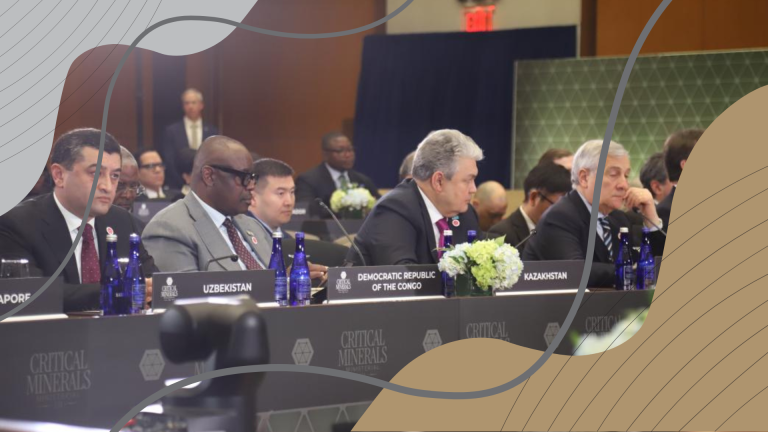
    Central Asia’s role in global critical minerals took a decisive turn at the 4 February 2026 Critical Minerals Ministerial in Washington, where officials from more than 50 countries acknowledged the region as a strategic hub rather than a geopolitical buffer.

    While Washington presented an ambitious framework to advance mineral sovereignty, analysts caution that the region—not the U.S.—must drive implementation to avoid becoming a passive arena for major‑power competition.

    U.S. Strategy: A Vertical Integration “New Order”

    The U.S. vision, centred on the FORGE initiative and the concept of “Pax Silica,” positions minerals and energy as shared strategic assets among trusted partners and offers an alternative to dependency on China.
    Washington differentiates its value proposition in three areas:

    1. Market Stability Through Price Floors
      Proposed tariff‑backed price floors aim to counter predatory market dumping and protect investments in assets such as Kazakhstan’s rare earth reserves.
    2. Vertical Value Integration
      The U.S. framework prioritises domestic processing and refining over raw‑ore exports, enabling Central Asian states to capture more value across the supply chain.
    3. Connectivity Autonomy
      By incorporating the Middle Corridor into initiatives like TRIPP, the West presents routes that bypass Russia and China, reducing geopolitical transit pressures.

    Kazakhstan and Uzbekistan have responded quickly—Kazakhstan has declared critical minerals the “new oil” and joined the Abraham Accords to strengthen supply‑chain integration, while Uzbekistan has pursued strategic MOUs to modernise mining and secure battery‑metal supply chains.

    Reality Check: Gaps Between Intent and Implementation

    Despite strong rhetoric, Western engagement has largely taken the form of frameworks and MoUs—not operational projects.

    Three challenges persist:

    • Operational Disparity – China continues to deliver turnkey, financed projects backed by contractors and long‑term offtake agreements, while Western partners emphasise declarations.
    • U.S. Inward Focus – Washington’s drive for techno‑economic sovereignty favours selective, de‑risked engagements rather than proactive industrial development in the region.
    • Execution Gaps – Uzbekistan’s $2.6bn program covering 76 projects illustrates regional ambition, but real progress requires partners capable of building at scale.

    Strategic Imperative: Central Asian Agency

    Experts argue that relying on future U.S. demand is a strategic mistake.
    To convert high‑level dialogue into economic gains, Central Asia must prioritise:

    1. Midstream Capabilities

    Refining and producing intermediary products offer higher margins and reduce reliance on long‑distance transport of low‑value raw ore.

    2. Direct Private‑Sector Engagement

    Regional firms should proactively present project‑ready opportunities to U.S. companies rather than depending on government‑to‑government frameworks.

    Conclusion

    The U.S. “New Order” provides Central Asia with a potential pathway to diversify away from Beijing and Moscow while improving price stability and long‑term sovereignty.
    But success hinges on regional execution. Astana and Tashkent must convert diplomatic signals into tangible midstream capacity—and do so quickly—to secure their strategic autonomy before the current window closes.

  • Europe Must Adapt to a New Era of Geoeconomics, EU Leader Warns at Berlin Global Dialogue

    Europe Must Adapt to a New Era of Geoeconomics, EU Leader Warns at Berlin Global Dialogue

    At the Berlin Global Dialogue, European Commission President delivered a stark warning about the accelerating pace of global change, urging Europe to act swiftly to safeguard its competitiveness and independence in an increasingly fragmented world. Addressing a room of policymakers, economists, and industry leaders, she emphasized that “the world is changing faster than our policies,” calling for institutional renewal and strategic agility across the continent.

    Europe, she said, faces a dual challenge: an economic slowdown and growing strategic vulnerabilities. Yet it also possesses “exceptional assets”—its single market, strong institutions, rule of law, research excellence, and skilled workforce. To harness these strengths, she announced plans to accelerate the completion of the Single Market, simplify regulations, and create a new “28th regime” for innovative companies to scale up across all EU member states under one unified framework.

    The speech also underscored the growing fusion of economics and geopolitics. “We are in the middle of a systemic shift,” she noted, warning that economic tools—such as export controls, subsidies, and technology theft—are increasingly being used as instruments of power. To confront these trends, Europe must rethink its approach to both economic and national security, she said, highlighting the EU’s “Made in Europe” strategy, which focuses on strategic autonomy in defence, energy, and key technologies.

    She cited China’s recent export restrictions on rare earth materials as a wake-up call, revealing Europe’s dangerous dependency on external suppliers. In response, she announced the forthcoming RESourceEU initiative—modelled on the REPowerEU plan—to secure critical raw materials through recycling, joint purchasing, stockpiling, and new international partnerships. “Europe cannot afford to repeat the mistakes of the past,” she stated. “The world rewards speed, not hesitation.”

    Despite the sobering tone, the President concluded on a note of determination, citing the EU’s recent trade deals with Mercosur, Mexico, Indonesia, and Switzerland as proof of Europe’s continuing global influence. Negotiations with India and several Southeast Asian nations are also advancing. “Europe must use its geoeconomic weight to its advantage,” she said. “With urgency, independence, and courage, we will make it happen together.”