Tag: East Star Resources

  • East Star Resources Partners with Kazakhstan’s Nova Ltd for Major Copper Project Development

    East Star Resources Partners with Kazakhstan’s Nova Ltd for Major Copper Project Development

    East Star Resources (EST), a British company operating in Kazakhstan, has announced a significant partnership with local firm Nova Ltd to establish a joint venture aimed at developing the Rulikha copper project in the East Kazakhstan region. The project will be operated by Orion Development Ltd, which has been tasked with the technical execution of the project, including resource confirmation, feasibility studies, permitting, construction, and the eventual commencement of production. This strategic collaboration is noteworthy as it allows East Star to advance the project without requiring additional funding from its side.

    Nova Ltd, specifically registered in the Astana International Financial Centre (AIFC) to finance the joint venture, boasts shareholders that include prominent figures in Kazakhstan’s natural resources sector. While the identities of these shareholders have not been officially disclosed, speculation suggests they may include notable entrepreneur Aigazy Kusaikov and businessman Askhat Omarov, the latter being associated with billionaire Aydin Rakhimbaev.

    Orion Development, also registered in the AIFC, brings a wealth of experience in the construction and operation of copper mines and processing facilities in Kazakhstan. This team is expected to leverage its expertise to ensure the successful development of the Rulikha project.

    The Nova and Orion teams have previously developed two copper assets in Kazakhstan: the Karshyga and Kamkor projects. The Karshyga site was acquired in February 2017 from British firm Orsu Metals, which had reported reserves of approximately 4.6 million tonnes of ore with an average copper content of 3.02%. Following the acquisition, the team designed, financed, and constructed a copper processing plant, which began operations in 2018, leading to a significant increase in annual revenue.

    The Kamkor project, acquired in 2021, contained around 15.7 million tonnes of copper ore with an average metal content of 0.65%. Construction of its processing facility commenced in January 2022, and it was operational by April 2023, with capital expenditures amounting to $14 million. The facility’s capacity was later increased by approximately 50%, resulting in a substantial rise in project revenues.

    With the Rulikha project, the initial phase requires the partner to drill at least 3,000 meters or fund $1.5 million worth of work. East Star has already secured drilling permits for the main site and plans to initiate operations in the third to fourth quarters of 2026. As the project progresses, Nova’s stake in the joint venture will increase, potentially resulting in a final structure where Nova holds either 75% or 65% of the venture, depending on the financial arrangements.

    Located about 33 km from the Upper Uba project, another copper initiative by East Star, the Rulikha project’s geological exploration target is estimated at a maximum of 23 million tonnes of ore with an average copper equivalent grade of 2.4%. This development marks East Star’s second copper project in Kazakhstan, following the entry of Chinese investors into the Upper Uba project, where East Star aims to retain a 30% stake post-production commencement, while for Rulikha, it aims for a stake between 25% and 35%.


  • Kazakhstan’s Mining Investment Moment:  While Ministers Meet in Astana, Investors Commit in London

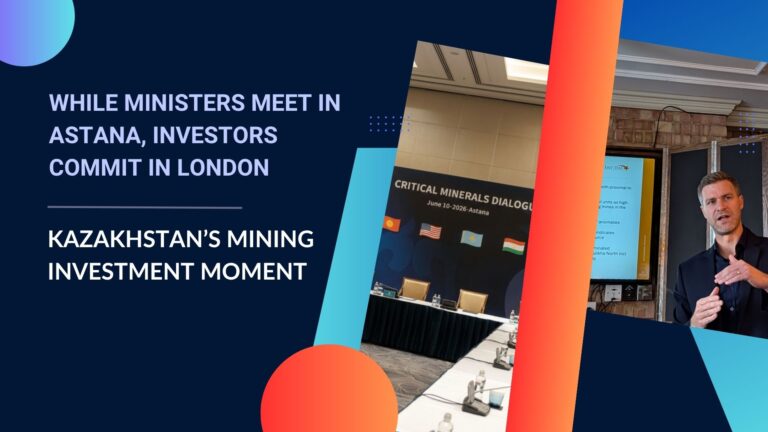
    Kazakhstan’s Mining Investment Moment: While Ministers Meet in Astana, Investors Commit in London

    This week, Astana is hosting two very different conversations about Kazakhstan’s mining future.

    In the official corridors, government delegations, US officials, and ministers from across Central Asia are gathered for high-level discussions. Grand statements are being made. Frameworks are being signed. Photographs are being taken.

    On the other side of the world in a brick-walled London dining room — a rather different conversation is taking place. A small group of private investors is gathered around a screen, listening to a junior mining CEO explain, with disarming candour, exactly how he plans to turn a copper deposit in Kazakhstan into a billion-dollar producing mine. Without debt. Without dilution. And without losing sleep over capex blowouts.

    These two conversations are not separate. They are, in fact, the same conversation — just conducted at different altitudes.


    The Ground-Level Reality of Kazakhstan Mining Finance

    East Star Resources CEO Alex Walker presented to investors with the kind of frankness that rarely makes it into official mining forums. His central message: the Verkhuba copper deposit in Kazakhstan is now funded to production, with Chinese EPCM powerhouse Xinhai taking 70% in exchange for carrying all development costs — an estimated US$65 million — to first copper.

    East Star retains 30%, fully carried, with no debt obligation. Xinhai gains majority only when it has delivered US$50 million worth of equipment to site. Until that moment, East Star holds control.

    “You do not get majority until you have sunk way more money into this,” Walker tells his audience.

    It is a deal structure worth understanding carefully, because it illuminates something important about how junior miners are actually navigating the Kazakhstan opportunity in 2026 — and it is a long way from the headline-grabbing announcements coming out of this week’s official forums.

    The Xinhai model — a Chinese EPCM contractor taking equity in exchange for funded development — is not new. But its scale and pace are accelerating. Xinhai now claims over 2,500 projects delivered globally, with more than US$42 million committed to ASX and LSE-listed companies for feasibility and construction in 2025 alone. They manufacture their own processing equipment, manage their own supply chains, and have demonstrated the ability to build a 1.5 million tonne per annum processing plant in Kazakhstan in under twelve months.

    Walker is characteristically direct about the implications: “I visited their factory in Yantai. They make everything — the rubber liners that go in your crushing plants. That means you are not reliant on where you sit in a queue for your equipment provider. You manage your entire supply chain.” When Xinhai told him they thought they could deliver Verkhuba within a compressed timeline, he said, he believed them.

    For a junior miner navigating the gap between resource and production — the graveyard of so many promising projects — this kind of vertically integrated partner is genuinely transformational. Walker is blunt about which risks he had effectively eliminated: financing, capex blowouts, and timing. Three of the five classic killers of junior development projects, struck off in a single deal.


    The Copper Market Context Nobody Is Ignoring

    Walker touched on the macro backdrop, referencing a conversation with senior Goldman Sachs mining analysts about the copper deficit forming in the rest-of-world, non-US market. The figures are striking. Goldman Sachs now projects a deficit of over 640,000 tonnes in ex-US copper markets in 2026 — a number revised sharply upward from a prior estimate of just 60,000 tonnes, driven largely by US front-loading of copper imports ahead of potential tariffs. J.P. Morgan adds a 330,000-tonne deficit projection of its own, while even the historically conservative International Copper Study Group has swung from forecasting a 209,000-tonne surplus in late 2025 to a 150,000-tonne deficit by May 2026.

    The convergence of major institutional forecasters on a significant 2026 deficit is the backdrop against which Walker’s geopolitical point lands hardest. Copper from the DRC loaded onto a ship can be diverted mid-voyage to capture a premium on the COMEX in New York. Copper that travels by rail from Kazakhstan cannot. Its destination is fixed. In a world where tariffs and trade route disruption are rewriting commodity flows in real time, Kazakhstan’s landlocked geography – once a liability – is becoming a structural advantage for certain end markets, particularly China. The supply cannot be diverted. It simply arrives.


    The Questions Investors Are Actually Asking

    The sharpest exchanges of the meeting came during questions. One investor raised the spectre familiar to anyone who has backed a junior miner in a joint venture with a larger partner: what stops the big partner from simply putting the project on ice when it suits them?

    Walker’s answer was layered. First, the deal structure itself: Xinhai only achieves majority when equipment worth US$50 million has been delivered to site. If they walk away before that, East Star keeps its majority and a significant amount of delivered capital. “They’d be selling US$50 million worth of equipment and still getting a good return on capital,” he noted. “So we’ll figure out how to build it ourselves.”

    Second, he made a pointed commercial observation: Xinhai wants East Star to be their business development partner in Kazakhstan, bringing them more deals. Betraying a partner publicly would destroy that franchise. “The first group they screw over — that business model is shut,” he said. “That’s why I don’t think they’d do it.”

    A second question probed the structure of East Star’s 30% retained interest more sharply: does the company actually own 30% of the project, or is it simply entitled to 30% of the copper? And crucially, who controls the surplus capital once the mine is producing?

    Walker confirmed that East Star owns 30% of the project entity, with marketing rights for approximately 30% of production. On dividend distribution, he was direct: under the shareholders’ agreement with Xinhai, dividend policy is a reserved matter requiring mutual agreement — the majority shareholder cannot unilaterally determine how cash is deployed. “Dividend distribution is one of those matters that needs a vote from both sides,” he said. Whether the cash ultimately flows back to shareholders or is redeployed into new projects — perhaps towards building a 300,000-ounce-per-year gold mine with Endeavour — is a question for later. The structural protection, he argued, is real.

    It was, collectively, the answer of someone who has read enough JV agreements to know exactly where the traps are.


    AI and the New Exploration Toolkit

    One detail from the evening deserves particular attention, and it speaks to how the competitive landscape for junior miners in Kazakhstan is changing.

    East Star’s porphyry gold exploration programme — the Snowy and Piket licences on the Balkash-Ili magmatic arc — was initially funded through a grant from the BHP Xplor programme, which Walker described as “a highly competitive programme: 600 applicants, 6 accepted.” The programme is explicitly oriented around applying advanced analytical techniques — including AI-driven target generation — to early-stage exploration. East Star’s selection is a mark of technical credibility that carries weight with institutional investors.

    The broader context matters here. Kazakhstan’s government has been investing heavily in the digitalisation of its geological archive — over 97% of primary geological information, approximately 250 terabytes of data, has now been scanned and consolidated into a unified system. An AI-powered platform has been developed to automatically process this archive, extract coordinates, and generate subsurface geological models. Officials describe the technology as significantly reducing data processing time and improving the quality of exploration decisions.

    For companies like East Star, operating across some of Kazakhstan’s most prospective but underexplored belts, this convergence of digitised state geological data and AI-assisted targeting represents a genuine step-change in the speed and cost of identifying drill-ready targets. The question of where the next Nikolskoye or Verkhuba might be hiding is increasingly one that algorithms, not just geologists, are helping to answer.


    The Regulatory Picture: Nuance Required

    One of the most interesting questions of the meeting came from an investor who had been tracking changes to Kazakhstan’s mining regulatory framework. The question concerned a reported increase in the threshold for mandatory government approval of ownership changes in mining companies, and the role of the national mining company Tau-Ken Samruk in new joint ventures.

    The regulatory picture here is genuinely nuanced, and worth examining carefully.

    Kazakhstan’s December 2025 amendments to the Subsoil and Subsoil Use Code were primarily aimed at digitalisation, transparency, and strengthening strategic investor incentives. Separately, amendments signed by President Tokayev also tightened state control in the uranium sector specifically, raising certain transfer thresholds and granting Kazatomprom priority rights over uranium exploration licences.

    As for Tau-Ken Samruk — the state’s national mining company and a subsidiary of the sovereign wealth fund Samruk-Kazyna — Chambers and Partners’ 2026 Kazakhstan Mining guide notes that the government is actively seeking to restore Tau-Ken Samruk’s priority rights for obtaining exploration and mining licences for critical minerals, a right that had previously been removed as part of earlier liberalisation efforts. “We expect this priority right to be restored in 2026,” the guide notes, describing it as a deliberate effort to increase the state’s foothold in the early stages of the critical minerals supply chain.

    The direction of travel is clear, even if the precise mechanics are still being finalised: Kazakhstan is simultaneously offering incentives to attract international capital and tightening state participation rights in the assets that matter most. For investors in junior miners operating here, this duality is not a contradiction — it is the operating environment. Understanding it, and structuring agreements, accordingly, is the price of entry.


    This is precisely the kind of regulatory intelligence that MINEX Eurasia Forum — convening in London on 30 November as part of London Mining Week — exists to provide. The forum brings together mining investors, operators, legal practitioners, and government representatives from across the region to examine exactly these dynamics: where is capital coming from, on what terms, and under what regulatory conditions?


    The Endeavour JV: A Different Model, Same Logic

    East Star’s joint venture with Endeavour Mining – a US$25 million exploration programme with one of the world’s top ten gold producers – follows a different but structurally similar logic. Endeavour funds exploration through to pre-feasibility study, earning up to 80% along the way. East Star manages the JV until Endeavour reaches 51% and is carried through to PFS completion.

    Again: no dilution beyond agreed thresholds, no unilateral majority until capital milestones are met, and a world-class operator bearing the exploration and development risk.

    Walker’s reference point is Independence Group in Western Australia — a company that held a minority in what became the Tropicana gold project with AngloGold, eventually building that stake into hundreds of millions of dollars of annual cash flow. The analogy is instructive: the value is not in owning the whole mine. It is in owning the right percentage of the right mine, with the right partner, under the right agreement.

    Walker put it simply: “If we have 20% of something that Endeavour is building, even with financing, that’s a billion-dollar company for just East’s percentage. That’s something I’m really excited to maintain.”

    This philosophy is increasingly evident among the better-managed junior miners operating in Central Asia. The era of the go-it-alone junior – raising capital dilutively on the back of exploration results, lurching from drill hole to drill hole – is giving way to something more sophisticated: structured, partner-funded development with clear milestone-based governance.


    MINEX Asia and the Longer Arc

    For those who follow the MINEX forum series closely, none of this comes as a surprise. Over more than a decade, MINEX Eurasia events in London have documented and debated the evolution of mining investment in Central Asia and the Caucasus — the shift from Soviet-era brownfield rehabilitation to greenfield discovery, the growing role of Chinese EPCM capital, the fitful but real improvement in regulatory environments, and the persistent challenge of converting geological endowment into investable projects.

    What is new in 2026 is the intensity of the moment. The critical minerals agenda — driven by the energy transition, by great power competition over supply chains, and by the explicit industrial policy of both the EU and the US — has focused international attention on Kazakhstan, Kyrgyzstan, Uzbekistan, and their neighbours in a way that was not true even three years ago.

    The question that MINEX Asia 2026, convening in Ankara this month, is already pressing — and that MINEX Eurasia Forum will continue to examine in London in November — is whether this intensified international attention translates into genuinely diversified investment, or whether the structural realities of Kazakhstani mining (Chinese EPCM dominance, evolving state participation requirements, infrastructure constraints) mean that the beneficiaries of the critical minerals boom will ultimately be narrower than the official narrative suggests.


    The Real Work

    Back in that London dining room, the questions kept coming. Minority shareholder protection. Dividend policy. The role of assay labs on site. The timeline to production. Each one answered with the same register: direct, detailed, and unspun.

    It was a window into the real sophistication now required to operate as a junior miner in Kazakhstan. The geology is compelling. The copper market backdrop is as strong as it has been in years. Chinese EPCM capital is available, at scale, on terms that can work for a well-advised junior. The regulatory environment, for all its complexity, is navigable.

    But the deals that will create value – the ones that will turn exploration licences into producing mines and producing mines into returns for investors — will be won or lost on the quality of the agreements, the rigour of the governance structures, and the acuity of the people sitting across the table.

    Ministers may gather for the photographs, but the real work happens away from the cameras.

  • East Star Resources Signs $25M+ Joint Venture with Endeavour Mining for Gold Exploration in Kazakhstan

    East Star Resources Signs $25M+ Joint Venture with Endeavour Mining for Gold Exploration in Kazakhstan

    East Star Resources Plc has entered into a binding earn-in and joint venture agreement with Endeavour Exploration, a subsidiary of global gold major Endeavour Mining, securing more than $25 million in staged investment for gold exploration across Kazakhstan.

    Under the newly established JV structure, Endeavour can earn up to an 80% stake in a dedicated joint venture company through phased funding. The first stage requires a $5 million investment within two years to secure 51%, followed by a further $20 million over three years to reach 70%. Completion of a NI 43-101 compliant pre-feasibility study would grant Endeavour the final 10% interest.

    East Star will retain a 20% stake upon full earn-in and will manage the joint venture during early operations, receiving compensation for its role. The agreement also includes milestone payments tied to maiden resource and PFS outcomes, to be verified by an independent qualified person.

    CEO Alex Walker described the deal as a transformative step for the company, highlighting Endeavour’s strong discovery and project-development track record, including five mines built in the past decade.

    A webcast for investors will be held on 18 November 2025 to discuss the agreement, with registration available through the Investor Meet Company platform.

  • East Star Resources Discovers New Copper and Gold Deposits in Kazakhstan

    East Star Resources Discovers New Copper and Gold Deposits in Kazakhstan

    British company East Star Resources Plc has released interim results from its geological exploration at three sites in Kazakhstan—Verkh-Uba, Talovskoye, and Snezhnoye. Having operated in the country for over three years, the investor is searching for copper and gold, with Verkh-Uba being considered the most promising site.

    In early February, the company completed drilling three exploratory wells at Verkh-Uba, discovering new copper deposits beyond previously explored areas. A total of 238 core samples have been sent to the ALS KazLab laboratory in Karaganda for analysis. According to a preliminary JORC estimate, the deposit contains 20.3 million tonnes of ore with an average copper content of 1.16%, zinc at 1.54%, and lead at 0.27%.

    East Star Resources plans to continue exploration in 2025 to assess the site’s development potential. The company aims to start open-pit mining of non-ferrous metals in the coming years.

    In addition to copper deposits, the Snezhnoye site has also shown potential, with initial studies identifying a significant gold anomaly in an area previously used for small-scale artisanal mining.

  • East Star Resources Discovers Potential Copper and Gold Reserves in Kazakhstan

    East Star Resources Discovers Potential Copper and Gold Reserves in Kazakhstan

    British company East Star Resources Plc has reported the discovery of additional potential copper and gold reserves at the Verkh-Uba, Snezhnoye, and Talovskoye exploration sites in Kazakhstan, with Verkh-Uba identified as the most promising deposit.

    “Recent exploration work has yielded encouraging results across both of our current operational areas. The findings at Verkh-Uba demonstrate that we are advancing this already significant copper asset while refining other targets, including Talovskoye, for near-term drilling. Additionally, the discovery of a large epithermal gold deposit at Snezhnoye, constrained by old artisanal gold workings, is undoubtedly exciting,” said East Star CEO Alex Walker.

    East Star, which has been operating in Kazakhstan for over three years, expressed optimism that 2025 would mark significant progress in all three exploration projects.

    As of February 4, the company completed drilling three boreholes at Verkh-Uba, each confirming copper deposits beyond previously explored areas. All 238 core samples have been sent to ALS in Karaganda for analysis, with results expected by the end of February. Furthermore, satellite data revealed a substantial gold-in-soil anomaly measuring four by one kilometer at the Snezhnoye site.

    Drilling at Verkh-Uba commenced on November 12, 2024, and paused for the winter break on December 19, 2024. Based on analysis results, the company will determine whether to proceed with additional drilling in 2025 and assess the potential for substantial reserves. If viable, East Star may initiate open-pit mining operations.

    Verkh-Uba remains the company’s most promising project, with a preliminary JORC-compliant resource estimate of 20.3 million tonnes containing 1.16% copper, 1.54% zinc, and 0.27% lead. East Star Resources is listed on the London Stock Exchange under the ticker EST.

  • East Star Resources Announces Significant Progress on Copper Exploration in Kazakhstan

    East Star Resources Announces Significant Progress on Copper Exploration in Kazakhstan

    East Star Resources Plc (LSE: EST), a company focused on copper exploration in Kazakhstan, has shared promising updates from its exploration strategy at the Snowy licence. The project, located on the Paleozoic Balkash-Ili volcanic arc, received initial funding through a US$500,000 BHP Xplor grant.

    Recent soil sampling efforts have revealed two significant anomalies. The first is a 5 km by 1 km gold anomaly aligned with the alteration patterns observed in multispectral imagery and situated near an artisanal gold mine. The second anomaly spans 2 km by 2 km and exhibits strong molybdenum (Mo) and bismuth (Bi) signals, exceeding thresholds by over 10 times for Mo and 100 times for Bi, indicative of potential porphyry systems.

    Chris van Wijk, East Star’s Technical Director, remarked, “The geochemical results align with regions known for hydrothermal activity, strengthening the case for further exploration. These findings showcase the value of integrating multispectral imaging and soil geochemistry in mineral exploration.”

    The next steps include field verification and geological mapping to identify mineralisation characteristics. If supportive data is obtained, the company plans to proceed with Induced Polarity (IP) surveys to target disseminated sulphides.

    During the 2024 field season, East Star collected 1,469 soil samples, revealing two targets, the Central Target and East Target. The Central Target displayed anomalies in Mo and Bi, consistent with porphyry systems. The East Target showed elevated gold and silver levels, aligning with epithermal vein systems observed in nearby artisanal operations.

    Systematic soil geochemistry, combined with multispectral analysis using ASTER data, has been pivotal in refining exploration areas. The analysis highlighted silica lithocaps with distinct geochemical signatures, further substantiating their potential.

    East Star’s strategy underscores its commitment to leveraging advanced techniques in uncovering mineral resources in Kazakhstan, paving the way for future exploration milestones.

  • Introducing the 2024 BHP Xplor Cohort | East Star Resources

    Introducing the 2024 BHP Xplor Cohort | East Star Resources

    Hear from Alex Walker and Christopher van Wijk from East Star Resources, a United Kingdom-based company listed on the London Stock Exchange exploring for copper and other base and precious metals in Kazakhstan BHP Xplor is a cohort-based accelerator program supporting early-stage mineral exploration start-ups in finding critical minerals to drive the energy transition. We are excited to introduce the 2024 cohort as they begin their journey with BHP Xplor.

  • East Star Resources awarded copper porphyry exploration licence

    East Star Resources awarded copper porphyry exploration licence

    East Star Resources Plc, a company focused on copper exploration and resource development in Kazakhstan, has secured its first copper porphyry exploration license under a new strategy, funded in part by a US$500,000 grant from the BHP Xplor program.

    Partnering with BHP, East Star aims to generate regional targets for copper porphyry deposits, primarily in the Balkash-Ili magmatic arc, which hosts significant deposits like Kounrad and Aktogai-Aidarly. Utilizing modern mineral systems concepts and advanced analytical techniques, East Star plans to secure additional exploration licenses and conduct fieldwork in the region.

    The BHP Xplor grant will cover license costs, field programs, desktop evaluations, and administrative expenses. The program, managed by East Star with guidance from BHP and experts, aims to advance prospects identified through satellite imagery and geological mapping.

    Alex Walker, CEO of East Star, expressed satisfaction with obtaining the first license under the new strategy, highlighting the identification of hydrothermal alteration associated with a silica lithocap during an initial site visit. The license is located in the Balkash-Ili volcanic arc, known for hosting copper and gold-rich porphyry and skarn deposits.

    The Aktogai cluster, located nearby, contains significant copper and gold reserves. The historical data on the license indicates anomalous gold and secondary quartzites, characteristic of porphyry intrusions, further confirming its prospectivity.

    The license benefits from existing infrastructure, including a railway and a gravel road, facilitating access to the site. Initial work will include geological mapping and soil sampling to assess the prospectivity of the area based on metal zonation patterns and clay species analysis.

  • East Star Resources Secures 500 000 USD from BHP Xplor for Copper Exploration in Kazakhstan

    East Star Resources Secures 500 000 USD from BHP Xplor for Copper Exploration in Kazakhstan

    Introduction

    BHP has announced its second cohort of six companies, chosen from a pool of over 500 applicants, to join the BHP Xplor* accelerator program.

    BHP Xplor is a global accelerator program targeting innovative, early-stage mineral exploration companies to find the critical resources necessary to drive the energy transition.

    Out of six companies, BHP Xplor invited two companies to explore copper and other base and precious metals in Kazakhstan.: Pallas Resources and East Star Resources. Both companies will receive up to US$500,000 in non-dilutive funding. Proceeds will go toward accelerating exploration over a defined area of interest hunting significant copper systems.

    A Momentous Achievement for East Star Resources

    East Star Resources’ CEO, Alex Walker, expressed his gratitude for the grant and highlighted the extensive application process. BHP, known for their stringent due diligence, selected East Star Resources as a partner, signalling the potential of their copper exploration project in Kazakhstan.

    The Application Process

    The application process involved pitching an exploration concept, a task that required careful planning and consideration. Copper porphyries, known for their complexity and substantial financial requirements, presented a challenging proposition for East Star Resources. However, with the guidance of their new director, Chris Van Weck, they formulated a compelling exploration concept.

    BHP’s Role

    BHP’s involvement goes beyond financial support. They bring a wealth of expertise in exploration, ecology, environmental impact, and governance. Access to a network of service providers and international experts enhances East Star Resources’ capabilities.

    The Significance of Prospectivity

    Kazakhstan holds enormous potential for copper exploration, akin to Western Australia in the 1970s. With two world-class copper projects already identified in a vast area, the odds are that more remain undiscovered. BHP recognises this prospectivity and views East Star Resources as a valuable partner in unlocking this potential.

    Dual Exploration Strategies

    East Star Resources is pursuing two parallel exploration strategies. While the VMS (Volcanogenic Massive Sulfide) projects remain a focus due to their excellent return on invested capital, the grant from BHP will fund the copper porphyry exploration. This dual approach maximizes their chances of success in a burgeoning copper market.

    Financial Prudence

    It’s essential to use the grant wisely. East Star Resources aims to de-risk the project with the initial funding, making it an attractive proposition for future investors. While there is no specific obligation tied to the funding, having BHP as a potential partner is a significant advantage.

    Plans for Q1 and Beyond

    East Star Resources is actively building the copper porphyry exploration team and refining its strategy. With Chris Van Weck’s geological expertise, they are poised for a successful exploration campaign. The company also plans to continue advancing its VMS projects, aiming to reach drilling-ready status and apply for mining licenses.

    2024 promises to be a pivotal year for East Star Resources. With increasing demand for copper and forecasts of significant deficits in the coming years, the company’s exploration activities are well-timed. As they embark on both VMS and copper porphyry exploration, shareholders can anticipate an eventful and potentially rewarding year.

    In conclusion, East Star Resources’ partnership with BHP and their dual exploration strategies position them as a key player in the evolving copper market. As they continue their exploration journey, the mining industry and investors alike will closely watch their progress.

    Watch the interview with Alex Walker the CEO of East Star Resources following news that the company have received $500,000 in grant funding from BHP Xplor.