Tag: digital platform

  • Kazakhstan Senate Approves Subsoil Code Amendments to Digitize Geological Data and Expand Investor Incentives

    Kazakhstan Senate Approves Subsoil Code Amendments to Digitize Geological Data and Expand Investor Incentives

    Kazakhstan’s Senate on December 18 2025 approved amendments to the Code “On Subsoil and Subsoil Use,” according to a report by Zakon.kz. Senator Sagyndyk Lukpanov said the law is aimed at fulfilling presidential поручения on systematizing and digitizing the country’s geological information.

    The amendments закрепляют the Unified Subsoil Use Platform as the sector’s core digital infrastructure, featuring an open database of geological data. The platform is designed to cover nearly all business processes and government services related to exploration and extraction of solid minerals and common minerals. It will also be integrated with the Unified State System for Managing the Fuel and Energy Complex, which is used to collect, store, analyze, and process subsoil information in the hydrocarbons sector.

    The law also formally establishes the National Geological Service as the operator responsible for managing geological information. According to Lukpanov, the national operator will provide a centralized and standardized approach to monitoring the state subsoil fund, preventing duplication and fragmentation of data across institutions. The service, which is subordinate to the Geology Committee, will not be subject to privatization.

    Another major block of amendments introduces electronic auctions as a mechanism for granting subsoil use rights. Auctions will be used to allocate free subsoil plots as well as areas where subsoil use rights have been terminated. In addition, the amendments raise the required share of domestic content in works and services from 50% to 70% for exploration and mining operations, including uranium.

    The legislation also introduces a priority right for strategic investors to explore and mine solid minerals when implementing large industrial and innovation projects valued above 14.5 million MRP (over 50 billion tenge). Under the new rules, subsoil use rights for such projects may be granted outside the auction process, provided investors meet specified requirements.

    Further amendments regulate the granting of subsoil use rights for technogenic mineral formations located within populated areas. One licensing condition is the mandatory removal of extracted technogenic mineral materials beyond settlement boundaries, followed by processing. The law also confirms investment preferences for subsoil users implementing solid mineral processing projects, provisions already reflected in the new Tax Code. These incentives include exemptions from corporate income tax and land tax for 10 years, property tax for 8 years, and VAT on imported equipment for 5 years.

    For processing projects, the minimum investment threshold required to conclude a processing agreement will increase tenfold, from 7 million to 70 million MRP. The bill had previously been adopted by the Mazhilis in a second reading on November 19 as part of implementing presidential instructions.

  • Kazakhstan Targets Economic Growth with Rare-Earth Expansion and SEZ Reforms

    Kazakhstan Targets Economic Growth with Rare-Earth Expansion and SEZ Reforms

    Kazakhstan is launching a comprehensive strategy to boost economic growth by strengthening special economic zones (SEZs) and expanding rare-earth metal production, as announced by Industry and Construction Minister Yersayin Nagaspayev during a government meeting chaired by Prime Minister Olzhas Bektenov

    To improve SEZ efficiency, the government will conduct a comprehensive review of their performance and strengthen monitoring mechanisms to ensure investors fulfill their obligations. The country also plans to introduce a framework for foreign companies to manage certain SEZs, while local authorities will intensify efforts to attract new investors.

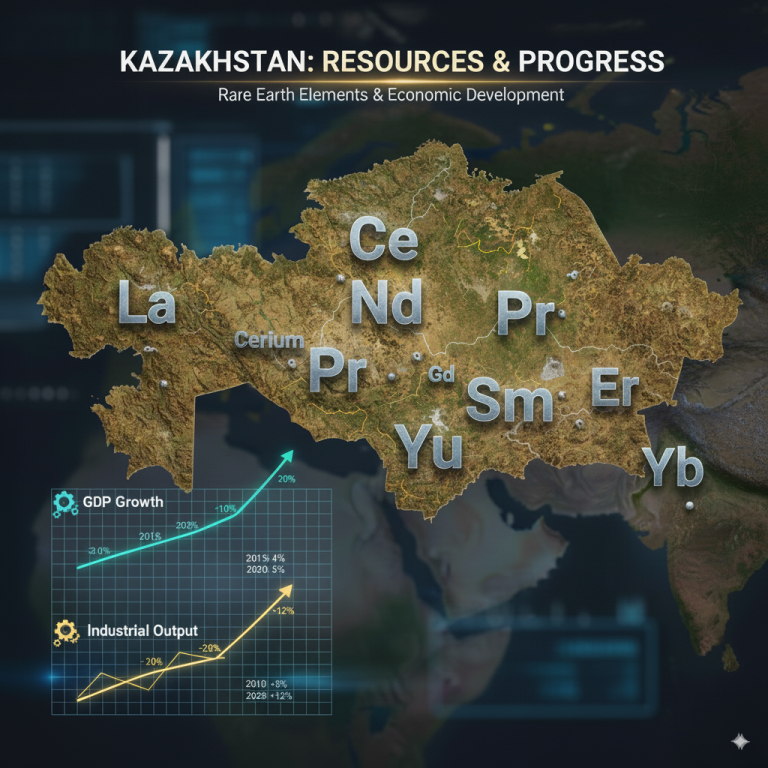
    In addition to SEZs, the government has identified rare-earth metal production as a key area for development. Kazakhstan plans to implement at least three major projects in this field, focusing on the production of battery materials, recycling and manufacturing heat-resistant alloys for jet engines, developing semiconductor components, and reprocessing permanent magnets.

    The country has already established strategic partnerships with leading players from the European Union, the United States, Japan, South Korea, and China. Upcoming projects include the launch of gallium production with an annual capacity of 15 tons, the manufacturing of high-purity manganese sulfate, and the production of graphite for battery components.

    Kazakhstan is also taking significant steps to modernize its geological exploration and mapping. A next-generation geological map will be developed using advanced digital tools, with project preparations already underway and fieldwork scheduled to begin in 2026. The government has allocated funding for new surveying methods, including aerogeophysics, geochemistry, spectral imaging, and high-resolution satellite data analysis.

    Furthermore, the country is introducing a unified digital platform to consolidate all processes related to construction and housing management. The platform will be introduced by the end of 2025 and is expected to enhance efficiency and transparency in the sector.

    The reforms are part of Kazakhstan’s efforts to diversify its economy and reduce its dependence on oil exports. The country aims to become a major player in the global rare-earth market and to attract foreign investment in its SEZs.