Tag: critical minerals investment

  • Kazakhstan’s Copper Sector: Strategic Asset in a Tightening Market

    Kazakhstan’s Copper Sector: Strategic Asset in a Tightening Market

    Kazakhstan rarely commands the attention its copper endowment deserves. Producing roughly 900,000 tonnes annually from 35 million tonnes of registered reserves, it accounts for approximately 4% of global copper output — a share comparable to many of the names that dominate industry headlines. Yet Western investment community engagement with the sector remains shallow relative to the opportunity, and the geological case for what remains undiscovered is, if anything, more compelling than the production figures alone suggest.

    At a recent British-Kazakh Society webinar on copper in Kazakhstan — convened jointly with the Embassy of Kazakhstan in London and the UK Department of Business and Trade — geologists, exploration executives, and market analysts gathered to examine the sector in detail. The discussion made one thing clear: Kazakhstan’s copper story is not simply one of existing production. It is one of a sector arriving at a structural inflection point at precisely the moment the global market needs it most.

    The Resource Base

    Kazakhstan’s copper reserves are concentrated in two mature producing provinces. The Zhezkazgan deposit in central Kazakhstan is one of the great sediment-hosted copper systems on earth, developed since the post-war Soviet era and still the backbone of national production. Eastern Kazakhstan contributes largely through complex polymetallic deposits, of which Aktogai — a world-class porphyry system — is the most prominent. Together these provinces underpin an annual output of around 900,000 tonnes, placing Kazakhstan comfortably among the world’s significant copper producers.

    The registered reserve figure of 35 million tonnes, however, almost certainly understates the country’s true endowment. USGS analysis of undiscovered global copper potential consistently identifies central and eastern Kazakhstan as among the most prospective territories on earth for porphyry copper systems. Two distinct porphyry belts cross the country. The younger Valerianov Belt connects, across the Uzbek border, to the super-giant Kalmakyr deposit; that belt, within Kazakhstan, remains largely undrilled. A substantial portion of central Kazakhstan lies beneath Aral Sea basin sediments with no surface outcrop and minimal modern exploration coverage. What has been found is not broadly what exists.

    The Data Opportunity

    Unlocking Kazakhstan’s exploration frontier depends significantly on data — and here, material progress is underway. The National Geological Service has scanned 97.5% of its Soviet-era archive, a vast repository of maps, drill logs, and technical reports accumulated over decades of intensive geological work. An AI and OCR programme now underway aims to render that material machine-readable by mid-2027, and a unified digital subsoil platform will eventually integrate it with online licensing and compliance functions.

    The Soviet geological archive has long been one of Central Asia’s most underleveraged assets — rich in detail, largely inaccessible to modern analytical methods. As that changes, the information barrier that has historically complicated early-stage investment decisions in Kazakhstan will begin to fall. The same technology has implications for Uzbekistan, Mongolia, and other jurisdictions carrying similar archival burdens.

    The Exploration Dynamic

    Despite over 3,500 active exploration licences — a market that has grown dramatically since Kazakhstan’s current mining code opened competitive licence pegging — major mining companies outnumber junior explorers among active operators. This is structurally unusual for a jurisdiction at Kazakhstan’s stage of geological maturity. Seventy percent of the world’s mineral discoveries are made by junior companies. The early-stage risk capital that drives discovery is underdeveloped relative to the opportunity.

    That is beginning to shift. Aurora Minerals Group, a Kazakh-rooted exploration services company with international technical partnerships, has spent years systematically de-risking early-stage copper targets — culminating in First Quantum Minerals taking an earn-in position on the Lakeside porphyry project in the northern Balkhash district. A second project targeting sediment-hosted copper in the Tenis Basin, an analogue setting to the Zhezkazgan deposit, is entering its first field season on ground only recently opened by the government for exploration. The model — patient local knowledge combined with international technical and capital partnerships — is one the market needs more of.

    Market Dynamics and Kazakhstan’s Position

    The global copper market is broadly balanced today, but the trajectory is clear. A supply deficit of around 140,000 tonnes is expected this year, widening materially into next. Exchange stocks, inflated by the US tariff distortion that pulled copper from China and Europe into COMEX warehouses at premiums of up to $3,000 per tonne above LME, are elevated but unwinding. Underneath the short-term noise, the structural picture is one of tightening supply against demand that governments and industries across the developed world are now treating as a strategic priority rather than a market variable.

    Kazakhstan sits well within that supply picture. It produces 24 of the 36 minerals identified in the UK’s critical minerals strategy. Its copper is exported into global supply chains that are increasingly subject to scrutiny over reliability and geopolitical exposure. The Astana International Financial Centre provides an internationally anchored legal framework. There is explicit political will to support long-term foreign investment — not extractive engagement, but sustained industrial partnership.

    The friction points are real: dual reserve reporting systems under GKZ and KAZRC create disclosure complexity for internationally oriented investors; permitting timelines warrant attention; and Kazakhstan’s position between China and a reengaging Western investment community requires careful navigation. None of these are disqualifying. All are manageable with the right local knowledge and structuring.

    The copper market’s structural shift is not speculative. The demand is real, the supply constraint is real, and the timeline for bringing new production online is unforgiving. Kazakhstan, with a large established production base, a geologically compelling frontier, and an improving investment environment, is one of the few jurisdictions that can contribute meaningfully to closing that gap — if the engagement comes early enough to matter.

  • AIFC’s New Junior Mining Platform Tackles Kazakhstan’s Early-Stage Financing Gap as Global Minerals Demand Creates Narrow Window of Opportunity

    AIFC’s New Junior Mining Platform Tackles Kazakhstan’s Early-Stage Financing Gap as Global Minerals Demand Creates Narrow Window of Opportunity

    With more than 65% of Kazakhstan’s territory still geologically underexplored and some 3,000 active exploration licences in need of capital, the Astana International Financial Centre has launched a dedicated platform to bridge the structural gap between early-stage mineral projects and the investors willing to fund them — a gap that has long kept promising licences stranded at the riskiest point in the mining cycle.

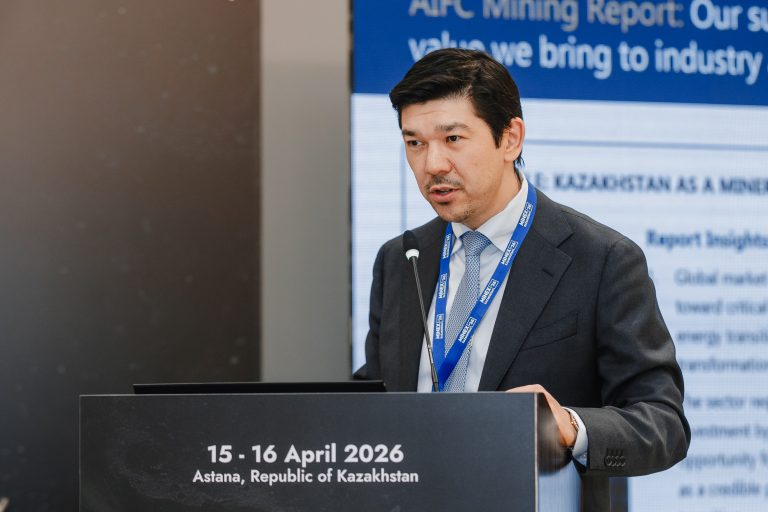
    The Junior Mining Platform, announced ahead of the MINEX Kazakhstan 2026 forum, addresses what AIFC chief product officer Zhanbolat Kakishev described as the sector’s defining problem: a lack of structured access to capital at the exploration stage. Many projects stall precisely because they cannot yet demonstrate reserve confirmation under internationally recognised standards — JORC or KAZRC — which institutional investors typically require before committing funds. The platform is designed to move projects through that gap by pre-screening and curating them according to industry criteria, then presenting the resulting pipeline to both domestic and international investors.

    The timing is deliberate. Global demand for critical minerals is accelerating, and the world’s capital requirement for the extractive sector is estimated to reach $2.1 trillion by 2050. Kazakhstan, whose mining sector generated 12.1% of GDP and approximately 33% of total exports in 2024, is positioned to capture a meaningful share of that investment flow — but only if early-stage projects can access financing before competitors in other jurisdictions do. Mining and metallurgy currently account for 17%, or roughly $3 billion, of Kazakhstan’s total foreign direct investment, a figure that experts say should rise significantly if exploration-stage barriers are lowered.

    To oversee the platform’s development, the AIFC has established a Mining Sector Expert Council drawing on senior figures from across the industry, including the chairmen of Tau-Ken Samruk and the National Geological Survey, the deputy chief executive of Solidcore Resources, the founder of Aurora Minerals Group and the chief executive of Arras Minerals Corp. The council’s mandate is to develop modern financial instruments suited to junior mining — including royalties, streaming agreements and earn-in structures — that can create a replicable and transparent model for connecting licence holders with capital providers.

    Junior companies wishing to apply to the platform can find selection criteria and submission details on the AIFC’s official website.

  • MINEX Kazakhstan 2026 Marks Turning Point for Mining Sector as Forum Calls for Legislative Overhaul and Proactive Investor Engagement

    MINEX Kazakhstan 2026 Marks Turning Point for Mining Sector as Forum Calls for Legislative Overhaul and Proactive Investor Engagement

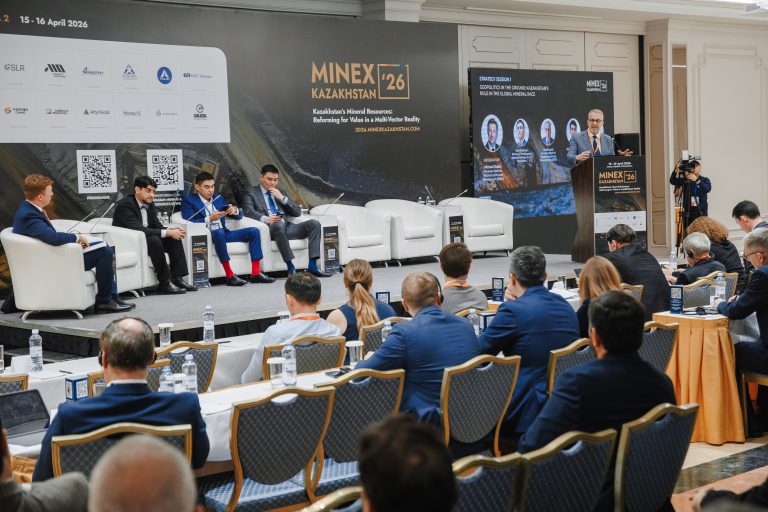
    Kazakhstan’s mining sector has reached a turning point, with the era of easy extraction behind it and a new strategic imperative to build domestic value chains, attract long-term investors and align national legislation with international best practice — that was the overarching message from the XVI MINEX Kazakhstan 2026 forum in Astana, held under the motto “Mineral Resources of Kazakhstan: Reforming for Value in a Multi-Vector Reality.”

    The forum brought together more than 500 representatives of government bodies, mining company executives, financiers, scientists and technology suppliers from over 30 countries. Opening the event, MINEX executive chairman Artur Polyakov declared that the global mining industry had entered a new era in which the focus is shifting from rapid extraction to the strategic use of key minerals as instruments of economic competitiveness, energy security and international influence.

    Vice minister of industry and construction Iran Sharkhan reaffirmed the scale of Kazakhstan’s geological endowment — approximately 10,000 registered deposits, with 17 new objects including Kok-Zhon, Altyn-Shoko and Samombet placed on the state register in 2025 alone — and highlighted the 2025 amendments to the Subsoil and Subsoil Use Code as a significant step toward simplified administrative procedures, investment attraction and process digitalisation.

    However, the forum also surfaced persistent structural problems. Nikolai Radostovets, executive director of the Association of Mining and Metallurgical Enterprises, acknowledged the importance of the 2018 Subsoil Code while noting that its adoption failed to fully synchronise provisions with the Land, Water, Environmental and Tax codes — a gap that continues to generate administrative barriers for exploration and production projects. “Kazakhstan must not only maintain investment attractiveness but also bring national legislation in line with the best international practices,” he said, citing growing global interest in critical and rare earth metals as a further reason for urgency.

    Geopolitical forecasting analyst Eldaniz Huseynov, founder of Nightingale Ind., argued that Kazakhstan should move beyond passive openness to investment toward actively offering turnkey projects to international partners. He identified molybdenum, zinc, cobalt, uranium and tungsten as priority resources for domestic processing, and said competition between investors from China and Europe could itself serve as a lever to improve cooperation terms. “Kazakhstan must build strategic partnerships and confidently offer its own projects to the international community,” he said, adding that investor engagement should encompass technology development, domestic supply chain integration, job creation and infrastructure commitments — not merely raw material exports.

    The forum concluded that Kazakhstan must simultaneously advance extraction infrastructure, refine its legislative framework, improve the investment climate and consolidate its position as a reliable partner in global critical mineral supply chains.