Tag: Copper Production

  • Kazakhstan Maintains Position Among Top Copper Producers with 710,000 Tonnes in 2025

    Kazakhstan Maintains Position Among Top Copper Producers with 710,000 Tonnes in 2025

    Kazakhstan’s copper industry has reaffirmed its status as a significant player in the global market, producing 710,000 tonnes of copper in 2025. This output has secured the country a place in the top ten copper-producing nations, ranking ninth alongside Indonesia, which reported similar production figures. The data, sourced from the Energy Institute and the United States Geological Survey, highlights Kazakhstan’s continued relevance in the competitive landscape of copper mining.

    The global copper production landscape is led by Chile, which produced a staggering 5.3 million tonnes in the past year. The Democratic Republic of Congo follows in second place with 3.2 million tonnes, while Peru rounds out the top three with 2.7 million tonnes. China and Russia occupy the fourth and fifth positions, respectively, with outputs of 1.8 million tonnes and 1.3 million tonnes.

    In addition to Kazakhstan and Indonesia, other notable producers include the United States, which achieved a production level of 1 million tonnes, Zambia at 740,000 tonnes, and Australia with 730,000 tonnes. Collectively, the top ten copper-producing countries accounted for a total of 18.39 million tonnes of copper, contributing significantly to the estimated global production of over 23 million tonnes, as reported by the Energy Institute.

    Kazakhstan’s performance in copper production not only underscores its mining capabilities but also reflects the country’s strategic importance in the global supply chain for this essential metal, which is critical for various industries, including electronics and renewable energy. As demand for copper continues to rise, Kazakhstan’s position in the market may further strengthen, providing opportunities for investment and development in its mining sector.


  • Uzbekistan’s mining sector marks a year of major discoveries, expansions and digital upgrades

    Uzbekistan’s mining sector marks a year of major discoveries, expansions and digital upgrades

    The past year brought several landmark developments for Uzbekistan’s extractive industry, ranging from new discoveries to large-scale industrial expansion and digital transformation.

    In September, President Shavkat Mirziyoyev announced the discovery of a giant gas deposit on the Ustyurt Plateau. For the first time in the country’s history, exploration drilling in the area reached depths of 6.5 km. While technical details of the find have not yet been disclosed, exploration work in the region is being carried out by Uzbekneftegaz in partnership with Azerbaijan’s SOCAR.

    Industrial expansion was led by Almalyk Mining and Metallurgical Complex, one of the country’s largest resource producers. In October, the company launched the first processing line of its new MOF-3 concentrator. Once all lines are commissioned by 2026, the facility is expected to process up to 60 million tonnes of ore annually, producing 894,000 tonnes of copper concentrate and 1,500 tonnes of molybdenum concentrate. AMMC says MOF-3 will become the largest copper production facility in Central Asia.

    The company also commissioned its own emulsion explosives plant with a capacity of 90,000 tonnes per year, supporting expanded drilling and blasting operations at the Yoshlik I deposit. In addition, AMMC became the first producer in Uzbekistan to introduce an automated fleet management system at the Kalmakyr and Yoshlik I open pits.

    Another key milestone came in April, when Navoi Mining and Metallurgical Company put into operation a new mine shaft at the Zarmitan gold deposit. The “Skipovoy” shaft, 6.5 meters in diameter and 1 km deep, will increase ore transport to Hydrometallurgical Plant No. 4 by 1.4 million tonnes per year.

    At the policy level, the government also announced plans to implement 76 projects focused on rare and rare earth metals, with total investments estimated at $2.6 billion.

  • Uzbekistan Plans to Double Copper Production to 500,000 Tonnes by 2030

    Uzbekistan Plans to Double Copper Production to 500,000 Tonnes by 2030

    Uzbekistan aims to double its copper output to 500,000 tonnes annually by 2030, according to a statement from the press service of President Shavkat Mirziyoyev. The country is strengthening its raw material base to support the development of high-tech sectors such as electrical engineering, electronics, and the semiconductor industry.

    Currently, products with high added value make up about 60% of Uzbekistan’s copper exports, reflecting steady progress toward deeper industrial processing. The government reports that the sector’s investment portfolio includes 157 projects worth $2.1 billion, covering new mining, processing, and manufacturing initiatives.

    Plans are also underway to increase domestic copper refining capacity to 300,000 tonnes, with new enterprises and industrial clusters being established to produce finished copper products.

    One of the key projects is the Ahangaran Copper Cluster in Tashkent Region, where facilities will be set up to manufacture semiconductors, microelectronic components, and other high-tech copper-based products in cooperation with the Almalyk Mining and Metallurgical Complex (AMMC).

    The initiative is part of Uzbekistan’s broader industrial policy to expand value-added production, reduce dependence on raw material exports, and position the country as a regional hub for advanced manufacturing in Central Asia.

  • Central Asia Metals Delivers Strong Financial Performance and Targets Sustainable Growth

    Central Asia Metals Delivers Strong Financial Performance and Targets Sustainable Growth

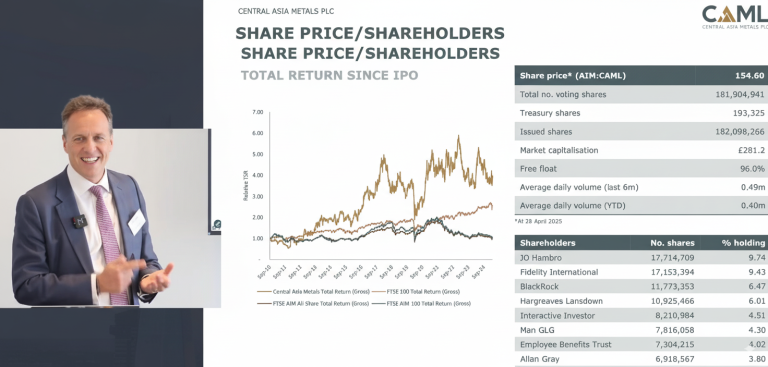
    Central Asia Metals PLC, during its recent ShareSoc Seminar investor presentation, outlined a solid financial and operational performance for 2024, underpinned by exceptional profitability from its primary mining assets in Kazakhstan (Kunrad) and North Macedonia (Sasa). The company reported EBITDA margins of 47%, notably higher than industry averages, with Kunrad achieving margins as high as 73% owing to its unique low-cost copper recovery process. CAML closed the year with $67.6 million in cash and generated nearly $66 million of free cash flow, positioning itself firmly as a low-debt, cash-strong operator.

    Shareholders have benefited from a consistent dividend policy, with payouts between 30% and 50% of free cash flow, although the latest 18p annual dividend actually represented a payout of 63% of cash flow, reflecting the board’s commitment to return surplus capital to investors. Since its 2010 IPO, CAML’s dividend returns have exceeded funds raised, exemplifying its prudent capital management.

    Operationally, the Kunrad copper operation stands out for its innovative in-situ leaching method, extracting copper from historic waste dumps without traditional mining, resulting in first-quartile cost performance and a reliable output profile. Sasa, in North Macedonia, remains a stable but higher-cost asset due to conventional underground mining, recent capital investment in new mining methods and infrastructure, and inflationary pressures closer to Europe.

    CAML’s growth strategy pivots on selective expansion of its asset base. In 2024, the management evaluated 37 potential acquisitions, focusing on base metal properties in familiar jurisdictions such as Kazakhstan, the wider European time zone, and parts of Africa. The criteria for new investment emphasise accretive deals that bolster shareholder earnings and leverage CAML’s strong borrowing ability. The company also maintains minority stakes in exploration ventures such as the Arthra project in Scotland and the Camel X JV in Kazakhstan, aiming for scalable, affordable copper projects to support future production.

    Sustainability and community engagement remain core to CAML’s ethos, with significant investments in solar energy reducing greenhouse gas emissions and philanthropic initiatives supporting local health, education, and disaster relief. Both Kunrad and Sasa have active programmes to minimise environmental footprint, including innovative tailings management and local entrepreneurship support.

    Looking ahead to 2025 and beyond, CAML expects continued steady production, further asset optimisation, and sustained shareholder returns, maintaining its reputation as a defensive stock with a strong balance sheet. The company continues to operate debt-free, with ongoing efforts to extend mine life and pursue disciplined expansion in base metals.

  • Aurubis Reports Strong Q1 Earnings Driven by High Metal Prices and Copper Demand

    Aurubis Reports Strong Q1 Earnings Driven by High Metal Prices and Copper Demand

    Aurubis, Europe’s largest copper producer, posted stronger-than-expected first-quarter earnings, fueled by rising metal prices, strong copper product sales, and increased revenue from sulphuric acid. The company also benefited from lower costs, contributing to a 17% year-on-year rise in pre-tax earnings to €130 million ($135 million), surpassing analyst estimates of €126 million.

    CFO Steffen Hoffmann highlighted the growing demand for sulphuric acid, widely used in fertilizers and the chemical industry, which is helping offset declining refining fees for copper concentrate. Analysts predict a sharp drop in benchmark refining fees from $80 per tonne to around $20–$25 in 2025, posing a challenge for smelters like Aurubis.

    Despite concerns over potential U.S. tariffs, Hoffmann reaffirmed the company’s strategic focus on local production. Aurubis is expanding its recycling plant in Georgia, adding a second module that will increase blister copper output from 35 to 75 kilotonnes.

    The Hamburg-based company, which recycles raw materials into copper anodes, cathodes, and wire rods, expects the artificial intelligence (AI) boom to drive further demand for its wire rod products, a crucial component in data centers.

    Aurubis confirmed its full-year outlook, maintaining confidence in sustained demand and strategic expansion.

  • Boliden Acquires Lundin Mining Assets for $1.3 Billion in Strategic Expansion

    Boliden Acquires Lundin Mining Assets for $1.3 Billion in Strategic Expansion

    Swedish mining giant Boliden is set to acquire the Neves-Corvo mine in Portugal and the Zinkgruvan mine in Sweden from Lundin Mining in a deal valued at $1.3 billion upfront, with potential contingent payments of up to $150 million.

    This acquisition is expected to nearly double Boliden’s zinc concentrate output and increase its copper concentrate production by 43%, significantly bolstering its resource portfolio. The move aligns with Boliden’s strategic goal to enhance its smelting capacity and secure a stable supply of mined ores amidst intensifying global competition.

    According to Boliden CEO Mikael Staffas, the deal represents both “industrial logic and strategic fit,” with the acquired mines projected to contribute between $300 million and $350 million annually in earnings over the next five years. Boliden plans to finance the upfront payment through a bridge loan, half of which will be refinanced via a share issue and the remainder through medium- and long-term debt instruments.

    For Lundin Mining, the sale reflects a pivot in focus toward South America. Earlier this year, the company announced a joint venture with BHP to acquire Filo Corp, which owns the Filo del Sol project in Chile. This deposit boasts estimated resources of 2.2 billion pounds of copper, 2.86 million ounces of gold, and 133.33 million ounces of silver. The joint venture also acquired the Josemaría copper-gold-silver project in Argentina.

    The Neves-Corvo mine, located in Portugal’s Iberian Pyrite Belt, produced 108,812 tonnes of zinc, 33,823 tonnes of copper, 6,500 tonnes of lead, and 1.9 million ounces of silver in 2023. Meanwhile, the Zinkgruvan mine in Sweden yielded 76,349 tonnes of zinc, 4,434 tonnes of copper, 26,284 tonnes of lead, and 2.3 million ounces of silver last year.

    The transaction, which is subject to regulatory approvals, is expected to be finalized by mid-2025.

  • Activist Investor Urges Rio Tinto to Scrap London Listing and Focus on Australia

    Activist Investor Urges Rio Tinto to Scrap London Listing and Focus on Australia

    Rio Tinto is under pressure from Palliser Capital, an activist investor, to abandon its primary London listing and adopt a sole focus on Australia, according to reports. The UK-based hedge fund, holding an estimated $250 million (£197 million) stake in the mining giant, criticized the firm’s dual listing structure across the London and Sydney markets as “outdated.”

    Palliser’s proposal mirrors the move by BHP, which shifted its primary listing to Sydney in 2022, citing strategic advantages. Australian investment firm Blackwattle Investment Partners has expressed support for Palliser’s call, suggesting alignment around a central listing in Sydney. However, under the proposal, Rio Tinto shares would remain traded in London under a secondary listing.

    This push comes as London’s financial markets face growing challenges, with several high-profile firms, including Tuiand Flutter, recently relocating their main listings overseas.

    Meanwhile, at its investment day in London, Rio Tinto outlined an ambitious plan for “a decade of profitable growth,” including projections for significant increases in copper production. The company aims to produce 780,000-850,000 tonnes of copper by 2025, up from this year’s estimated range of 660,000-720,000 tonnes, driven by strong performance at its Oyu Tolgoi mine in Mongolia. By 2030, the company targets annual production of 1 million tonnes of copper, a critical material for the global energy transition.

    Jakob Stausholm, Rio Tinto’s CEO, emphasized the company’s long-term strategy: “We are committed to becoming a global leader in energy transition materials. Our improved performance enables us to pursue growth, meet our decarbonization targets, and maintain our dividend policy while preserving a strong balance sheet.”

  • Kazakhstan’s Role in Global Metal Markets: A Leading Producer of Copper and Aerospace Titanium

    Kazakhstan’s Role in Global Metal Markets: A Leading Producer of Copper and Aerospace Titanium

    Kazakhstan is reinforcing its position as a global leader in metal production, ranking 11th worldwide for copper production and holding a dominant share in aerospace titanium and other critical metals. Kanat Sharlapayev, Minister of Industry and Construction, highlighted that Kazakhstan accounts for 20% of the aerospace titanium market and 30%of global supplies of metals like beryllium and niobium.

    Sharlapayev emphasized that Kazakhstani enterprises control most of these markets, with significant state ownershipand minimal foreign investment. He clarified that purchases of Kazakh metals strictly adhere to market-based pricing, underscoring the country’s robust role in metallurgical production rather than merely raw material supply.

    Kazakhstan’s high standards in metallurgy—including advanced hydrometallurgy—make it an attractive partner for Western and European companies. Sharlapayev noted that Kazakhstan’s metal production capabilities are of particular interest in sectors like battery manufacturing, positioning the nation as a key player for international partnerships. He highlighted that for many metals, Kazakhstan does not require technology transfer, showcasing a self-sufficient and advanced metallurgical industry.

  • UK Export Finance Supports First Deal in Uzbekistan with €12.6 Million Loan Guarantee for Almalyk Mining

    UK Export Finance Supports First Deal in Uzbekistan with €12.6 Million Loan Guarantee for Almalyk Mining

    UK Export Finance (UKEF) has secured its first deal in Uzbekistan, providing a €12.6 million loan guarantee to Almalyk Mining and Metallurgical Complex (AMMC), one of Central Asia’s largest copper producers. The loan will support the refinancing of AMMC’s purchase of advanced automated machinery from Weir, a subsidiary of the Scottish multinational. This order, placed in 2022, helps Almalyk in enhancing its copper production capabilities.

    The UKEF guarantee, issued through an international bank, is aimed at promoting UK exports and strengthening economic ties between the UK and Uzbekistan. Total UK-Uzbekistan trade amounted to £381 million in 2023, with specialized machinery ranking as the fourth most traded commodity. The machinery supplied by Weir will be instrumental for AMMC, as copper plays a crucial role in sectors such as construction, renewable energy, and electric vehicles.

    UKEF has earmarked up to £4 billion to support future projects in Uzbekistan, with a focus on clean and sustainable technologies. Tim Reid, UKEF CEO, expressed optimism for further strengthening trade relations between the two nations. The recent appointment of Sevara Madgazieva as UKEF’s representative in Tashkent highlights the agency’s commitment to backing projects that contribute to Uzbekistan’s economic diversification.

  • Kazakhmys to Boost Capacity of Balkhash Copper Smelter

    Kazakhmys to Boost Capacity of Balkhash Copper Smelter

    Mining and metallurgical holding Kazakhmys plans to enhance the capacity of the Balkhash Copper Smelter. The project will be implemented by CNMC (China). The parties have already agreed on the contract details and signed the necessary documents.

    It is expected that after extensive modernization, the Balkhash plant, which previously produced no more than 250,000 tons of copper per year, will be able to reach 300,000 tons. If the new capacities are successfully launched, the plant will achieve this output by 2028.

    Mr. Nuriyev reported that the Chinese partners are to provide a basic 3D model of the new facility by September 2024. The feasibility study will be received by the Kazakh side in October-November.

    The head of Kazakhmys also noted that after the launch of the copper smelter in Aktogay, the company’s processing capacities will be underutilized. Therefore, it is crucial to focus on expanding the raw material base. Nuriyev also reminded that according to the approved development plan of Kazakhmys, ore extraction, which is economically feasible, is planned until 2058.