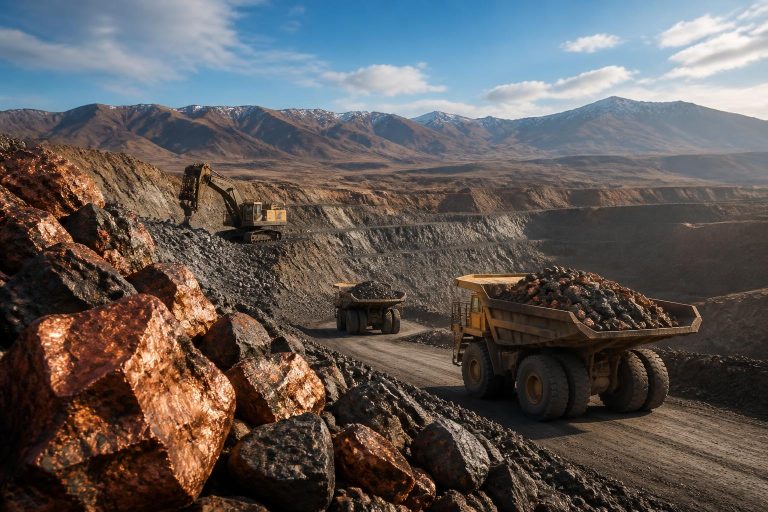
Tag: copper mining

  • Erdenet Mining Corp Embraces Digital Transformation for Sustainable Operations

    Erdenet Mining Corp Embraces Digital Transformation for Sustainable Operations

    Erdenet Mining Corp, located on the outskirts of Mongolia’s second-largest city, Erdenet, is undertaking a significant digital transformation to enhance its operations at one of the country’s largest porphyry-copper deposits. With an annual processing capacity of 32 million tons of ore, producing 130,000 tons of copper concentrate and over 10,000 tons of molybdenum concentrate, the company is focused on optimising its operations through innovative technology. The chief operations officer, Batmunkh, emphasises the necessity for innovation within the mining sector, stating that the company has established an Innovation Center aimed at modernising its practices to match global standards.

    Historically reliant on paper-based data, Erdenet faced challenges in resource estimation and decision-making due to the cumbersome nature of managing vast amounts of information. The introduction of Seequent software in 2018 marked a turning point, enabling the exploration department to model geology using Leapfrog Geo and process geophysical data with Oasis montaj. This transition to digital has significantly improved efficiency, allowing for near real-time access to insights and models via Seequent Central, a cloud-based data management solution.

    The digitisation of historical data has streamlined operations, reducing the time required for 3D design and resource estimation from months to mere hours. This advancement has fostered collaboration among the 32 departments within Erdenet, breaking down silos and ensuring that all teams can work together effectively. Senior geologist Amarzaya notes that the quality of work has improved, with manual errors reduced and tasks completed in a fraction of the time previously required.

    As a government-run entity, Erdenet is committed to providing accurate information to stakeholders, including investors and regulatory authorities. The integration of advanced mining software has enhanced the company’s ability to deliver precise data, facilitating better decision-making processes. Looking ahead, Erdenet is not only focused on operational efficiency but is also preparing for future challenges, including mine closure and environmental remediation. The Innovation Center is exploring advanced solutions for tailings and dam modelling, ensuring that Erdenet is well-equipped for sustainable mining practices in the years to come. With a projected operational lifespan of another 60 years, the future of Erdenet Mining Corp appears promising, driven by its commitment to innovation and sustainability.


  • Kazakhstan at PDAC 2026: The Next Major Frontier for Mineral Discoveries?

    Kazakhstan at PDAC 2026: The Next Major Frontier for Mineral Discoveries?

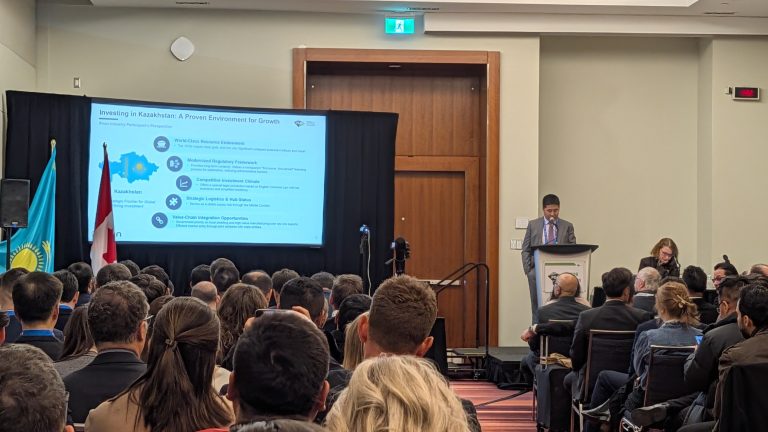
    This year marked a significant milestone as the Kazakhstan Chamber of Mines took the lead as the official organiser of Kazakhstan Day — and what a resounding success the debut turned out to be!

    Despite a packed PDAC schedule, the session drew an impressive crowd of over 130 industry leaders, investors, and exploration experts. The atmosphere in the room confirmed one thing: the global mining community is paying very close attention to Central Asia.

    MINEX Forum was proud to support the event as the Official Media Partner, capturing the insights that are shaping the next wave of exploration in the region.

    Key Highlights from the Plenary Session: The tone was set by Ruslan Baimishev, President of the Kazakhstan Chamber of Mines:

    “Kazakhstan is entering a new era of exploration — driven by robust reforms, international partnerships, and the soaring global demand for copper and critical metals.”

    We also heard high-level perspectives from H.E. Dauletbek Kussainov, Ambassador of Kazakhstan to Canada, and Iran Sharkhan, Vice-Minister of Industry and Construction.

    Expert Insights & Project Showcases: The technical session, “Unlocking New Discovery Potential in Kazakhstan,” featured a stellar line-up including Tim Barry (Arras Minerals), Charlie Liu (Zijin Mining), Simon Cooper (Pallas Resources), and world-renowned experts Anna Fonseca and Professor Jeffrey Hedenquist.

    The afternoon shifted to tangible opportunities, with project presentations from AMG Ltd, Kogadyr Gold, Taskora, and Muzbel. As Tim Barry aptly put it: “Kazakhstan offers unique opportunities for Canadian juniors to enter new jurisdictions — and the future looks bright.”

    Kazakhstan is no longer just a “prospective” jurisdiction; it is rapidly becoming the territory where the next big copper success stories are being written.

    Special thanks to the Kazakhstan Day partners:

    • General Sponsors: Aurora Minerals Group, NAC Kazatomprom, Pallas Resources.

    • Sponsors: Arras Minerals, TauGold Copper.

    Missed the session?  📺 Watch the session recordings and download expert presentations at:

  • Boliden Reviews Kevitsa Mine Operations After Finland Quadruples Mining Tax

    Boliden Reviews Kevitsa Mine Operations After Finland Quadruples Mining Tax

    Swedish mining group Boliden has launched change negotiations at its Kevitsa open-pit mine in northern Finland, a process that could affect up to 285 employees as the company reassesses operations following a significant increase in the country’s mining tax.

    Boliden said the review was triggered by the Finnish government’s decision earlier this year to quadruple the tax applied to metal ores. The levy is calculated based on the taxable value of metals, which is linked to international market prices.

    The Kevitsa mine, located north of Sodankylä in the Lapland region, is one of Europe’s largest nickel and copper operations. Boliden warned that the higher tax burden could undermine the competitiveness of large-scale mining projects in Finland.

    Tom Söderman, general manager of Boliden Kevitsa, said the company believes European mining of critical metals such as nickel and copper should be supported by stable and competitive long-term business conditions.

    According to the company, the tax increase has already forced it to suspend plans for a €1 billion investment programme intended to extend the life of the Kevitsa mine beyond 2034. The company also noted that contractors and service providers linked to the operation could be negatively affected if operational adjustments are implemented.

    The review comes despite Boliden reporting strong financial performance. The company posted profits of 9.4 billion Swedish kronor (approximately €879 million) in 2025, representing a net profit margin of around 10 percent.

    Industry observers say the development highlights growing tensions in Europe between efforts to strengthen domestic supply of critical minerals and policy decisions that may increase costs for mining companies.

  • EBRD Considers €55 Million Loan for Bulgaria’s Asarel Medet Copper Mine

    EBRD Considers €55 Million Loan for Bulgaria’s Asarel Medet Copper Mine

    The European Bank for Reconstruction and Development (EBRD) is reviewing a proposal to provide a loan of up to €55 million to Bulgarian copper producer Asarel Medet to support a major sustainability and renewable energy project.

    According to documents published on the lender’s website, the financing is expected to be considered for approval on 11 March. The funds would partially finance a €109.5 million investment programme focused on the development of captive solar power installations and the implementation of more sustainable copper mining practices at the company’s operations.

    The project also aims to bring the mine’s environmental and social standards in line with international best practices, reinforcing its long-term operational resilience and ESG performance.

    Part of the loan is expected to be backed by the InvestEU Fund, the European Union’s financial instrument that consolidates multiple centrally managed EU funding mechanisms, including the European Fund for Strategic Investments.

    Asarel-Medet operates near the town of Panagyurishte in southern Bulgaria and is the country’s leading open-pit copper mining company. The group employs around 1,200 people directly, along with an additional 400 staff in subsidiary companies.

    Ownership of the company is concentrated in VA Copper Invest Limited, a Malta-based investor holding a 63% stake as of September 2025, according to Trade Registry data.

    Financial results for 2024 show that the Asarel Medet Group generated revenues of 929.8 million levs, equivalent to approximately €480.8 million, and recorded an after-tax profit of 223.9 million levs. During the year, the company extracted 45.8 tonnes of ore mass and processed 15.03 tonnes of ore.

  • Development Bank of Kazakhstan Transfers Aktogay Project Financing to Halyk Bank Under New Investment Model

    Development Bank of Kazakhstan Transfers Aktogay Project Financing to Halyk Bank Under New Investment Model

    The Development Bank of Kazakhstan (DBK), a subsidiary of Baiterek Holding, has completed a landmark refinancing transaction for the Aktogay mining and processing complex, demonstrating a new model for attracting private capital into large-scale industrial projects.

    KAZ Minerals Aktogay LLP operates one of Central Asia’s крупнейших open-pit copper mines in the Abai Region. The complex includes two sulphide concentrators with a combined capacity of 50 million tonnes of ore per year, along with a cathode copper plant processing oxidised ore. The facility employs advanced mining and beneficiation technologies, including automated process control systems.

    DBK first financed the Aktogay project in 2016 during the high-risk construction and commissioning phase. With the Bank’s support, a second concentrator was built, doubling sulphide ore processing capacity from 25 million to 50 million tonnes annually and creating more than 2,100 permanent jobs. The initial financing facility has since been fully repaid, and the first phase of the project has reached its planned payback.

    In a significant next step, Halyk Bank refinanced the company’s outstanding debt to DBK, assuming responsibility for servicing the now operational and financially stable project. The transaction reflects a structured approach in which DBK assumes early-stage project risks, while commercial banks step in once operational performance and cash flows become predictable.

    According to Marat Yelibayev, Chairman of DBK’s Management Board, the refinancing frees up state development funds for new capital-intensive industrial projects, reinforcing an investment cycle in which DBK supports projects from inception to stability before transferring them to private lenders.

  • Polish Government Moves to Cut Copper Mining Taxes and Restructure Coal Sector

    Polish Government Moves to Cut Copper Mining Taxes and Restructure Coal Sector

    The Polish government has approved a draft amendment to the tax act on the extraction of certain minerals, designed to ease the tax burden on copper producers, government spokesman Adam Szłapka announced on Tuesday. The cabinet also adopted draft changes to the acts regulating hard coal mining and personal income tax, paving the way for a gradual restructuring of Poland’s coal sector.

    The Ministry of Finance, which prepared the proposal, said the reform aims to support copper producers as they invest in projects crucial for the energy transition, noting copper’s vital role in clean energy technologies. The tax reductions will be implemented in phases: in 2026, the coefficient used to calculate mineral extraction tax will drop from 0.85 to 0.74, followed by a further cut to 0.68 in 2027–2028.

    Earlier drafts of the legislation, presented in July, proposed even lower coefficients — 0.71 for 2026 and 0.64 for 2027–2028 — but these were adjusted during consultations. According to ministry estimates, the reduced rates will lower annual state revenues from copper and silver mining taxes by about PLN 0.5 billion (EUR 117.2 million) in 2026, and by PLN 0.75 billion (EUR 175.8 million) per year in 2027–2028.

    Separately, the draft amendment to the act on the functioning of hard coal mining and the personal income tax act will enable companies in the support system to gradually close down coal mines and pay social benefits to affected workers — a process previously blocked by legal constraints.

    The new regulatory impact assessment projects that closing down Poland’s hard coal mines over the next decade will cost PLN 11.275 billion (EUR 2.6 billion). Earlier estimates placed the cost between PLN 4.182 billion (EUR 980 million) and PLN 9.125 billion (EUR 2.1 billion).

  • Mining Turns to Waste Reprocessing, AI, and Bio-Tech to Meet Global Copper and Critical Metal Demand

    Mining Turns to Waste Reprocessing, AI, and Bio-Tech to Meet Global Copper and Critical Metal Demand

    The global pivot away from fossil fuels is creating unprecedented demand for copper and other critical minerals, but the mining industry faces a daunting challenge: falling ore grades, scarce new discoveries, and project timelines that can stretch over a decade. To bridge the gap, miners are reviving old waste, deploying advanced processing technologies, and turning to artificial intelligence.

    Between 1910 and 2010, an estimated 100 million tonnes of copper were discarded into tailings ponds, according to Germany’s Fraunhofer Institute. These legacy deposits are now being seen as a resource. Rio Tinto has already extracted scandium and tellurium from waste streams, while Hudbay Minerals is evaluating re-mining opportunities at its closed Flin Flon mine in Canada. Australia’s Cobalt Blue Holdings is studying pyrite tailings as a potential sulphur source, and India’s Hindustan Zinc has committed $438 million to process 10 million tonnes of tailings per year at its Rampura Agucha mine.

    At the same time, miners are working to reduce waste from new operations. Glencore’s ISAMill and Albion Process are enabling higher recovery rates with lower water use, while US bio-tech firm Allonnia has developed D-Solve, a microbial process that removes impurities like magnesium. At the Eagle nickel mine in the US, Allonnia is piloting a system that boosts nickel grades by 18% while cutting impurities by 40%.

    Artificial intelligence is becoming a central driver of efficiency. BHP uses generative AI and digital twin technology at its Escondida copper mine in Chile to optimize blasting, blending, and mill performance. Freeport-McMoRan, working with McKinsey, trialed AI at its Baghdad mine in Arizona, achieving a 5–10% increase in copper production. Rolling this out across its US operations could add 90,000 tonnes of copper annually — equivalent to a new $1.5 billion processing plant, but without the decade-long construction timeline.

    The push to reprocess waste, integrate bio-engineering, and apply AI represents a quiet revolution in one of the world’s oldest industries. If successful, it could transform mining from one of the planet’s most polluting activities into a cleaner, more efficient sector — ensuring that the energy transition has the metals it needs.

  • Uzbekistan’s AGMK Unveils Nation’s Largest Industrial Project in Copper Mining Sector

    Uzbekistan’s AGMK Unveils Nation’s Largest Industrial Project in Copper Mining Sector

    Uzbekistan’s Almalyk Mining and Metallurgical Complex (AGMK) recently hosted journalists on an exclusive press tour to showcase progress on the largest investment project in the country’s history, signaling a major leap in industrial development.

    The tour began at AGMK’s Engineering School, which trains specialists in geology, mining, metallurgy, and automation using methodologies from world-leading institutions like Germany’s Freiberg University of Technology. “We’re not just building factories—we’re cultivating the talent to run them,” said Behzod Salimov, the school’s director.

    Reporters then visited the Kalmakyr deposit, one of the world’s largest copper reserves, followed by the Yoshlik I mine, a gold-rich copper deposit spanning 4 km long and 235 meters deep. The site employs 400 heavy machines and has introduced an innovative conveyor system, cutting ore transport costs by 30%.

    A highlight was Copper Processing Plant No. 3, under construction since 2021 on a 200-hectare site. Once operational, it will process 60 million tons of ore annually, producing 894,000 tons of copper concentrate. Plans are also underway for Plant No. 4 and a new metallurgical complex, expected to create thousands of jobs.

    Tashkent Region Governor Zoir Mirzaev emphasized the project’s global significance, noting rising copper demand. AGMK Chairman Abdulla Khursanov added that the $multibillion investment is boosting Uzbekistan’s economic appeal, with several countries expressing interest in partnerships.

    The project is also spurring growth in auxiliary industries, including six new metalworks plants and a lime factory in Jizzakh to supply reagents.

    Sherzodkhon Kudratkhodja, head of Uzbekistan’s National Media Association, remarked: “This proves Uzbekistan can build its industrial future independently.”

  • East Star Resources Discovers Potential Copper and Gold Reserves in Kazakhstan

    East Star Resources Discovers Potential Copper and Gold Reserves in Kazakhstan

    British company East Star Resources Plc has reported the discovery of additional potential copper and gold reserves at the Verkh-Uba, Snezhnoye, and Talovskoye exploration sites in Kazakhstan, with Verkh-Uba identified as the most promising deposit.

    “Recent exploration work has yielded encouraging results across both of our current operational areas. The findings at Verkh-Uba demonstrate that we are advancing this already significant copper asset while refining other targets, including Talovskoye, for near-term drilling. Additionally, the discovery of a large epithermal gold deposit at Snezhnoye, constrained by old artisanal gold workings, is undoubtedly exciting,” said East Star CEO Alex Walker.

    East Star, which has been operating in Kazakhstan for over three years, expressed optimism that 2025 would mark significant progress in all three exploration projects.

    As of February 4, the company completed drilling three boreholes at Verkh-Uba, each confirming copper deposits beyond previously explored areas. All 238 core samples have been sent to ALS in Karaganda for analysis, with results expected by the end of February. Furthermore, satellite data revealed a substantial gold-in-soil anomaly measuring four by one kilometer at the Snezhnoye site.

    Drilling at Verkh-Uba commenced on November 12, 2024, and paused for the winter break on December 19, 2024. Based on analysis results, the company will determine whether to proceed with additional drilling in 2025 and assess the potential for substantial reserves. If viable, East Star may initiate open-pit mining operations.

    Verkh-Uba remains the company’s most promising project, with a preliminary JORC-compliant resource estimate of 20.3 million tonnes containing 1.16% copper, 1.54% zinc, and 0.27% lead. East Star Resources is listed on the London Stock Exchange under the ticker EST.

  • Dundee Precious Metals (DPM) Preliminary Production Results for 2024

    Dundee Precious Metals (DPM) Preliminary Production Results for 2024

    Dundee Precious Metals Inc. (TSX: DPM) reported its preliminary gold and copper production for Q4 and FY 2024. Both Chelopech and Ada Tepe mines achieved their annual production guidance, marking DPM’s tenth consecutive year meeting gold production targets.

    Chelopech processed 2,143.7 Kt of ore, producing 167,000 ounces of gold and 29.7 million pounds of copper for the year, while Ada Tepe processed 772.4 Kt, yielding 94,300 ounces of gold. Consolidated annual production totaled 261,300 ounces of gold and 29.7 million pounds of copper. The Q4 results were highlighted by Ada Tepe’s strongest quarter with 29,000 ounces of gold produced.

    Additionally, DPM concluded a tolling agreement, receiving $162M from Sinomine Resource Group, and maintained capital returns through share repurchases ($50M in 2024) and dividends ($0.04/share payable January 15, 2025).