Tag: chromium

  • Chinese investor plans ferrochrome processing project in Kazakhstan’s Aktobe region

    Chinese investor plans ferrochrome processing project in Kazakhstan’s Aktobe region

    Chinese ferrochrome producer Suzhou Hunan New Materials is planning to implement an investment project in Kazakhstan’s Aktobe region focused on the deep processing of chromite ores.

    The initiative was discussed during an official visit to Shanghai by Abzal Abdikarimov, deputy akim of the Aktobe region, who held talks with the company’s management. Following the meeting, the parties signed a memorandum of cooperation aimed at establishing advanced chromite processing facilities in the region.

    The project is designed to be implemented in two stages. The first phase предусматривает construction of a chromite concentrate processing plant with an investment volume of $150 million. At the second stage, the project will expand to include processing of metallic chromium, increasing the depth of value addition.

    Representatives of Suzhou Hunan New Materials said during the talks that the company is ready to move forward with the practical implementation of the project and to continue cooperation with Kazakhstan’s national and regional authorities.

    The Aktobe region hosts the South Kempirsai chromite deposits, an area that ranks second globally in terms of confirmed chromium reserves. Most of the chromite ore mined in the region is currently processed by the Aktobe and Aksu ferroalloy plants operated by Kazchrome.

  • Outokumpu to Build $45 Million Pilot Plant in U.S. to Scale Up Sustainable Chromium Production

    Outokumpu to Build $45 Million Pilot Plant in U.S. to Scale Up Sustainable Chromium Production

    Finland’s Outokumpu, Europe’s largest stainless steel producer, announced plans to invest $45 million in a new pilot plant in New Hampshire, marking a major step toward industrial-scale production of low-carbon, high-purity chromium materials. The facility is scheduled to begin operations in the first half of 2027, the company said.

    The investment follows the establishment of a research laboratory near Boston in 2024, where Outokumpu developed and tested proprietary technology over the past four years. The company has successfully scaled production of enriched ferrochrome and chromium metal from laboratory scale (1 g) to pre-pilot scale (1 kg).

    The pilot plant will aim to prove the industrial feasibility and scalability of this process by increasing daily output from 1 kg to 1 ton. It will produce two high-value materials:

    • Enriched ferrochrome with 65% chromium content, and

    • Chromium metal with more than 90% chromium content.

    If successful, Outokumpu plans to follow up with the construction of a full-scale industrial plant capable of producing 10,000 tons per year between 2029 and 2030, unlocking the full commercial potential of its proprietary technology by 2030.

    The company’s new process promises a significantly lower carbon footprint compared to conventional methods, while creating opportunities to supply premium-grade chromium materials for aerospace, defense, and energy sectors, where demand for sustainable, high-performance metals is growing rapidly.

    “Backed by years of research, we are leveraging proprietary technology targeting premium-priced, high-purity metals essential for demanding sectors,” said Stefan Erdmann, Outokumpu’s Chief Technology Officer. “With limited Western supply and growing demand, we see a significant market opportunity for sustainable, high-performance materials.”

  • China Imports Up to 70% of Critical Metals from Central Asia

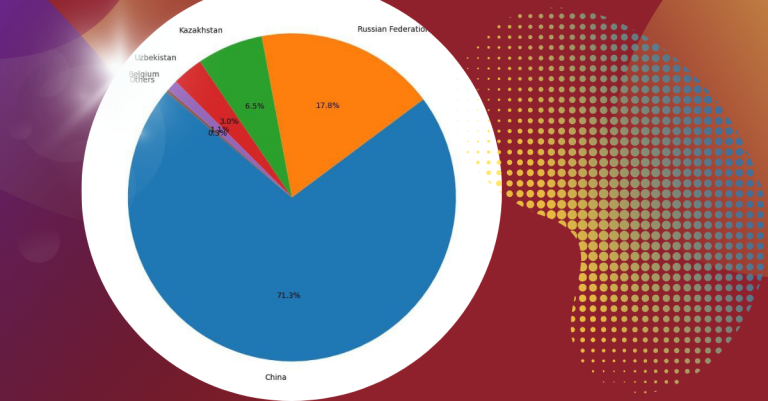
    China Imports Up to 70% of Critical Metals from Central Asia

    Despite the lack of official data on the export of rare earth metals by Central Asian countries, an analysis of ore, slag, and ash exports reveals interesting trends. These exports often include critical resources highly sought after by leading global powers, particularly metals such as molybdenum, titanium, and vanadium.

    According to Trademap.org data from 2019 to 2023, Central Asian countries exported a wide range of ores and concentrates, including copper, iron, precious metals, zinc, lead, molybdenum, chromium, and niche metals such as niobium and tantalum.

    In recent years, the market has also seen the introduction of products such as tin, tungsten, and titanium ores. For example, copper ore exports showed stable growth—from approximately $1.17 million in 2019 to around $3.15 million in 2023. Iron ore peaked at $1.6 million in 2021 before experiencing a decline in export volumes in subsequent years.

    One notable trend is the significant increase in molybdenum ore exports, which surged from about $4 million in 2019 to approximately $144 million in 2023. This is a clear reflection of increased global demand and investment.

    An analysis of trade with the European Union under the category “26 Ores, Slags, and Ash” shows that molybdenum stands out: its exports increased from around $11 million in 2021 to nearly $60 million in 2023. In this segment, Kazakhstan holds a dominant position, providing nearly the entire cumulative export value, while contributions from other Central Asian countries remain significantly lower.

    Central Asian countries’ export portfolios reveal a trend towards transitioning from traditional raw materials such as copper and iron to more valuable niche ores, especially molybdenum. This trend is evident both in the global market and in trade with the European Union, where Kazakhstan acts as a key supplier.

    Will the European Union be able to position itself as a key importer of critical metals from Central Asia? The future will tell.

  • Chromium Leads Albania’s Mining Sector in Production and Permits

    Chromium Leads Albania’s Mining Sector in Production and Permits

    Chromium continues to be the mineral with the greatest weight in Albania in terms of the number of permits granted for exploitation, as well as the quantity produced. The annual publication by the National Agency of Natural Resourcesreveals that a total of 920 thousand tons of chrome were produced in 2023, primarily for export.

    Albania is known for its significant potential in chrome ore compared to other Mediterranean and Balkan countries,” the report states. As of December 31, 2023, there were 236 active exploitation licenses in the chrome mining sector. Production activities are concentrated in the Bulqiza district, with around 120 active permits, followed by Kukës, Tropoja, and Hasi.

    By the end of 2023, 920,769.98 tons of chrome ore were produced, mainly for export. The main chromium deposits are located in the Ophiolites of the Eastern Belt area, stretching from Tropoja and Kukës to Bulqizë, Shebenik, and Pogradec. Lesser development has been identified in the ophiolites of the western belt.

    Geologically, chrome ore in Albania is found in three main regions:

    • Northeast Region (Ultrabasic Massif of Tropoja and Kukës);
    • Central Region (Ultrabasic Massif of Bulqiza and Lura, which is the most important);
    • Southeast Region (Shebenik-Pogradec Ultrabasic Massif).

    The publication also notes that in 2023, there were 552 active usage permits, mainly in Bulqiza, Krujë, Berat, Tirana, or Librazhd. Besides chrome, which holds the majority of active permits, limestone ranks second with 137 permits, according to the National Agency of Natural Resources.