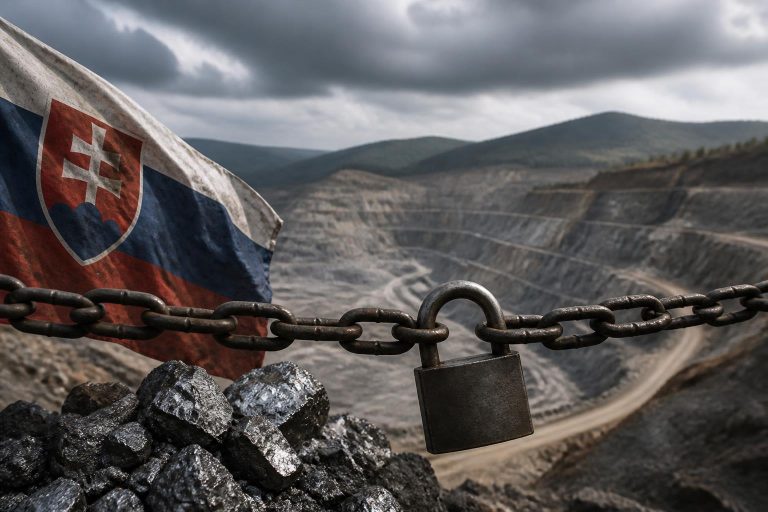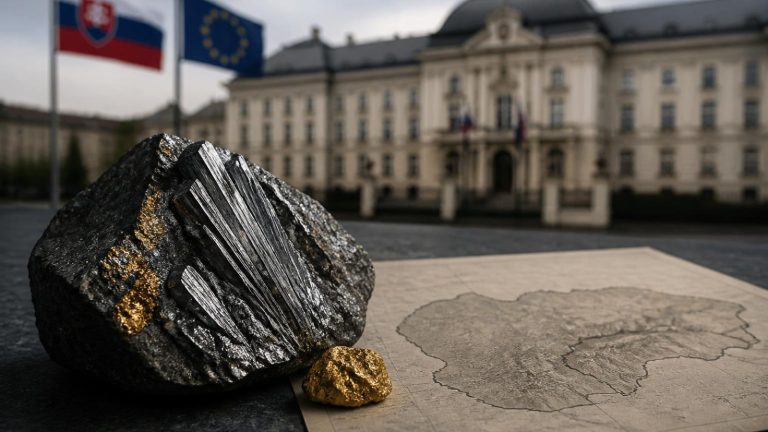
Slovakia’s decision to cancel the exploration license for the Trojarova Antimony-Gold Project has ignited a significant political and economic crisis. The project, located in the Small Carpathian mountains, was poised to become Europe’s largest compliant antimony resource, with an independent estimate of 67,000 tonnes of contained antimony and 222,000 ounces of gold. This cancellation, executed by the Slovak Environment Ministry, has not only sent shockwaves through the market, causing Military Metals Corp’s share price to plummet by 43%, but it has also raised alarms about Europe’s strategic autonomy in critical mineral supplies.
The abrupt cancellation was justified by the ministry on environmental and public health grounds, but many see it as a politically motivated move amidst a turbulent domestic landscape. The Slovak government is facing internal strife, with Environment Minister Tomáš Taraba under pressure from his own party and opposition. In a bid to bolster his political standing, Taraba has leveraged the cancellation as a way to position himself as an eco-friendly leader, despite previously supporting the project.
The geopolitical implications of this decision are profound. Antimony is crucial for military applications and high-tech industries, and the Trojarova project was expected to supply up to 30% of Europe’s demand. The cancellation not only jeopardises this supply but also highlights the fragility of Europe’s critical mineral supply chains, which are under increasing scrutiny as the continent seeks to enhance its military capabilities.
Military Metals Corp is not taking the cancellation lightly and has initiated legal actions to challenge the decision. The company argues that the project was included in Slovakia’s National Program for the Exploration of Critical Mineral Raw Materials, which contradicts the ministry’s sudden reversal. This situation illustrates the complexities of navigating regulatory environments where political agendas can override economic necessities.
As the political landscape in Slovakia continues to evolve, the outcome of this legal battle will be closely watched by investors and industry stakeholders alike. The stakes are high, not just for Military Metals Corp, but for Europe’s broader ambitions to secure its own critical mineral resources amidst growing global competition.
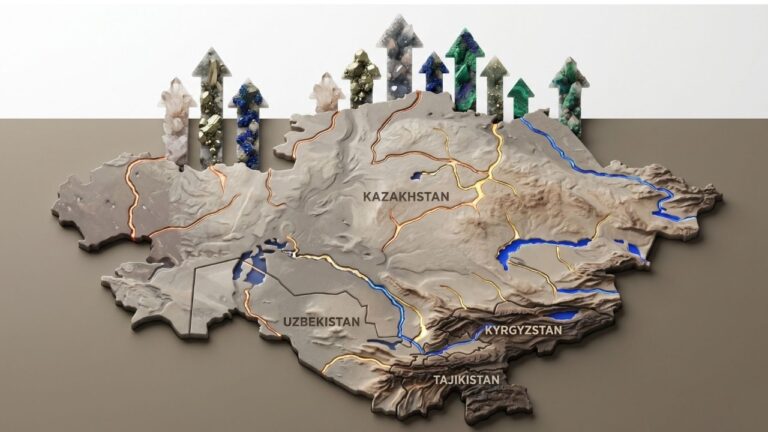
Central Asia and Mongolia will remain resilient to geopolitical shocks and record the highest growth rates of the EBRD countries of operation in 2026 and 2027, according to the latest Regional Economic Prospects report published on 3 June 2026, by the European Bank for Reconstruction and Development (EBRD). The combined economies of Kazakhstan, the Kyrgyz Republic, Mongolia, Tajikistan, Turkmenistan, and Uzbekistan are projected to grow by 5.6% in 2026 and 5.3% in 2027.
These are compelling headline figures. Yet beneath them lies a more consequential story—one that the OECD’s March 2026 report, Advancing Security and Transparency for the Governance of Critical Raw Materials in Central Asia, articulates with rare precision: the region is not merely growing; it is repositioning itself at the very heart of the global critical raw materials race.
The mining sector is no longer a background variable in Central Asia’s development story. It is the plot itself.
MINEX Asia 2026 is where it gets real. Join EBRD and OECD peers presenting on Kazakhstan’s scale, Tajikistan’s green pivot, Uzbekistan’s processing ambitions—and the governance gaps that determine success.
The Regional Narrative: Resilience With Structural Depth
Growth prospects remain robust but are increasingly dependent on the pace of domestic reforms and efforts to strengthen resilience to external shocks. Strong domestic consumption, rising real wages, and robust capital investment are real. But so are the fault lines: downside risks include energy price volatility, supply-chain disruptions, economic sanctions, and slower growth in the region’s largest trading and economic partners, Russia and China.
The OECD note adds a structural dimension that the growth forecasts alone cannot convey. Central Asia’s substantial yet untapped resource base, combined with its location between major markets in Europe and Asia, raises the region’s relevance in CRM geopolitics and efforts to diversify global supply chains. This is a geostrategic statement. The region holds extraordinary assets: Kazakhstan, already the world’s largest producer of uranium, produces and processes around twenty of the 34 CRMs included on the European Union’s official list. The Kyrgyz Republic and Tajikistan both host some of the world’s largest antimony reserves. Uzbekistan possesses some of the largest copper reserves globally and is advancing lithium and molybdenum production.
Taken together, these endowments amount to a critical minerals portfolio of exceptional strategic depth. Whether the region can translate that portfolio into durable prosperity is the central question of the coming decade.
Country by Country: Where the Headlines Don’t Tell the Full Story
Tajikistan: Gold and Strategic Minerals
Tajikistan’s economic performance continues to confound those who underestimate it. In March 2026, Moody’s upgraded Tajikistan’s sovereign credit rating to B2 with a stable outlook, citing the country’s continued economic resilience. The EBRD projects growth easing to 7.9 per cent in 2026 — still remarkable for a landlocked, remittance-dependent economy navigating elevated regional volatility.
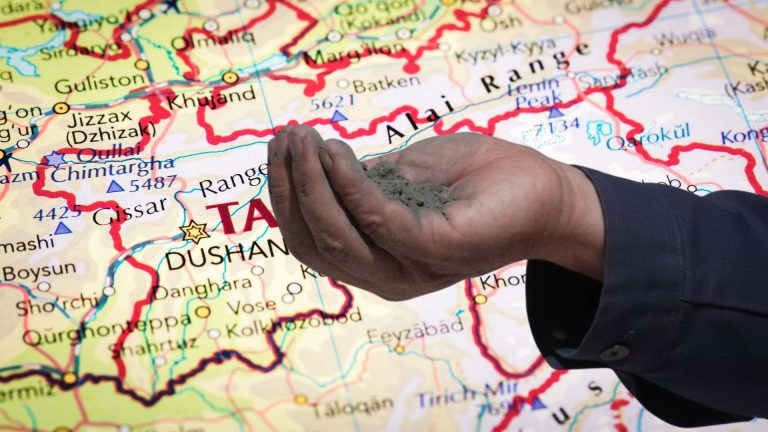
The mining dimension is crucial. Gold remains the cornerstone of export revenue and fiscal stability, and Tajikistan’s antimony sector is poised for a structural step-change. Tajikistan possesses the world’s second largest antimony reserves, and China’s effective ban on antimony exports to the US and EU provides a significant window of opportunity. Together, France and Belgium accounted for 77% of Tajikistan’s antimony exports in 2024. With TALCO nearing completion of a new antimony metallurgical plant, Dushanbe is finally beginning to capture processing value rather than simply shipping raw material.
But what I find most intriguing about Tajikistan’s trajectory is the emerging convergence of green energy and artificial intelligence with its mining ambitions. The Rogun Hydropower Project — set to have an annual capacity of over 3,600 megawatts once fully operational — would cover most of Tajikistan’s domestic consumption and create the conditions for green aluminium production, with approximately 70 per cent of output earmarked for export to Kazakhstan and Uzbekistan. Cheap, clean electricity is not merely an industrial asset — it is the foundation for competitive mining, smelting, and increasingly, data infrastructure.
Tajikistan has initiated groundbreaking infrastructure projects, including the launch of “Area AI” — the world’s first dedicated AI Zone — a technopark and cluster designed to serve as a hub for research, development, and application of AI technologies. The country has forged partnerships with international tech firms including Perplexity AI, Google DeepMind, Yotta and Presight to accelerate technology transfer and innovation. The government has declared 2025–2030 the “Years of Digital Economy and Innovation Development.” Taken alongside the Rogun-powered industrial ambitions, this is Tajikistan’s bid to become not just a minerals supplier but a genuinely integrated green industrial economy — using AI and clean energy together to escape the extractive trap.
The key vulnerability remains Tajikistan’s dependence on Russia, where a slowdown would depress the remittance inflows that underpin household incomes. That risk is real and should not be minimised. But the strategic direction of travel is clear — and it is more ambitious than most Western observers appreciate.
Kyrgyzstan: The Kumtor Imperative and Exploration Needs
Kyrgyzstan remains the region’s most dramatic case study in resource-dependent growth. Kumtor Gold Company — nationalised in 2022 after nearly three decades of Canadian stewardship — generated net profit exceeding USD 706 million in 2025, contributes 10–15 per cent of GDP, and represents nearly two-thirds of the country’s mineral exports. The March 2025 discovery of an additional 147 tonnes of gold reserves extended the mine’s productive life to at least another 17 years.
Underground mining operations, launched in August 2025, are transformative. At current gold prices hovering above USD 4,500 per ounce, Kumtor’s economics are exceptional — and the government’s plan to process tailings estimated to contain over 100 tonnes of gold adds further upside. Fixed capital investment rose by 25.5 per cent year on year thanks to strong investment in infrastructure, energy and housing.
Yet the near-term outlook has darkened. The European Union’s 20th sanctions package, announced in late April, restricts exports of dual-use goods to Kyrgyzstan and tightens controls on its financial and logistics sectors. The EBRD has revised its 2026 growth forecast down to 8.7 per cent as a result. This is a significant geopolitical constraint on what would otherwise be an exceptionally strong growth story — and it underscores the OECD’s broader finding that regulatory unpredictability and governance gaps impose real costs on the region’s investment attractiveness.
The OECD note also flags a structural vulnerability that sits beneath the Kumtor euphoria: limited exploration since independence means that the Kumtor mine, accounting for 90% of the Kyrgyz gold exports, is set to close in 2031 due to reserves depletion — and the lack of exploration since independence will make it harder to offset this decline quickly. The reserve discovery of 2025 has bought time but not resolved the underlying fragility.
Kazakhstan: Scale, Strategy, and Industrial Output
Kazakhstan’s mining profile is defined by scale and global strategic significance. The country holds the world’s largest chromium reserves, accounts for roughly 40 per cent of global uranium output, and produces massive quantities of refined copper, largely exported to major industrial buyers like China and Türkiye.
Graphite is a high-potential sector for Kazakhstan. With the exploitation of its Sarytogan deposit — added to the EU’s list of strategic raw material projects and reported to contain 30% of the world’s graphite reserves — Kazakhstan is expecting to become a crucial player on the world graphite market.
The tungsten story is equally striking. Kazakhstan holds roughly 2 million tonnes of tungsten resources out of approximately 3.6 million tonnes of global reserves. A joint venture between Kazakhstan’s Tau-Ken Samruk and US-based Cove Kaz Capital Group has been formed to develop the Severniy Katpar tungsten project, with the US International Development Finance Corporation issuing Letters of Interest for up to USD 700 million in potential financing — marking Washington’s most significant entry yet into the region’s critical minerals sector.
Yet the near-term picture carries a real cautionary note. In Kazakhstan, the extractive industry contracted by 11.4 per cent year on year in Q1 2026 following disruptions to the Caspian Pipeline Consortium pipeline and an incident at the Tengiz oil field. The EBRD projects Kazakhstan’s GDP growth moderating to 4.7 per cent in 2026 and 4.5 per cent in 2027 — the lowest in the region, reflecting the inherent vulnerability of commodity-led economies to infrastructure and logistics shocks.
Uzbekistan: The Ambitious Reformer
Uzbekistan’s ambitions deserve particular attention. The country is the world’s fifth-largest uranium supplier, a top-ten gold producer, and is rapidly positioning itself as a critical minerals investment destination. Uzbekistan has actively signed Memorandums of Understanding with Western partners, including the United States, for securing supply chains in the mining and processing of Critical Minerals and Rare Earths. The government has also launched massive industrial initiatives to bolster its critical minerals sector.
The Almalyk Mining and Metallurgical Complex (AMMC) and its specialised subsidiaries targeting tungsten, molybdenum, rhenium, lithium, and graphite signal a genuine strategic shift from raw extraction towards value-added processing. Whether governance and transparency standards keep pace with ambition will be the decisive variable.
The Structural Challenge: From Resource Extraction to Value Creation
Both the EBRD and the OECD converge on a single, uncomfortable truth: Central Asia’s growth is impressive, but its mining sectors remain structurally exposed. The OECD note identifies several systemic vulnerabilities that macro-growth figures obscure.
On reserves reporting: Most countries still operate on Soviet-era GKZ classification systems that differ fundamentally from international CRIRSCO standards — creating information asymmetries that deter sophisticated investors and complicate due diligence. Kazakhstan has made progress through its KAZRC system; other regional peers have barely started.
On foreign investment dynamics: Foreign actors, predominantly Chinese, actively invest in Central Asia’s mining industry. China has been a primary investor in the mining sectors of the Kyrgyz Republic and Tajikistan, and is increasing its presence in Kazakhstan and Uzbekistan, not only by investing in extraction facilities but also by supporting the development of initial processing capabilities. This creates a strong strategic dependency that the region’s governments are increasingly aware of — and that Western partners, including the EU, UK, and US, are now actively looking to balance through alternative commercial partnerships.
On the Trans-Caspian International Transport Route (TITR): Traffic along the corridor (the Middle Corridor) has increased dramatically as exporters seek reliable East–West trade alternatives. Kazakhstan in particular has long relied on the corridor for its mineral, chemical, and agricultural exports, with a substantial portion of its uranium exports to Western markets utilising this bypass route. This corridor is central to the region’s ability to diversify export markets.
On ESG and governance: The OECD is frank: mining in the region is still heavily influenced by large state-owned enterprises with overlapping regulatory and commercial roles, needing stronger occupational health and safety oversight and remediation of legacy environmental risks. These are not peripheral concerns — they are the conditions on which Western investment and international supply chain partnerships will ultimately be conditioned.
The Strategic Opportunity
The OECD projects global demand for many critical raw materials to increase multifold over the coming decades to meet the needs of the green and digital transitions. Central Asia sits atop a significant share of the reserves that will need to come online to meet that demand. The region holds massive global shares of manganese ore, chromium, lead, zinc, titanium, aluminium, copper, cobalt, and molybdenum.
That is an extraordinary endowment. Translating it into durable prosperity requires three things that remain in genuinely short supply across the region: transparent governance, world-class ESG practice, and the institutional capacity to negotiate from strength with both regional and global partners.
This is precisely why platforms like the MINEX Forum matter. The conversation between producers, investors, policymakers, and development finance institutions that happens at these gatherings is not peripheral to the critical minerals agenda. It is where the terms of engagement are shaped.
Conclusion: Cautious Optimism, Clear Conditions
The EBRD’s projection of robust regional growth is credible. The OECD’s assessment of the region’s critical minerals potential is genuinely exciting. But both institutions are equally clear-eyed about the conditions that must be met for that potential to be realised responsibly.
Central Asia’s mining sectors are not simply economic contributors. They are strategic assets in the most consequential industrial transformation of our era. Their management — balancing extraction with environmental stewardship, concentrating revenue into productive capital formation, building institutional capacity, and securing diversified partnerships — will determine whether current growth translates into sustainable prosperity or rehearses the resource curse that has constrained other commodity-rich regions.
The next chapter will be written in mining offices, government ministries, and international forums across Dushanbe, Bishkek, Astana, Tashkent, and Ulaanbaatar. We should be not merely watching — we should be in the room.
References:
Central Asia and Mongolia to see highest economic growth in the EBRD regions
Arthur Poliakov is the Managing Director of the United Kingdom-based company Advantix Ltd and the Executive Chairman and founder of the MINEX Forum. He has over 30 years of experience in international business communications, event management, and natural resource markets.
He is currently organising the upcoming 12th MINEX Asia Forum (24–25 June 2026, Ankara, Turkey), the 10th MINEX Europe Forum (28–30 October 2026, Trim, Ireland), and the 14th MINEX Eurasia Conference (30 November 2026, London, United Kingdom).
Kazakhstani junior exploration company Qaz Aurum is advancing a diverse portfolio of antimony, copper and gold projects across several regions of the country, driven in part by geopolitical shifts that have dramatically elevated the strategic value of the minerals it is chasing, the company’s director Takhir Kaliyev told the Geoscience and Exploration Central Asia forum in Astana.
At the Karasuk antimony project in Aktobe Region, historic data points to high-quality mineralisation averaging 6.5% antimony, with peak grades reaching as high as 31% at individual occurrences. The project hosts two mineral showings separated by a tectonic fault which the company believes could host additional resources. All preparatory work has been completed, geophysical surveys and prospecting traverses are planned, and Qaz Aurum says it is ready to begin drilling at Karasuk this year. Antimony — a metalloid that hardens alloys and has critical applications in defence, flame retardants and battery technology — has surged in strategic importance following China’s export restrictions on the material.
On copper, the company is active at the Egemen porphyry copper project near the settlement of Shortandy in Akmola Region, which benefits from well-developed existing infrastructure. Of 17 drill holes completed to date, 16 have intersected ore-grade mineralisation. The mineralised strike extends approximately two kilometres with widths of up to 300 metres, and the deposit also contains molybdenum. Historical surveys conducted in the 1970s estimated copper potential at 10 million tonnes across the broader area, while Qaz Aurum has so far delineated 370,000 tonnes of copper equivalent in resources. Drilling and metallurgical testing are planned over the next two years, and the company is actively seeking investors to support the programme given current funding constraints.
The most advanced project in the portfolio is the Ungyrtas gold deposit, located 70 kilometres from Almaty. Qaz Aurum describes it as a high-grade, bonanza-style system — sample grades have exceeded 100 grams of gold per tonne in multiple instances, with a peak assay of 789 grams per tonne. A preliminary resource block modelled in Micromine returned an average grade of 19 grams per tonne over a 50-metre intersection. Metallurgical testwork using gravity separation and cyanidation has achieved gold recovery of 85.6%. The company has already reached an agreement with a processing plant located 70 kilometres away, allowing ore to be delivered without the need for capital-intensive on-site processing infrastructure. Drilling is planned for this year, with a resource estimate to follow, and the company intends to apply for a mining licence in 2026 with production targeted to begin the following year. Investor discussions are also underway for Ungyrtas.
In addition, Qaz Aurum is in the process of securing fresh exploration licences in the northern Pribalkhashye region, targeting copper and gold mineralisation. Following the forum, company geologists were set to travel to the area on a week-long field expedition to verify mineralisation described in historic geological reports, ahead of planned geophysical, geochemical and drilling programmes.
The past year was marked for Tajikistan’s extractive industry not by major new discoveries, but by a series of significant contracts and project announcements shaping development plans for the coming years. Several large initiatives across antimony, iron ore, gold, coal and lithium were either launched or confirmed.
In July 2025, construction began on a mining and processing plant at the Pakhandara antimony deposit in the Sughd region, located at an altitude of about 3,000 meters above sea level. The project is scheduled for completion by 2027. The license for both open-pit and underground mining is held by Pakhandara Mining, while HKSkyline Development Limited is acting as the contractor. Once operational, the plant is expected to process more than 150,000 tonnes of ore annually and produce around 5,000 tonnes of antimony.
The same month also saw the commissioning of several other facilities, including a new antimony processing plant operated by ARB Minerals Group, the second phase of the TVEA Dushanbe gold mining enterprise, and the Angishti Takht coal beneficiation plant.
In December, the Tajik Metallurgical Plant signed an agreement with the government to build an iron ore mining and processing facility, using deposits located in the Sughd region as its raw material base. The first phase of the project is set to be launched in 2027, with the second phase planned for 2031. The design capacity of the complex is 2.5 million tonnes of ore and 1.1 million tonnes of iron ore concentrate per year.
At the International Mining and Metallurgical Forum of Tajikistan held in Dushanbe in December, officials also announced the construction of a lithium plant in the country, although further details of the project have not yet been disclosed. During the same event, it was stated that around 800 prospective mineral deposits have been identified nationwide, while just over 100 sites covering 50 types of mineral raw materials are currently involved in active development.
Tajikistan holds deposits of 10 out of 12 metals critical for the global energy transition, with six already being mined, Minister of Industry and New Technologies Sherali Kabir said at the Dushanbe 2025 International Investment Forum, according to Asia-Plus.
Kabir outlined the government’s vision for Tajikistan to become an active player in the global rare earth supply chain, emphasizing that the country was once a hub for rare earth production within the former Soviet Union. Of the three rare earth processing plants that existed in the USSR, two were located in Tajikistan and one in Russia.
Authorities are now in talks with international partners to modernize these facilities, with Kabir noting that the government expects “very good results” from these negotiations in the near future.
Tajikistan is also doubling down on antimony, one of its most abundant resources. The country ranks second globally in terms of antimony reserves. Four new processing plants are in the pipeline, at various stages ranging from feasibility studies to construction.
The minister also highlighted the growing copper industry, confirming that domestic production has already begun and that the government plans to significantly expand output by attracting foreign investment.
Kabir further revealed that Tajikistan has large deposits of nickel and lithium ores, adding that the country’s ambition is to become the first among CIS nations to launch lithium production — a crucial material for batteries and clean energy technologies.
In Tajikistan’s mountainous heartland, the Soviet-era Saritag antimony mine stands testament to China’s growing influence in Central Asia. Run by the joint venture Talco Gold, a collaboration between Tajik and Chinese companies, the mine produces over 5,000 tonnes of antimony concentrate daily, crucial for many industrial applications. The ore is crushed, ground in large drums, and then separated from the metal using chemical reagents before being dried and bagged as 30% pure antimony. This large-scale operation was made possible by a significant Chinese investment in 2022, which is now being followed by the construction of a new purification plant.
Pictures of Tajikistan’s long-time President Emomali Rakhmon coexist with portraits of Chinese leader Xi Jinping on posters juxtaposing the country’s past with its present economic reality. While remnants of the Soviet era remain, China has overtaken Russia as the dominant power in the region’s crucial mining sector.
The full potential of the mine is yet to be unlocked. China’s ambitious $359 million project aims to build a state-of-the-art purification plant on the site, allowing for even greater control over the antimony production chain.
The Chinese investment, pouring in, signals a strategic move to secure access to vital resources and cement political ties. While offering much-needed economic boost to Tajikistan, it raises concerns about resource dependence and potential environmental consequences.
This narrative paints a picture of delicate balance: economic prosperity coupled with increasing reliance on a single partner, leaving Tajikistan to navigate the complex landscape of China’s expanding geopolitical footprint in Central Asia.
The European Union is well-positioned to weather, and potentially even benefit from, China’s new export controls on the critical raw material antimony, despite the measures causing a massive shock to global markets. A new policy brief from the European Commission’s Joint Research Centre (JRC) reveals that the EU’s strategic diversification of its supply chain has largely insulated it from the direct impact of the controls, which sent prices soaring by more than 170%.
The report, “China’s Antimony Export Controls: Risks and Opportunities for the EU,” analyzes the fallout from China’s decision, effective September 15, 2024, to require dual-use export licenses for antimony and its products. The material is vital for defense applications—including armour-piercing rounds and night-vision equipment—as well as flame retardants, electronics, and batteries.
The announcement immediately roiled the market, with the price of antimony metal surging from approximately 38,000 per tonne in September. The report describes this dramatic price jump as a reflection of “severe market disruptions, supply chain concerns, and potential shortages.”
However, the JRC analysis concludes that the EU’s exposure is limited, thanks to years of proactive efforts to reduce its dependency on China.
Key findings from the report include:
Diversified Supply Chains: While the EU is 100% reliant on imports for antimony ore, its primary supplier is Turkey (77%), not China. For antimony metal, the EU has dramatically shifted its sourcing, with Tajikistan now providing 52% of its imports. China’s share of the EU’s metal imports has fallen from 40% in 2020 to just 18% in 2023.
The US is More Exposed: The report highlights that the United States is far more vulnerable to the new regulations. China supplies 44% of US imports of antimony oxides—a refined product used in flame retardants and catalysts—compared to just 5% of EU imports.
An Opportunity for EU Exporters: The EU is a net exporter of high-value antimony oxides, producing 28,000 tonnes annually. The report suggests that if Chinese supply to the US and other markets is disrupted, EU producers could step in to fill the gap. “If European producers can secure stable antimony metal supplies, the EU may have an opportunity to expand exports,” the brief states.
The report concludes that the EU’s strategic foresight in diversifying its critical mineral sources has turned a potential supply chain crisis into a manageable situation with a potential upside. While the dramatic price increase will affect all global users, the EU’s direct reliance on China is minimal, placing it in a resilient position compared to other major economies.
Iran’s state-owned metals and mining company, IMIDRO, has announced the discovery of antimony, a rare metalloid with critical applications in technology and military industries, across multiple locations in the country. According to a report cited by Fars News Agency on Wednesday, the company invested a decade in exploration projects, uncovering approximately 7,000 metric tons (mt) of antimony reserves in eight regions.
The largest deposit was identified in the southeastern province of Sistan and Baluchestan, which is estimated to contribute 10% of the global supply of antimony. This discovery comes at a time when global demand for antimony is surging, driven by its growing use in solar panel manufacturing and the production of sensitive military equipment.
Antimony is primarily used in flame retardants, but it also has traditional applications in medicine and cosmetics. The metalloid’s price has been rising worldwide due to export restrictions in China, which dominates nearly half of global antimony mining and processing.
This discovery aligns with Iran’s broader strategy to diversify its economy away from crude oil exportsby expanding its mining sector. Earlier this year, IMIDRO also revealed the discovery of Iran’s first lithium ore deposit, with plans to commence mining operations by 2025.
Antimony prices surged by 40% on Wednesday following China’s ban on exports of key critical minerals to the United States. The ban, announced on Tuesday, enforces restrictions on antimony, gallium, and germanium, minerals critical to military applications. The decision comes as the U.S. prepares for President-elect Donald Trump to take office next month.
“In principle, the export of gallium, germanium, antimony, and superhard materials to the United States shall not be permitted,” stated the Chinese Commerce Ministry.
China, the world’s largest producer of antimony, accounted for 48% of global production in 2023, with an output of 40,000 tonnes, nearly double that of second-place Tajikistan. Turkey ranks third with 6,000 tonnes. Antimony, recognized as a strategic metal, is widely used in military applications, including ammunition, infrared missiles, and nuclear weapons. Its heat-resistant properties make it valuable in automotive batteries and brake pads, as well as in solar cell glass and smartphone screens.
“This is a clear signal of rising geopolitical tensions,” commented Christopher Ecclestone, a mining strategist at Hallgarten & Company. “The military importance of antimony is driving this move, which will significantly impact U.S. and European defense industries.”
The announcement sent rare metal producer stocks soaring. Shares of Hunan Gold Corporation, a leading antimony producer, have risen by 64% this year, while Perpetua Resources has surged by 270%.
The ban follows Washington’s recent measures targeting China’s semiconductor industry, escalating the trade war between the world’s two largest economies. Last year, China imposed export restrictions on gallium and germanium products, and in August 2023, further tightened controls on antimony exports.
Military Metals Corp. (CSE: MILI) has successfully finalized the acquisition of three antimony exploration projects in Slovakia, following the amalgamation of its subsidiary, 1509149 B.C. Ltd., with 1458205 B.C. Ltd. This acquisition gives Military Metals 100% ownership of the three projects: the Trojarová antimony-gold project, the Tiennesgrund antimony-gold project, and the Medvedi tin project.
As part of the transaction, Military Metals issued 10 million common shares at a deemed price of $0.56 per share to the shareholders of the acquired company. Notably, the company decided not to assume the obligations related to share purchase warrants that were previously outlined in the agreement.
The Trojarová project, initially explored in the late 1970s, holds historical resource estimates that the company plans to verify through drilling and subsequent technical reports. Military Metals intends to conduct a National Instrument 43-101 compliant report on the Trojarová site, with the goal of reclassifying the historical estimates into current resources.
Alongside this acquisition, Military Metals is also strengthening its marketing efforts, entering into several investor relations agreements to increase its presence in the German-speaking market and enhance its visibility through digital and media platforms.
This acquisition marks a significant expansion for Military Metals, positioning the company to tap into Slovakia’s promising mineral resources, particularly in the antimony sector.