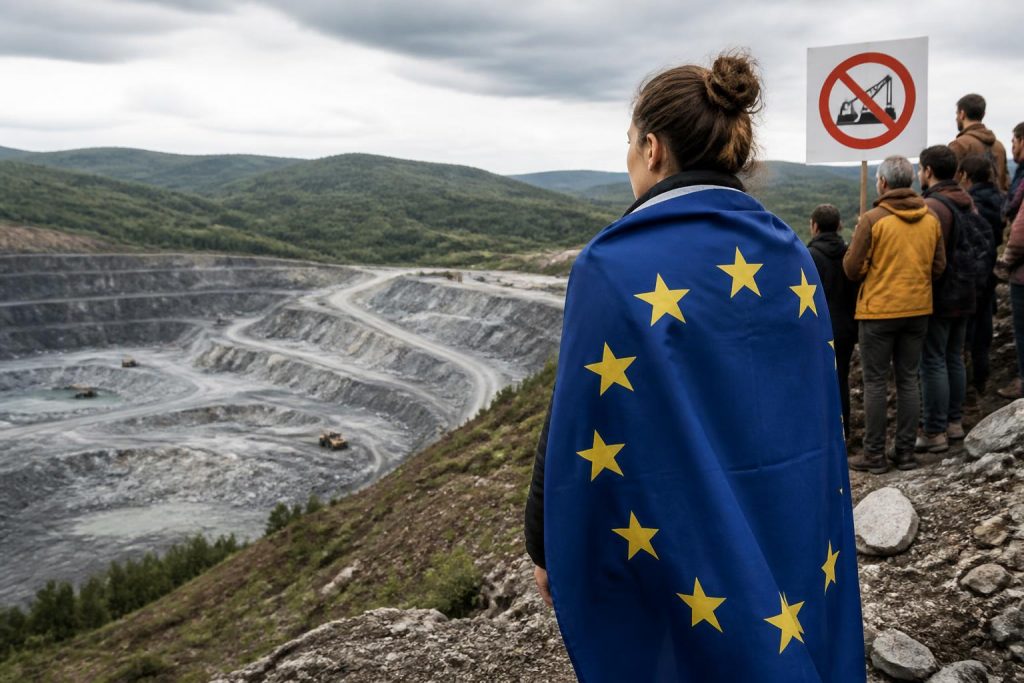
A group of researches from Finland, Portugal, France and Greece published a new research on paradoxes and challenges of the energy transition analysed through sociopolitical geology perspective. This academic paper examines the complex sociopolitical challenges surrounding Europe’s energy transition through the lens of sociopolitical geology, a transdisciplinary field addressing the intersection of geology, environment, and society. The authors identify a critical paradox: while the environmental movement has long advocated for energy transition away from fossil fuels, opposition to mining for critical raw materials (CRM) needed for this transition has emerged from both radical environmental groups and right-wing populist movements, creating what the authors describe as a “political shear zone” in society.
The paper traces how geopolitical shifts, including China’s dominance in CRM production, Russia’s resource-focused strategy, and the rise of populist movements, have complicated Europe’s path toward energy independence. The EU’s Critical Raw Materials Act (2024) aims to accelerate domestic mineral extraction, yet this conflicts with simultaneous commitments to nature conservation, as mineral deposits often overlap with protected areas.
The authors highlight specific case studies, particularly European lithium projects in Serbia (Jadar) and Portugal (Barroso), where opposition has become entangled with broader political agendas unrelated to mining itself. They note that communities in southern and eastern Europe view these projects as “sacrifice zones” for northern European consumers, raising legitimate concerns about unequal distribution of transition costs and benefits.
Crucially, the paper argues that known global mineral resources may be insufficient for the energy transition, and limited new supply can be ramped up in the short term. The authors contend that the energy transition requires profound societal change that cannot be achieved through technology or top-down regulation alone. They advocate for legally binding community development agreements, responsible project siting, genuine stakeholder engagement, and cross-disciplinary collaboration between industry, governments, scientists, and activists to build trust and achieve sustainable solutions.