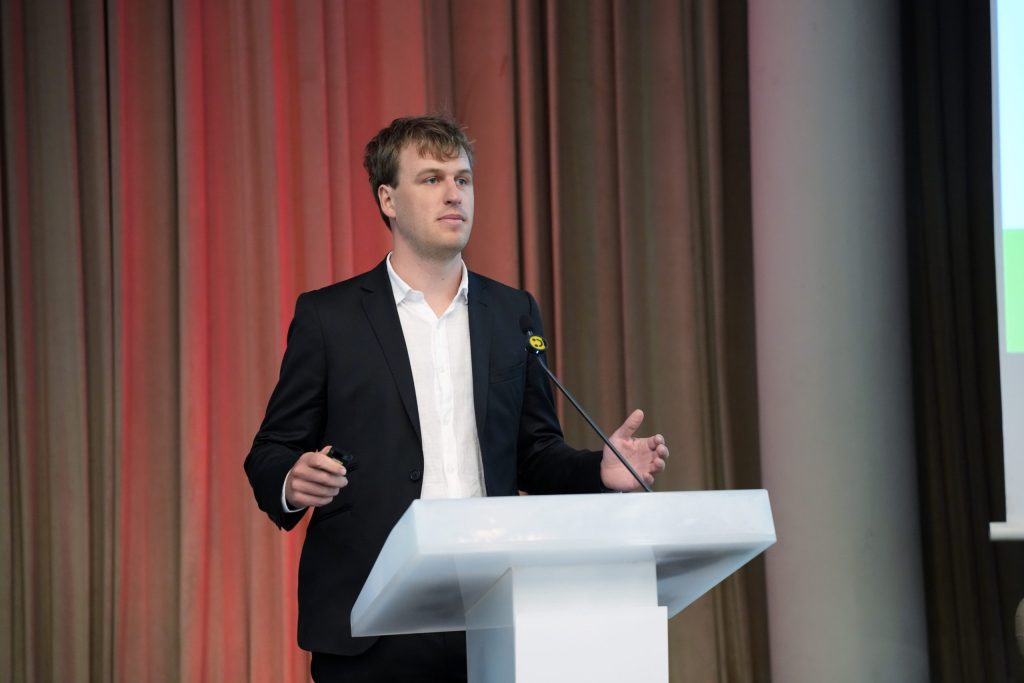
Alistair White opened with a personal reflection on growing up in Zimbabwe during a period of hyperinflation, noting that what struck him wasn’t the economic failure itself but the community’s capacity to recover afterward — a framing he used to introduce the concept of resilience-based design in tailings engineering.
He defined resilience as a system’s ability to reduce the chance of a shock, absorb it if it occurs, and recover afterward. Using a graph plotting operational performance against time, he illustrated how a disruption — whether an earthquake or operational failure — causes performance to drop before (hopefully) recovering. He introduced the “resilience triangle,” representing the area of lost performance during this disruption-recovery cycle, and framed resilience-based design as the effort to shrink that triangle.
He positioned his talk as bridging the previous speaker’s focus on robust risk-based design (reducing the likelihood of the initial drop) and the next speaker’s focus on recovery and monitoring. He noted that GISTM’s success stems partly from its alignment with resilience engineering principles — its first several requirements focus on reducing risk, while later ones focus on governance and recovery capacity.
He shared two concrete project examples. In West Africa, his team designed a tailings facility near a significant population by deliberately incorporating a diversion channel using repurposed topsoil stockpiles and a borrow pit — accepting that failure could occur while ensuring any breach would be controlled, thereby speeding recovery. In Scotland, within a national park, his team shifted from a single tailings dam design to a co-disposal, filtered-stack approach with multiple facilities in progressive closure — creating redundancy so that if one facility experienced issues, operations could continue via others, protecting the mine’s overall performance.
He then raised a more ambitious question: rather than merely returning environmental performance to baseline after mining and closure, could mining leave an area in better environmental condition than before it started? He connected this to opportunities in re-mining old tailings, particularly given current gold prices, suggesting that revisiting legacy sites could both extract additional value and improve environmental outcomes beyond their original state. He closed with a brief overview of Knight Piésold’s global presence across 16 countries, emphasizing the firm’s active engagement in the Central Asian region.