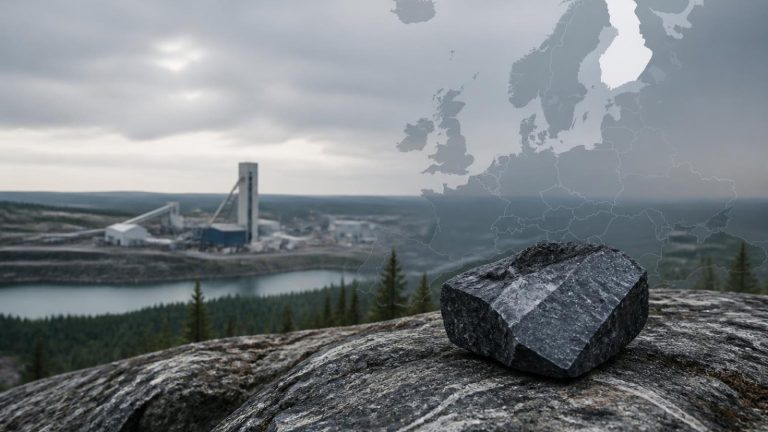
Norway’s government has stepped in to assume direct planning authority over the Fen rare earth deposit in Telemark, Europe’s largest known rare earth resource, citing the need to accelerate development and resolve potential land-use conflicts after a resource upgrade last month nearly doubled the project’s estimated size.
The deposit was upgraded to 15.9 million metric tonnes of rare earth oxide in indicated and inferred resources — 81% larger than a 2024 estimate — a revision that significantly enhances Fen’s strategic importance to Europe’s push to reduce dependence on China, which dominates global rare earth production and processing. Europe currently has no operating rare earth mines.
Prime Minister Jonas Gahr Stoere framed the government’s intervention in explicit supply security terms. “The Fen field could be of major significance for Telemark, Norway and Europe’s supply security and competitiveness,” he said. “To ensure future access to critical minerals, it is important to increase production both in Norway and in other countries with which we cooperate in terms of security.”
The government said it had taken over planning at the request of the local authority, pointing to the risk of land-use disputes and the need to balance competing national interests — a challenge familiar across Europe, where onshore infrastructure projects including wind farms have repeatedly faced delays due to opposition from environmental and agricultural groups.
Approximately 19% of the oxides at Fen are neodymium and praseodymium, the heavy rare earth materials used in permanent magnets for electric vehicles, wind turbines, electronics and defence systems — placing them among the most strategically sensitive materials in the global energy transition. Developer Rare Earths Norway has said it expects production to begin in late 2031, with output of 800 tonnes of NdPr by 2032, equivalent to approximately 5% of total European Union demand.