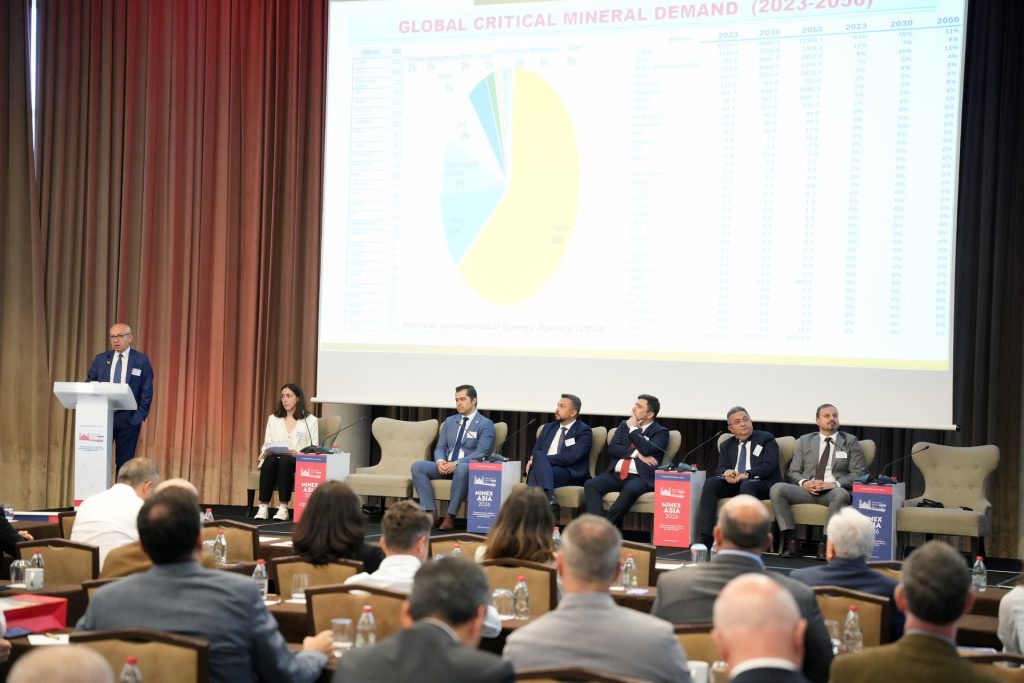
Ibrahim Halil Kırsan opened with a historical sweep of global energy transitions — from coal’s dominance following the industrial revolution, through oil in the 20th century, to natural gas from the 1970s, and now the shift toward renewables over the past two decades. He noted that despite this transition, fossil fuels remain heavily used globally, particularly in Asia (China, India), the Middle East (oil and gas), and hydro-rich countries like Canada. He cited that coal’s share of global electricity generation has only modestly declined, from roughly 35% to about 34%, meaning fossil-based systems will persist until renewable capacity grows substantially further.
He presented IEA projections showing critical mineral demand could grow four to six times by 2040 depending on the climate scenario, with battery-related minerals like lithium and cobalt seeing the steepest increases. He highlighted that global mineral production has surged particularly in the last 5-10 years, driven by clean energy, digitalization, and space industry demands, with copper playing an especially central role in future demand projections due to insufficient scrap-based supply relative to other metals.
He explained that while mineral deposits are widely distributed geographically, refining capacity is heavily concentrated in China across nearly all major critical minerals — lithium, cobalt, nickel, rare earths — with the notable exception of nickel, where Indonesia holds a dominant position. He cited an estimate that if China restricted exports of these materials, the EU and US could face combined annual losses of roughly $3.5 trillion, underscoring the depth of Western dependency. He connected this dependency directly to recent US-China trade tensions, noting China’s extensive mining investments across multiple continents to secure both supply and refining dominance.
He reviewed how numerous countries (EU, US, Canada, Japan, and now Turkey, whose list was published in 2025) have begun publishing critical minerals lists, with substantial overlap across roughly 200 shared minerals. Turning to Turkey specifically, he described the country as geologically comparable to a “small continent” in terms of mineral diversity — ranking in the top 8 globally for diversity, with strong positions in boron (world’s largest reserves), marble, chromium, and pumice, among many other metallic, industrial, and energy raw materials.
A significant highlight was his discussion of the Eskişehir Beylikova rare earth element deposit, which he described as potentially the world’s second-largest known REE resource after China’s Bayan Obo deposit, with an estimated 694 million tons of material and roughly 12.5 million tons of REE reserves at approximately 3% grade. He noted that extensive drilling (roughly 125,000 meters across 310 locations) has been completed and pilot-scale processing work is underway, though the site hasn’t yet been formally certified against international reserve reporting standards.
He closed with policy recommendations: Turkey needs to move beyond exporting raw or concentrated ore toward producing finished, technology-enriched products; critical minerals lists need regular updating; and — his central proposal — Turkey should establish a dedicated Critical Minerals Presidency or Institute, given that the issue now spans multiple ministries (Energy, Industry, National Defense) rather than falling under any single one.