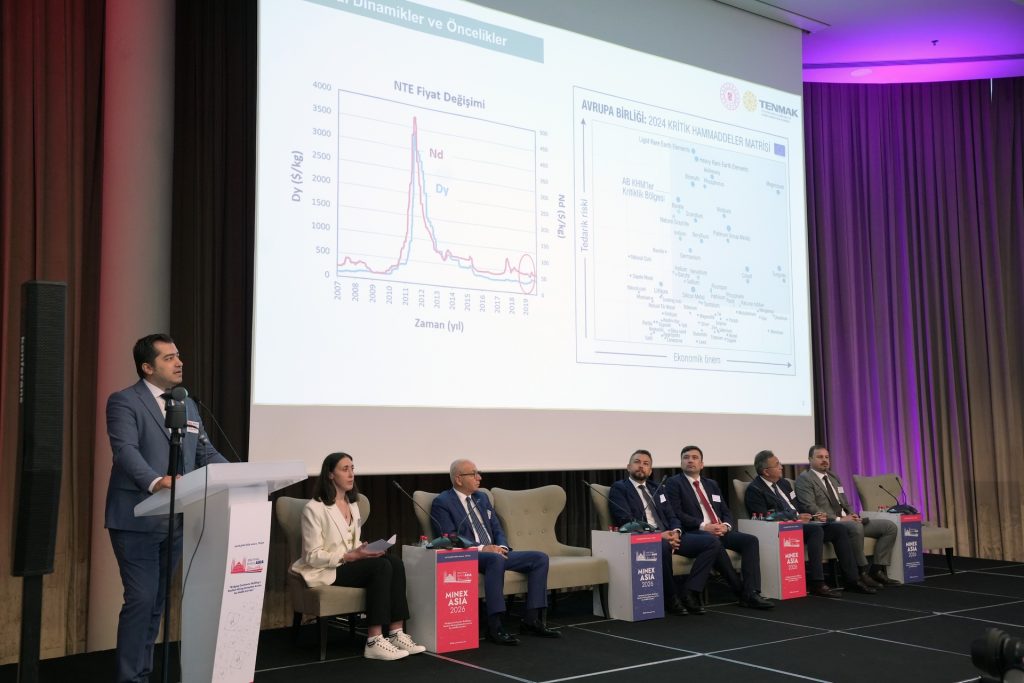
Hüseyin Çaldırak traced global rare earth (REE) awareness to a 2010 China-Japan dispute that triggered export restrictions and market volatility, prompting the EU to launch its Critical Raw Materials framework in 2011, with updated lists every three years since. Roughly 9-10 other countries now publish similar lists, typically converging on materials with high supply risk and economic importance — REEs feature prominently due to wind turbine and EV applications, with defense uses carrying outsized strategic weight despite smaller volumes.
He detailed China’s dominance across the REE value chain, illustrated by Lynas Corporation processing Australian ore but relying on Malaysia for purification, with China now requiring export licenses for any product containing Chinese-origin REE content. He noted REE economics vary sharply by element: cerium and lanthanum comprise about half of REE volume, while neodymium, praseodymium, dysprosium, and terbium represent roughly 96% of market value despite scarcity.
He described the EU’s 2024 Critical Raw Materials Act setting concrete targets — no single country supplying over 65% of any material, with minimums of 10% domestic mining, 40% processing, and 25% recycling — alongside similar strategies emerging across the US, Australia, Canada, and 25+ other countries in the past year.
A major focus was the US approach, including a policy effective January 2027 barring magnet production stages from China, Russia, Iran, or North Korea. He highlighted Mountain Pass’s ten-year MP Materials partnership plus agreements with Lynas and Serra Verde, which establish price floors regardless of spot prices. He noted Serra Verde’s ore grade is just 0.12% — far below Turkey’s often-criticized 2% at Beylikova — arguing this shows US willingness to invest despite lower ore quality.
On recycling, he cited European magnet recycling processing only 4,000-5,000 tons annually, with the EU’s 25% target currently realized at under 1%, though the IEA projects recycling could reduce virgin REE mining needs by up to 35% by 2050.
Turning to Turkey, he presented Beylikova’s figures: roughly 694 million tons at ~2.5% grade, yielding potentially 12.5 million tons of reserves — enough to rank third globally, pending international certification. If state miner Eti Maden reaches 10,000 tons annual production with 30% yearly growth, Turkey could become self-sufficient in REE for domestic wind needs and potentially an exporter. He walked through demand modeling: wind turbines require ~650 kg of neodymium-iron-boron per megawatt (~165 kg REE), and Turkey’s planned growth from 15 GW to 48 GW by 2035 would require roughly 3,500 tons of REE — demand Beylikova could fully satisfy.
He outlined institutional history: REEs entered the 11th Development Plan, leading to the Institute’s 2018 founding, 2020 integration into NADEM, and the 2025 Ministry Critical and Strategic Minerals Report, which he described as Turkey’s only report built on genuine mathematical modeling rather than qualitative lists.
He detailed technical achievements: upgrading Beylikova’s 2% concentrate to over 30% REE oxide at above 80% efficiency, plus high-yield barite and fluorite concentrates; achieving over 99% purity mixed oxides; and developing a domestic mixer-settler separation system with Istanbul Technical University. On secondary sources, he cited successful extraction from fluorescent lamps, waste magnets, PCB boards, and hard drives, including a prototype domestic magnet from recycled materials, plus ongoing work on mining waste, geothermal sources, and partnerships with Turkey’s coal institutes showing promising Zonguldak results.
He closed by listing end-product goals — permanent magnets, optical and polymeric nanocomposites, magnetic materials — alongside EU Horizon project participation and infrastructure spanning ore beneficiation labs and dedicated magnet R&D facilities.