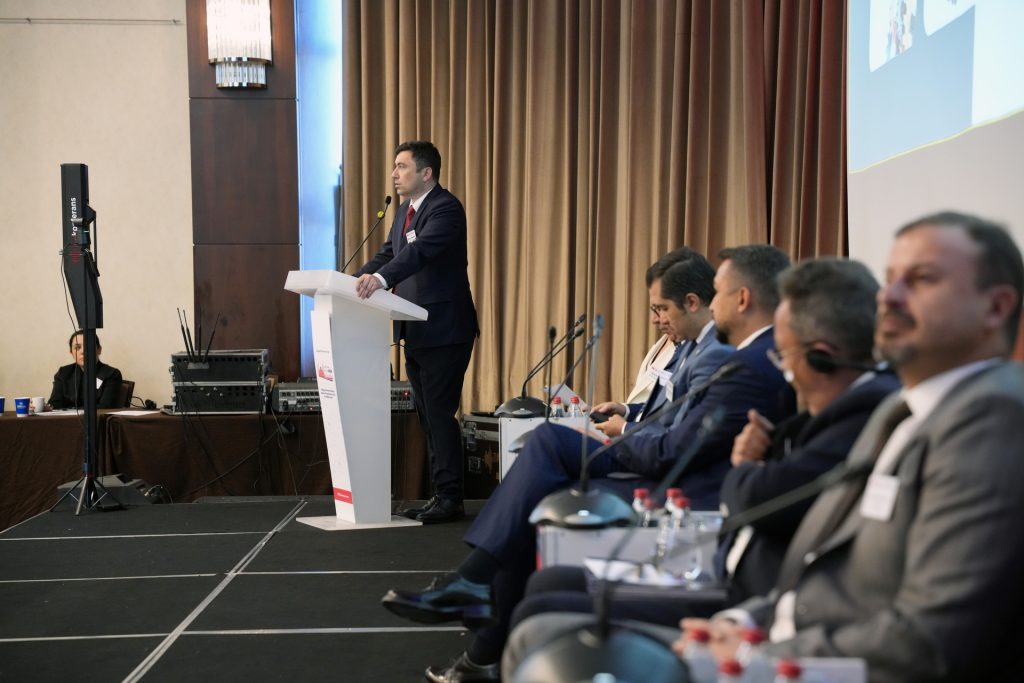
Özkan Özkardeş presented a macroeconomic case for investing in Turkey, framing his talk explicitly as a non-specialist, broad-perspective overview rather than a technical mining presentation. He outlined ten core strengths making Turkey attractive to international investors, starting with the country’s robust economy — now around $1.6 trillion in GDP — supported by Customs Union membership, trade agreements with over 30 countries, and a population of roughly 86 million providing indirect access to a billion consumers globally.
He emphasized Turkey’s strategic geographic position at the crossroads of multiple continents, and its favorable demographics — a young, dynamic population with a median age around 35, contrasting favorably with aging populations in many advanced economies, even while acknowledging recent declining fertility rates. He cited Turkey’s 10th-place global ranking by purchasing power parity, with a trajectory potentially reaching the top five economies by that measure in coming years, and highlighted sound public finance indicators — including manageable public debt and budget balance ratios — comparing favorably to EU peer averages.
On trade performance, he noted export volumes exceeding $283 billion in goods (excluding services), with roughly 9% average annual growth over 22 years compared to a global average closer to 6%, alongside more than 50 product categories with over $1 billion in export value each. He cited quality-of-life indicators like quadrupled automobile ownership and roughly eightfold growth in aviation passenger volumes as evidence of committed infrastructure investment.
Turning to foreign direct investment specifically, he cited over $13 billion in FDI received in the most recent year, spanning manufacturing, finance, energy, and mining sectors, and extended an explicit invitation for international investors to take advantage of Turkey’s incentive schemes. On mining specifically, he noted Turkey’s position as a global producer of several critical minerals — citing chromium and fluorite (fluorspar) as areas of particular strength — alongside gold and copper, and referenced over 600 international companies currently operating within the Turkish economy.
He devoted a substantial portion of his talk to logistics, acknowledging that rail currently represents a relatively underdeveloped share of Turkey’s freight transport but noting government commitment to raising rail’s share to roughly 20% by the mid-2050s through four major infrastructure projects currently under construction. He connected this investment directly to the Middle Corridor initiative, positioning Turkey as a stable geographic anchor for international trade given recent geopolitical developments in the region. He also referenced Turkey’s Development Road initiative — a planned rail and highway corridor connecting from Iraq’s Al-Faw port through Iraqi territory to integrate with existing Turkish infrastructure — as another emerging alternative trade route relevant to mineral logistics. He closed by positioning Turkey as poised to become a major hub not just for mineral production but for the transport of minerals from source to global markets.