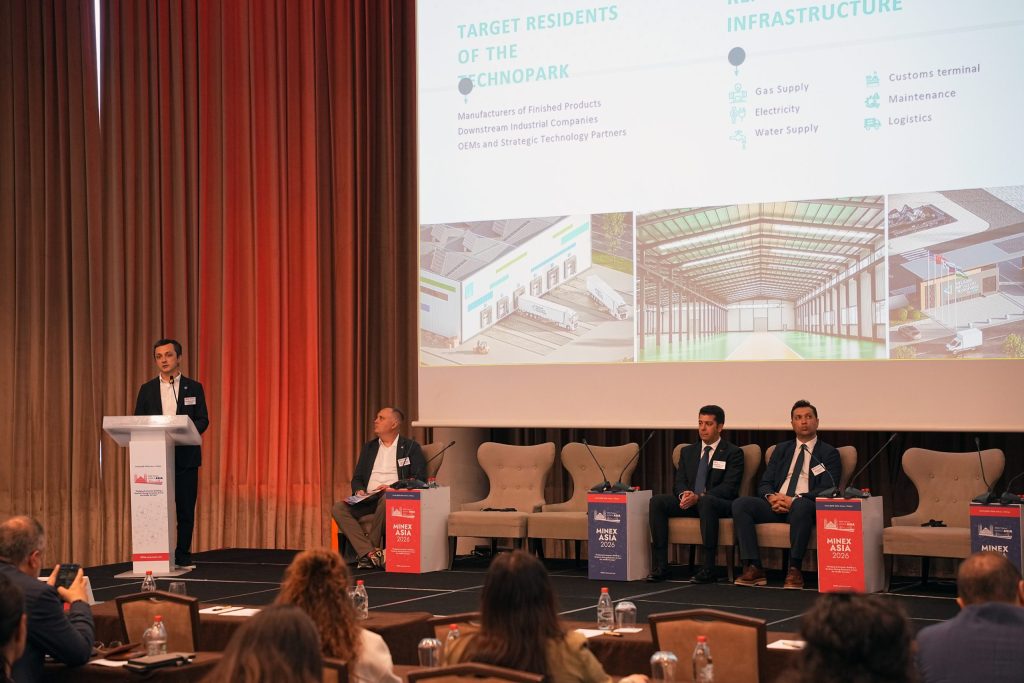
Umid Salokhutdinov presented the Future Metals Technopark as a platform designed to shrink the distance between raw mineral extraction and application-ready product. He opened by introducing TMK’s existing capabilities — established technology for molybdenum, tungsten, and rhenium, with selenium and tellurium production launching later in the year — and framed the company’s ambition as building a complete value chain from upstream mining through midstream processing, explicitly inviting downstream manufacturers to complete that chain rather than trying to do it alone.
He contextualized this within Uzbekistan’s broader economic shift, noting that mining’s share of the economy has grown steadily over the past eight years as agriculture’s share has declined, with GDP projected to approach $200 billion by 2030. He noted that Uzbekistan’s critical minerals list overlaps significantly with those of the EU, US, and other jurisdictions, giving the country’s resource base direct relevance to multiple international buyers.
He described the technopark’s cluster-based strategy, organized geographically around where specific minerals are concentrated: a tungsten cluster in Samarkand (where roughly 80% of the country’s tungsten is located), a molybdenum cluster in Tashkent, and a dedicated R&D hub in the city of Chirchiq focused on research and workforce development for the sector.
A central theme of his presentation was risk-sharing as an investment attraction strategy. He explained that the technopark absorbs the capital risk of building processing infrastructure, so that downstream partners bringing their own technology don’t need to bear that upfront cost themselves — partners can either operate their own production lines within the park or enter joint ventures with TMK or other local companies. He argued this de-risking model is central to what makes the technopark attractive to international manufacturers.
He gave concrete examples of active partnerships: an ongoing molybdenum concentrate trade relationship with Armenia to supplement domestic capacity, a new antimony project developed in cooperation with Turkey (with four domestic antimony deposits also in development), and existing technopark projects with South Korean partners on powder metallurgy for the automotive sector (a roughly $50 million project producing local auto parts) and hydrometallurgy/pure metallurgy projects with Chinese partners.
He positioned Uzbekistan’s value proposition partly on geography — its access to Turkey, the EU, US, South Korea, and Japan via the Middle Corridor — and partly on the tax-free incentives available within the technopark’s designated free industrial zone status, covering raw materials, equipment imports, and general business taxation. He closed with a direct call to action, inviting end-user manufacturers and downstream producers to engage with TMK and the technopark to take advantage of these partnership structures and incentives.