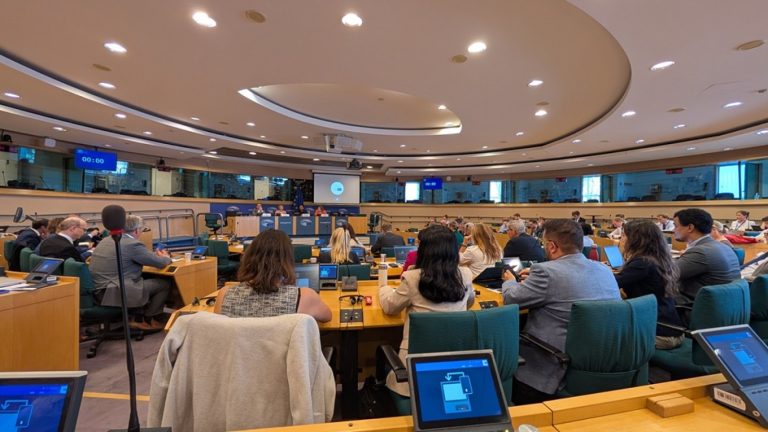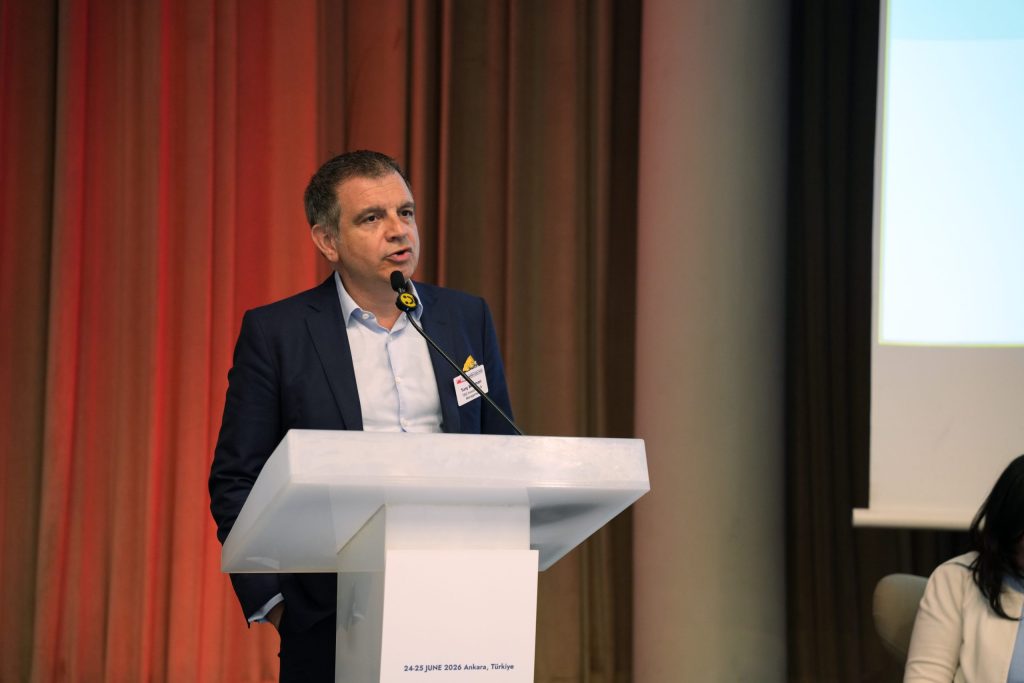
Tunç Berkman opened by noting he isn’t a mining professional but a marketing, PR, and branding specialist with over 30 years of experience across major Turkish corporations and, more recently, startup and VC investing. He engaged the audience directly, asking them to name mining’s biggest current challenges — public perception, environment, human resources, and water all came up, setting the stage for his central argument.
He built the case that mining is more essential now than ever, despite public perception suggesting otherwise. He cited projections of trillions in global clean energy investment by 2030, and noted that even “clean” technologies are mineral-intensive: a single AI data center requires roughly 1,000 tons of copper, a wind turbine needs dozens of tons, and electric vehicles require several times more minerals than combustion vehicles. He argued mining has become critical infrastructure — economic (contributing hundreds of billions annually to developing economies), national security-related (with dozens of minerals classified as critical to US defense), energy-related (batteries require lithium, nickel, and cobalt), and digital (cloud infrastructure depends on copper, aluminum, and rare earths).
He framed the core paradox: society wants the products mining enables — data centers, EVs, clean energy grids, 5G networks — but opposes the mines, smelters, and processing facilities that make them possible. He offered a memorable metaphor, comparing mining to a difficult birth: messy and disruptive at first, but capable of healing and producing something valuable if done properly and responsibly.
He walked through several high-profile trust failures — environmental discharge incidents, water-intensive lithium extraction, the Samarco dam collapse in Brazil, and low industry-wide transparency in social impact reporting — as sources of the “trust gap” the industry faces. He quantified the cost of that gap: permit delays costing roughly $1 million per day, a large share of mining M&A deals now incorporating social license due diligence, and substantially longer project timelines in low-trust jurisdictions. He cited a specific case — a large Congo gold-copper project halted despite passing regulatory review, ultimately becoming unfinanceable and representing billions in lost investment.
Conversely, he presented trust as a competitive advantage: companies with strong reputations attract better graduate talent, retain smoother operational continuity through community partnerships, and command valuation premiums. He then pivoted into an extended discussion of psychology and marketing, arguing that humans have an innate need for social approval and belonging, and that this drives behavior on social media and, by extension, could be leveraged to build public trust in mining if approached thoughtfully.
He offered concrete industry examples of trust-building initiatives: De Beers’ evolution from Blood Diamond-era reputation damage toward long-term government joint ventures, quarterly community sentiment tracking tied to executive KPIs at some major miners, and revenue-sharing programs with local oversight boards. He argued for “radical transparency” — publishing real-time environmental data, independent audits, and public grievance mechanisms — noting these correlate with fewer permit delays and faster escalation resolution.
A significant portion of his talk focused on storytelling and content strategy. He argued mining needs to create relatable, human narratives — citing examples like documentary films that shifted public perception in other industries (fishing, agriculture) and arguing mining lacks an equivalent. He suggested rehabilitated mine sites, community partnership stories, and worker testimonials are underutilized content opportunities, and cited examples of successful mining-related social media content (TikTok series, YouTube channels) that achieved viral reach despite being individual efforts rather than coordinated industry campaigns.
He advocated for early, sustained public education — citing Canada’s school-based mining curriculum reaching tens of thousands of students annually — arguing that shaping perception in childhood is far more effective than reactive messaging later. He closed by contrasting old and new industry narratives: from “extract and leave” to “restore and regenerate,” from “jobs versus environment” to “jobs and environment,” and from “opacity as protection” to “transparency as advantage.” He concluded that the future of mining will be decided above ground, and that trust — not reserves — will determine which companies and countries succeed.
During Q&A, he emphasized tailoring communication strategy to specific audiences (regulators, communities, youth), advocated for consistent but not excessive content cadence, and stressed relating mining’s output to tangible daily-life impacts as the most effective way to build public understanding and support.