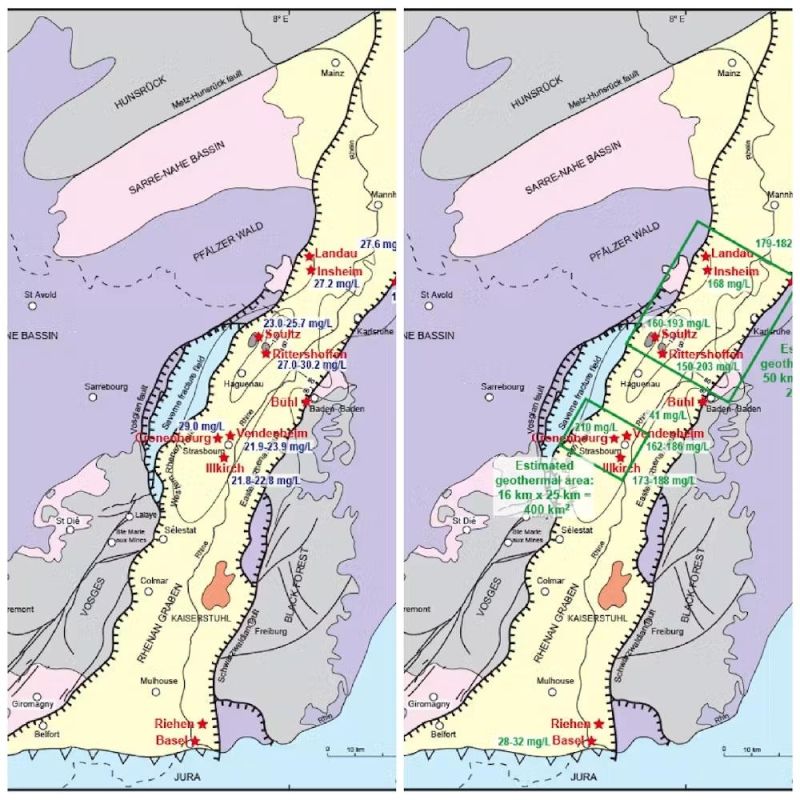
The Rhine Graben, a geological formation located between France and Germany, is emerging as a significant potential source of strategic metals, specifically lithium and rubidium. A recent study highlights the region’s promising resources, which are found in the hot, saline waters of its geothermal systems. As Europe seeks to reduce its reliance on external sources, particularly China, for these critical elements, the Rhine Valley could play a pivotal role in meeting the growing demand, especially for lithium used in electric vehicle batteries.
Lithium demand is surging due to its essential role in the production of electric vehicle batteries, while rubidium, though less known, is vital for advanced technologies including optics and atomic clocks. The study suggests that the geothermal brines in the Rhine Graben, which are already being harnessed for energy production, could also be tapped for their rich lithium and rubidium content. The brines contain approximately 174 mg/L of lithium and 25 mg/L of rubidium, making them among the richest sources globally.
The research updates previous estimates of lithium reserves in the Rhine Graben, now suggesting they could range from 1 million to 16 million tonnes, with an average estimate of 6.2 million tonnes. This is a significant increase from earlier figures, indicating the region’s potential to contribute substantially to Europe’s lithium supply, especially as global production is projected to rise.
Rubidium resources are also noteworthy, estimated between 150,000 and 2.3 million tonnes, which could incentivize further exploration and extraction efforts. The study proposes that integrating lithium and rubidium extraction into existing geothermal energy operations could be a sustainable approach, potentially producing 3,000 to 9,000 tonnes of lithium annually, meeting a considerable portion of France’s projected needs by 2035.
However, several challenges remain before these resources can be fully exploited. Technical hurdles include identifying the most productive areas within the complex geological formations and improving extraction technologies. Additionally, environmental concerns, particularly the risk of induced seismicity associated with deep geothermal energy, must be addressed to gain public support.
Initial pilot projects in the region are already underway, with ambitions to establish Alsace as a hub for low-carbon lithium production. As the exploration and extraction of these strategic metals progress, the Rhine Graben could soon become a key player in Europe’s quest for energy independence and sustainability.