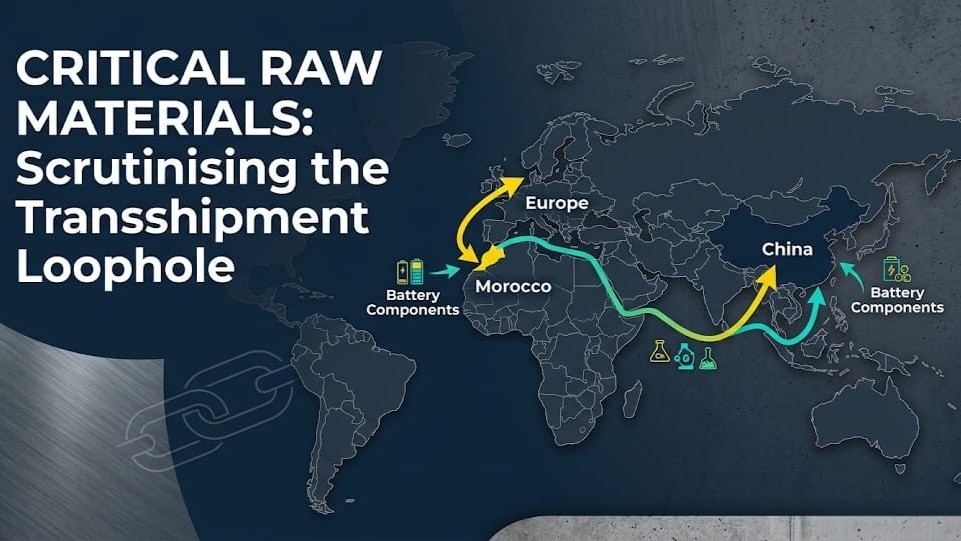
The European Union faces a multi-billion-dollar geopolitical dilemma that cuts to the very core of its economic security.
EU Trade Commissioner Maroš Šefčovič recently issued a stark warning regarding a massive surge in Chinese industrial investment in Morocco. The fear? Beijing is utilising “transshipment” to offshore its domestic industrial overcapacity and bypass mounting Western tariffs.
With over $6 billion in Chinese capital flooding into Morocco’s green energy and automotive sectors, the North African nation is rapidly morphing into Africa’s premier EV hub.
🔍 The Scale of the Pivot
Major projects are reshaping the supply chain:
- Gotion High-Tech is constructing a $1.3 billion battery gigafactory in Kenitra.
- Industrial giants like CNGR, Shinzoom, and BTR New Material Group are establishing massive cathode, anode, and copper processing facilities.
⛓️ From Raw Materials to Consumer Products: The Resilience Crisis
This isn’t just about final vehicle assembly; it is an encroachment across the entire vertical supply chain. To build truly resilient European supply chains, the block needs secure access to everything from critical raw materials up to the final consumer product.
However, China already possesses the capability to dominate key components of Morocco’s industrial ecosystem, including the processing facilities and logistics infrastructure right up to the shipping ports. By dominating these upstream segments, foreign entities effectively lock in dependencies long before a battery component ever reaches a European consumer showroom. Under frameworks like the EU’s Critical Raw Materials Act (CRMA), Brussels has set ambitious targets to reduce reliance on dominant single nations—yet this investment pattern actively challenges those resilience goals.
🇺🇸 vs 🇪🇺 Market Protection: Carrots vs. Sticks
The Morocco-China nexus highlights a profound asymmetry in how the US and the EU protect their domestic markets and enforce economic resilience:
- The US “Carrot” Model (Inflation Reduction Act): The US takes a highly transactional, aggressive approach to friendshoring. The IRA relies on massive tax incentives and localised demand signals (like the $7,500 EV consumer credit). Crucially, it deploys strict Foreign Entity of Concern (FEOC) restrictions that explicitly bar subsidies if battery components or critical minerals are sourced from Chinese entities—even if they are processed in an FTA partner nation. It explicitly redirects the flow of capital via financial reward.
- The EU “Stick” Model (Regulatory & Compliance): Conversely, the EU relies on complex legal enforcement, strict “Rules of Origin” audits, and retrospective anti-subsidy tariffs. Without an equivalent pool of centralised cash or explicit bans on foreign entities operating in neighbouring free-trade zones, the EU has a much less efficient mechanism for preventing circumvention. Brussels must rely on tedious bureaucratic investigations to prove a product wasn’t “significantly transformed” locally—a process that is slow, easily litigated, and reactive.
⚖️ Brussels’ Policy Gridlock
Retaliation isn’t simple. The European Commission is caught between economic defence and its own climate targets:
- Supply Chain Disruption: European automotive giants like Renault and Stellantis have massive, long-standing manufacturing operations in Morocco. Punishing Moroccan exports directly penalises European corporate bottom lines.
- The 2035 EV Mandate: Roughly 85% of Morocco’s automotive output is bound for Europe. The EU fundamentally relies on these close, cost-effective supply routes to meet its legally mandated 2035 ban on new fossil-fuel vehicles.
- The Local Content Battle: Moroccan trade officials strongly reject allegations of corporate camouflage, noting that Chinese firms must achieve strict, legal thresholds of “significant local transformation” to qualify for tariff-free EU access.
The EU has previously penalised specific Moroccan exports (like aluminium wheels) after finding evidence of unfair state aid. But scaling up enforcement to cover the entire battery ecosystem could spark a massive trade dispute or tank Europe’s own EV transition.

🌐 Join the Discussion Across Europe, the Middle East, and Central Asia!
These complex cross-border value chains, regulatory shifts, and mineral security strategies will be at the very center of our upcoming regional forums. Connect with industry leaders, policymakers, and midstream operators to debate the future of critical raw materials:
🗓️ 24–25 June | Ankara: https://2026.minexasia.com/
🗓️ 28–29 Oct | Trim: https://2026.minexeurope.com/
👇 To the supply chain, trade policy, and automotive experts in my network:
Is the EU’s regulatory approach robust enough to prevent this kind of economic circumvention, or does Europe need to adopt a US-style, incentive-backed “FEOC” policy to truly protect its clean-tech sector?