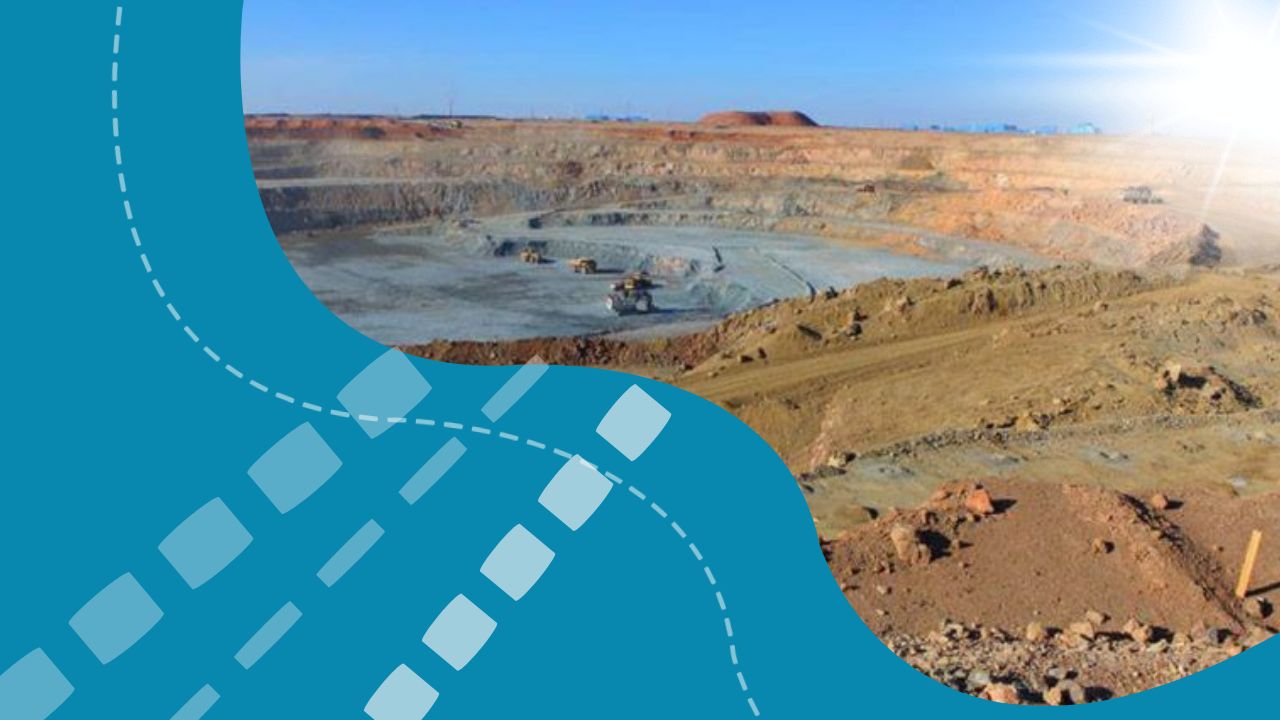
The Dobra lithium deposit in Ukraine’s Kirovohrad Region may contain between 60 and 100 million tonnes of ore, sufficient to sustain decades of production and potentially making it one of the most significant lithium assets in Europe, according to the geologists leading its development.
Mykhailo Heichenko, CEO and Chief Geologist of UkrLithiumMining, estimates the deposit at around 60 million tonnes, while Bohdan Slobodian, a PhD candidate at the Institute of Geochemistry, Mineralogy and Ore Formation of the National Academy of Sciences of Ukraine, puts the figure closer to 100 million tonnes based on exploration data from Kirovgeology. At an extraction rate of one million tonnes per year, 60 million tonnes would support 60 years of operations; even scaling up to 1.5 to 2 million tonnes annually, the deposit would remain productive for decades. “With 100 million tonnes, our grandchildren could still be working here,” Heichenko said.
Slobodian explained that the assessment draws on borehole data collected between 1989 and 1994, with lithium ore beginning at depths of 60 to 80 metres below surface sediments and extending to 500 metres across the 1,700-hectare licensed area.
Lithium-bearing ores at the site were first identified in 1989 during gold exploration, with the discovery also revealing associated deposits of tantalum, niobium, rubidium, beryllium, tin, cesium and tungsten. In 2017, the Ukrainian State Commission on Mineral Resources consolidated the Nadiya and Stankuvata ore deposits into the unified Dobra zone. The deposit contains two key lithium minerals — petalite and spodumene — and is located in Novoukrainka district, stretching between the villages of Novostankuvata and Ternove.
Ukraine’s Cabinet of Ministers has selected Dobra Lithium Holdings JV as the winner of a tender to develop the deposit under a production sharing agreement. The joint venture is backed by internationally recognised companies Techmet and The Rock Holdings, and the project is expected to attract at least $179 million in capital investment — $12 million for new geological exploration and international reserve audits, and $167 million for mining and processing operations subject to confirmation of industrial-scale reserves.
Europe is confronting a structural vulnerability in critical minerals supply chains that mirrors — and in some respects exceeds — its former dependence on Russian gas, as China’s dominance of rare earth refining, magnesium production and graphite processing leaves European manufacturers exposed to geopolitical leverage at the most fundamental level of their supply chains.
The scale of dependence is striking. Approximately 97% of magnesium consumed in the EU comes from China, dependence on heavy rare earths is near absolute, and more than 90% of global rare earth refining capacity is concentrated in a single country. The consequences became concrete in April 2025, when Beijing imposed export restrictions on certain rare earth categories amid trade tensions with the United States: permanent magnet exports contracted sharply and several European car manufacturers temporarily suspended production lines.
Europe’s legislative response is the Critical Raw Materials Act, which entered into force in May 2024. The regulation sets four targets for 2030: at least 10% of EU consumption to come from domestic extraction, 40% of processing to occur within the EU, 25% of demand to be covered through recycling, and no single third country to supply more than 65% of any critical material. Strategic project designation under the CRMA unlocks accelerated permitting capped at 27 months — compared with five to ten years in many member states — and priority access to financing from the European Investment Bank, EBRD and EU funds.
Romania emerges as one of the most significant potential contributors to Europe’s mineral security, holding reserves of graphite, titanium, boron, germanium, magnesium and copper, all on the European Commission’s critical and strategic materials list. Three of the 47 projects on the Commission’s first strategic list are in Romania, with combined value exceeding €1.3 billion. Euro Sun Mining’s Rovina copper project in Hunedoara County, valued at €300 million, is the EU’s second-largest copper and gold deposit. SALROM’s Baia de Fier graphite project in Gorj County is state-owned. Verde Magnesium’s Bihor County project, valued at approximately $1 billion, could become both the EU’s first magnesium mine and its largest magnesium deposit — addressing the material for which European dependence on China is most acute.
At national level, progress has been partial. Emergency Ordinance 61/2025 designated a single contact point for strategic project authorisation, but a more ambitious legislative proposal — L143/2026, which would have recognised critical minerals projects as public interest investments and introduced expedited judicial procedures — was rejected by the Senate, leaving a legislative gap that prolongs the competitiveness disadvantage.
Writing in an opinion piece, Lorena Novac of IJDELEA & Associates frames Romania’s situation as a historic opportunity that risks being squandered. “The alternative is straightforward: leave resources underground and import from China materials that already exist within Romania’s own subsoil. Europe has learned its lesson on energy security. The question is whether Romania will learn the lesson on mineral security before it is too late.”
DPM Metals has announced a significant gold-copper porphyry discovery at its Brevene South Porphyry target in Bulgaria, with a single hole cutting 713 metres grading 1.31 grams per tonne gold and 1.16% copper — results that analysts say could distinguish the site as one of Europe’s most compelling new porphyry systems.
Standout hole EX_BRESPO_03, drilled approximately one kilometre from the reserve footprint of the operating Chelopech underground mine, returned the 713-metre interval from 1,172 metres downhole, including a higher-grade core of 398 metres at 1.48 grams gold and 1.45% copper from 1,487 metres depth. The hole remains in progress. RBC Capital Markets analyst Harrison Reynolds described the results as distinguishing BSP as “a potentially very high-grade porphyry system,” adding that proximity to existing mine infrastructure materially de-risks the path to eventual economic extraction.
DPM shares rose 1.6% to C$46.70 in Toronto on Wednesday, valuing the company at approximately C$10.3 billion ($7.5 billion).
The BSP target sits within the southeastern portion of the Brevene exploration licence, contiguous with the Chelopech mine concession approximately 75 kilometres east of Sofia. The new mineralised zone lies within a hydrothermal alteration system measuring more than 1,000 by 1,500 metres and remains open for expansion. Additional holes released Wednesday include 95 metres at 0.43 grams gold and 0.48% copper from 1,250 metres, and 37 metres at 0.53 grams gold and 0.63% copper from 1,357 metres.
DPM has mobilised five high-capacity drill rigs to the target and plans up to 15,000 additional metres of drilling by year-end. The company is targeting a Commercial Discovery Certificate after exploration work concludes in September, followed by a mining concession application and environmental permitting. The discovery is DPM’s fourth significant find since 2023, following Čoka Rakita, Dumitru Potok and Wedge Zone.
Chelopech, one of Europe’s highest-grade operating gold-copper mines, had its operating life extended by four years to 2036 four months ago. DPM forecasts Chelopech will produce 150,000 to 170,000 ounces of gold and 29 to 34 million pounds of copper this year.
Настоящее исследование посвящено фундаментальному технологическому, экономическому и кадровому сдвигу в мировой горнодобывающей промышленности на горизонте 2026–2031 годов. Переход индустрии от изолированных цифровых экспериментов к сквозному внедрению агентного искусственного интеллекта (ИИ), мультимодальных нейросетей и пограничных вычислений (Edge Computing) обусловлен жесткими макроэкономическими факторами: истощением богатых месторождений, усложнением горно-геологических условий и жесткими регуляторными рамками ESG.
В работе на основе примеров анализируется влияние ИИ на всю цепочку создания стоимости — от обработки геологоразведочной информации до автоматизации карьеров и оптимизации обогатительных фабрик. На основе математических моделей изменения производительности труда представлен финансовый и кадровый прогноз: описаны экономические механизмы снижения себестоимости производства, трансформация структуры затрат (OPEX/CAPEX), топ-10 профессий будущего и радикально изменившаяся роль HR-департаментов. Исследование опирается на передовой опыт макрорегионов (Центральная Азия, Европа, США, Китай) и данными авторитетных академических и аналитических источников.
Агентный ИИ, периферийные вычисления и нейросети против крупнейших макроэкономических вызовов отрасли: как технологии перекраивают рынок труда в 2026–2031 годах.
Присоединяйтесь к обсуждению на горно-геологических форумах MINEX
1. Введение и макроэкономический контекст (2026 год)
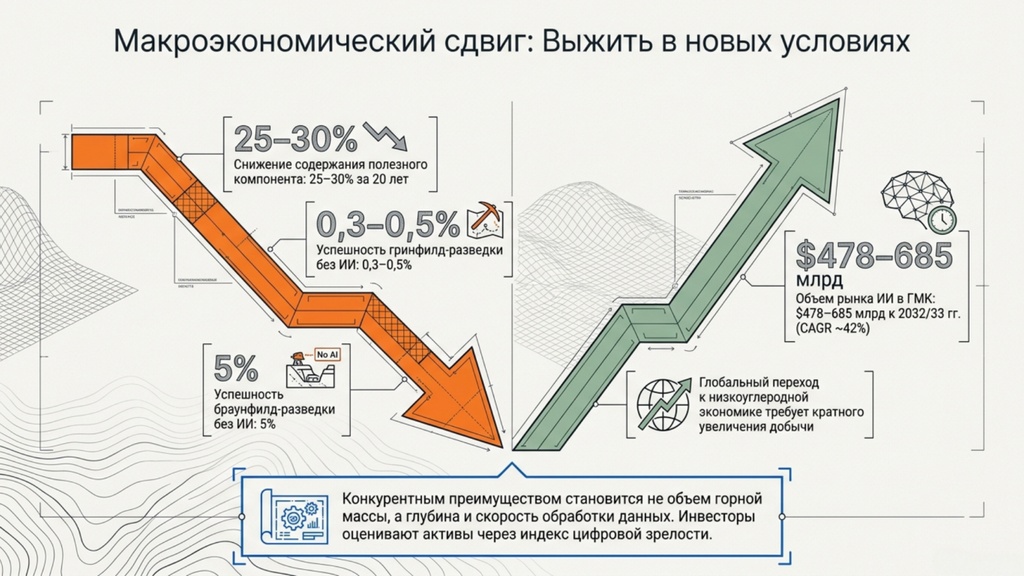
В 2026 году мировая горнодобывающая отрасль функционирует в условиях беспрецедентного давления. Глобальный переход к низкоуглеродной экономике требует кратного увеличения добычи критически важных металлов (лития, кобальта, меди, никеля). В то же время среднее содержание полезного компонента в разрабатываемых рудах за последние два десятилетия снизилось на 25–30%, а глубина залегания вновь открываемых рудных тел увеличилась. По данным отраслевой аналитики, вероятность коммерческого успеха поисково-разведочных проектов без применения продвинутых методов прогнозного анализа снизилась до критических 5% (для браунфилд-проектов на ранее освоенных территориях; для гринфилд-разведки на нетронутых площадях — лишь 0,3–0,5%).
Исторически ассоциировавшаяся с тяжелым физическим трудом, высокими рисками для здоровья и массивным воздействием на экологию, индустрия переживает тектонические сдвиги. Искусственный интеллект эволюционировал из категории передовых ИТ-надстроек в ядро операционной и управленческой деятельности предприятий. Как отмечают эксперты на международных форумах MINEX в Великобритании, Казахстане, Узбекистане, ключевым конкурентным преимуществом компаний становится не просто физический объём добываемой горной массы, а глубина и скорость обработки данных. Инвесторы при оценке стоимости активов напрямую учитывают индекс их цифровой зрелости и способность верифицировать экологические показатели с помощью прозрачных ИИ-алгоритмов.
Объём глобального рынка ИИ в горнодобывающей промышленности оценивается различными аналитическими агентствами по-разному: Grand View Research оценивала рынок в 29,94 млрд долларов в 2024 году с ростом до ~41,77 млрд в 2025 году и прогнозом 685,61 млрд долларов к 2033 году (CAGR 41,87%); SNS Insider — в 28,91 млрд долларов в 2024 году с прогнозом 478,29 млрд долларов к 2032 году (CAGR 42,15%). Разброс в прогнозах объясняется различиями в методологии и охвате рынка. Основными драйверами этого феноменального роста выступают технологии глубокого машинного обучения и стремительно растущий сегмент компьютерного зрения.
2. Глобальные технологические тренды ИИ в горном деле
Технологическая архитектура современного предприятия базируется на переходе от централизованных облачных вычислений к гибридным пограничным системам (Edge Computing). Удаленность большинства рудников от мегаполисов и нестабильность каналов связи привели к тому, что обработка критических данных перенесена непосредственно на бортовые компьютеры тяжелой техники и локальные серверы предприятий. Задержка передачи данных в облачных ИИ-системах составляет от 50 до 500 миллисекунд, что недопустимо для систем промышленной безопасности, тогда как пограничные вычисления выполняют транзакции за доли миллисекунд.
Основные сквозные технологии:
Мультимодальные агентные системы: Автономные программные агенты, способные одновременно анализировать неструктурированные текстовые отчеты, каротажные диаграммы, спутниковые снимки и финансовые документы для комплексной поддержки принятия решений.
Цифровые двойники (Digital Twins) на базе ИИ: Динамические трехмерные модели фабрик и карьеров, которые не просто отображают текущее состояние объектов, но и симулируют сценарии развития ситуации при изменении внешних физических или экономических параметров.
Умное оптическое сортирование: Интеграция гиперспектральных камер и нейросетей на конвейерных лентах для мгновенной отбраковки пустой породы до стадии энергоемкого измельчения.
3. Влияние ИИ на цепочку создания стоимости
3.1. Геологоразведка и геодезия
Традиционный процесс сбора и интерпретации геологических данных занимал месяцы ручного труда. Генеративные модели преобразуют терабайты исторических неструктурированных отчетов, старых карт и полевых журналов в стандартизированные цифровые датасеты за несколько часов.
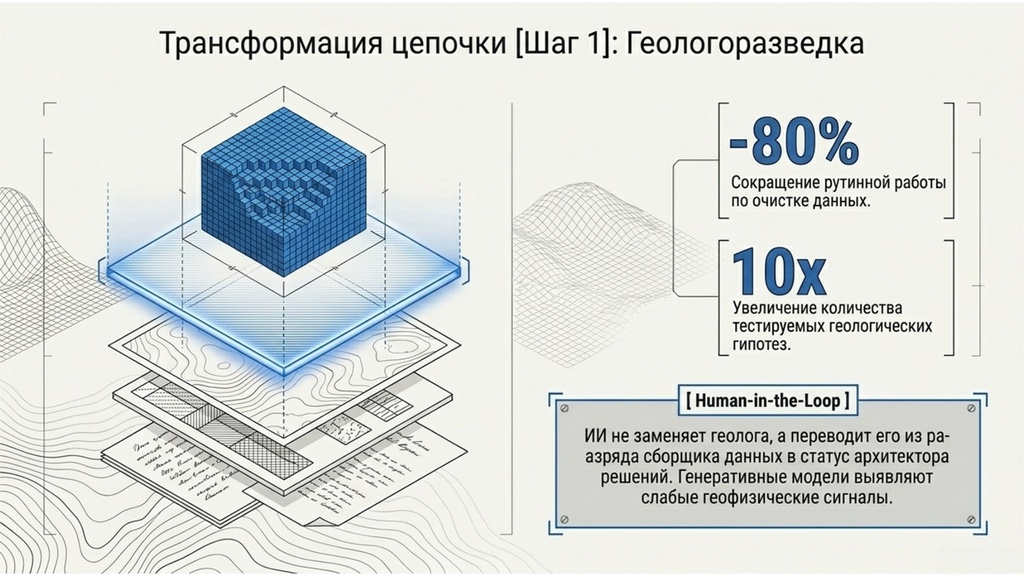
Платформы нового поколения используют алгоритмы для выявления скрытых закономерностей и слабых сигналов в больших массивах геофизических и геохимических данных. Нейросети строят вероятностные 3D-модели блочного распределения содержаний металлов, оптимизируя планирование разведочного бурения. При этом реализуется концепция «геолога в контуре управления» (Human-in-the-Loop): ИИ не заменяет человека, а убирает до 80% рутинной работы по очистке данных, позволяя специалисту тестировать в десятки раз больше гипотез.
3.2. Горные работы
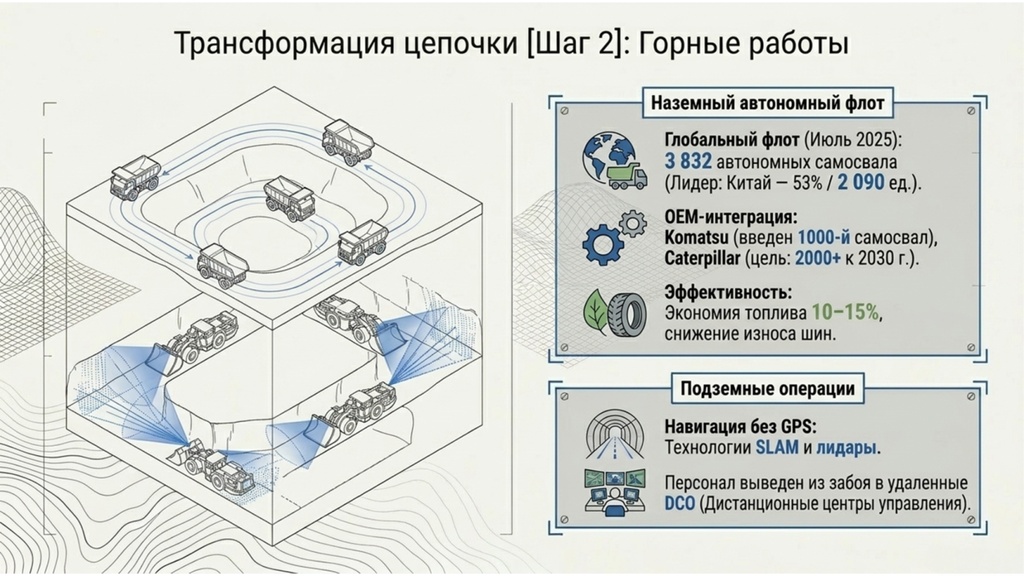
В сегменте открытых горных работ стандартом индустрии стали автоматизированные системы управления потоками. Программно-определяемые платформы автономии позволяют карьерным самосвалам двигаться без водителей, оптимизируя расход топлива на 10–15% и снижая износ крупногабаритных шин.
Масштаб глобального внедрения впечатляет: по данным GlobalData, к июлю 2025 года в мире на открытых горных работах эксплуатировались 3 832 автономных самосвала. Лидирует Китай с 2 090 машинами (53% мирового флота), следом — Австралия, Канада и Чили. Komatsu в апреле 2026 года ввёл в эксплуатацию тысячный автономный карьерный самосвал автономный самосвал класса ultra-class с системой FrontRunner, став первым производителем оборудования (OEM), достигшим этого рубежа. Caterpillar, в свою очередь, поставила цель довести парк до 2 000+ автономных машин к 2030 году, в том числе активно расширяя применение технологии на карьерах и каменных разработках меньшего масштаба.
В подземных условиях, где отсутствует сигнал GPS, ИИ решает задачи навигации с помощью технологий одновременной локализации и картографирования (SLAM) на базе лидаров. Автономные буровые установки и погрузочно-доставочные машины (ПДМ) работают в зонах повышенной опасности, в то время как операторы находятся в комфортных дистанционных центрах управления за сотни километров от забоя.
3.3. Переработка и обогащение полезных ископаемых
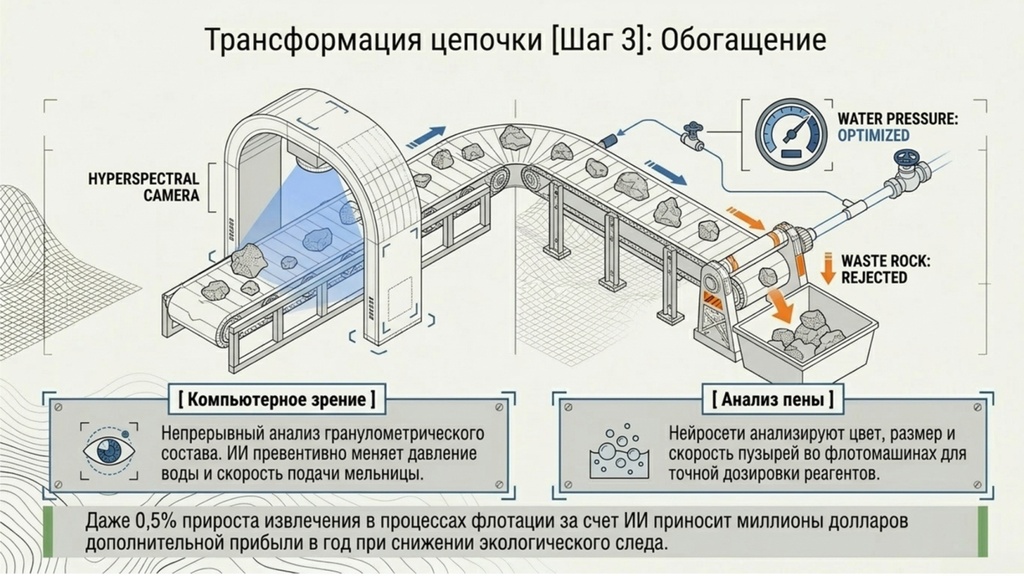
Обогатительная фабрика — это сверхсложная система с сотнями переменных. Алгоритмы машинного обучения непрерывно анализируют гранулометрический состав руды на конвейере с помощью компьютерного зрения. Если на мельницу поступает слишком крупный или твердый материал, ИИ превентивно изменяет скорость подачи и давление воды.
В процессах флотации нейросети анализируют цвет, размер и скорость движения пузырей пены на поверхности флотомашин, автоматически регулируя расход реагентов. Это позволяет повысить извлечение ценного компонента до 0,5%, что в масштабах крупного комбината приносит миллионы долларов дополнительной прибыли в год, одновременно снижая воздействие на экологическую среду.
4. Региональный анализ
4.1. Центральная Азия: Казахстан как региональный ИИ-хаб
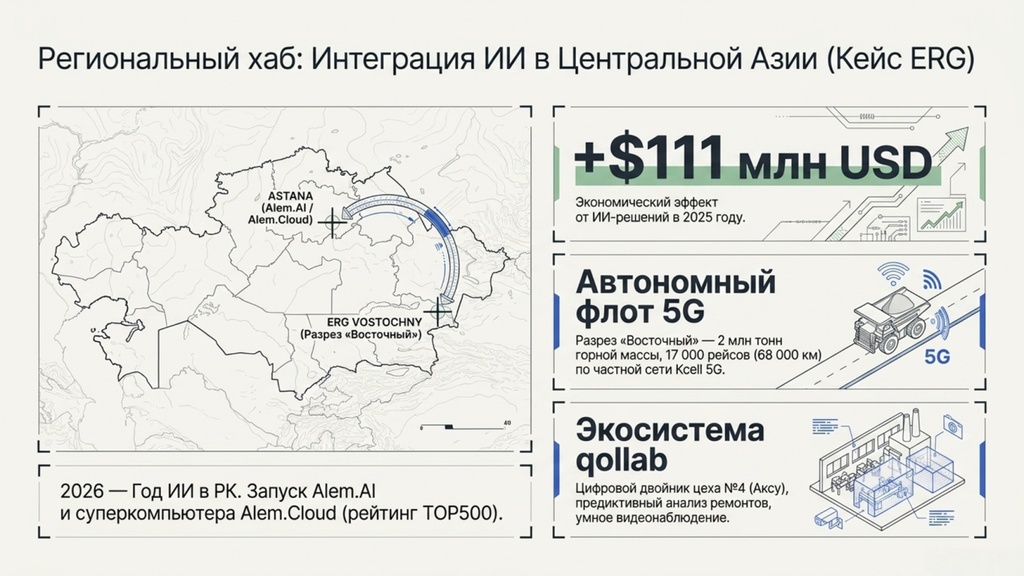
Республика Казахстан официально объявила 2026 год Годом цифровизации и искусственного интеллекта. В рамках национальной стратегии в стране развернуто Министерство искусственного интеллекта и цифрового развития, создан национальный AI-центр Alem.AI (расположен на площадке EXPO в Астане; открыт в октябре 2025 года), а также введён в эксплуатацию суперкомпьютерный кластер Alem.Cloud — крупнейший в Центральной Азии суперкомпьютерный кластр, вошедший в мировой рейтинг TOP500. Компания Presight AI (дочерняя структура G42, ОАЭ) участвует в проекте ситуационного центра при Alem.AI и в реализации инициативы Астана Смарт-Сити.
Флагманом внедрения промышленного ИИ в регионе выступает международная горно-металлургическая группа Eurasian Resources Group (ERG). Экономический эффект от внедрения собственных цифровых инструментов и ИИ-решений на предприятиях ERG в Казахстане по итогам 2025 года превысил 111 млн долларов США. Разработкой систем занимается выделенная IT-структура группы — BTS (Business & Technology Services), развернувшая технологии по трем направлениям:
Компьютерное зрение: Система видеоаналитики в режиме реального времени контролирует степень загрузки конвейеров, оценивает качество готовой продукции и отслеживает ТБ персонала. На Аксуском заводе ферросплавов модернизированный центр управления использует полномасштабный цифровой двойник плавильного цеха №4, позволяя инженерам осуществлять виртуальные обходы и моментально выявлять отклонения.
Роботизированная и автономная техника: ИИ применяется для точного расчета себестоимости технологических переделов, оптимизации энергопотребления и сквозного планирования горных работ.
Корпоративные платформы интеграции: Все ремонтные и операционные процессы оцифрованы в рамках единой экосистемы qollab, где ИИ распределяет наряды, формирует графики загрузки ремонтных бригад и прогнозирует выход оборудования из строя на основе предиктивного анализа.
Флагманским проектом в сегменте автономного транспорта стал угольный разрез «Восточный»: беспилотные самосвалы ERG к началу 2026 года перевезли более 2 млн тонн горной массы, совершив 17 000 рейсов и преодолев свыше 68 000 км под управлением по частной сети 5G от казахстанского оператора Kcell. ERG стала первой компанией в Казахстане, развернувшей беспилотные грузовики в промышленной эксплуатации; к 2027 году группа планирует нарастить объём перемещения горной массы автономными машинами до 115 млн тонн.
4.2. Западная и Северная Европа: Устойчивое развитие и мониторинг
В Европейском союзе фокус смещен в сторону максимальной экологичности, безопасности и глубокой аналитики данных геосферы. Примером служит внедрение комплексных беспроводных экосистем мониторинга (разработки компаний Senceive и европейской инициативы SensAI Mining).
Эти системы используют распределенные сети датчиков с элементами пограничных вычислений:
Контроль устойчивости бортов карьеров: Инструменты класса InfraGuard фиксируют микросдвиги грунта, отфильтровывают ложные шумы окружающей среды и отправляют ранние предупреждения о рисках оползней.
Мониторинг хвостохранилищ: ИИ анализирует поровое давление воды и структурную целостность дамб, исключая прорывы и минимизируя риски экологических катастроф.
Умный подземный мониторинг: Датчики деформации и конвергенции крепи в выработках позволяют предсказывать обрушения кровли задолго до визуальных проявлений.
Параллельно в Европе бурно развивается рынок специализированного ПО. Около 90% сделок слияний и поглощений (M&A) в секторе горнодобывающих технологий приходятся на компании, специализирующиеся на сенсорах и программном обеспечении со встроенным машинным обучением.
5. Государственное регулирование ИИ и его влияние на кадровый потенциал (ЕС, США, Китай)
Период 2026–2031 годов знаменует собой переход к эпохе жесткого суверенного регулирования ИИ, что напрямую трансформирует карту дефицитных профессий.
5.1. Европейский союз: Жесткая комплаенс-модель
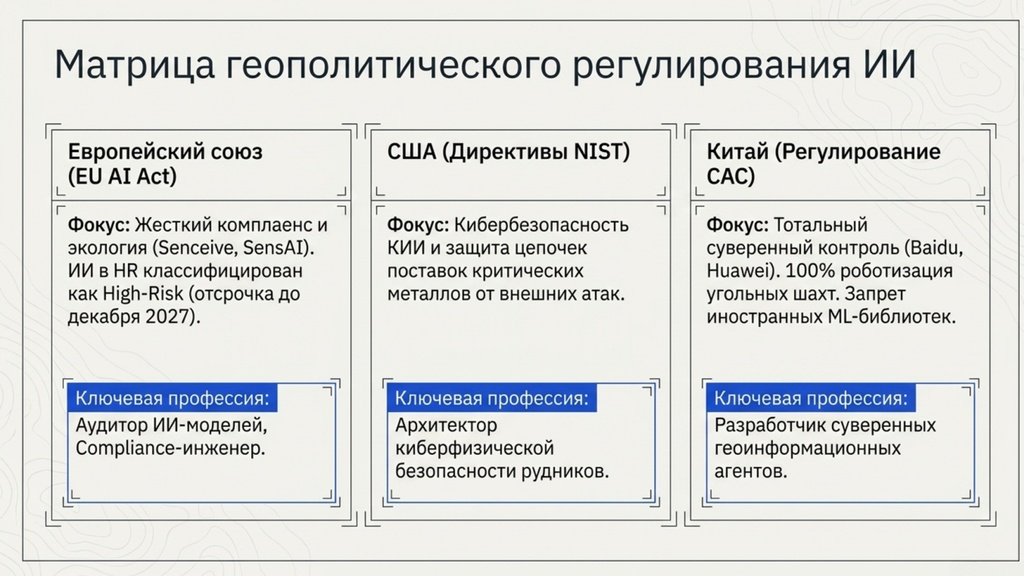
Поэтапно вводимый в действие (с августа 2024 года) Закон ЕС об искусственном интеллекте (EU AI Act) сформировал самую строгую в мире регуляторную среду. Важное уточнение: в мае 2026 года ЕС достиг предварительного политического соглашения о переносе сроков полного соответствия требованиям для высокорисковых ИИ-систем (Annex III, включая HR-приложения) с 2 августа 2026 года на 2 декабря 2027 года — в рамках пакета “Digital Omnibus”. Требования к запрещённым практикам (эмоциональное распознавание на рабочих местах и др.) вступили в силу в феврале 2025 года.
Регуляторный контекст: Любые ИИ-системы, используемые для управления персоналом (скрининг резюме, оценка KPI), а также системы мониторинга поведения рабочих на опасных объектах, классифицированы как «высокорисковые» (High-Risk).
Влияние на кадры: Рожден взрывной спрос на Аудиторов ИИ-моделей и Compliance-инженеров. От традиционных HR-директоров теперь требуется уровень AI Literacy и понимание принципов работы объяснимого ИИ (XAI), чтобы легитимно защищать перед профсоюзами решения, принятые алгоритмами.
5.2. США: Кибербезопасность КИИ и критические цепочки поставок
Стратегия США строится вокруг защиты критической информационной инфраструктуры (КИИ) и форсирования добычи критически важных минералов.
Регуляторный контекст: Согласно исполнительным указам Белого дома и директивам NIST, ИИ-решения в добывающем секторе рассматриваются через призму национальной безопасности. Особое внимание уделяется защите от кибератак на геоинформационные системы и автономный транспорт.
Влияние на кадры: Критически востребованными стали Архитекторы киберфизической безопасности рудников и Инженеры по безопасности Edge Computing. От ИТ-директоров требуется глубокое знание стандартов киберустойчивости, таких как NIST AI Risk Management Framework.
5.3. Китай: Суверенный контроль алгоритмов и сквозная роботизация
Китай демонстрирует модель тотального государственного контроля в сочетании с жестким директивным планированием индустриальной модернизации.
Регуляторный контекст: Администрация киберпространства Китая (CAC) требует обязательной государственной регистрации всех промышленных алгоритмов. Действует пятилетний план по полной автоматизации угольных и железорудных шахт. Использование иностранных ML-библиотек в контуре стратегических предприятий запрещено.
Влияние на кадры: Сформирован колоссальный внутренний рынок для Разработчиков геоинформационных агентов и Инженеров цифровых двойников, работающих исключительно на китайском технологическом стеке (Baidu Ernie, Huawei Pangu). Обучение инженерного персонала жестко стандартизировано под концепцию «Умных шахт».
6. Экономика трансформации: Снижение себестоимости труда и производства
Внедрение искусственного интеллекта меняет традиционную структуру стоимости человеческих ресурсов за счет трех ключевых экономических механизмов:
Интеграция мультимодальных ИИ-помощников сокращает время выполнения сложных инженерных задач на 15–50%. ИИ нивелирует разрыв между начинающими специалистами и экспертами. Менее опытные сотрудники, подстрахованные ИИ-агентами, начинают выполнять задачи уровня senior без потери качества. Это резко снижает «кадровую премию за дефицитный стаж», которую компании вынуждены выплачивать на перегретом рынке труда.
2. Географический арбитраж и ликвидация вахтовых издержек
Перенос функций управления в удаленные центры (DCO) позволяет нанимать персонал на стандартных городских условиях. Компания полностью ликвидирует или сокращает на 35–40% сопутствующие издержки: содержание вахтовых поселков, вертолетную логистику, повышенное медицинское страхование и законодательные надбавки за работу в экстремальных климатических условиях.
3. Ликвидация операционных микропростоев
Человеческий фактор обуславливает циклические потери (пересменки, обеды, снижение концентрации внимания). Автономные комплексы под управлением ИИ работают в режиме 24/7, что повышает утилизацию техники на 10–15%. Удельная стоимость человеческого труда, заложенная в каждую тонну перемещенной горной массы, падает пропорционально росту непрерывной производительности оборудования.
Трансформация OPEX в CAPEX и снижение AISC
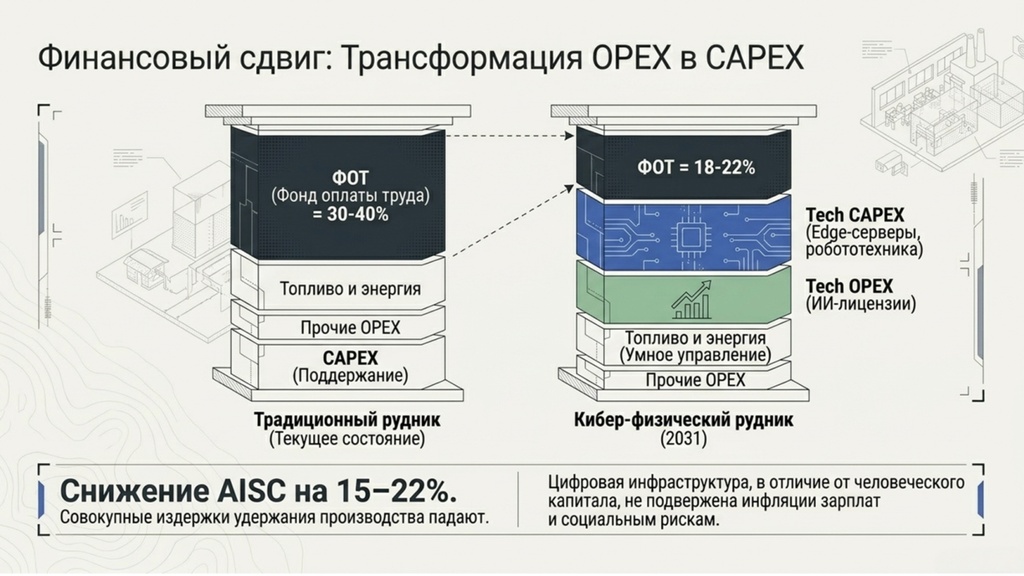
Фонд оплаты труда (ФОТ), составляющий на традиционных рудниках до 30–40% от операционных расходов (OPEX), к 2031 году сократится до 18–22%. Эти затраты частично перейдут в категорию технологического OPEX (оплата лицензий) и CAPEX (закупка Edge-серверов и роботизированных комплексов). Цифровая инфраструктура, в отличие от людей, не подвержена инфляции зарплат и социальным рискам.
За счет сквозного применения ИИ-агентов совокупные издержки удержания производства (AISC — All-In Sustaining Costs) на унцию/тонну готового металла снизятся к 2031 году в среднем на 15–22%, что позволит сохранять высокую маржинальность даже при разработке бедных руд.
7. Прогноз кадровой структуры и потребностей (2026–2031 годы)
Для оценки изменения структуры трудозатрат инженерно-технического персонала ) применяется модель разделения времени на рутинные операции () и экспертную деятельность ():
Внедрение мультимодальных ИИ-агентов приводит к экспоненциальному снижению временных затрат на рутинные операции, что описывается коэффициентом автоматизации α, зависящим от цифровой зрелости предприятия
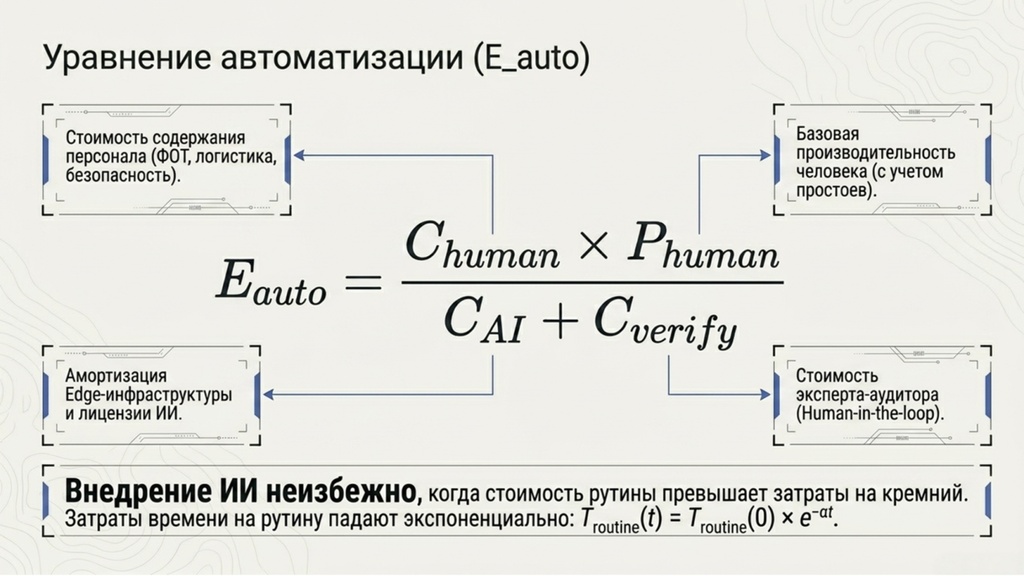
Освобождающийся временной ресурс перенаправляется на экспертный анализ. Для принятия решения о замещении человеческого труда ИИ-системами финансовые департаменты оценивают коэффициент экономической эффективности автоматизации ()
Где:
— совокупная стоимость содержания человека в единицу времени (ФОТ, логистика, охрана труда).
— индекс базовой производительности человека с учетом простоев.
— стоимость эксплуатации ИИ-инфраструктуры (амортизация железа, лицензии).
— стоимость труда эксперта-аудитора, осуществляющего контроль решений ИИ (Human-in-the-loop).
На горизонте 2031 года за счет удешевления вычислительных мощностей показатель будет снижаться в среднем на 12–15% в год, делая автоматизацию выгодной даже в регионах с исторически дешевой рабочей силой.
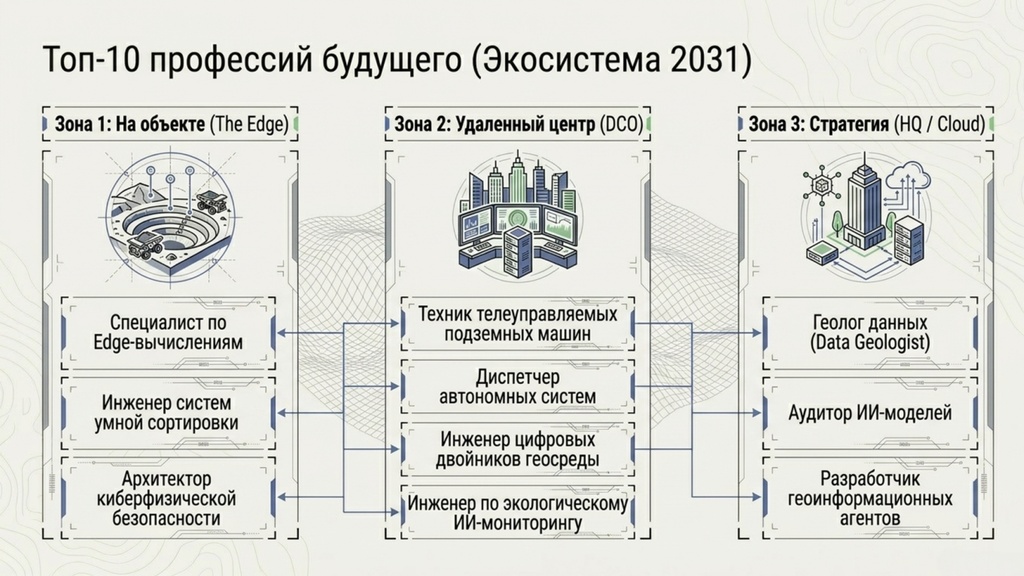
7.2. Топ-10 профессий будущего (2026–2031 годы)
Геолог данных (Data Geologist): Специалист на стыке классической геологии и Big Data. Занимается подготовкой и структурированием геологической информации для ML-моделей.
Инженер цифровых двойников геосреды: Оператор динамических ИИ-моделей месторождений, связывающий данные датчиков из карьеров с 3D-моделью рудника.
Диспетчер автономных транспортных систем: Специалист ситуационного центра, координирующий работу беспилотных самосвалов, буровых станков и дронов.
Специалист по пограничным вычислениям (Edge AI Engineer): IT-инженер, поддерживающий модели непосредственно на бортовых компьютерах тяжелой техники.
Оператор систем умной сортировки руды: Инженер-обогатитель, управляющий параметрами нейросетей, распознающих руду на конвейерных лентах по спектральным характеристикам.
Аудитор моделей и алгоритмов искусственного интеллекта: Эксперт, проверяющий решения на предмет «галлюцинаций» и соответствия физико-геологической реальности.
Инженер по экологическому ИИ-мониторингу: Специалист, управляющий системами контроля углеродного следа, выбросов и состояния хвостохранилищ на базе машинного обучения.
Разработчик геоинформационных агентов: IT-специалист, настраивающий LLM- и мультимодальные модели под специфику конкретных типов месторождений.
Техник телеуправляемых подземных машин: Профессиональный рабочий нового типа, управляющий подземными погрузчиками и комбайнами из удаленного городского офиса.
Архитектор киберфизической безопасности рудников: Специалист по защите автоматизированных систем управления и Edge-сетей предприятия от внешних атак.
7.3. Исчезающие и трансформирующиеся профессии к 2031 году
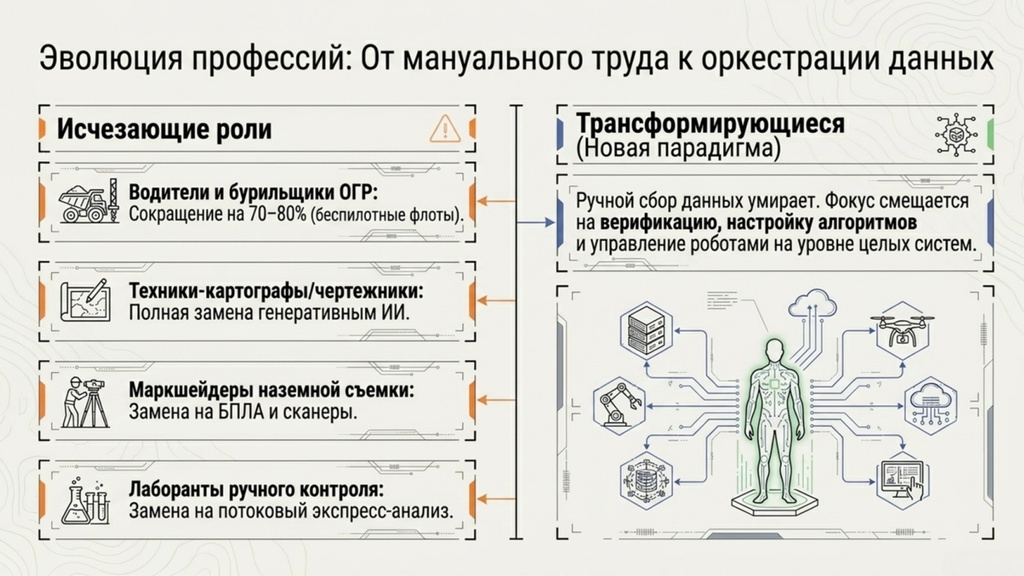
Техники-картографы и чертежники: Полностью заменяются генеративным ИИ.
Водители самосвалов и бурильщики на ОГР: Численность сократится на 70–80% за счет перехода на беспилотные флоты.
Маркшейдеры наземной съемки: Перейдут в статус операторов беспилотных летательных аппаратов (БПЛА) и лазерных сканеров.
Лаборанты ручного контроля проб: Уступят место потоковому экспресс-анализу, встроенному в технологический поток обогатительных фабрик.
8. Влияние на кадровые службы (HR-департаменты)
Трансформация HR-департаментов носит радикальный характер. Основные изменения включают:
Использование профильных ИИ-платформ: Для поиска редких междисциплинарных специалистов HR переходит на специализированные площадки. Алгоритмы автоматически сопоставляют специфический набор навыков соискателя с профилем вакансии, осуществляют автоимпорт данных и предиктивный скоринг (рейтинг).
Управление концепцией непрерывного обучения (Lifelong Learning): Главной задачей становится не увольнение старых сотрудников, а их рескиллинг (переобучение). Кадровые службы создают внутренние цифровые академии для повышения цифровой грамотности рабочих и инженеров.
Переход к матрицам компетенций T-Shaped: Оценка смещается в сторону выявления навыков, где горизонтальная черта — это широкие междисциплинарные знания и мягкие навыки, а вертикальная — глубокая экспертиза в базовой дисциплине.
9. Практические рекомендации для стейкхолдеров
9.1. Матрица компетенций T-Shaped для специалистов
Для сохранения востребованности профессионалы горного профиля должны сформировать сбалансированный портфель навыков:
9.2. Стратегия для горнодобывающих компаний
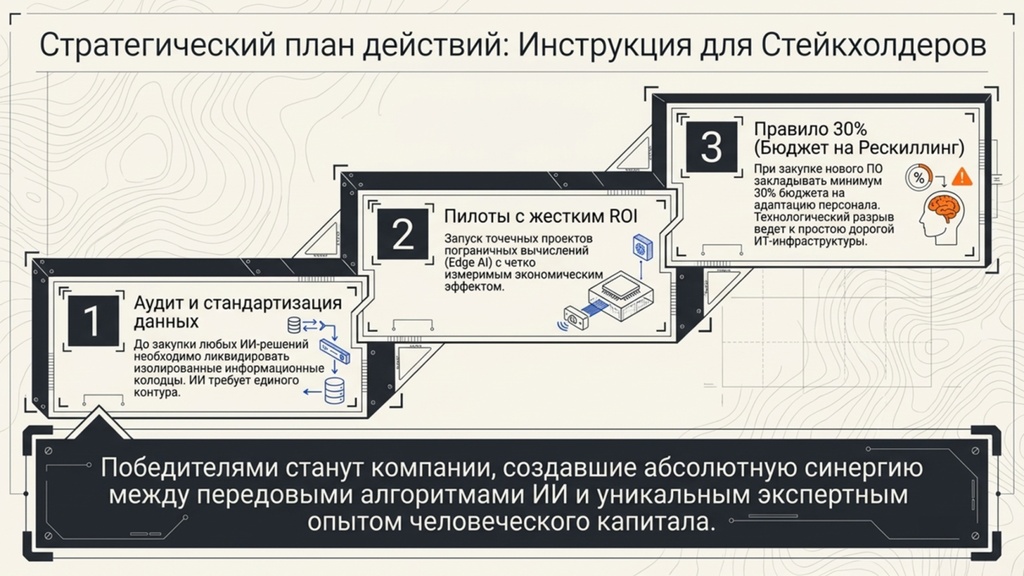
Стандартизация данных: До начала внедрения ИИ необходимо провести тотальный аудит данных, ликвидировав информационные колодцы.
Бюджет на рескиллинг (получение новых навыков): При закупке нового цифрового ПО закладывать в бюджет не менее 30% средств непосредственно на обучение и адаптацию персонала. Если внутреннее обучение отстает от коэффициента автоматизации, возникает технологический разрыв, приводящий к неэффективному использованию дорогой ИТ-инфраструктуры при падающих показателях производства.
9.3. Трансформация академического сектора
Вузы и колледжи горного профиля должны срочно пересмотреть учебные планы, внедрив обязательные модули по машинному обучению, анализу больших данных, управлению беспилотными системами и основам кибербезопасности киберфизических систем в традиционные программы.
10. Заключение
Искусственный интеллект в период с 2026 по 2031 год окончательно превращает горнодобывающую отрасль из мануальной и трудоемкой в высокотехнологичную киберфизическую индустрию. Общая численность штата крупных холдингов к 2031 году сократится в среднем на 20–25%, однако затраты на оставшийся высококвалифицированный персонал вырастут. ИИ также снизит барьер входа на рынок для юниорных и сервисных компаний: небольшие команды из 10–15 специалистов, вооруженные ИИ-агентами, смогут выполнять объемы работ, которые раньше требовали целых институтов. Победителями в этой технологической гонке станут те компании, которые смогут выстроить синергию между передовыми алгоритмами ИИ и уникальным экспертным опытом человеческого капитала.
11. Источники, использованные в исследовании
Recent Advances and Future Perspectives of AI-Based Mineral Exploration — MDPI Minerals
Machine Learning Approaches for Real-Time Mineral Classification and Educational Applications — MDPI Applied Sciences
Digital Twins and Enabling Technology Applications in Mining — IEEE Xplore
Time-Space-Quantity-Energy Coupling in Intelligent Caving Mines — MDPI Minerals
The Evolution of Machine Learning in Large-Scale Mineral Prospectivity Prediction — MDPI Minerals
Integration of machine learning with complex industrial mining systems for reduced energy consumption — PMC/Nature
Canadian explorer Mundoro Capital and mining giant BHP are intensifying exploration across five targets in eastern Serbia’s Timok Magmatic Complex, one of Europe’s most prospective copper-gold belts, with drilling results from the flagship Skorusa project expected to provide a critical indicator of the programme’s potential by the end of summer.
According to Mundoro’s first quarter 2026 report, exploration activity has focused on new drilling programmes, geophysical surveys and geological data integration across the Skorusa, Oblez, Borsko, Trstenik and South Timok Corridor projects near Bor. BHP is financing the majority of work under a stake acquisition agreement.
Skorusa is drawing the most attention. Two exploration holes totalling nearly 1,300 metres were completed during spring, with one intersecting a wider zone of advanced argillic alteration than anticipated — a feature that may indicate a preserved hydrothermal system. Laboratory analysis of drill samples is expected in June and geological interpretation should be complete by end of summer.
At the Borsko project, work to date has defined a large alteration zone measuring approximately 1.6 by 1.5 kilometres, which Mundoro believes could conceal a previously untested copper-gold porphyry system. Additional targeting and exploration preparation are planned. At the South Timok Corridor’s Lipovica area, two holes totalling approximately 1,278 metres have been completed alongside audio-magnetotelluric, gravimetric and passive seismic surveys across several licences. A new stratigraphic hole near Vitanovac is planned for the third quarter.
Mundoro is also evaluating new prospect areas across the Timok and other igneous belts in Serbia, targeting copper-gold porphyry systems, skarn mineralisation and epithermal deposits.
Americas Uranium has received approval to list its shares on the Frankfurt Stock Exchange under the ticker symbol WA7, expanding the Canadian uranium explorer’s market presence to three continents as investor interest in nuclear energy grows.
The Frankfurt listing follows the company’s existing trading on the Canadian Securities Exchange and quotation in the United States, giving Americas Uranium access to European institutional and retail investors at a moment when uranium and nuclear power are attracting renewed attention as components of the global energy transition.
CEO Nicholas Luksha described the development as an important milestone in the company’s international expansion. “Being publicly listed in Canada and quoted in the US, and now Germany, represents an important milestone for the company as we continue to expand our international profile and connect with investors who recognise the growing importance of uranium and nuclear energy in the global energy transition,” he said.
Americas Uranium focuses on acquiring, discovering and advancing uranium projects across prospective jurisdictions in the Americas.
Cornish Tin & Lithium — formerly Cornish Tin Limited — has announced significant Phase 3 drilling results from its Tregonning project in west Cornwall, confirming that a lithium-bearing rock formation extends 3.27 kilometres from Tregonning North to Tregonning South while simultaneously intersecting a new high-grade tin mineralisation system containing ten lodes identified to date.
The Phase 3 programme, conducted between September 2025 and January 2026, was primarily designed to test lithium-enriched aplite-pegmatite sheets in the newly identified Tregonning South extension area. Results confirmed that the Newall Formation — a lithium-bearing geological unit first identified at Tregonning North, where earlier drilling returned intervals including 0.3 metres grading 1.33% lithium oxide with a peak grade of 1.42% — extends continuously across the full 3.27 kilometre strike length. Multiple lithium-bearing layers at different depths across the project area suggest the total resource potential may be larger than previously assessed.
The tin discovery at Tregonning South adds a second commodity dimension of significant scale. High-grade intersections include 2.69% tin in the Norcross No.1 Lode, 1.68% tin in Rib South Lode and 1.26% tin in Rib North Lode, alongside an associated sheeted vein system extending across the area.
To reflect the project’s dual-commodity evolution, the company has rebranded as Cornish Tin & Lithium. CEO and founder Sally Norcross-Webb said the name change underscored the company’s potential to become a leading domestic source of responsibly produced tin and lithium for electric vehicles, renewable energy systems and advanced electronics. “Tregonning South clearly has spectacular potential. Never before explored systematically, as a combined mining operation, our project areas in West Cornwall could make a very significant and positive contribution to Cornwall’s economy and the critical minerals resilience of the UK and Europe,” she said.
The Ukrainian Embassy in Ireland has issued a formal statement expressing serious concern over continuing exports of alumina from the Aughinish Alumina plant in Limerick to Russia, as the Irish government conducts an investigation and the European Commission declines to include the facility in its latest sanctions package.
Ukraine’s embassy said the exports — which it claims are extensively used by Russia’s military-industrial complex — have grown significantly since the full-scale invasion of Ukraine in February 2022, rising from €196 million in 2021 to €318 million in 2025 and making Russia the largest single destination for Irish alumina exports. The embassy linked the material directly to Russian weapons production, naming Iskander-M ballistic missiles, Tsirkon hypersonic missiles, Kh-101 and Kalibr cruise missiles and Shahed-136 attack drones as systems that use aluminium derived from processed alumina.
The Aughinish plant, Europe’s largest alumina refinery, has been owned since 2007 by Rusal — the Russian aluminium giant founded by Oleg Deripaska, a close associate of President Vladimir Putin who has himself been subject to repeated Western sanctions. The company operating the plant says it complies fully with all applicable EU laws, sanctions and export controls, and has implemented a robust sanctions compliance framework across its supply chain.
The controversy deepened after an investigation by the Organised Crime and Corruption Reporting Project — a collective that includes The Irish Times — found that alumina from Aughinish was processed into aluminium and sold through a Moscow-based trader to clients including more than 40 EU-sanctioned Russian arms manufacturers. The European Commission nonetheless decided against including the plant in a recent sanctions package despite calls from nearly 40 MEPs.
An accuracy dispute over the scale of Russian exports has also emerged. Ireland’s Central Statistics Office received data from the operating company indicating more than 80% of Aughinish exports went to Russia, a figure the company now says should be closer to 45% and is being corrected. Minister for Enterprise Peter Burke said the discrepancy in data supplied to the CSO was now being rectified.
Minister of State Niall Collins defended the government’s approach, saying the Department of Enterprise review would be completed and furnished to the European Commission before any collective EU decision was taken. He also criticised some media reporting on the issue, though his remarks appeared directed at sources beyond the OCCRP, which has a long track record of award-winning investigations into corporate and financial data.
The plant employs 475 staff directly and supports several hundred more indirect jobs, complicating any decision to restrict its operations.
This research is dedicated to a fundamental technological, economic, and workforce shift in the global mining industry over the horizon of 2026–2031. The sector’s transition from isolated digital experiments to end-to-end deployment of agentic artificial intelligence (AI), multimodal neural networks, and edge computing is driven by severe macroeconomic pressures: depletion of high-grade deposits, increasingly complex geological conditions, and stringent ESG regulatory frameworks.
Drawing on case study examples, this paper analyses the impact of AI across the entire value chain — from processing exploration data to open-pit automation and mineral processing plant optimisation. Based on mathematical models of labour productivity change, a financial and workforce forecast is presented: the economic mechanisms of production cost reduction are described, alongside a transformation of the cost structure (OPEX/CAPEX), the top 10 professions of the future, and the radically altered role of HR departments. The research draws on leading practice from macro-regions (Central Asia, Europe, the USA, and China) and data from authoritative academic and analytical sources.
Discover how agentic AI, edge computing, and neural networks are tackling the industry’s biggest macroeconomic pressures and transforming the workforce (2026–2031).
Join the discussion across Europe, the Middle East, and Central Asia🌍
In 2026, the global mining industry is operating under unprecedented pressure. The global transition to a low-carbon economy demands a significant increase in the extraction of critical metals (lithium, cobalt, copper, and nickel). At the same time, the average grade of ore in active mines has fallen by 25–30% over the past two decades, and newly discovered ore bodies are found at ever greater depths. According to industry analysis, the probability of commercial success in exploration projects without the use of advanced predictive analysis methods has fallen to a critical 5% (for brownfield projects in previously developed areas; for greenfield exploration in untouched areas — just 0.3–0.5%).
Historically associated with heavy physical labour, significant health risks, and substantial environmental impact, the industry is undergoing tectonic shifts. Artificial intelligence has evolved from a category of advanced IT add-ons into the core of operational and managerial activity at enterprises. As experts note at the international Resourcing Tomorrow forum in London, the key competitive advantage for companies is no longer simply the physical volume of ore extracted, but the depth and speed of data processing. Investors directly factor in an asset’s digital maturity index and its ability to verify environmental indicators using transparent AI algorithms when assessing the value of assets.
The volume of the global AI market in mining is estimated differently by various analytical agencies: Grand View Research valued the market at $29.94 billion in 2024, with growth to approximately $41.77 billion in 2025 and a forecast of $685.61 billion by 2033 (CAGR 41.87%); SNS Insider valued it at $28.91 billion in 2024 with a forecast of $478.29 billion by 2032 (CAGR 42.15%). The variation in forecasts is explained by differences in methodology and market coverage. The figure of $1,384 billion by 2035, which appeared in a previous version, has not been confirmed by any verified source and has been removed from the text. The primary drivers of this phenomenal growth are deep machine learning technologies and the rapidly growing computer vision segment.
2. Global Technological Trends of AI in Mining
The technological architecture of a modern enterprise is based on a transition from centralised cloud computing to hybrid edge systems. The remoteness of most mines from major cities and the instability of communication channels have led to critical data processing being moved directly onto the onboard computers of heavy machinery and local enterprise servers. Data transmission latency in cloud AI systems ranges from 50 to 500 milliseconds, which is unacceptable for industrial safety systems, whereas edge computing performs transactions in fractions of a millisecond.
Core cross-cutting technologies:
• Multimodal Agentic Systems: Autonomous software agents capable of simultaneously analysing unstructured text reports, geophysical logs, satellite imagery, and financial documents for comprehensive decision-making support.
• AI-Powered Digital Twins: Dynamic three-dimensional models of processing plants and open pits that not only display the current state of objects but also simulate scenarios of how the situation develops when external physical or economic parameters change.
• Intelligent Optical Ore Sorting: Integration of hyperspectral cameras and neural networks on conveyor belts for the instant rejection of waste rock prior to the energy-intensive crushing stage.
3. The Impact of AI on the Value Chain
3.1. Exploration and Surveying
The traditional process of collecting and interpreting geological data took months of manual labour. Generative models transform terabytes of historical unstructured reports, old maps, and field journals into standardised digital datasets within a few hours.
Next-generation platforms use algorithms to identify hidden patterns and weak signals in large arrays of geophysical and geochemical data. Neural networks construct probabilistic 3D block models of metal grade distribution, optimising the planning of exploration drilling. In doing so, the concept of the ‘geologist in the control loop’ (Human-in-the-Loop) is realised: AI does not replace the human, but removes up to 80% of the routine data-cleansing work, allowing the specialist to test many times more hypotheses.
3.2. Mining Operations
In open-pit mining, automated flow management systems have become the industry standard. Software-defined autonomy platforms allow dump trucks to travel without drivers, optimising fuel consumption by 10–15% and reducing wear on large-diameter tyres.
The scale of global deployment is impressive: according to GlobalData, by July 2025, 3,832 autonomous dump trucks were in operation at open-pit mines worldwide. China leads with 2,090 vehicles (53% of the global fleet), followed by Australia, Canada, and Chile. In April 2026, Komatsu commissioned its 1,000th ultra-class autonomous haul truck fitted with the FrontRunner system, becoming the first original equipment manufacturer (OEM) to reach this milestone. Caterpillar, for its part, has set a target of bringing over 2,000 autonomous vehicles into its fleet by 2030, including actively expanding the use of the technology at smaller-scale quarries and open pits.
In underground conditions, where there is no GPS signal, AI solves navigation tasks using simultaneous localisation and mapping (SLAM) technology based on LiDAR. Autonomous drilling rigs and load-haul-dump (LHD) machines operate in high-hazard zones, while operators are located in comfortable remote operations centres hundreds of kilometres from the face.
3.3. Mineral Processing and Beneficiation
A processing plant is an extraordinarily complex system with hundreds of variables. Machine learning algorithms continuously analyse the particle size distribution of ore on the conveyor using computer vision. If material that is too coarse or too hard arrives at the mill, the AI pre-emptively adjusts the feed rate and water pressure.
In flotation processes, neural networks analyse the colour, size, and movement speed of froth bubbles on the surface of flotation cells, automatically regulating reagent consumption. This makes it possible to increase recovery of the valuable component by even 0.5%, which at the scale of a large processing facility generates millions of dollars of additional profit per year whilst minimising the environmental footprint.
4. Regional Analysis
4.1. Central Asia: Kazakhstan as a Regional AI Hub
The Republic of Kazakhstan officially declared 2026 the Year of Digitalisation and Artificial Intelligence. As part of the national strategy, the country has established a Ministry of Artificial Intelligence and Digital Development, created the national AI centre Alem.AI (located on the EXPO site in Astana; opened in October 2025), and commissioned the Alem.Cloud supercomputing cluster — the largest supercomputing cluster in Central Asia, which has entered the global TOP500 ranking. Presight AI (a subsidiary of G42, UAE) is participating in the situational centre project at Alem.AI and in the implementation of the Astana Smart City initiative, but is not a partner in the supercomputing infrastructure.
The flagship of industrial AI deployment in the region is the international mining and metallurgical group Eurasian Resources Group (ERG). The economic effect from deploying proprietary digital tools and AI solutions at ERG’s enterprises in Kazakhstan for the full year 2025 exceeded $111 million USD. Systems development is carried out by the group’s dedicated IT arm — BTS (Business & Technology Services) — which has deployed technologies across three areas:
• Computer Vision: A real-time video analytics system monitors conveyor loading levels, assesses the quality of finished products, and tracks personnel health and safety compliance. At the Aksu Ferroalloy Plant, an upgraded operations control centre uses a full-scale digital twin of Smelting Shop No. 4, allowing engineers to conduct virtual walkthroughs and instantly identify deviations.
• Robotic and Autonomous Equipment: AI is used for precise calculation of the cost of individual production stages, energy consumption optimisation, and end-to-end mine planning.
• Corporate Integration Platforms: All maintenance and operational processes are digitised within a unified qollab ecosystem, where AI assigns work orders, creates loading schedules for maintenance crews, and forecasts equipment failures based on predictive analysis.
The flagship project in the autonomous haulage segment has been the Vostochny coal open pit: ERG’s driverless dump trucks had transported over 2 million tonnes of rock by the beginning of 2026, completing 17,000 trips and covering over 68,000 km, operated via a private 5G network provided by Kazakhstani operator Kcell. ERG became the first company in Kazakhstan to deploy driverless trucks in commercial operation; by 2027, the group plans to scale up the volume of material moved by autonomous vehicles to 115 million tonnes.
4.2. Western and Northern Europe: Sustainable Development and Monitoring
In the European Union, the focus has shifted towards maximum environmental sustainability, safety, and deep geosphere data analytics. A prime example is the deployment of comprehensive wireless monitoring ecosystems (developed by companies such as Senceive and the European SensAI Mining initiative).
These systems use distributed sensor networks with edge computing elements:
• Open-Pit Slope Stability Monitoring: InfraGuard-class instruments record micro-movements in the ground, filter out false environmental noise, and send early warnings of landslide risks.
• Tailings Facility Monitoring: AI analyses pore water pressure and the structural integrity of dams, preventing breaches and minimising the risks of environmental disasters.
• Intelligent Underground Monitoring: Deformation and convergence sensors in mine workings allow roof collapses to be predicted well before any visual signs appear.
In parallel, the market for specialist software is developing rapidly in Europe. Approximately 90% of mergers and acquisitions (M&A) in the mining technology sector involve companies specialising in sensors and software with embedded machine learning.
5. AI Government Regulation and Its Impact on the Workforce (EU, USA, China)
The period 2026–2031 marks a transition to an era of strict sovereign AI regulation, which is directly transforming the map of scarce professions.
5.1. European Union: A Stringent Compliance Model
The EU Artificial Intelligence Act (EU AI Act), being phased in from August 2024, has created the world’s most stringent regulatory environment. An important clarification: in May 2026, the EU reached a preliminary political agreement to postpone the full compliance deadline for high-risk AI systems (Annex III, including HR applications) from 2 August 2026 to 2 December 2027, as part of the ‘Digital Omnibus’ package. Requirements relating to prohibited practices (emotional recognition in the workplace, etc.) came into force in February 2025.
• Regulatory Context: Any AI systems used for personnel management (CV screening, KPI assessment), as well as systems for monitoring worker behaviour at hazardous sites, are classified as ‘High-Risk’.
• Workforce Impact: Explosive demand has emerged for AI Model Auditors and Compliance Engineers. Traditional HR directors are now required to have a level of AI Literacy and an understanding of the principles of explainable AI (XAI) in order to legitimately defend algorithm-driven decisions before trade unions.
5.2. USA: Critical Infrastructure Cybersecurity and Critical Supply Chains
The US strategy is built around protecting critical information infrastructure (CII) and accelerating the extraction of critical minerals.
• Regulatory Context: Under White House executive orders and NIST directives, AI solutions in the extractive sector are viewed through the lens of national security. Particular attention is paid to protecting against cyberattacks on geographic information systems and autonomous transport.
• Workforce Impact: Mine Cyber-Physical Security Architects and Edge Computing Security Engineers have become critically sought after. Chief Information Officers (CIOs) are required to have a deep knowledge of cyber-resilience standards such as the NIST AI Risk Management Framework.
5.3. China: Sovereign Algorithm Control and End-to-End Robotisation
China is demonstrating a model of total state control combined with rigorous directive planning for industrial modernisation.
• Regulatory Context: The Cyberspace Administration of China (CAC) requires mandatory state registration of all industrial algorithms. A five-year plan is in place for the full automation of coal and iron ore mines. The use of foreign ML libraries within the perimeter of strategic enterprises is prohibited.
• Workforce Impact: A vast domestic market has been created for Geoinformation Agent Developers and Digital Twin Engineers working exclusively on the Chinese technology stack (Baidu Ernie, Huawei Pangu). The training of engineering personnel is strictly standardised under the concept of ‘Smart Mines’.
6. The Economics of Transformation: Reducing Labour and Production Costs
The deployment of artificial intelligence is changing the traditional structure of human resource costs through three key economic mechanisms:
1. Skill Compression
The integration of multimodal AI assistants reduces the time required for complex engineering tasks by 15–50%. AI narrows the gap between junior specialists and experts. Less experienced employees, supported by AI agents, begin to perform senior-level tasks without any loss of quality. This sharply reduces the ‘talent premium for scarce experience’ that companies are forced to pay in an overheated labour market.
1. Geographical Arbitrage and the Elimination of Rotational Costs
Relocating management functions to remote operations centres (DCOs/ROCs) allows personnel to be hired on standard urban terms. Companies fully eliminate or reduce by 35–40% the associated costs: maintaining rotational camps, helicopter logistics, enhanced medical insurance, and statutory allowances for working in extreme climatic conditions.
1. Elimination of Operational Micro-Downtime
The human factor causes cyclical losses (shift changes, meal breaks, reduced concentration). Autonomous complexes under AI control operate 24/7, which increases equipment utilisation by 10–15%. The per-unit cost of human labour embedded in each tonne of rock moved falls in proportion to the rise in continuous equipment productivity.
Transformation of OPEX to CAPEX and Reduction in AISC
The payroll (labour costs), which at traditional mines accounts for up to 30–40% of operating expenditure (OPEX), will fall to 18–22% by 2031. These costs will partially shift into the category of technological OPEX (licence payments) and CAPEX (procurement of edge servers and robotic complexes). Digital infrastructure, unlike people, is not subject to wage inflation and social risks.
Through the end-to-end application of AI agents, the All-In Sustaining Costs (AISC) per ounce or tonne of finished metal will fall by an average of 15–22% by 2031, allowing high margins to be maintained even when processing low-grade ores.
7. Forecast of Workforce Structure and Requirements (2026–2031)
7.1. Mathematical Basis for the Employment Transformation
To assess changes in the structure of working hours for engineering and technical personnel (T_total), a model is applied that separates time spent on routine operations (T_routine) and expert activity (T_expert):
T_total = T_routine + T_expert
The deployment of multimodal AI agents leads to an exponential reduction in the time spent on routine operations, described by the automation coefficient α, which depends on the digital maturity of the enterprise:
T_routine(t) = T_routine(0) × e^(−αt)
The freed-up time is redirected towards expert analysis. To decide whether to replace human labour with AI systems, financial departments evaluate the economic efficiency coefficient of automation (E_auto):
E_auto = (C_human × P_human) / (C_AI + C_verify)
Where:
• C_human — the total cost of employing a person per unit of time (payroll, logistics, health and safety).
• P_human — the index of baseline human productivity, accounting for downtime.
• C_AI — the cost of operating AI infrastructure (hardware depreciation, licences).
• C_verify — the cost of the expert auditor’s labour in exercising oversight of AI decisions (Human-in-the-Loop).
By 2031, due to falling computing costs, C_AI will decrease by an average of 12–15% per year, making automation economically advantageous (E_auto > 1) even in regions with historically cheap labour.
7.2. Top 10 Professions of the Future (2026–2031)
2. Data Geologist: A specialist at the intersection of classical geology and Big Data. Responsible for preparing and structuring geological information for ML models.
3. Geoenvironment Digital Twin Engineer: An operator of dynamic AI models of ore deposits, linking sensor data from open pits with a 3D mine model.
4. Autonomous Transport Systems Controller: An operations centre specialist coordinating the operation of driverless dump trucks, drilling rigs, and drones.
5. Edge AI Engineer: An IT engineer who maintains models directly on the onboard computers of heavy machinery.
6. Intelligent Ore Sorting Systems Operator: A processing engineer who manages the parameters of neural networks that recognise ore on conveyor belts using spectral characteristics.
7. AI Model and Algorithm Auditor: An expert who verifies decisions for ‘hallucinations’ and compliance with physical and geological reality.
8. Environmental AI Monitoring Engineer: A specialist who manages systems for monitoring carbon footprint, emissions, and the condition of tailings facilities using machine learning.
9. Geoinformation Agent Developer: An IT specialist who configures LLM and multimodal models to the specifics of particular deposit types.
10. Remote Underground Machine Operator: A new type of skilled worker who operates underground loaders and continuous miners from a remote urban office.
11. Mine Cyber-Physical Security Architect: A specialist in protecting automated control systems and the enterprise’s edge networks from external attacks.
7.3. Disappearing and Transforming Professions by 2031
• Cartographic Technicians and Draughtspeople: Fully replaced by generative AI.
• Dump Truck Drivers and Drillers at Open Pits: Numbers will fall by 70–80% due to the transition to driverless fleets.
• Mine Surveyors (Ground-Based): Will transition to the role of unmanned aerial vehicle (UAV) and laser scanner operators.
• Manual Sample Control Laboratory Technicians: Will give way to in-stream express analysis embedded in the processing plant’s production flow.
8. Impact on HR Departments
The transformation of HR departments is radical in character. The main changes include:
• Use of Specialist AI Platforms: To find rare interdisciplinary specialists, HR is transitioning to specialist platforms. Algorithms automatically match an applicant’s specific skill set to the vacancy profile, carrying out automatic data import and predictive scoring.
• Managing the Lifelong Learning Concept: The primary task is no longer dismissing old employees, but reskilling them (retraining). HR departments are creating internal digital academies to improve the digital literacy of workers and engineers.
• Transition to T-Shaped Competency Matrices: Assessment is shifting towards identifying skills where the horizontal bar represents broad interdisciplinary knowledge and soft skills, and the vertical bar represents deep expertise in a core discipline.
9. Practical Recommendations for Stakeholders
9.1. T-Shaped Competency Matrix for Professionals
To remain in demand, mining professionals must build a balanced skills portfolio:
Core Engineering Skills (Hard Skills)
Digital Competencies (AI Skills)
Soft Skills
Geology, processing, mine surveying
Understanding the principles of ML and Edge AI
Systems and critical thinking (verifying AI conclusions)
Knowledge of the physical and mechanical properties of rock
Working with digital twins and GIS
Cross-functional communication
Understanding industrial safety requirements
AI Literacy and basic data analysis
Adaptability and capacity for rapid retraining
9.2. Strategy for Mining Companies
• Data Standardisation: Before beginning AI deployment, a comprehensive data audit must be carried out, eliminating information silos.
• Economically Justified Pilots: Launch AI projects with a clearly measurable economic effect (ROI).
• Reskilling Budget: When procuring new digital software, budget no less than 30% of funds directly for personnel training and adaptation. If internal training lags behind the rate of automation, a technology gap emerges, leading to inefficient use of expensive IT infrastructure alongside falling production metrics.
9.3. Transformation of the Academic Sector
Mining universities and colleges must urgently revise their curricula, embedding compulsory modules in machine learning, big data analysis, unmanned systems management, and the fundamentals of cybersecurity for cyber-physical systems within traditional degree programmes.
10. Conclusion
Artificial intelligence will definitively transform the mining industry between 2026 and 2031 from a manual, heavy industry into a high-technology cyber-physical sector. The total headcount at large holding companies will fall by an average of 20–25% by 2031; however, expenditure on the remaining highly qualified personnel will rise. AI will also lower the barrier to market entry for junior and service companies: small teams of 10–15 specialists, armed with AI agents, will be able to carry out volumes of work that previously required entire institutes. The winners in this technological race will be those companies that are able to build a synergy between advanced AI algorithms and the unique expert experience of their human capital.
11. Sources and Primary References
12. Recent Advances and Future Perspectives of AI-Based Mineral Exploration — MDPI Minerals
13. Machine Learning Approaches for Real-Time Mineral Classification and Educational Applications — MDPI Applied Sciences
14. Digital Twins and Enabling Technology Applications in Mining — IEEE Xplore
15. Time-Space-Quantity-Energy Coupling in Intelligent Caving Mines — MDPI Minerals
16. The Evolution of Machine Learning in Large-Scale Mineral Prospectivity Prediction — MDPI Minerals
17. Integration of machine learning with complex industrial mining systems for reduced energy consumption — PMC/Nature
18. Mine Management Optimisation in the Era of AI and Advanced Analytics — MDPI Mining Special Issue
19. Computer Vision and Machine Learning in Mining Technology — MDPI Applied Sciences Special Issue
20. New machine learning tools uncover hidden mineral resources in complex terrains — European Commission CORDIS (MultiMiner Project)
21. Digital Twins for Mine Safety and Infrastructure Monitoring — PMC open access research
22. Artificial Intelligence (AI) in Mining Market Report: Trends and Forecasts — SNS Insider Market Research
23. Copper in the Age of AI: Strategic Implications for Global Supply Chains — S&P Global Special Report (January 2026)
24. Machine learning applications in minerals processing: A review — GlobalData — Development of Autonomous Trucks in Mining (2025)
25. AI in Mining Market Report 2024-2032 — SNS Insider
26. Stanford AI Index Report 2026 — Stanford Institute for Human-Centered AI (hai.stanford.edu)
27. Tracking the Trends: The top 10 issues shaping the future of mining and metals — Deloitte Insights
28. Rock Solid AI: How Digital Tools Are Unearthing a New Era of Mining Exploration — Cleantech Group (2025)
29. Development of Autonomous Trucks in the Global Mining Sector (2025) — GlobalData Mining Intelligence (2025)
30. Artificial Intelligence in Mining Market Size, Share & Industry Analysis — Grand View Research (grandviewresearch.com)
31. Mining’s top ten ESG trends for 2026: Verification and Transparency — Mining.com (2026)
32. ERG heralds ‘Year of Digitalisation and AI’ as new programmes start paying off — International Mining (February 2026)
33. Komatsu becomes first OEM to commission 1,000 ultra-class autonomous haul trucks — IVT International (April 2026)
34. EU AI Act Update: Timeline Relief, Targeted Simplification, and New Prohibitions (Digital Omnibus, May 2026) — Inside Privacy / Gibson Dunn (2026)
The European Union faces a multi-billion-dollar geopolitical dilemma that cuts to the very core of its economic security.
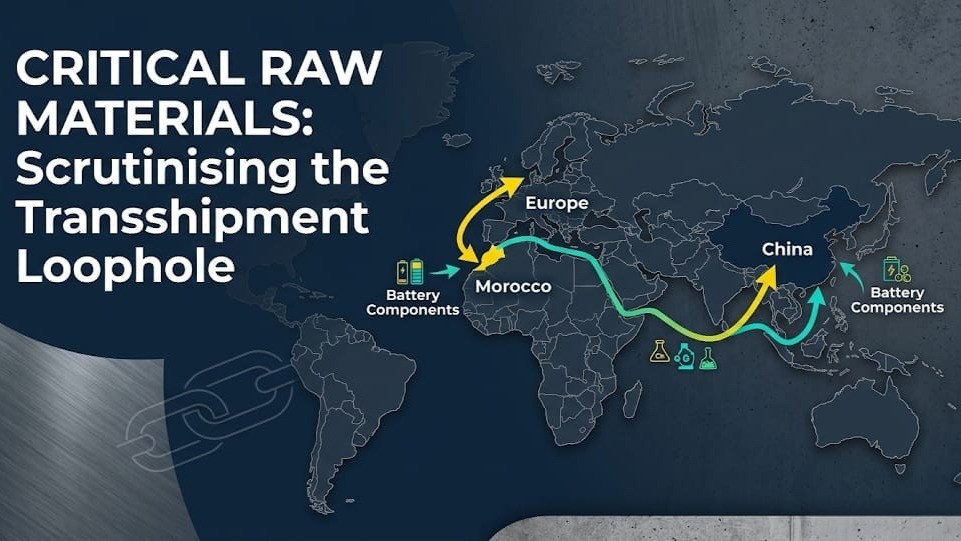
EU Trade Commissioner Maroš Šefčovič recently issued a stark warning regarding a massive surge in Chinese industrial investment in Morocco. The fear? Beijing is utilising “transshipment” to offshore its domestic industrial overcapacity and bypass mounting Western tariffs.
With over $6 billion in Chinese capital flooding into Morocco’s green energy and automotive sectors, the North African nation is rapidly morphing into Africa’s premier EV hub.
🔍 The Scale of the Pivot
Major projects are reshaping the supply chain:
Gotion High-Tech is constructing a $1.3 billion battery gigafactory in Kenitra.
Industrial giants like CNGR, Shinzoom, and BTR New Material Group are establishing massive cathode, anode, and copper processing facilities.
⛓️ From Raw Materials to Consumer Products: The Resilience Crisis
This isn’t just about final vehicle assembly; it is an encroachment across the entire vertical supply chain. To build truly resilient European supply chains, the block needs secure access to everything from critical raw materials up to the final consumer product.
However, China already possesses the capability to dominate key components of Morocco’s industrial ecosystem, including the processing facilities and logistics infrastructure right up to the shipping ports. By dominating these upstream segments, foreign entities effectively lock in dependencies long before a battery component ever reaches a European consumer showroom. Under frameworks like the EU’s Critical Raw Materials Act (CRMA), Brussels has set ambitious targets to reduce reliance on dominant single nations—yet this investment pattern actively challenges those resilience goals.
🇺🇸 vs 🇪🇺 Market Protection: Carrots vs. Sticks
The Morocco-China nexus highlights a profound asymmetry in how the US and the EU protect their domestic markets and enforce economic resilience:
The US “Carrot” Model (Inflation Reduction Act): The US takes a highly transactional, aggressive approach to friendshoring. The IRA relies on massive tax incentives and localised demand signals (like the $7,500 EV consumer credit). Crucially, it deploys strict Foreign Entity of Concern (FEOC) restrictions that explicitly bar subsidies if battery components or critical minerals are sourced from Chinese entities—even if they are processed in an FTA partner nation. It explicitly redirects the flow of capital via financial reward.
The EU “Stick” Model (Regulatory & Compliance): Conversely, the EU relies on complex legal enforcement, strict “Rules of Origin” audits, and retrospective anti-subsidy tariffs. Without an equivalent pool of centralised cash or explicit bans on foreign entities operating in neighbouring free-trade zones, the EU has a much less efficient mechanism for preventing circumvention. Brussels must rely on tedious bureaucratic investigations to prove a product wasn’t “significantly transformed” locally—a process that is slow, easily litigated, and reactive.
⚖️ Brussels’ Policy Gridlock
Retaliation isn’t simple. The European Commission is caught between economic defence and its own climate targets:
Supply Chain Disruption: European automotive giants like Renault and Stellantis have massive, long-standing manufacturing operations in Morocco. Punishing Moroccan exports directly penalises European corporate bottom lines.
The 2035 EV Mandate: Roughly 85% of Morocco’s automotive output is bound for Europe. The EU fundamentally relies on these close, cost-effective supply routes to meet its legally mandated 2035 ban on new fossil-fuel vehicles.
The Local Content Battle: Moroccan trade officials strongly reject allegations of corporate camouflage, noting that Chinese firms must achieve strict, legal thresholds of “significant local transformation” to qualify for tariff-free EU access.
The EU has previously penalised specific Moroccan exports (like aluminium wheels) after finding evidence of unfair state aid. But scaling up enforcement to cover the entire battery ecosystem could spark a massive trade dispute or tank Europe’s own EV transition.
🌐 Join the Discussion Across Europe, the Middle East, and Central Asia!
These complex cross-border value chains, regulatory shifts, and mineral security strategies will be at the very center of our upcoming regional forums. Connect with industry leaders, policymakers, and midstream operators to debate the future of critical raw materials:
👇 To the supply chain, trade policy, and automotive experts in my network:
Is the EU’s regulatory approach robust enough to prevent this kind of economic circumvention, or does Europe need to adopt a US-style, incentive-backed “FEOC” policy to truly protect its clean-tech sector?