Website: Europe.com

  • G7 Critical Minerals Trading Bloc Stumbles as Allies Reject Pentagon AI Pricing Model and Industry Divides Over Price Controls

    G7 Critical Minerals Trading Bloc Stumbles as Allies Reject Pentagon AI Pricing Model and Industry Divides Over Price Controls

    The Trump administration’s push to create a Western critical minerals trading bloc is facing significant headwinds from sceptical G7 allies and a divided mining industry, with negotiations over price supports, governance structures and enforcement mechanisms producing more disagreement than consensus ahead of the G7 leaders’ summit in France.

    The bloc concept, first proposed by Vice President JD Vance in February, aims to help Western nations reduce dependence on China — which built its dominant position in cobalt, lithium, nickel, rare earths and other strategic minerals partly by operating at a loss and suppressing global prices, driving Western competitors out of business. The proposed measures include price supports, market standards, subsidies and guaranteed purchases, potentially enforced by adjustable tariffs to uphold pricing integrity.

    A central sticking point is the US plan to use prices derived from the Pentagon’s DARPA-developed OPEN AI metals programme, designed to calculate what a mineral should cost when labour, processing and other inputs are factored in while alleged Chinese market manipulation is excluded. European allies have pushed back against this approach, with one source citing concerns about Washington having too much sway over EU pricing. “For Europe, it would be better to have a price index based on real deals in the European market,” said Nicola Beer, who oversees minerals financing at the European Investment Bank. As an alternative, EU-funded body EIT RawMaterials is working with digital platform Metalshub to create pricing indices outside Chinese government-led mechanisms that could include the US, Australia, Canada and the UK.

    Governance is generating its own fractures. France, holding the G7 presidency, and Canada want a permanent administrative secretariat within the IEA or OECD to track initiatives as presidencies rotate. The US is reluctant. France and Canada also favour a multilateral trading bloc approach, while Washington wants to forge fast bilateral deals and expand them later. US Trade Representative Jamieson Greer said Washington aims to present proposals for binding bilateral agreements to Japan and the EU before the end of June, potentially covering five to ten minerals including heavy rare earths, antimony, graphite and tungsten — all subject to Chinese export bans or restrictions.

    European officials say they want to study the impact of price supports on medium and long-term dynamics rather than commit to fast deals. A broader concern is who ultimately pays the premium for higher-priced minerals and how far down the supply chain any subsidy should extend — questions complicated by the fact that many Western nations import very few minerals in raw or lightly processed form.

    Within the US itself, more than 230 public submissions to Greer’s office reveal a divided mining industry. General Motors, Umicore, Sibanye Stillwater, MP Materials and the US Chamber of Commerce all offered divergent proposals. The National Mining Association advised against price-fixing, recommending tax credits and incentives instead. “While market interventions such as pricing mechanisms may play a role in certain circumstances, incentive-based approaches are better suited to addressing challenges facing the domestic mining industry,” said its CEO Rich Nolan.

    “There’s nervousness from all sides about what to do and how different actions could affect different parts of the supply chain,” said Blake Harden of EY.

  • Kyrgyzstan and Turkey Advance Mining Cooperation Talks as Bishkek Courts Foreign Expertise in Rare Earths and Critical Minerals

    Kyrgyzstan and Turkey Advance Mining Cooperation Talks as Bishkek Courts Foreign Expertise in Rare Earths and Critical Minerals

    Kyrgyzstan’s Minister of Natural Resources, Ecology and Technical Supervision Akyl Toktobaev has met with a delegation from Turkish company MTA International Mining Inc., led by CEO Nail Yildirim, to discuss prospects for bilateral cooperation across the full mining value chain including geological exploration, mineral processing and critical minerals development.

    The discussions focused on joint geological exploration, technology and knowledge sharing in exploration, production, beneficiation and mineral processing, personnel training, specialist internships and joint research projects in rare earth elements and critical minerals — areas of growing strategic priority as Western governments seek to diversify supply chains away from Chinese-dominated sources.

    The meeting follows Toktobaev’s participation in April 2026 in the OECD Forum on Strategically Important Minerals in Istanbul, where he emphasised Kyrgyzstan’s ongoing implementation of international reporting standards and strengthened disclosure requirements in the subsoil use sector. “This contributes to increased transparency in the industry and strengthens investor and public confidence,” he said. On the sidelines of the Istanbul forum, Toktobaev also held a bilateral meeting with Turkish Energy and Natural Resources Minister Alparslan Bayraktar to discuss expanding subsoil use cooperation between the two countries.

    Kyrgyzstan holds significant critical mineral endowment including approximately 13% of global antimony reserves and substantial gold, copper and rare metal resources, and has been working to position itself as an investable jurisdiction as Western and allied interest in Central Asian mineral assets intensifies. Turkey’s MTA International Mining is the international arm of the Turkish state geological survey, giving the cooperation discussions an institutional rather than purely commercial character.

  • C5+1 Format Broadens Into Culture and Heritage as Critical Minerals Session in Astana Follows Tashkent Diplomatic Week

    C5+1 Format Broadens Into Culture and Heritage as Critical Minerals Session in Astana Follows Tashkent Diplomatic Week

    The United States and Central Asia advanced the C5+1 format on multiple fronts in the same week, with a cultural cooperation meeting in Tashkent on 5 June followed days later by a critical minerals dialogue session in Astana — a sequence that reflects the format’s deliberate expansion from security and energy diplomacy into a more comprehensive regional engagement framework.

    The Tashkent meeting brought together culture ministers from all five Central Asian states alongside US Under Secretary of State for Public Diplomacy Sarah Rogers. Participants discussed the formation of a permanent C5+1 Working Group on Culture, a joint Culture and Innovation Forum, expanded places for Central Asian cultural professionals in US education and exchange programmes, and closer cooperation in the creative industries. Uzbekistan proposed establishing joint English for Culture centres with US partners at cultural education institutions — a concrete institutional base for an agenda that has previously remained at the level of declarations. The meeting concluded with a protocol reaffirming commitments from the November 2025 Washington summit, covering joint events in art, literature, theatre, cinema and music, museum partnerships, heritage digitisation and tourism routes.

    The cultural diplomacy track sits alongside the more commercially focused critical minerals agenda that brought the C5+1 format to Astana for the 10 June Critical Minerals Dialogue, held immediately before the Astana Mining and Metallurgy Congress on 11 to 12 June. The congress programme covers investment conditions, taxation, transport and logistics, copper as a strategic metal and the transition from mineral resources to funded investment projects, with B2B and B2G meetings and a site visit to a Qarmet enterprise on 13 June. Companies and organisations from Kazakhstan, Canada, China, Germany, Saudi Arabia, Sweden and the United States are among confirmed participants.

    Kazakhstan’s position at the centre of these discussions reflects its genuine strategic weight. The country accounted for 39% of global uranium production and 48.8% of global natural uranium exports in 2024, while hard minerals and metals made up 18% of exports by value. Refined copper exports generated $2 billion that year, zinc $788 million and silver $588 million. Kazakhstan is also working to develop rare earth potential into bankable projects, following the 2025 announcement of the Zhana Kazakhstan deposit with estimated resources exceeding 20 million metric tonnes containing neodymium, cerium, lanthanum and yttrium.

    The week’s sequence illustrates how the C5+1 format is evolving from broad diplomatic declarations toward working-level deliverables. Leaders set priorities in Washington in November 2025; ministers and sectoral officials are now converting those priorities into practical workstreams. For the United States, critical minerals represent the strongest economic rationale for maintaining the format’s momentum. For Central Asian governments, the incentive is technology transfer, financing, market access and a larger share of value captured domestically from their own resources.

  • UK’s Last Opencast Coal Mine Application Rejected as Wales Closes Chapter on Surface Coal Mining

    UK’s Last Opencast Coal Mine Application Rejected as Wales Closes Chapter on Surface Coal Mining

    The final outstanding proposal for opencast coal mining in the United Kingdom has been refused, after Carmarthenshire Council rejected plans by Bryn Bach Coal Ltd to extend the Glan Lash mine near Llandybie in south Wales, citing unacceptable impacts on protected woodland, peatland and an endangered butterfly population.

    The council’s head of place and sustainability, Rhodri Griffiths, said the proposals conflicted with multiple policies on biodiversity and the environment. The scheme would have adversely affected protected woodland and hedgerows and caused what he described as “the unacceptable disturbance, degradation and loss” of irreplaceable peatland. The application also raised concerns for a local population of marsh fritillary — one of the UK’s most threatened butterfly species.

    Bryn Bach Coal had sought to extend the site over 10.3 hectares, promising extraction of 85,000 tonnes of coal and 11 jobs. The company had revised its application after councillors rejected an earlier version in 2023, arguing it had developed a niche non-thermal market for premium anthracite with demand from water filtration, battery production and green steelmaking industries. It has six months to appeal the decision.

    The rejection means there are now no live applications for new coal mines anywhere in the UK. Coal Action Network described the decision as reflecting “a clear, strategic commitment to climate leadership, rare habitat protection, and safeguarding the health of surrounding communities,” while Friends of the Earth Cymru called it “great news” that brought to a close years of campaigning and ended Wales’ last opencast coal mine.

    The Glan Lash mine opened in 2012 under a licence permitting extraction of 92,500 tonnes of coal over four and a half years before closing in 2019. The UK’s largest opencast coalmine, Ffos-y-Fran above Merthyr Tydfil, closed in 2023 after its extension application was similarly refused. Wales retains one deep mine, at Aberpergwm in Neath Port Talbot.

  • Kazakh Exporters Face Rising Costs Under EU Carbon Border Mechanism

    Kazakh Exporters Face Rising Costs Under EU Carbon Border Mechanism

    The European Union’s Carbon Border Adjustment Mechanism (CBAM), which came into force in 2026, is creating new compliance challenges for Kazakh металлургical exporters supplying the European market.

    CBAM is designed to account for carbon dioxide emissions generated during the production of imported goods and serves as an environmental standard for both European and foreign manufacturers. Kazakh exporters are now required to maintain detailed carbon reporting in order to preserve access to EU markets.

    More than half of Kazakhstan’s aluminum exports are destined for the European Union. In addition to the aluminum sector, the new rules also apply to ferrous metallurgy products.

    Kazakhstan’s Ministry of Trade and Integration, the International Trade Centre (ITC) and QazTrade conducted an assessment of CBAM’s impact on local businesses and prepared practical recommendations for metallurgical companies adapting to the new framework.

    According to the study, exporters of raw aluminum, ferrochrome, steel bars and rods could face annual CBAM-related costs of around €114 million if export volumes remain at 2025 levels.

    QazTrade Deputy Chairman Nurlan Kulbatyrov said Kazakh industrial exporters have already begun adapting to the new EU requirements. Support measures are being introduced to help companies reduce financial pressure and maintain the competitiveness of Kazakh products in the European market.

    During a June 3 seminar, representatives of business, government and international organizations discussed methods for monitoring and verifying emissions, as well as opportunities linked to greener industrial production.

    One of the report’s authors, ITC expert Joost Pauwelyn, noted that Kazakhstan exports more than €600 million worth of steel and aluminum products to the EU annually. He warned that European greenhouse gas regulations could increase annual costs for Kazakh exporters by more than €100 million. Approximately 90% of the additional burden is expected to fall on steel bars and rods. In some cases, CBAM-related expenses could exceed the value of the exported product itself.

    Pauwelyn outlined several measures that could significantly reduce the financial impact on producers, including:

    • Monitoring and declaring actual emissions rather than relying on default values
    • Accrediting Kazakh verification bodies
    • Reducing greenhouse gas emissions at production facilities
    • Developing domestic carbon pricing mechanisms in Kazakhstan
  • US Startup Atana Elements Plans Lithium Exploration Beneath Volkswagen and BMW Factory Sites in Germany and Poland

    US Startup Atana Elements Plans Lithium Exploration Beneath Volkswagen and BMW Factory Sites in Germany and Poland

    American startup Atana Elements is targeting lithium exploration beneath industrial areas in Germany and Poland where Volkswagen and BMW operate manufacturing facilities, in a project backed by Chilean mining major Antofagasta that aims to reduce Europe’s dependence on Chinese critical mineral imports.

    The company has secured exploration licences covering approximately 1.5 million acres across regions around Salzgitter in Germany and Wrocław in Poland, according to the Financial Times. The fact that the exploration areas lie beneath facilities already consuming lithium in battery production is described as coincidental rather than by design.

    Atana Elements is combining historical geological data with artificial intelligence technologies to identify promising lithium deposits, working in cooperation with Antofagasta. The company estimates it could extract up to 26 million tonnes of lithium across the two sites over the next 20 years — a figure that, if realised, would represent a significant addition to European domestic critical mineral supply. However, analysts cited by the Financial Times cautioned that the project remains at an early stage and that any assessment of actual production volumes is premature.

    The initiative reflects growing interest in unconventional domestic lithium sources across Europe as governments and industries seek to reduce exposure to Chinese-dominated supply chains for battery materials essential to the electric vehicle transition.

  • Terra Balcanica Secures Viogor Polymetallic Licence in Bosnia Targeting Antimony and Silver as European Critical Minerals Demand Grows

    Terra Balcanica Secures Viogor Polymetallic Licence in Bosnia Targeting Antimony and Silver as European Critical Minerals Demand Grows

    Terra Balcanica Resources has secured a new mineral exploration licence for the Viogor polymetallic project in eastern Bosnia and Herzegovina, consolidating three previously drilled targets into a single 49 square kilometre tenure within the historically significant Srebrenica mining district.

    The licence, issued on 20 May 2026 by the Republic of Srpska Ministry of Energy and Mines to Terra’s wholly owned subsidiary Energetski minerali doo Banja Luka, is valid for three years with two potential two-year extensions providing up to seven years of continuous exploration tenure. It covers the Čumavići polymetallic corridor, the Kiseli Potok molybdenum porphyry and the two Brežani discoveries — all defined during Terra’s exploration work between 2020 and 2022.

    The Čumavići corridor is the flagship target, hosting a series of high-grade intermediate sulphidation epithermal silver-antimony-zinc-lead-gold vein systems across more than 7.2 kilometres of strike length. The Čumavići Ridge system has been tested across more than 28 drill holes along 180 metres of strike, returning an average grade of 485 grams per tonne silver equivalent over 4.0 metres. The mineralisation is characterised by sphalerite, stibnite and galena with silver-rich sulphosalts — making antimony, a metal subject to Chinese export controls since September 2024, a key strategic commodity within the project.

    The Brežani discovery hosts a large multidomain magmatic-hydrothermal system including a 650 by 400 metre gold-bearing skarn and a structurally controlled base metal epithermal zone at depth. A discovery hole intersected approximately 20 metres of fault-breccia hosted silver-antimony-zinc mineralisation at 480 metres depth grading above 436 grams per tonne silver equivalent. An electromagnetic conductor interpreted as the antimony-silver-zinc mineralisation extends 1.2 kilometres in length and up to 600 metres in width, offering potential for a large tonnage ore body.

    The project is strategically located approximately 80 kilometres east-northeast of Dundee Precious Metals’ Vareš silver-zinc mine and adjacent to the Mineco Sase mine, which produces approximately 330,000 tonnes of lead-zinc-silver-gold concentrate per year using processing infrastructure genetically compatible with Terra’s mineralised targets.

    Terra CEO Dr. Aleksandar Mišković said securing the licence removes tenure uncertainty and paves the way for a preliminary resource estimate in 2027, positioning the company as a potential supplier of critical metals — notably antimony — to neighbouring European markets.

  • Disinformation and Political Inertia Are Costing Bulgaria Billions as EU Critical Minerals Drive Opens a Window It Cannot Afford to Miss

    Disinformation and Political Inertia Are Costing Bulgaria Billions as EU Critical Minerals Drive Opens a Window It Cannot Afford to Miss

    Bulgaria possesses the geological endowment to make a meaningful contribution to Europe’s critical minerals security — tungsten, copper, gold, barite and other strategic materials sit in its subsoil — yet for 35 years the country has managed to bring only one significant new mining project to completion. Industry leaders say the primary obstacle is not geology, regulation or finance, but organised disinformation that has repeatedly killed projects with broad economic potential before they reach production.

    The analysis comes from two prominent voices in the Bulgarian mining sector, Assoc. Prof. Ivan Mitev of the Bulgarian Chamber of Mining and Geology and Vanya Deneva, Procurator and Board Member at Assarel-Investment, both of whom point to a recurring pattern: legitimate environmental concerns become intertwined with unfounded or exaggerated claims that embed themselves in public consciousness before expert corrections can take hold.

    Deneva is blunt about the mechanism. “Disinformation is key for stopping mining projects in Bulgaria,” she says, describing campaigns that routinely portray investors as entities willing to trade public health for profit and leave behind environmental destruction. The rhetoric — amplified by green NGOs, populist parties and mainstream media — exploits deep post-communist distrust of private enterprise. More troubling, she argues, is that foreign-funded civil society programmes nominally designed to strengthen democratic participation have been repurposed into instruments of organised opposition. “They post on Facebook false and misleading information about mining activities,” she notes.

    The Trun gold project provides the clearest case study. An initiative by Assarel-Medet in a region with a long mining history, the project initially attracted relatively positive local sentiment. That changed after externally supported activists launched door-to-door campaigns warning residents of an influx of migrants, the importation of communities from other regions, and even the blocking of cemetery access. A referendum in June 2017, conducted amid a heavy media smear campaign, produced a 93% vote against — effectively ending the project. Local authorities had stayed silent to avoid reputational risk.

    The tungsten deposit at Grancharitsa near Velingrad represents a similar impasse. Tungsten is a strategic material essential for high-performance alloys, electronics and defence. But local opposition, centred on fears that mining would destroy the region’s spa tourism and contaminate mineral water sources, has stalled the project indefinitely. Mitev describes the mineral water contamination claims as “scientifically nonsense” — but notes that once such narratives are established they become nearly impossible to dislodge.

    The economic cost of this pattern is measurable. A 2018 analysis by Bulgaria’s Ministry of Environment and Water estimated that project appeals and delays had already inflicted damages of approximately 1.35 billion euros over a decade. Accounting for inflation and projects blocked since then, the true cumulative figure is likely substantially higher. These losses translate directly into foregone jobs, reduced tax revenues and stalled development in depopulated rural areas where mining could provide stable, well-paid employment.

    Both Mitev and Deneva argue that the EU’s Critical Raw Materials Act — with its targets for domestic extraction, processing and recycling by 2030 — creates a genuine window of opportunity for Bulgaria. But realising it requires proactive state leadership rather than neutrality, greater transparency over NGO funding and activities, improved public communication that translates expert assessments into accessible language, and genuine community engagement modelled on successful European examples where benefit-sharing mechanisms have secured social licence.

    The only major new mining project to reach production in Bulgaria in 35 years is the Dundee Precious Metals gold mine in Krumovgrad, which opened in 2019 — the same company now facing criminal charges over lead contamination at its Vares mine in Bosnia.

  • JRC Report Finds EU Losing Thousands of Tonnes of Critical Raw Materials From Wind Turbines and EV Batteries as 2030 Recycling Wave Approaches

    JRC Report Finds EU Losing Thousands of Tonnes of Critical Raw Materials From Wind Turbines and EV Batteries as 2030 Recycling Wave Approaches

    A new report from the European Commission’s Joint Research Centre has identified significant gaps in EU waste treatment systems that are causing large-scale losses of critical and strategic raw materials — including from wind turbines, electric vehicle batteries and household electronics — with losses from wind turbine permanent magnets alone projected to surge more than twenty-fold by 2030.

    The report, developed in support of the Critical Raw Materials Act, establishes a priority list of products, components and waste streams with the highest circularity potential for critical and strategic materials. Key targets include permanent magnets from wind turbines, cobalt and lithium from EV batteries, and aluminium components from vehicles. The list is designed to help EU member states identify priority waste streams, spot gaps in existing recovery legislation and processes, and develop effective national circularity programmes as required under the CRMA.

    The scale of current losses is striking. In the small electrical and electronic equipment category, 46% of the total critical and strategic raw materials contained in products is lost at the collection stage alone. Common household items such as hard disk drives and cables could offer significant recovery potential if collected and treated properly, yet current systems fail to capture them.

    Critical raw materials embedded in EV batteries and wind turbines — the very technologies driving the shift to cleaner energy — are frequently not recovered sufficiently when products reach end of life. Permanent magnets from wind turbines are particularly at risk: they tend to be lost in bulk steel and aluminium waste flows rather than being separated for targeted recovery. Losses are projected to rise from 1,900 tonnes per year in 2022 to approximately 45,000 tonnes per year by 2030, when the first large wave of turbines installed during the early renewable energy buildout reaches the end of its operational life.

    The report supports the implementing act under Article 26 of the CRMA and provides governments with tools to identify legislative, process and data gaps. By retaining critical and strategic materials within the continent rather than allowing them to be dissipated in mixed waste streams or lost to export, the EU can reduce exposure to supply disruptions, lower dependence on third-country suppliers and strengthen the competitiveness of its circular economy.

  • Avrupa Minerals Confirms 6.5 Million Tonne Copper-Zinc Resource at Portugal’s Sesmarias Project

    Avrupa Minerals Confirms 6.5 Million Tonne Copper-Zinc Resource at Portugal’s Sesmarias Project

    Initial mineral resource estimate for the Iberian Pyrite Belt deposit grades 2.9% zinc and 0.6% copper, with exploration upside targeting a doubling of the resource through further drilling.

    4 June 2026TSX-V: AVUSource: Avrupa Minerals Ltd. press release, 3 June 2026

    Avrupa Minerals Ltd. has published its first NI 43-101-compliant mineral resource estimate (MRE) for the Sesmarias copper-zinc project in northern Portugal, reporting a total inferred resource of 6.5 million tonnes grading 2.9% zinc, 1.2% lead, 0.6% copper, and 35 grams per tonne silver — equivalent to a copper equivalent (CuEq) grade of 2.2%, or a zinc equivalent (ZnEq) of 6.2%. The estimate was compiled by SLR Consulting’s Frank Browning and carries an effective date of 1 May 2026.

    The project sits within the Iberian Pyrite Belt (IPB), one of the world’s most productive volcanic-hosted massive sulphide (VMS) districts, stretching across southern Spain and Portugal. Sesmarias lies in the northern portion of the belt and hosts polymetallic mineralisation within a synformal fold structure with a known strike length of at least 1,700 metres.

    “The study supports the vitality of the mineralisation and provides clear encouragement for prioritised drilling in all zones at Sesmarias to potentially increase the size of the deposit.” — Paul W. Kuhn, President & CEO, Avrupa Minerals

    The resource is classified entirely as inferred and is broken into four zones. The Central Zone, at 2.2 million tonnes grading 3.4% zinc and 0.9% copper, carries the highest average grades in the deposit and accounts for 76,000 tonnes of contained zinc metal. The North and South zones each contribute approximately 1.9–2.1 million tonnes at lower but still material grades.

    The resource is classified entirely as inferred and is broken into four zones. The Central Zone, at 2.2 million tonnes grading 3.4% zinc and 0.9% copper, carries the highest average grades in the deposit and accounts for 76,000 tonnes of contained zinc metal. The North and South zones each contribute approximately 1.9–2.1 million tonnes at lower but still material grades.

    Table: Sesmarias initial mineral resource estimate by zone (4.0% ZnEq cut-off grade)

    Zone Tonnage (Mt) Zn (%) Pb (%) Cu (%) Ag (g/t) ZnEq (%) CuEq (%)
    Central 2.2 3.4 1.6 0.9 48 8.1 3.0
    Upper Central 0.3 2.3 1.2 1.3 37 7.4 2.7
    North 1.9 2.5 1.0 0.4 33 5.0 1.8
    South 2.1 2.9 0.9 0.3 23 4.9 1.8
    Total 6.5 2.9 1.2 0.6 35 6.2 2.2

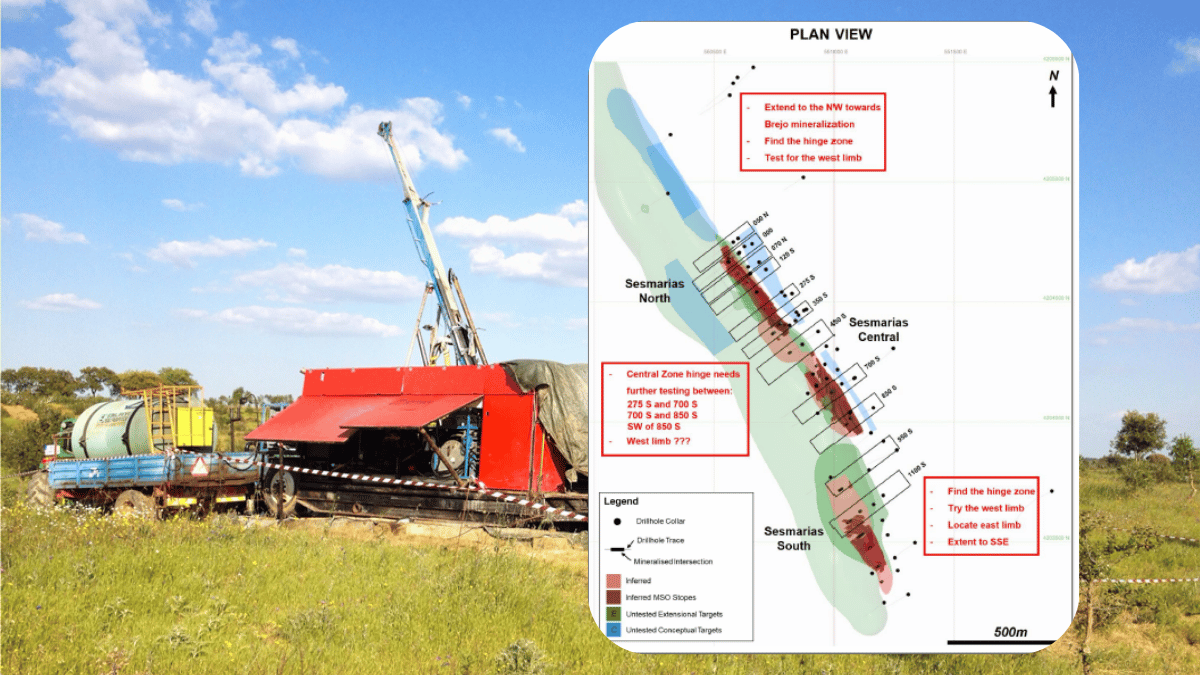
    Alongside the MRE, SLR completed an independent assessment of exploration potential identifying seven drill targets beyond the current resource footprint — two extensional (E1, E2) and five conceptual (C1–C5). The extensional targets pursue down-plunge continuations of the Central and South zones, while the conceptual targets test largely undrilled portions of the synform’s hinge and west limb, where structural models suggest additional massive sulphide lenses may exist. SLR’s sensitivity analysis shows that at a 3% ZnEq cut-off, the deposit could contain up to 10.6 million tonnes grading 5.1% ZnEq — though that figure is not a declared mineral resource.

    The company has initiated a mining licence application for the Sesmarias deposit and is seeking a joint-venture partner to fund the next drilling campaign and advance the project through pre-feasibility studies. First-priority drilling will target the Central Zone hinge and west limb between sections 275 S and 700 S, where moderate existing drill density has left the synform’s geometry incompletely characterised. Near-term exploration success in the Central and North zones is expected to inform the sequencing of work in the more geologically complex Southern Zone.

    Avrupa Minerals trades on the TSX Venture Exchange (AVU), the US OTC market (AVPMF), and the Frankfurt Stock Exchange (8AM). The company also holds the 100%-owned Alvalade VMS project in Portugal and a 49% stake in the Slivova gold project in Kosovo.