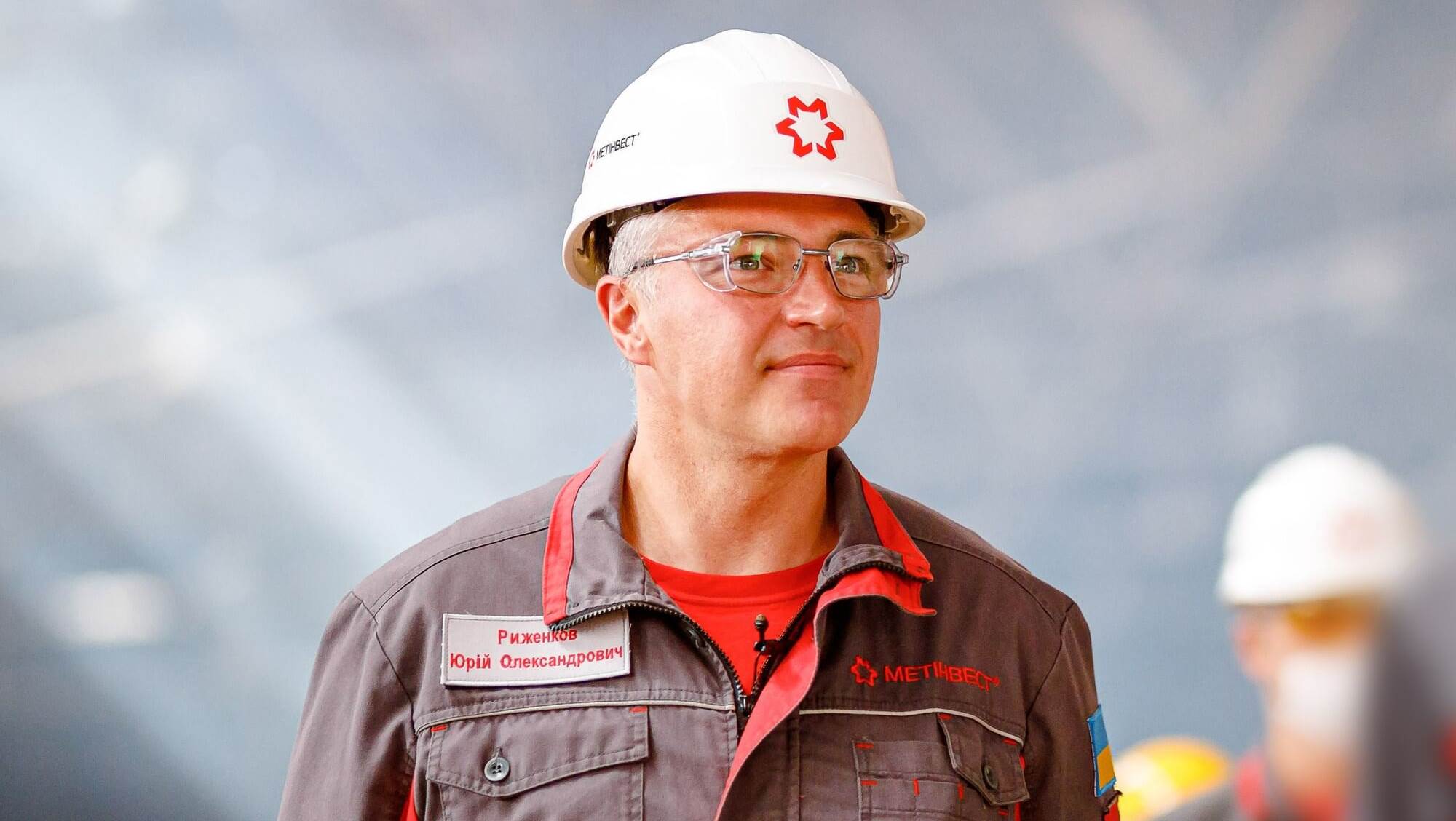
In an extended interview for The FAQ Talks, Metinvest Group’s CEO, Yuriy Ryzhenkov, spoke about the main aspects of life for Ukraine’s largest private company and the transformation of its business in wartime.
During a one-and-a-half-hour interview, the Group’s chief executive answered the most pressing questions, including:
- about employees and the toughest decisions
- about rebuilding Mariupol and steel construction
- about green metallurgy and Ukraine’s role in the European economy
- about Metinvest’s future, robot-aided manufacturing and skyscraper construction
- about his own vision of Ukraine’s victory in the war.
The full video of the interview is available on Metinvest Group’s official YouTube channel. Here are the key highlights from the conversation.
The biggest challenge is how to retain the team
– I believe that today Metinvest is, first of all, a pillar of our country. Both a financial pillar and the country’s main helper on our way to victory. Who is supporting this pillar? People themselves. Metinvest is our team, working 24/7 at our plants and in offices around the world. These are the people who make the Group what it is.
Today, our biggest challenge is how to retain the team, its best representatives, and the most motivated and talented among them. And how to preserve the businesses that we have now. We know that there is shelling every day, and that our plants have been hit. Avdiivka, New York and Novhorodsk are particularly in the crosshairs, and this is a big challenge for our people: first, how to make sure that people can work safely at our plants. Even today, under shelling, people go to work every day; they work even when an air raid siren sounds. There are some workplaces where people cannot go to a shelter. They must remain at their workplace because a process is continuous and interrupting it can be more dangerous than an enemy attack. Second, how to preserve assets, to make sure that even after a missile or a ‘shahed’ hits our plants, they are not seriously damaged.
– What were the most difficult decisions you had to take over the past year?
– The hardest decision was to shut down Avdiivka Coke. We fought hard for it in 2014, 2015 and 2016, during the shelling, when the power was cut off. Later, a gas pipeline was built in Avdiivka together with a state-owned company, and we managed to keep the coke plant in operation back then. However, in March 2022, we had to shut it down completely because the gas pipeline was damaged, the electricity was cut off, and a large number of people were killed. So, we decided then that we needed to shut down the plant. Unfortunately, when a coke plant is shut down, there is very little chance of getting it back up and running. We will certainly revitalise what we can, but it will never be the giant it was.
And that was the hardest part because the coke plant is Avdiivka’s largest enterprise. That is, people lost their jobs in a moment. We had no other option, and this was a very sad decision. There were other problems that were less dependent on us. For one, Mariupol, when we had to end our relationship with workers who remained in the occupied city. There were also shutdowns at mining and processing plants for some time in the second half of last year, but it was a little bit easier there, as we retained the teams and were able to restart the plants at the end of last year. Even now, the mining and processing plants are only 35-40% utilised, but they are running.
– Operating enterprises is primarily about supporting people, paying salaries and taxes. This is the main thing, and you are doing this diligently. What else are you doing to support Ukraine’s economy?
– We have been providing humanitarian assistance since the first day of the invasion. To date, Metinvest has spent almost UAH 2 billion on humanitarian projects. Second, there is our military assistance. In total, we have already spent UAH 3.5-4.0 billion on humanitarian and military aid.
– Just as the country is suffering from the war, Metinvest also has seen people killed and wounded. How many have there been, and how has the Group been helping them and other employees?
– Unfortunately, more than 1,500 of our employees or their family members have been killed or wounded in this war. This includes losses among both the military – conscripted employees – and civilians. More than 8,000 of our employees are currently fighting in the ranks of the Ukrainian defence forces. Regrettably, we have lost more than 200 people and more than 500 have been wounded.
As for what we have been doing to help the families who have evacuated from the sites of fierce fighting, we have looked for housing for them and provided them with the opportunity to stay in health resorts or retreats for a while. Then we have tried to find them jobs so that they could return to normal life. As for our conscripted employees, we have done our best to equip them. This includes providing a helmet, bulletproof vest and possibly tactical clothing. We are trying to protect them as much as possible.
– This means that about 10% of Metinvest’s employees have been conscripted…
– More than 10%; it is 15%. If we are talking about 60,000 active employees at the Group today. Eight thousand is a lot. In fact, it’s every sixth.
– To what extent can Metinvest cope today with the fact that the Group has a great need for highly skilled professionals in certain occupations, and on the other hand, they have to defend the country in the ranks of the Armed Forces of Ukraine?
– The government understands this situation. That’s why there is a law on the exemption of people employed in critical industries, and our industry is a strategically critical industry for the country. As such, we can book people who are most needed to keep our manufacturing running. And I always tell our guys at the plants that the war is going on everywhere: both in the trenches on the front line and at the plants. Our victory also depends on how the plant operates and how efficiently it produces armour steel, for one. So, they are soldiers just like those who are fighting in the ranks of the Ukrainian Armed Forces.
A country is only as strong as its home front. And all these people working at our plant are Ukraine’s reliable home front, which, among other things, is bringing victory closer.
– You said that Avdiivka was affected, and a difficult decision was made to shut down the plant and support the employees, just like evacuees from Mariupol. How is their integration going at the plants today?
– To date, nearly 5,000 of our employees from these cities have applied to continue working for the Group, but only 1,500 have been employed so far. Others are taking courses to either change their occupation or upgrade their skills for new jobs. From there on, the integration is quite fast. After all, all these people – steelworkers and miners – have worked together, and they know the equipment and facilities, so they adapt quickly enough in the workplace.
Many of them are waiting to return home. I know a lot of people who, for example, came from Mariupol to work at Zaporizhstal or Kamet Steel. They have good jobs but dream of returning to Mariupol.
– The second issue of reintegration is the return to normal life for those who are currently serving in the military: veterans and the wounded who need rehabilitation. What is the Group doing in this regard?
– We have several ongoing initiatives in this area. The biggest one is the Heart of Azovstal project launched by our shareholder, Rinat Akhmetov. It is aimed at supporting the Mariupol defenders who protected the city at the beginning of the full-scale invasion and then held out inside the Azovstal fortress and their families. Our employees were among them. Some of them were or still are in captivity. We have a multi-faceted assistance programme for them and their families.
– How easy will it be for your conscripted employees to return to the shop floor?
– War traumatises people no matter what we do, so it is always difficult to return to normal life. We have the Saving Lives initiative, established by the Rinat Akhmetov Foundation and Metinvest, through which we are assisting all our other defenders. We are helping with prosthetics and psychological rehabilitation. And these are the two most important things. After all, you can provide a job, find housing, all such things can be done. It’s pretty straightforward. All it takes is money. However, to undergo psychological rehabilitation, you need psychologists who can bring this person out of the state that the war has put them in, or you need someone who can properly design a prosthesis and then teach them how to use it.
– At the beginning of the full-scale invasion, the Group did not stop paying salaries as a matter of principle. What is the situation like today? What is Metinvest doing to increase the earnings of its employees amid a really difficult economic situation in the country?
– First, we have so-called ‘combat allowances’ that we pay at the plants operating near the front line and where there are increased risks. We are also monitoring the labour market in Ukraine and will keep abreast of the market to revise salaries or introduce special allowances and bonuses throughout the duration of the war until the situation stabilises.
Renaissance of steel construction
– How can Metinvest contribute to Ukraine’s post-war recovery?
– As for today, we are primarily helping our employees who have lost their homes or whose homes have been damaged. Secondly, we are helping people living in the areas where our businesses operate to repair their homes after shelling. We are even providing temporary accommodation, e.g., at our health centre in Zaporizhzhia or our retreats in Kamianske.
This is what we can do now, while the war continues. And once the war is over, we will need to rebuild the country, we will face the task of recovery. I am convinced that this recovery of Ukraine will bring a renaissance for steel construction, and we will be able to rebuild our country by supplying the steel it needs for such a rebuild. One of the stages of this effort was the launch of Metinvest’s Steel Dream project.
– Will Metinvest be able to provide all the steel needed to rebuild all the buildings in Ukraine, for example?
– Unfortunately, the problem today is not the amount of steel needed to rebuild these buildings. The problem is the steel products we can produce. When we lost control of Ilyich Steel and Azovstal in Mariupol, we lost our plate, beam and rail production facilities. And today, unfortunately, we cannot supply everything that is needed for immediate construction in the country. We are bringing plates from our Italian mills, buying rails or beams in other countries and delivering them to Ukraine.
But all this can be restored. Metinvest can build new rolling facilities to produce the required products. By the way, the metallurgical panel of the Ukraine recovery conference held in Italy featured an interesting presentation of a new method of steel construction by Italian architects, where houses are built without the use of concrete or cement at all; even the foundations are made entirely of steel. These are mostly multi-storey buildings, but they can be built with modules that can be produced by shipbuilding companies located near our mill in Italy. Then all this can be transported to Ukraine, assembled at our facilities and installed wherever a building needs to be constructed.
We can buy or produce steel in other countries, bring it to Ukraine and assemble such buildings here.
– In other words, this is a kind of synchronised effort where we must combine the restoration of the industry itself with the recovery of the social sector and construction in general.
– We simply have no other choice but to do this in parallel. People need to live somewhere. And once the war is over, as soon as we win, we should start building for people. At the same time, we will rebuild our industry.
– Are there any landmarks on the list of potential steel construction projects that could be built after the war? Something that will assume a symbolic significance for Metinvest’s steel?
– We have already done some things that could be symbols. For example, our safe confinement structure over the Chernobyl nuclear power plant, which is also made of Metinvest steel. This is a building that has few analogues in the world. Yes, this is a sad part of Ukraine’s history, but the new confinement structure represents the best we can do.
When we rebuild our country after the war, we will have the opportunity to create many such structures that we will be proud of for many years to come.
– Do you have any plans or dreams, for example, for a new steel building to rise in Ukrainian Donetsk or Mariupol, as a counterpart to the Empire State Building?
– I think this idea should be pitched from those involved in development. We are ready to help, to provide technologies that have already been accumulated at the Ukrainian Steel Construction Centre. We are ready to provide steel that can be used for this construction. We will share the contacts of Europeans experienced in the construction of these structures: architects, engineers and others.
That is, we are ready to participate fully in such projects, but the inspiration must come from the public. Inspiration should come from entrepreneurs who want to do this.
Revival of Mariupol
– How do you see the future of Mariupol?
– This is an interesting question, but why only Mariupol? We need to remember that, unfortunately, we left Donetsk once. When I talk about our victory, I believe that Donetsk, Mariupol, Crimea and Luhansk will be liberated from the occupiers. So, we need to think about how to rebuild the whole of eastern Ukraine, not just Mariupol.
If we are talking specifically about Mariupol, Metinvest certainly has a vision for its recovery. Rinat Akhmetov has already joined the Mariupol Reborn project. We have already allocated funds for this centre, which will help us, first of all, to elaborate a city development strategy. This is important. We cannot expect to come back and rebuild Mariupol as it was. We all understand that there were good things in Mariupol, but there were also things that we would not like to recreate.
As such, a new city strategy is needed, a new industrial strategy. One can’t just come and say: we will now fully rebuild Azovstal. Today, Azovstal is a symbol, it is a fortress. Therefore, we will need to understand what part of the steelmaking operations should remain in Mariupol, what it will look like, and what the so-called industrial map of the city should look like. And only then should we start rebuilding the city.
– Continuing with the topic of Mariupol’s recovery, how do you see Metinvest Group’s role in this process?
– Today it is about being the main partner in creating the design of the future city: developing this design and identifying the specific steps to be taken. Then our role is to be the main partner in the reconstruction. It will be a modern city with a developed economy.
– Azovstal: to what extent can you currently assess the damage to the steelworks?
– Unfortunately, from what we can see in the photos and videos, it appears that the damage is severe. Nevertheless, I do not give up hope that we will be able to resume some production at Azovstal. When the Ukrainian military liberates Mariupol, when we get there, we will see what we can do about it.
– We understand that the propaganda of the aggressor works to tell fables about the resumption of production at the plant even tomorrow.
– We don’t see an opportunity for them now to revive any production at Azovstal. I think the most they will be able to use Azovstal or Ilyich Steel for is as repair bases.
– Then there is a question for the future: do we come and estimate how long it may take for the resumption of mills?
– Once, we reviewed the archives related to the restoration of Mariupol and Donetsk after the Second World War. And we saw that at Azovstal, the first furnace was launched six months after the liberation, while, for example, it only took four months at Donetsk steel. Therefore, the technology exists and we have an understanding of how quickly production can be resumed. But here, we should not forget that we have no desire to resume using the old technology that existed at Ilyich Steel and Azovstal, because it is all from yesterday. Today, the whole world is moving towards green metallurgy, electrometallurgy, and the restoration of our plants in Mariupol will take place in this vein.
Therefore, the restoration of production using new green technologies will take more time, because it will be necessary to build almost from scratch. This takes three to five years.
– In addition to resuming production at Azovstal, are there any ideas to create a memorial at the site of the plant itself? To honour the memory of the heroes who defended the city?
– Heroes need to be honoured now: when they return from captivity, when they and their families need help. And this is exactly what we are doing now with the Heart of Azovstal project. I believe that this is the most important memorial to the defenders of Azovstal. As for what to do on the site of the plant – a monument, a park or something else – the Mariupol community will decide when the city becomes Ukrainian again.
– An important issue for all the territories that will return to Ukraine is the return of people to these territories and the reintegration of those who remained there.
– That is precisely why the Mariupol Reborn project exists. It is needed to develop the meanings that will be embodied in new Mariupol and will allow people who have left for western or central Ukraine, or to Europe, to return home. And it should also cover the reintegration of those people who are now in Mariupol. As far as I understand, more than 100,000 people remained in the city. This is a very large number. Some remained there for various vital reasons, while others remained because they believe in the ‘Russian world’. We will have to decide how to reintegrate all the people. I am convinced that those who believe in the ‘Russian world’ will simply go as far as possible towards their ‘Russian world’, as happened in Kherson, for example. So, I don’t think there will be problems with this. But we will have to deal with people who remained there because of some vital considerations and could not leave, in order for there to be normal integration and for them to become normal members of the community in the future.
– Who will be the first to return to the communities? Will people come for work, for opportunity? Will activists, patriots of the city – in a good sense of the word – come back?
– We saw how it was in Kherson. Nova Poshta and Ukrtelekom will be the first to come back. And then others will return. Our engineers who will survey the city and the plants and draw conclusions about how we can adjust our plans to restore the city’s economy, will be among them.
Defence production and Metinvest’s support of the Armed Forces of Ukraine
– Metinvest provides a lot of help to those who are defending Ukraine today. What are the main focuses of this important support? What are the plans?
– At the very beginning of the war, I had a telephone conversation with our shareholder Rinat Akhmetov, and he was the first to believe in the victory of Ukraine. He said that we will definitely win, there is no doubt about it, but in order to win, everyone must work for victory. And then he said: “Do whatever it takes for us to win.” I talk to him almost every day now. After all, the situation is not simple, both on the markets and at our enterprises. But I can see that the position of our shareholder has not changed. It has even strengthened, become tougher: he believes in victory, and he also believes that victory is possible only if everyone helps our country to achieve this victory. Therefore, our task has not changed. We will win.
If we talk in detail about what has been done in a year and a half, we began to help the army, like all volunteers. They delivered equipment and vehicles. During all this time, we have delivered more than 400 vehicles, almost 2,000 thermal imagers and nearly 1,200 drones to the Armed Forces of Ukraine. We delivered quite a lot of different things, even armoured vehicles.
But in parallel with this, we began to think that during the war we could not just buy something or bring it from abroad. We need to set up production here, at home, so that our army is provided with the products of our enterprises. During the war, we started manufacturing 24 new products at our enterprises related to the military in one way or another, such as armour steel. We have already supplied 150,000 armoured vests for the Armed Forces of Ukraine. Now we can say that every tenth military servicemember in the Armed Forces of Ukraine wears body armour made of Metinvest steel. I even talked to the guys on the front lines. They told me how they took foreign body armour with ceramic plates, pulled out these plates, and inserted Metinvest’s instead. Because they trusted our products more. This is very nice to know.
– Is it because of the optimal thickness and weight of the Metinvest armoured plates?
– At first, we thought that the highest protection is the best, and we made Class 6 body armour right away. But then, when we began to communicate with the military, we realised that you can only sit in a trench with this class of body armour. You can neither move forward nor backward. And this is impractical for military operations, plus the load on the back, which causes pain.
Therefore, Metinvest has developed a lighter model of body armour, corresponding to Class 4 or 5, that is relatively lightweight. It weighs 8-9 kilogrammes. You can even run in it.
In parallel with body armour, we have developed new, special metal shelters for our military. Metinvest also produces them. These shelters can be placed in a dugout or trench. They allow the military to be safe even under fire. The Group has already supplied more than 200 such shelters. How did we come up with this idea? We found the drawings of these bunkers in old papers at Zaporizhstal. Back during the Soviet Union, Zaporizhstal had a mobilisation mission – these bunkers were developed during that period. We modernised them and started manufacturing.
Metinvest also produces special structures that protect equipment from Lancets. We also make protective armoured body kits for vehicles that can be used for demining or just for moving around on the battlefield. Currently, we are also trying to test whether our steel is suitable for armouring ships or boats.
– What will we do with enemy machinery that is being destroyed? There are already hundreds of tonnes of it.
– We will place memorials later.
– Can it be used in metallurgy as scrap?
– Many people think that you can take it, melt it and make new steel or new machinery, but this is not the case. Those remains are a rather complicated story, since there are many additional substances in that metal. Therefore, we cannot just add it to our steel because we will not get the quality of steel we want. If we talk about enemy armoured vehicles, then only 5% can be used in our steel production as a raw material.
– Metinvest has produced many anti-tank hedgehogs. Can this steel be reused?
– Yes, they can be melted. But I think that even after the war, Russia will not disappear, it will remain where it is, as a whole country or as part of a country. I think that for a certain time it will remain an aggressor nation towards us. Therefore, defence against Russia will be on the agenda for many years. I believe that it is too early to melt the hedgehogs, and, on the contrary, we will have to build more protective structures to protect the border of Ukraine.
Holding Russia accountable for damages caused
– A difficult question: how will the Group act if the war lasts a long time and does not end this year?
– We have already placed the Group on a war footing, so we will continue to improve the efficiency of this work and help the state. If we have already lived a year and a half during the war, rebuilt logistics and sales functions, then we can withstand for a long time. Metinvest is a tough company.
– So, we have endured a certain crisis, and now we are moving on to operational efficiency?
– We have lived in a crisis almost constantly since 2014. The war started in 2014, and then global markets have faced crises that we have had to endure. Metinvest has adapted to this. Then there have been various political crises in Ukraine, which have also affected the economy; there is nothing you can do about it. Therefore, we already know how to work with it, and we can live for a long time. Well, that’s uncomfortable. It will be difficult, but I think we can withstand it. Some might think that Ukraine is not ready for a long war, but I believe that is not the case.
– CEO in wartime. How has your personal approach to work changed?
– Of course, it has changed. I need to delegate more, trust the people I work with more, let them take decisions. Before this invasion, after the crisis of 2014-15, from 2016-17 to 2022, everyone was already doing business as usual. Then the Group had many procedures, rules, various regulations, and people followed them. But when a crisis begins, such as an invasion, like a full-scale hot war that comes to your home, you need to depart from the rules and procedures, delegate more, trust people more. Take decisions that are needed at that moment and in the place where they are. And this is the main thing that has changed.
– Part of the future is probably bringing the Russian aggressor to justice for what it has done. But here the responsibility is different — financial, economic and human losses. What is the Group doing today in this area?
– Regarding human losses, here the state should appeal to international courts, as it has done. We even have the first outcomes of the proceeding — there is an arrest warrant. If we talk about finances, the Group documents all the losses it suffers from Russian aggression and submits them to the European Court of Human Rights. This is how we are trying to hold the Russian Federation accountable and compensate for the losses.
– Can you compare 2014 with last year? After all, the first Russian aggression actually took place then, and it greatly affected the Group and its enterprises. Which was harder?
– You can definitely compare them. Especially since today there is no difference between the occupied part of Donetsk and Luhansk regions, occupied Crimea and other regions of Ukraine. Wherever Russia goes, it occupies our territories. And it is responsible for everything that happens there.
In 2014, it was different. After all, Russia did not acknowledge that it was the one who came to Donbas. It admitted that it went to Crimea, therefore our group company DTEK sued the Russian Federation for the nationalisation of its assets in Crimea, but it was impossible to do this in Donbas. Because Russia’s position was “we are not there,” that it was all some alleged “people of Donbas”. Now all the masks have been torn off, and we understand that this is Russia. Russia itself admits that it is the one. Therefore, now we have every right to recover the damage that it has caused in Donbas, as well as what it inflicted in Mariupol or Avdiivka and the like.
– Today we feel that we have reached the bottom – we have touched it and we are moving up. Are there any real risks?
– There are several aspects to this. The war is going on, and we don’t know how long it will last. How many losses that the Group will suffer, that Ukraine will suffer. Therefore, it is still too early to say that we have already reached the bottom and are going back up. Although we believe in Ukraine’s counterattack, in our success.
On the other hand, the situation in the world economy is the same: we have not yet entered a crisis. We are only just on the path to a global economic crisis. We don’t know whether we will fall into this crisis or not.
Many factors indicate that we will get there. But there are also optimists who say that we will manage and that we will be able to avoid a serious crisis. It will be a kind of plateau. And then we will go up again.
Therefore, here I would be careful and prepare for new challenges together with the Group . Let’s see where we can be more efficient and flexible. We are optimistic, but we are preparing for any scenario.
Prospects for the development of the Ukrainian economy and Metinvest’s plans
– How does the industry feel today, how does the economy of Ukraine continue to survive?
– The time since the beginning of the full-scale invasion has not been easy for Ukraine’s heavy industry. The main thing is that previously built logistics chains have stopped working, and without ports, the new ones lack the capacity to meet the needs of the Ukrainian economy. Due to the blockade, many cargoes have had to leave the Black Sea ports, and they have been redirected to the railways and to the European border crossings. And these were not ready to deal with these volumes. As a result, heavy industry cannot work at full capacity. Currently, Metinvest’s metallurgical plants have a 60-70% utilisation rate, and the iron ore plants are generally running at 35-40% of pre-war indicators.
– How stable does the Group feel in view of reduced capacity, power outages, shelling and other risks?
– Even under today’s conditions, we are generating positive cash flow, and therefore we are able to work with our creditors and investors, and even make certain investments. These are not global expenditures from the standpoint of strategic development, but local ones, investing in improvements at our enterprises.
– The Group repaid the 2023 bonds. I understand that due to force majeure related to the war there was an opportunity not to pay them. Why did Metinvest decide to pay them anyway?
– First, Metinvest is not only a Ukrainian company. We also have facilities in Europe and the US. Therefore, we cannot just go out and tell our investors that if everything is bad in Ukraine, then we will put all our payments on hold. This would be wrong, both for our investors and for the financial markets. The Group is able to generate positive cash flow, which is enough to service the debts. And for now, we predict the same situation will continue in the near term. Therefore, the Group will service its debts and fulfil its obligations to its investors.
– By the way, how do you assess the balance of the activity of the Ukrainian and the international assets?
– It is difficult to say, because if you look at the utilisation rates of the foreign enterprises, they are currently loaded at 100%, that is, they are working at full capacity. If we look at the financial side, we still generate the lion’s share of our profits in Ukraine. As a result, the balance remains.
– What are the Group’s future plans?
– We have some short-term plans, including, for example, the launch of new products from Zaporizhstal and Kamet Steel. We are studying the possibility of beam production on existing equipment or by carrying out some additional work at Kamianske. This product can be used in the construction of buildings or bridges. We are looking at the possibility of plates production at Zaporizhstal. We have already carried out some tests, producing a plate, shipping it to customers and getting their feedback. There are quick things that we want to do to restore the supply of products that we lost with the loss of control over Mariupol and the consequent impact on Ukrainian industry. We would like to resume the supply of these types of products from our other facilities.
Our plans for the next three to five years are also more related to the restoration of the production capacity for steel products in Ukraine. Now they are mostly focused on Zaporizhstal and Kamet Steel. These enterprises are working and we know what we can build there. But, as I said earlier, after the de-occupation of Mariupol, we will be able to see what production can be localised there.
Our strategic programme for the development of the iron ore plants remains nearly unchanged. From the outset, the programme was built on producing better quality final products with a higher percentage of iron content. This is very important for the green metallurgy that is being developed all over the world. The European Union is leading the way and Ukraine is on the path to the EU. I think that when Ukraine becomes part of the EU, the Ukrainian mining and metallurgical industry supply chain will be integrated into the European one. We can produce semi-finished products for green metallurgy. This is quite important for the EU.
And that’s what we’re working on. Currently, we can’t implement large investments in Ukraine for obvious reasons, but we can develop design and project documentation, work out the process and so on. And we will start the implementation of these projects immediately after the end of the war. For Metinvest, Europe is not a foreign market, because, after Ukraine, Italy has been the second largest market for the Group.
– Are we reaching the point that Europe has become our home market?
– The European market has always been the number one market for Metinvest. So, we are just continuing this process. We are studying the opportunities that may be there, primarily ones that strengthen our capabilities here in Ukraine. For example, many people have talked about the possibility of Metinvest building a new plant in Italy. It’s true. This plant is precisely what needs to be built in Italy to drive the development of the super high-quality pellets at our Ukrainian iron ore plants. It will be a direct chain from Ukraine to Europe, it will be a serious sales market for our mining products.
Development of green metallurgy
– When we look into the future, we always talk about green metallurgy. There were plans to build a new, green plant in Mariupol. How relevant are these plans today? What will decarbonisation mean for the Group?
– There are always two sides to green metallurgy. One is metallurgy itself. This is what we were discussing about Mariupol, where one can build a new electric steel plant, replacing blast furnaces and basic oxygen furnace vessels with electric steelmaking. Today, we understand that this idea is not currently viable and that we will consider topics related to metallurgy in Mariupol after its de-occupation.
The second side is the raw materials that we will produce. And here Metinvest has a competitive advantage as the iron ore stocks we mine can be enriched to quite a high level of iron content. And this raw material can be turned into a semi-finished product that will be used by electric steel plants in Ukraine or Europe. This is important for Europe as there is a shortage of these semi-finished products. Green metallurgy is an opportunity for Ukraine to properly integrate its own economy into the EU. Ukraine can become the first link in the green metallurgy chain.
Subsequently, our production can be converted to use hydrogen and make completely carbon-free metals products. This project is currently active. Yes, we are not building new units yet, but we are investing in project and design work for these units and we are modernising our production to use this technology.
A rapid leap forward is possible here. For this, we will need to find customers who are prepared for a long-term relationship. Either it will be some European metallurgical companies or we can build a plant in Europe that will use these products.
– To become an example for other Europeans.
– Investments in direct reduced iron (DRI) and hydrogen have a quite large multiplier effect as they require infrastructure and electricity. It is necessary to build new, green power capacity, which can be either renewable or decarbonised. By developing the nuclear power industry, for example. There are things the state can do and there is a direction for its efforts. This will be a multiplier for the entire economy of Ukraine.
– If we develop the decarbonisation topic, how critical is the Carbon Border Adjustment Mechanism (CBAM) for the Group today? Do we need a pause here?
– CBAM has not yet been launched, so we are still in the dialogue with the European Commission. In some areas, concessions have been made for us and we have been provided with longer transition periods, or some of our goods have not been included in the first round of CBAM. We will continue this discussion. It will depend on Ukraine’s integration into the EU. Because the most straightforward way to integrate Ukraine would be the incorporation of the country into the European Emissions Trading System. And then there will not be any CBAM. As a result, we will work as all European metallurgical companies work. And I believe it is most likely that everything will go this way. It is easier than CBAM, especially for a country joining the EU. It is better to join the Emissions Trading System.
– How do you see the metallurgical industry developing? Maybe green zones, robotic complexes?
– First, I believe that the metallurgical industry will exist for a very long time, because steel is such a unique product. And the production process is a standardised one. This is quite important for production efficiency. In this respect, nothing can be compared with steel, not plastic, not wood, not even aluminium.
However, the production of steel will look completely different. It is already different in the projects that we are currently developing. For example, the Italian plant project we are working on. The plant should have the highest level of automation. People will not be in the shop, only at control panels and it will incorporate artificial intelligence (AI) . AI has come to metallurgy. We will move at the same pace in using new technologies as the most advanced industries.
Now Europe, and Ukraine together with Europe, are planning for the green transition of steel production. This means we can start almost from scratch. And we can draw upon what we want here: green opportunities, artificial intelligence, automated production and coffee at the desk. This is what the future of metallurgy will look like.
Metinvest Polytechnic is the world-class provider of the skilled workers that Ukraine needs
– Modern technologies and innovation in metallurgy will require highly skilled specialists. Like those provided by Metinvest Polytechnic. Unfortunately, the campus building was not built in Mariupol as you had planned, but the university has begun functioning. What future do you see for Metinvest Polytechnic?
– We could not build the steel building that would have been a symbol of the new Mariupol. But this is not a tragedy. We will come back – we will build, perhaps, some other building. This will be Metinvest Polytechnic. Maybe something like the London Shard, but in Mariupol. Or something similar.
And Metinvest Polytechnic has worked according to plan, as it should have. More than 400 students have been recruited and they are currently studying. Now we will recruit the next cohort of students, including the next first-year class. This is a serious step. If we can continue to maintain this growth dynamic, it will prove to be a reliable supplier of high-level specialists for our country, and not only for the metallurgical industry.
– Broadly speaking, for industry.
– Yes. Even today, the university has courses on labour safety and the environment, and there will be courses on the power industry. We will start with industrial power, but if our colleagues from DTEK are interested, we can develop a course on the global power industry. So, I believe that, in general, the university has worked. It launched successfully. And I am sure that it will be the world-class provider of staff that Ukraine needs.
– Ukraine will really need technicians during the post-war reconstruction.
– We will have time to prepare them for Ukraine’s victory in the war. We will work on it.
Blitz. Ten years at Metinvest and Ukraine’s victory in the war
– Blitz is a traditional part of our interviews. Today is almost ten years since you became the CEO of Metinvest. If you were to go back ten years and you knew what lay ahead, would you agree to take this path or would you have hesitated?
– No one says that it would be easier in the position I held ten years ago. Therefore, it is not important to know or not to know. This is our life, and we have to live it in any case.
– What are you proud of in these ten years?
– I think we were able to build a company that is respected and known by the communities in which it works. We cooperate with these communities and look for ways to improve their lives. I think this is important for the future of any company.
– Is there anything you would do differently?
– That’s difficult to answer. Yes, there are certain things that were difficult, some things that are regrettable. But you never know, would it be better if you did something differently? Would it be better if we had not invested in Mariupol, for example, over this past decade? I think not. Although someone may ask me now, why did you invest more than US$2 billion in Mariupol over these past ten years if it was all destroyed? Would I do it differently now if I could go back? I think I would still invest there. I think our investments have benefited both people and our shareholders. Unfortunately, today, we have lost control over the physical assets, but what has been done, we have not lost.
– If you summarise this past decade, can you formulate three principles that guide you today when making decisions?
– The first thing is to always try to do something that, in the future, you will not be ashamed of having done.
Second, if there is a choice between a strategic and a tactical goal, it is always better to choose the strategic one.
And last, but not least. Most of the work of any senior manager should be related to people. Either directly, or analysing working with people, with your team, with other levels in the team. This is the most important part of the work of any senior manager.
– How did the war change you, what did it teach you, who did you learn from?
– During the war, I began to plan my time better. It would seem that it should be different, because there is a level of unpredictability. But you can manage and somehow compensate for this unpredictability if you manage your time properly.
Who did I learn from? You know, I am currently inspired by our military authorities. We knew them from Mariupol, where the headquarters of the United Forces was located, and we knew many of today’s generals. We helped them and communicated with them, but the war has demonstrated them to be real human beings and officers. They are not about politics or corruption, they are about victory and that is inspiring.
– When was the worst?
– Every person is afraid at some point, the fearless die in childhood. So yes, it was scary. I would say that in the last year and a half, the scariest time was February 24, when the war began in the early hours in Kyiv and we did not know what would happen. We were afraid for our people and our facilities because we did not understand what would happen next.
And if we talk about the whole war since 2014, it was terrible in Donetsk when the riots started. It was in March and April. When I saw how ordinary people were beaten with sticks. When there was a crowd that could stop a car and pull out the passengers. My wife saw this – she was driving with our daughter, and it happened right in front of her eyes. It was also scary.
– Every person is somehow a support for someone and needs support himself. What is your point of support?
– For me, our team is the main point of support. Thanks to them, despite all the crises, problems in the markets, in the country, at our enterprises, we are still moving forward. Well, personally, of course, my family is my support.
– What is victory for you personally? Is this the liberation of Mariupol, Donetsk, the de-occupation of all territories? Or if Russia disappears as a state in its current form?
– I think, unfortunately, the neighbour will stay. And what this state will be, its residents will decide. They wanted to decide for us what our state should be, but we will not repeat this mistake. Let them decide what country they want to live in.
Well, in Ukraine, I will consider the liberation of all territories up to the borders of 1991 and joining NATO as victory.
– The victory will surely be, and be followed by, recovery. Someday the time will come to decide where Metinvest’s headquarters will be. This question is premature, but still, any thoughts on where it could be? Kyiv, Mariupol, Donetsk?
– Let’s see what the Metinvest Group will be like when it happens. But we had COVID, and then the invasion. We have already learned to work remotely. And we now have people in more than 50 countries who effectively work at Metinvest. Therefore, we will decide. Of course, there will be some symbolic offices in both Donetsk and Mariupol, while Kyiv will probably remain. But I don’t know where the headquarters will be. Perhaps it will be completely virtual, in the cloud.
– What is the first thing you will do after victory and the return of all territories to Ukraine?
– First, we will gather with our entire team here in Kyiv and celebrate this victory. And then I will go home to Donetsk.