Website: Europe.com

  • Europe’s top science panel supports call for moratorium on deep-sea mining

    Europe’s top science panel supports call for moratorium on deep-sea mining

    • In a new report, the council conveys its skepticism that deep-sea mining is necessary to meet the needs of critical minerals for renewable technologies.
    • It also points out that deep-sea mining would cause irreparable harm to marine ecosystems, and that the mining regulator lacks a scientific definition of what qualifies as serious harm.
    • Many European nations and companies currently possess licenses to explore the international seabed for resources, although exploitation has yet to begin.

    National science academies from across Europe have become the latest group to announce their support for a moratorium on deep-sea mining, a proposed but disputed activity that would extract minerals like copper, zinc and manganese from the seabed for commercial purposes.

    In a report released June 8, the European Academies’ Science Advisory Council (EASAC) challenges the widespread claim that seabed minerals are needed to transition to renewable energy technologies, arguing that the necessary metals are available from other sources. The group — an association of 28 national science academies of EU member states, Norway, Switzerland and the U.K. that provides independent advice to policymakers — also questions the ability of the International Seabed Authority (ISA) to fully and properly assess the environmental impacts of mining in international waters.

    The ISA is a U.N.-associated body established to regulate deep-sea mining in international waters while protecting it from “serious harm” under the United Nations Convention on the Law of the Sea (UNCLOS).

    Many European nations and companies currently possess ISA-issued licenses to explore the international seabed for resources, although exploitation has not yet begun. Norway also plans to mine the seabed in its territorial waters and nearby continental shelf.

    Next month, members of the ISA will meet at the agency’s headquarters in Kingston, Jamaica, to discuss whether deep-sea mining should be allowed to proceed and what rules should govern such activity. Two years ago, the Republic of Nauru, a Pacific island state, invoked a “two-year rule” that urges the ISA to agree upon mining regulations that would enable exploitation to begin. Nauru sponsors Nauru Ocean Resources Incorporated (NORI), a subsidiary of Canada-based The Metals Company (TMC). TMC has previously said it is looking to begin extracting minerals from the Clarion-Clipperton Zone (CCZ) in the Pacific as early as 2024 after it applies for an exploitation license sometime this year. The company already undertook a deep-sea mining test in the CCZ in 2022.

    A sea lily on the sea floor of the Clarion-Clipperton Zone at a 4,800-meter (15,700-foot) depth. Image courtesy of the SMARTEX Project, Natural Environment Research Council, UK.

    Michael Norton, EASAC’s environment director, said the claim that deep-sea mining is necessary for a green energy transition is “misleading.”

    “Deep-sea mining would not provide many of the critical materials needed for the green transition and other high-tech sectors,” Norton said in a statement.

    The report references a 2020 study published by the European Commission that found that while there was a moderate supply risk for metals like cobalt, other metals, such as manganese, nickel and copper, had low a very low supply risk. It also refers to an ISA report that found that in the highest-production scenario, which is based on the assumption of 12 to 18 parallel mining operations, deep-sea mining would account fo 50% of the current annual demand for manganese and cobalt, but only 20% of current nickel demand and just 2% of the larger copper demand.

    In a press briefing, Norton said there was also “huge” potential for obtaining metals via recycling processes, but that this potential was underutilized.

    “There are some very important first steps being taken by the [European] Commission to recycle batteries,” Norton said. “And we see that as the first step to a much more efficient recycling policy within Europe, and, by implication, would recommend that to other countries as well [to reduce] the demand for virgin materials.”

    The report also states that “it is not yet established what level of environmental harm would be regarded as serious or significant enough to justify refusal of a contract,” which calls into question the ISA’s decision-making processes when it comes to issuing mining licenses.

    “The debate on serious harm has only just started and is nowhere near being quantitative,” Norton said. “If the ISA gives a contract, then it judges by definition that it is not serious.”
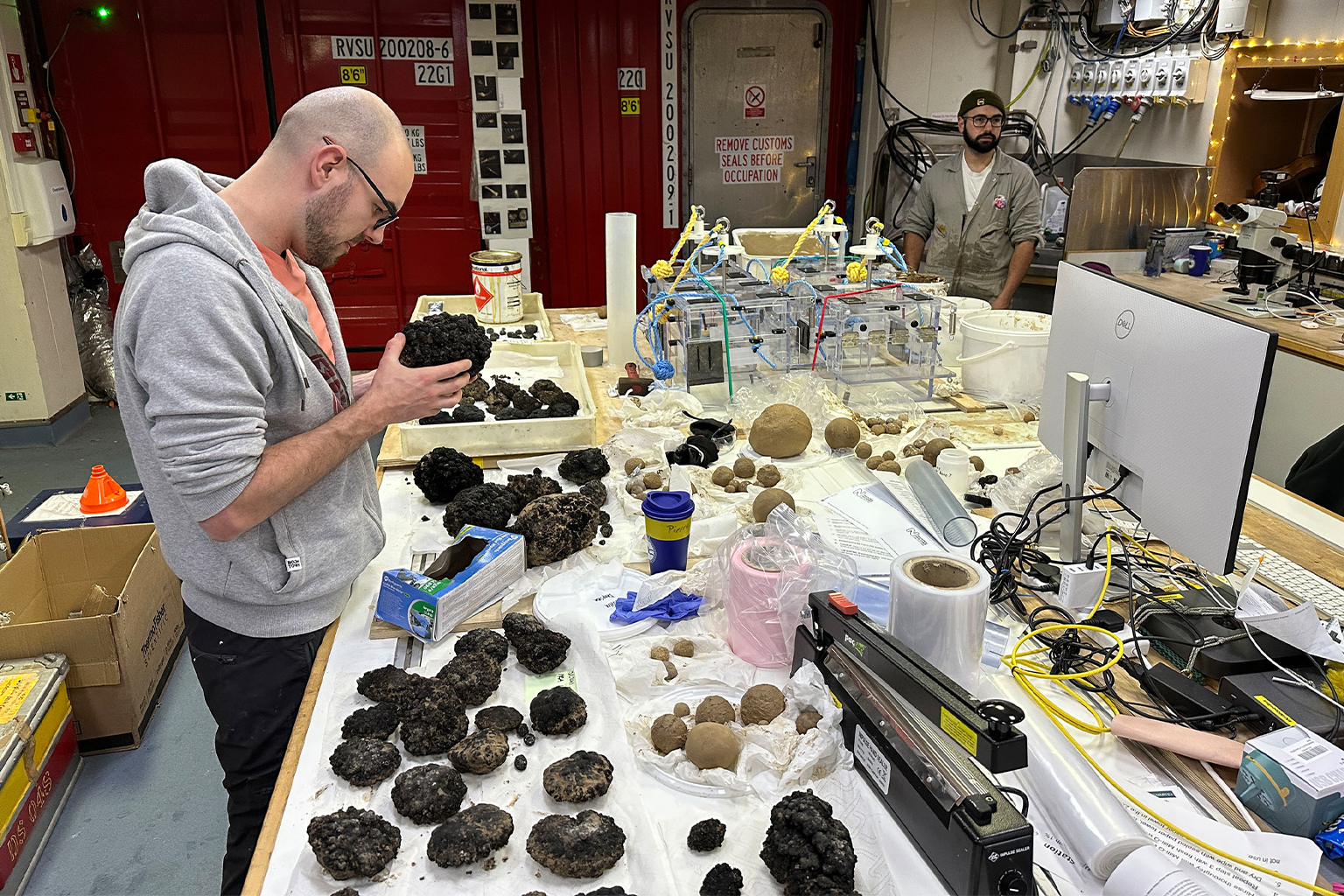
    A researcher looks at the specimen collected from the deep sea.
    A researcher looks at the specimen collected from the deep sea. The new report points out that deep-sea mining would cause irreparable harm to the marine ecosystem and that the mining regulator lacks a scientific definition of what qualifies as serious harm. Image courtesy of the SMARTEX Project, Natural Environment Research Council, UK.
    A deep-sea starfish in the Clarion-Clipperton Zone. Image courtesy of the SMARTEX Project, Natural Environment Research Council, UK.

    While there are many knowledge gaps around the impacts of deep-sea mining, vast swaths of the seabed will be damaged and the biota killed, Lise Øvreås, a professor at Bergen University in Norway and member of the EASAC, said in a statement.

    “There is also a risk of substantial secondary effects from the large amounts of sediment released,” Øvreås said. “The seabeds have taken thousands of years to form, and the damage will be irreparable on similar timescales.”

    A recent paper published in Current Biology compiled a list of 5,142 species yet to be scientifically described in the CCZ, 90% of which were in areas earmarked for deep-sea mining.

    However, the amount of life in the deep ocean is still being debated. On its website, TMC references a PNAS study that states that “terrestrial biomass is about two orders of magnitude higher than marine biomass.” The company says there’s far less life in the CCZ than on land, making it “one of the least populated areas on the planet.”

    “While we cannot promise that no species will go extinct in the deep sea, we know we can do much better than the status quo when it comes to metal production,” TMC said on its website when accessed on June 9. “Mining on land has driven species extinction and biodiversity loss for centuries.”

    Infographics: (Above) Rates of species descriptions in the CCZ; (below) proportion of species diversity in the CCZ that is undescribed.
    (Above) Rates of species descriptions in the CCZ; (below) proportion of species diversity in the CCZ that is undescribed. A recent paper compiled a list of 5,142 species yet to be scientifically described in the CCZ, 90% of which were in areas earmarked for deep-sea mining. Image by Rabone, M., et al.

    Norton acknowledged that terrestrial mining can be harmful, and said deep-sea mining is often referred to as the “lesser of two evils.” But there are differences, he went on.

    “Terrestrial mining is under our control,” Norton said. “The environmental impact is controllable; the human rights abuses are stoppable with appropriate governance and appropriate determination by the politicians.” By contrast, he said, deep-sea mining is “out of sight,” making its actual impacts unknowable and unmanageable.

    The EASAC also points out that the ISA’s mission appears to run counter to both the Convention on Biological Diversity and the so-called BBNJ agreement to increase marine biodiversity protection.

    “Further thought may be required if direct conflicts are to be avoided between the objectives and missions of these conventions,” the authors write in the report.

    Matt Gianni, a political and policy adviser for the Deep Sea Conservation Coalition (DSCC), told Mongabay he believes the EASAC statement will carry considerable weight in the deep-sea mining debate and may influence policy decisions, not only in Europe but beyond.

    “It reinforces the message that we’ve been putting out: that you don’t need to go deep-sea mining to get the metals necessary to transition to renewable energy economies and for use and renewable energy technologies,” Gianni said. “It’s a false narrative.”

    Banner image: A sea cucumber in a polymetallic nodule field of the Clarion-Clipperton Zone at 4,200-meter (13,800-feet) depth. Image courtesy of the SMARTEX Project, Natural Environment Research Council, UK.

  • Hiring activity in the European mining industry increased by 2% in Q1 2023

    Hiring activity in the European mining industry increased by 2% in Q1 2023

    Notably, Management Occupations jobs accounted for a 10% share of the European mining industry’s total new job postings in Q1 2023, drop 2% over the prior quarter.

    Management Occupations drive mining hiring activity

    Management Occupations, with a share of 10% new job postings, was the occupation with the greatest hiring activity in the European mining industry in Q1 2023 , ahead of Architecture and Engineering Occupations with a 9% share of new job postings.

    The other prominent roles included Computer and Mathematical Occupations with a 6% share in Q1 2023, Business and Financial Operations Occupations with a 6% share and Office and Administrative Support Occupations with a 5% share of new job postings.

    Top five companies accounted for 43% of hiring activity

    Constellium posted 2,043 jobs in Q1 2023 and registered a growth of 176% over the previous quarter, followed by Sulzer with 1,470 jobs and a 137% growth. Eaton, with 1,462 jobs, and ABB, with 1,181 jobs, recorded a 283% rise and a 45% drop, respectively, while Novolipetsk Steel recorded a 36% increase with a 932 new job postings during Q1 2023.

    Regional analysis of hiring in the European mining industry, Q1 2023

    France held the leading share of the European mining hiring activity with a 22.17% share, an 18% decrease over Q4 2022. Germany was next with 14.41%, four-percentage-point down over the previous quarter.

  • Tata Group to build $6-billion gigafactory in the UK

    Tata Group to build $6-billion gigafactory in the UK

    Under the plan, announced by the British government and Tata on Wednesday, the company will invest £4 billion ($6.7 billion) to build its first massive gigafactory outside of India.

    The plant is expected to create up to 4,000 jobs and produce an initial output of 40 gigawatt hours (GWh), starting in 2026. Prime Minister Rishi Sunak hailed the development, saying it would speed up the slow-moving transition of Britain’s auto industry from gas and diesel cars to electric vehicles (EVs). His office, however, has declined to say how much financial support it promised in order to secure the investment and fend off Spain, which had also lobbied to win the project.

    Muthu Krishna, Fastmarkets’ battery manufacturing cost modeller, estimated the alleged state assistance and grants to total $1.5 billion. He said the announcement represented a “crucial victory” for the U.K. automotive industry at a time when Chinese EV brands are entering western markets and companies abandon European plans to invest in the U.S.

    Tata’s EV battery plant would be the U.K.’s second. By contrast, the European Union is said to have more than 30 already operational or in the pipeline. Energy secretary Grant Shapps said the Indian firm’s decision was the “biggest investment ever” in the U.K. auto industry, as well as the most significant boost for the sector since Japanese makers moved to Britain in the 1980s.

    U.K. Business and Trade Secretary Kemi Badenoch said the multibillion-pound investment demonstrated that the government has “the right plan when it comes to the automotive sector.” The gigafactory could be built in Somerset, south-west England, but the location has not yet been confirmed. Jaguar Land Rover’s U.K. factories are located in Birmingham, in central England. Britain’s goal of phasing out new diesel and gas cars is part of its goal to achieve net zero carbon emissions by 2050 in order to help tackle climate change.

  • EBRD has agreed to invest €6 million to support the development of the Cinovec Project in the Czech Republic

    EBRD has agreed to invest €6 million to support the development of the Cinovec Project in the Czech Republic

    European Bank for Reconstruction and Development (EBRD) Strategic Investment: On July 21, 2023, European Metals Holdings Limited announced a strategic investment agreement with the European Bank for Reconstruction and Development (EBRD). EBRD has agreed to invest €6 million to support the development of the Cinovec Project in the Czech Republic.

    As part of the due diligence process, EBRD engaged an independent, international mining consultancy to undertake a technical review of the Cinovec Project. EBRD also performed a review of the Cinovec Project in respect to compliance with EBRD’s Environmental and Social Policy.

    Keith Coughlan, Executive Chairman, said: “The Company welcomes EBRD’s strategic investment, which is a strong endorsement of the Cinovec Project’s value and its commitment to the highest environmental and social standards. The EBRD investment aims to fund the project’s predevelopment work and opens a pathway to potentially securing project financing. The successful completion of the technical due diligence process is a testament to the quality of the Cinovec team, the work which has been done to date and a strong vote of confidence in the project.

    “The EBRD investment is confirmation that the Cinovec Project is a vital part of establishing a strong, sustainable European electric vehicle battery supply chain to support Europe’s accelerating transition to e-mobility.

    Natalia Lacorzana, Head of Natural Resources at EBRD said:

    “We are pleased to support the Cinovec project, the first lithium project financed by the Bank, on its path to become a responsibly mined source of battery grade lithium for Europe. EBRD is committed to supporting the global transition to a green economy, the move towards wider adoption of electric vehicles, in particular, via providing necessary funding and know-how to junior miners of critical and/or strategic raw materials.”

    The Company’s relationship with EBRD is expected to be highly strategic as the European Union charts a path towards greater lithium supply security and sustainability. Support for the Company’s lithium, tin and tungsten Cinovec Project aligns with these EU goals. The investment is to be implemented by way of a private placement of 12,315,213 shares of the Company to be issued to EBRD at a price of £0.423 per share (the “Placement”).2 Upon the closing of the Placement, EBRD will hold approximately 6% of the Company’s shares on issue (on a non-diluted basis).

    In connection with the Placement, European Metals and EBRD have an agreement whereby, subject to certain conditions, the EBRD has been granted rights that allow participation in future financings to maintain its pro rata equity interest in the Company. The agreements also provide for the Cinovec Project to be developed according to EBRD’s Environmental and Social Policy.

    The proceeds from the Placement will be used to assist in funding pre-development works and studies for the Cinovec Project including environmental works and working capital expenditures for the period up to the completion of the DFS. The Placement is subject to normal and customary conditions precedent for a transaction of this nature. The shares will be issued without shareholder approval utilising the Company’s existing placement capacity under ASX Listing Rule 7.1.

  • Adriatic Metals issues exploration update for Rupice Northwest deposit

    Adriatic Metals issues exploration update for Rupice Northwest deposit

    Paul Cronin, Adriatic’s Managing Director and CEO, commented: “Exploration in 1Q23 and 2Q23 positioned Adriatic Metals for a major Rupice mineral resource update in July 2023.

    Drilling has demonstrated narrower but higher-grade zones of mineralisation and added quality base and precious metals rich tonnes peripheral to the thick centre of RNW. Extension drilling to the west and southwest of RNW saw strong increases in copper and gold grades as mineralisation narrowed, while retaining outstanding lead, zinc and silver grades. The expansion of the narrow but extremely high grade continuous RNW Lower Zone has added further value and opportunity to an already rich RNW mineralised system. By drilling at Rupice and RNW it is now clear that the mineralisations overlap each other at their peripheries. Therefore, there is an opportunity to develop both deposits simultaneously, with minimal additional development capital. Capping-off the resource extensions was the successful infill drilling between the 2022 RNW holes. Excellent consistency of widths, equivalent high grades, mineralisation continuity on section and along strike gives us confidence that the majority of drilled mineralisation will have an Indicated resource level of confidence. This will support a further significant expansion of reserves which are to be determined in parallel to an updated mine plan incorporating RNW. The Q323 drilling schedule will turn attention back to the main Rupice orebody with a focus on growing the Rupice resource beyond the current reserve, both up-dip and down-dip, using the knowledge gained from RNW. Exploration will also be in full swing with drill testing of Rupice West, Semizova Ponikva and Droskovac prospects. Drilling has started with a regional exploration dedicated 4th diamond drill rig.”

  • Euro Sun Mining Provides Update on Rovina Valley Project Licensing Requirements

    Euro Sun Mining Provides Update on Rovina Valley Project Licensing Requirements

    The renewal is valid for two years, beginning July 2023. This is a significant milestone in the licensing process for the RVP, and it allows Euro Sun to move forward with the Land Rezoning Plan and Environmental Impact Assessment.

    The RVP is the second largest copper and gold deposit in Europe. It is designed to have one of the least environmental impacts globally, with no cyanide use or wet tailings. The project is expected to bring economic relief to the Hunedoara County in Romania, a region with a profound legacy in mining.

    Grant Sboros, CEO of Euro Sun Mining, commented on the renewal of the Certificate of Urbanisation: “This is a significant milestone for the RVP. It secures the mineral tenure and allows us to begin the formal procedure for the Land Rezoning Plan and Environmental Impact Assessment. We are grateful for the support of the Romanian authorities and the local communities. We are confident that the RVP will be a major economic driver for the region.”

    About Euro Sun Mining Inc.

    Euro Sun is a Toronto Stock Exchange listed mining company focused on the exploration and development of its 100%-owned Rovina Valley gold and copper project located in west-central Romania. The RVP is one of the largest gold and copper deposits in Europe, and it is expected to have a significant economic impact on the region.

  • Savannah Resources fundraise raises extra GBP400,000

    Savannah Resources fundraise raises extra GBP400,000

    Savannah Resources PLC has recently announced a successful increase in the gross proceeds from its fundraise. The company raised the amount from GBP 6.1 million to GBP 6.5 million after issuing 8.8 million new shares, resulting in GBP 400,000 being raised. This brings the total number of new shares issued for the fundraise to 139.2 million, and the company will now have approximately GBP 11.4 million in cash reserves.

    Chief Executive Officer Dale Ferguson expressed great enthusiasm about Savannah’s current position, stating that the company is at an exciting juncture. The positive declaration of environmental impact received for the Barroso lithium project, followed by significantly improved project economics in their recent scoping study, marked important milestones for the company.

    The successful fundraise, conducted effectively at market price, adds to these achievements. With the cash balance of approximately GBP 11.4 million, Savannah is now well-positioned to significantly advance its strategic European lithium project.

    As of the date mentioned (2023-07-21), Savannah Resources’ stock price has increased by 10%, reaching 352.40 pence, and the company has experienced an impressive 32% increase over the past 12 months.

    The significance of Savannah’s achievements becomes more apparent in light of the growing importance of lithium ion batteries in the transport and energy sectors. The European Commission’s classification of lithium as a ‘Critical Raw Material’ emphasises the rising demand for lithium in the EU. Savannah’s commitment to responsibly producing lithium raw material from its Barroso Lithium Project in Portugal aligns with the region’s energy transition and climate change goals. This effort positions Savannah to play a crucial role in Europe’s new lithium value chain, catering to the increasing domestic battery manufacturing forecast in the region and reducing reliance on imported battery-grade lithium raw material.

  • European Green Metals Ltd announces Eichigt licence results

    European Green Metals Ltd announces Eichigt licence results

    European Green Metals Ltd (EGM), a critical metals exploration and development company focused in Europe, has announced positive results from its initial work programme at the 14 km2 Eichigt licence in Saxony, Germany. These results highlight the potential for critical minerals and in particular rare earth elements (REE) in this historic mining district in the industrial heart of Europe, which relies heavily on imported minerals from geopolitically sensitive regions.

    EGM CEO, David Hall, said: “These initial results highlight the presence of multiple critical minerals and REEs within the Eichigt licence, located in the vicinity of energy-transition industrial end users in Saxony. Saxony has excellent infrastructure, a long mining history and mining culture, combined with strong links to cutting-edge academic research in the field of various critical metal deposit types.

    “We applied for the license following analysis of historic data and now, with our own rock and soil sampling programme yielding results better than anticipated, especially with regards to REEs, the intention is to rapidly advance Eichigt to drill stage. Scout drilling will test the scale of this multi-critical metal system whilst contemporaneously developing new target areas for quantification and development.

    “Our strategy is to identify and develop economic critical mineral and REE projects in Europe, to supply Europe. The reliance of European industry on critical minerals produced in regions where geopolitical issues are prevalent means that it is imperative that Europe develops its own supplies; the main theme of the recently announced European Critical Raw Materials Act. With this backdrop, the economic potential of a licence in the heart of Europe prospective for Li-Co-Mn-REE make the Eichigt prospect extremely exciting.

    “On a wider level, we continue to advance the Olserum REE and Pajala graphite projects in Sweden, securing our position as an emerging supplier of critical mineral projects in Europe for Europe.”

    In total, 35 grab rock samples were taken and are the first from the licence area to be analysed for the full REE spectrum. The analysis was carried out by ALS Minerals at Loughrea, Ireland. These results back up reports by the previous operator of highly anomalous Li, Co, Ni (+/-REE) in an area of old surface workings for iron ore.

    REE and critical metals values are highlighted by the selected samples:

    AA-4009: Ce 8500 ppm, Nd 1725 ppm, La 965 ppm, Pr 428 ppm, Li 1280 ppm, and Co 8280 ppm.
    AA-4019: Li 2330 ppm, Co 3230 ppm, Cu 2300 ppm, Ce 4430 ppm, La 387 ppm, and Nd 306 ppm.
    AA-4002: Ce 5610 ppm, La 880 ppm, Nd 821 ppm, Li 1290 ppm, and Co 3090 ppm.
    Importantly, samples show low levels of U and Th with <20 ppm and <31 ppm respectively.

    Following the results from this initial sampling, EGM geologists carried out follow-up rock sampling, which has expanded the footprint of the mineralisation in all directions, as well as an orientation soil sampling grid. Samples are currently with ALS with results expected shortly. EGM geologists have also scouted the area for drill pads with the aim of carrying out a scout drilling programme in 4Q23.

    Source: Global Mining Review

    The post European Green Metals Ltd announces Eichigt licence results appeared first on European Mining News.

  • Venus Minerals IPO proceeding

    Venus Minerals IPO proceeding

    Highlights:

    Venus is proposing to raise up to £3 million from new investors, following which Ariana will hold approximately 35% of Venus.
    Venus is progressing towards an IPO on AIM during 3Q23, with marketing to commence imminently.
    The IPO will enable Venus to undertake a further exploration programme on its portfolio of 100%-owned copper/gold assets in Cyprus.

    Dr. Kerim Sener, Managing Director, commented: “We are very pleased to report the latest progress on Venus. With the support of its brokers and other advisers, Venus is currently expecting to advance toward listing on AIM during 3Q23. With a very strong pipeline of copper-gold exploration and development projects in Cyprus and a cutting-edge exploration model, Venus is strategically placed to capitalise on the global deficit currently predicted in the years ahead for the copper market. Cyprus is a well-established and low-risk mining jurisdiction in Europe, so now it is imperative for Europe to develop its own copper resources to support the global decarbonisation agenda. We expect Venus to help advance and develop a series of high-quality copper projects to satisfy this demand. Ariana looks forward to reporting further progress from Venus in due course.”

    Peter van der Borgh, Managing Director of Venus, added: “The Venus project portfolio is the culmination of years of geological fieldwork and research, which has resulted in a proprietary, island-wide database of historical exploration, and innovative exploration models for target selection. Ariana’s involvement over the past few years has enabled us to define JORC 2012 Resources, expand our portfolio to include several exciting new projects, and position ourselves for the IPO.”

  • European Energy Metals Confirms Pegmatites at Lappajarvi West

    European Energy Metals Confirms Pegmatites at Lappajarvi West

    Vancouver, British Columbia–(Newsfile Corp. – July 18, 2023) – European Energy Metals (TSXV: FIN) (FSE: W28) (“European Energy” or the “Company”) is pleased to announce exploration crews have confirmed the presence of pegmatites at Lappajarvi West, one of the five concessions comprising its 2,300 square kilometre Lithium-Cesium-Tantalum (“LCT”) and Rare Earth Element (“REE”) Finnish Pegmatite Project, in central and southern Finland.

    As part of the Company’s Phase 1 exploration program, exploration crews have visited a number of the pegmatite occurrences noted in the Geological Survey of Finland “GTK” database, confirming the historic locations and also uncovering additional previously unknown pegmatites. Minerals commonly associated with LCT pegmatites1 have been observed in several locations, including: blocky K-feldspar, green muscovite, beryl and tourmaline.

    “Our Phase 1 exploration program has yielded encouraging preliminary results with the presence of LCT indicator minerals noted in multiple locations,” commented European Energy Metals CEO Jeremy Poirier. “We are feeling confident our exploration crews can successfully highlight high priority areas for subsequent permitting for Phase II drilling,” he continued.

    Cannot view this image? Visit: https://images.newsfilecorp.com/files/9006/173823_d63e246c64384b0c_001full.jpg

    Figure 1. Blue/green beryl crystal in pegmatite outcrop at Lappajärvi West Reservation.

    To view an enhanced version of this graphic, please visit:
    https://images.newsfilecorp.com/files/9006/173823_d63e246c64384b0c_001full.jpg

    Cannot view this image? Visit: https://images.newsfilecorp.com/files/9006/173823_d63e246c64384b0c_002.jpg

    Figure 2. Quartz and tourmaline in pegmatite outcrop at Lappajärvi West Reservation.

    To view an enhanced version of this graphic, please visit:
    https://images.newsfilecorp.com/files/9006/173823_d63e246c64384b0c_002full.jpg

    Cannot view this image? Visit: https://images.newsfilecorp.com/files/9006/173823_d63e246c64384b0c_003.jpg

    Figure 3. Pegmatite outcrop at at Lappajärvi West Reservation.

    To view an enhanced version of this graphic, please visit:
    https://images.newsfilecorp.com/files/9006/173823_d63e246c64384b0c_003full.jpg

    The first series of samples will be shipped to the ALS Minerals geochemical prep lab in Sodankylä, Finland this week. The samples will be analyzed with procedure ME-MS89L, utilizing a sodium peroxide fusion and ALS’s Super Trace ICP-MS methodology. The results will be released once the technical team completes QA/QC reviews.

    European Energy Metals cautions investors the presence of LCT indicator minerals in the pegmatites at Lappajärvi West are not necessarily indicative of presence of lithium mineralization.

    Pursuant to an earn-in agreement with Capella Minerals Ltd (TSXV: CMIL)., European Energy has the right to earn an 80% interest in the Finnish Pegmatite Project by issuing 1,750,000 shares, paying Cdn$500,000 and incurring Cdn$2,500,000 dollars in exploration expenditures staged over a 4 year earn in period. A detailed assessment of the historic and government exploration data compiled by the Finnish Geological Survey (“GTK”) identified a series of permissive tracts for LCT pegmatites. The concessions comprising the Finnish Pegmatite Project were identified as a result of this pegmatite research.

    About the Finland Pegmatite Project

    The Finland Pegmatite Project consists of four exploration concessions in central Finland and one exploration concession in southern Finland. These reservations cover a total area of 2,300 square kilometres and are focused on Lithium-Cesium-Tantalum or LCT pegmatite complexes located within the Jarvi-Pohjanmaa and Seinajoki lithium-permissive tracts as defined by the Geological Survey of Finland (GTK). Four of the reservations (Nabba, Lappajarvi West, Lappajarvi East and Kaatiala) lie immediately adjacent to, and to the south of, Keliber Oy’s spodumene mine development project in the Kaustinen district.

    Keliber Oy is a consortium, comprised of Sibanye-Stillwater (79%), Finnish Minerals Group (20%) and Finnish shareholders (1%). A Definitive Feasibility Study by Hatch dated June 14, 2018 states a JORC Code 2012 compliant Measured and Indicated Mineral Resource of 9.47 million tonnes at a grade of 1.16% Li2O2.

    European Energy cautions investors the presence of lithium mineralization at Keliber Oy is not necessarily indicative of similar mineralization at the Nabba concession.

    1J.B.Selway, F.W.Breaks and A.G.Tindle. (2005) A Review of Rare-Element (Li-Cs-Ta) Pegmatite Exploration Techniques for the Superior Province, Canada, and Large Worldwide Tantalum Deposits. Exploration and Mining Geology, Volume 14 No.s 1-4, pp. 1-30.

    2Definitive Feasibility Study – Executive Summary June 14, 2018 by Hatch. http://mb.cision.com/Public/14755/2547948/b83a99f0255413fe.pdf.

    R. Tim Henneberry, P.Geo. (BC), a Director of European Energy Metals Corp., is the Qualified Person who has reviewed and approved the technical content disclosed in this release.

    About European Energy Metals Corp.

    European Energy Metals Corp. is a junior mining company currently focussed on the Lithium-Cesium-Tantalum Finnish Pegmatite Project in central Finland. Governing bodies in Europe and Finland are legislating environmentally friendly and energy independent laws and policies. One of the key components is access to REE and, specifically, lithium. The company concessions are located within 11 miles of Keliber mine being constructed which is expected to begin production H2 2025.