Website: Europe.com

  • Stahlwerk Thueringen and Ferngas Unite for Hydrogen-Powered Steel

    Stahlwerk Thueringen and Ferngas Unite for Hydrogen-Powered Steel

    German mining and metals company Stahlwerk Thueringen GmbH, in collaboration with gas network operator Ferngas Netzgesellschaft mbH, is set to revolutionize the steel industry.
    This partnership aims to connect a prominent steel plant in the Thuringia state of Germany to the nation’s ambitious hydrogen network, propelling the industry towards a greener era.

    The visionary collaboration between Stahlwerk Thueringen and Ferngas entails the establishment of a robust hydrogen infrastructure to supply the steel plant with this clean energy source. At the heart of this endeavor lies the conversion of an existing 70-kilometer natural gas pipeline, stretching from Erfurt to Unterwellenborn, where the steel plant is strategically situated. This transformation represents more than just a technological advancement—it embodies a paradigm shift towards a sustainable future for steel production.

    With an unwavering commitment to decarbonization, Stahlwerk Thueringen has already incorporated renewable electricity into its operations. The introduction of green hydrogen through the network infrastructure takes this commitment to an entirely new level. The hydrogen, supplied via pipeline, will progressively replace the reliance on natural gas in the plant’s production processes. In an initial phase, hydrogen is projected to constitute over 50% of the natural gas volume, with its share expected to grow steadily over time.

    Alexander Stolze, the head of procurement at Stahlwerk Thueringen, highlighted the profound implications of this collaboration. “Connecting to the hydrogen network will preserve our competitiveness and strengthen Stahlwerk Thueringen as a hub for low-emission steel production,” Stolze emphasized. This sentiment underscores the transformative potential of this endeavor, not only for the company but for the steel industry as a whole.

    Stahlwerk Thueringen, a part of Brazil’s CSN Group since 2012, stands at the forefront of innovation, exemplifying the harmony between industrial prowess and environmental responsibility. By embracing green hydrogen as a pivotal energy source, the company is trailblazing a path towards a more sustainable future, aligning with Germany’s broader vision of a carbon-neutral economy.

  • Negotiations for additional pay for JSW employees have been suspended. “we will be consistent”

    Negotiations for additional pay for JSW employees have been suspended. “we will be consistent”

    On August 1, the representative trade unions operating in JSW (Solidarity, Confederation of JSW Miners’ Trade Unions and Kadra) started a collective dispute, demanding payment of 15 percent of the wages of the company’s employees. The net value of the amount allocated for future tax. On Friday, the trade unions met with the JSW board of directors on the matter.

  • Kazakhstan, Macedonia Discuss Ways to Boost Trade Relations

    Kazakhstan, Macedonia Discuss Ways to Boost Trade Relations

    Kazakh Foreign Minister (FM) Murat Nortlu and current chairman of Organization for Security and Cooperation in Europe, and North Macedonian Foreign Minister (FM) Boyar Osmani discussed ways to strengthen trade relations, during their meeting in the capital, Astana.

    “The two sides agreed on the effective use of the resources of the Intergovernmental Committee for Trade and Economic Cooperation in order to maintain the pace of development of trade relations,” the Kazinform news agency quoted the minister as saying.

    He indicated that he agreed with Osmani to focus on promising sectors such as new technologies, energy, agriculture, mining and tourism, especially since sales of goods between Kazakhstan and North Macedonia increased in 2022 by 5.5 times.

    Nortlu emphasized that Kazakhstan could increase its commodity exports and mutual sales by $350 million.

    For his part, Osmani indicated that the OSCE attaches great importance to developing relations with Kazakhstan and Central Asia.


  • RANKED: World’s largest clay and hard rock lithium projects

    RANKED: World’s largest clay and hard rock lithium projects

    The lithium market has been in turmoil with dramatic price swings over the last few years as demand from electric cars take off and global supply growth tries to keep up.

    Junior miners are piling into the lithium market with competing new projects — the US state of Nevada is the emerging hotspot and where this year’s top three lithium projects are all located.

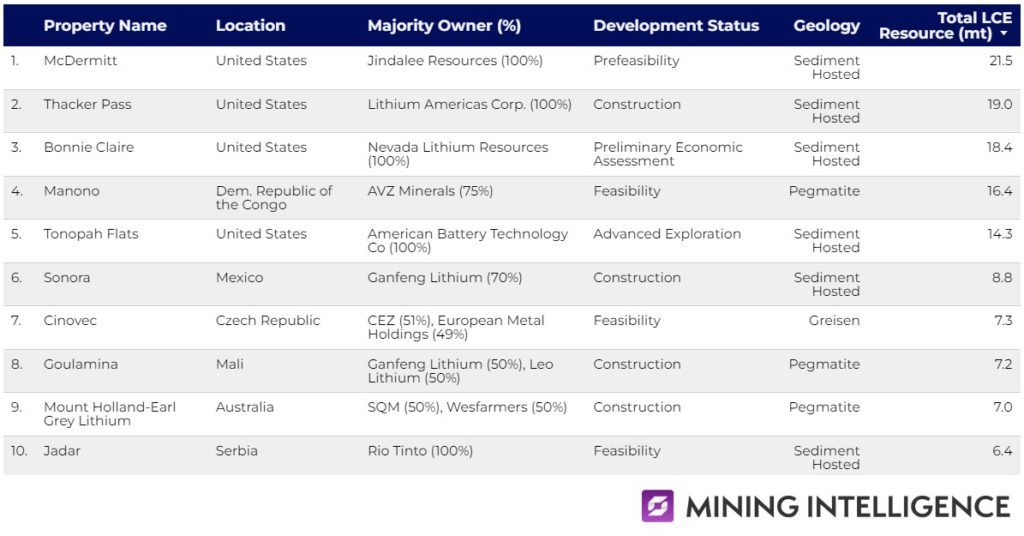
    In a snapshot of the global project pipeline, Mining Intelligence data provides a ranking of the largest clay and hard rock projects in 2023, based on total reported lithium carbonate equivalent (LCE) resources and measured in million tonnes (mt).

    These projects will add to already robust production growth with global output set to come close to 1 million tonnes this year ramping up to 1.5 million tonnes in 2025, double production levels in 2022.

    #1 McDermitt

    Development status: Prefeasibility // Geology: Sediment hosted

    Topping the list is the McDermitt project, located on the Nevada-Oregon border in the US and owned by Jindalee Resources. The Australian miner this year updated the resource to 21.5 mt LCE, up  65% from the 13.3 million tonnes reported last year.

    #2 Thacker Pass

    Development status: Construction // Geology: Sediment hosted

    In second place is Lithium Americas’ Thacker Pass project in northwest Nevada with 19 mt LCE. The project was challenged by environmental groups, but the US Interior Department in May removed one of the last remaining obstacles to development after a federal judge rejected claims the project would cause unnecessary harm to the environment. This year General Motors announced it will invest $650 million in Lithium Americas to help it develop the project.

    #3 Bonnie Claire

    Development status: Preliminary economic assessment // Geology: Sediment hosted

    Nevada Lithium Resources’s Bonnie Claire project Nevada’s Sarcobatus Valley slides from last year’s top spot to third place with 18.4 mt LCE.

    #4 Manono

    Development status: Feasibility // Geology: Pegamite

    The Manono project in the Democratic Republic of Congo is in fourth place with a 16.4 mt resource. The majority owner, Australian miner AVZ Minerals, holds 75% of the asset, and is in a legal dispute with China’s Zijin over the purchase of a 15% stake.

    #5 Tonopah Flats

    Development status: Advanced exploration // Geology: Sediment hosted

    American Battery Technology Co’s Tonopah Flats in Nevada is a newcomer to this year’s list, taking fifth place with 14.3 mt LCE. The Tonopah Flats project in Big Smoky Valley encompasses 517 unpatented lode claims covering approximately 10,340 acres, and ABTC controls 100% of the mining lode claims.

    #6 Sonora

    Development status: Construction // Geology: Sediment hosted

    Ganfeng Lithium’s Sonora in Mexico, the most advanced lithium project in the country, comes in number six with 8.8 mt LCE. Although Mexico nationalized its lithium deposits last year, president Andres Manuel Lopez Obrador said his government wanted to reach agreement with the company over lithium mining.

    #7 Cinovec

    Development status: Feasibility // Geology: Greisen

    The Cinovec project in the Czech Republic, the largest hard rock lithium deposit in Europe, is in seventh place with 7.3 mt LCE. CEZ holds 51% and European Metal Holdings 49%. In January, the project was classified as strategic for the Czech Republic’s Usti region.

    #8 Goulamina

    Development status: Construction // Geology: Pegamite

    The Goulamina project in Mali is in eighth place with 7.2 mt LCE. A 50/50 JV between Gangfeng Lithium and Leo Lithium, the companies are planning to undertake a study into expanding the combined production capacity of Goulamina Stages 1 and 2.

    #9 Mount Holland – Earl Grey Lithium

    Development status: Construction // Geology: Pegamite

    Chilean miner SQM and Australia’s Wesfarmers joint venture, Mount Holland-Earl Grey Lithium in Western Australia, takes ninth place with a 7 mt resource.

    #10 Jadar

    Development status: Feasibility // Geology: Sediment hosted

    Rio Tinto’s Jadar project in Serbia rounds out the list with a 6.4 mt resource. The world’s second largest miner faces local opposition for the project, but is eyeing a revival and keen to reopen talks with the Serbian government after it revoked licenses in 2022 in response to protests sparked by environmental concerns.

  • The Zenica Government Treat For The World’s Ore Traders

    The Zenica Government Treat For The World’s Ore Traders

    The Zenica-Doboj Canton favored the company Adriatic Metals, awarding them concessions in Vareš thus depriving the budget of nearly five million marks. In return, illegal stone mining and road reconstruction left the locals with a devastated picnic area and stream.

    The noise of heavy construction machines on the border between Vareš and Kakanj disturbs the harmony of nearly pristine nature at the doorstep of the Trstionica virgin forest. The forest stream has already been devastated, and the animals are in danger because a foreign mining company expects to make money from the bowels of Bosnian soil.

    The mine of the British company Adriatic Metals has not even started working but ten years of their exploration and preparatory work have already left behind destroyed nature. However, locals are most concerned about the water that supplies Kakanj.

    The Zenica-Doboj Canton authorities granted the company a concession for the exploration and exploitation of ores, accommodating the interests of investors to the detriment of public budgets.

    CIN reporters revealed that in 2018, this company – which was called Eastern Mining at the time – got the concession six times cheaper than domestic companies, thus depriving citizens of about five million marks.

    “Everything will be contaminated. All for a fistful of gold?! It’s not worth a fistful of gold”, warns Dalibor Ballian, a professor from the Sarajevo University Faculty of Forestry.

    Miscalculation

    During the last decade, the government of the Zenica-Doboj Canton (ZDK) granted Adriatic Metals the use rights for about forty square kilometers (four thousand hectares) of land in Vareš for the exploration and exploitation of lead, zinc, and barite. The company has so far paid more than BAM 2.5 million in concession fees to the municipal and cantonal budgets.

    In 2012, Miloš Bošnjaković, an Australian businessman originally from Tuzla, and his company Balkan Mining Pty Ltd bought the small Kreševo company MM Project, which would later become Eastern Mining.

    In the spring of 2013, MM Project bought the DP Rudnik Olova, Zinka i Barita [Social Enterprise “Mine of Lead, Zinc and Barite] in Vareš aiming to start mining operations in this area.

    “This was a prerequisite for participation in the public call of the Zenica-Doboj Canton. (…) To participate in the granting of the right to geological survey”, recalls Bošnjaković.

    The first and basic concession contract was signed in March 2013. MM Project was granted a concession for 116.8 acres for BAM 1,500 per acre. It was only about three percent of the total area that the government will give them for use in the next ten years based on three annexes to the contract.

    A month later, the Zenica-Doboj canton rendered a decision regulating this area for the first time and ordering that the concessionaires should pay a compensation of BAM 10,000 per acre for entering the estate, but as will turn out later, this rule did not apply to this company.

    In 2017, Eastern Mining was bought by the British company Adriatic Metals Ltd. A year later, they signed the first annex to the basic contract with Zenica-Doboj Canton, adding a new 584 acres to the concession field – five times the area of the previous one. However, they did not pay the concession fee of BAM 10,000 per acre the Government set forth earlier. Instead, they were charged a concession fee of BAM 1,500 per acre, as they paid per the basic contract.

    According to Bošnjaković, had the government insisted on a price of BAM 10,000 per acre, Eastern Mining project “would not have extended” [the area] by a single inch.

    Nermin Ćosić, a former employee of the Ministry of Economy of Zenica-Doboj Canton who was involved in the concession granting process confirmed that the Government accepted the conditions of investors.

    “Since they were taking that big piece of land, the amount of money they would need to pay would have been huge. Hence, right at the beginning we agreed with Easter Mining that this one-time concession fee should be some 10-15 pfennigs per square meter (BAM 1,000-1,500 per acre, author’s note), explained Ćosić.

    Thus, Eastern Mining paid for the concession six times cheaper than other concessionaires. Had they paid the regular price of the concession, the budgets would be richer by about BAM 5 million.

    In this case, the Zenica-Doboj Canton Attorney’s Office gave no opinion on awarding the concession at a lower price, although under the law the Government was required to request it. Public Attorney Seđad Kliko did not want to talk about it on record.

    Since 2017, Adriatic Metals has been glorifying the importance of the project for the citizens of this region in the media and announcing works that are also supported by the local government.

    In 2020, Easter Mining also received the largest piece of the field for exploration and exploitation, this time at a ten times lower price – BAM 150 per acre. The government previously passed a decision reducing the one-time concession fee for all concessionaires from BAM 10,000 to BAM 150. Thus, the concessionaire got the use rights for more than 3,200 acres of land for a fee of BAM 481,650.

    The Ministry of Economy of Zenica-Doboj Canton explained that the one-time fee was reduced because the “continuous fee” that will be payable once the excavation works start has been increased. Under this decision, the continuous fee jumped from BAM 1.50 to BAM 3.90 per ton of mined ore. Eastern Mining has not yet started paying the compensation at the new price.

    Adriatic Metals General Manager Paul David Cronin claims it was he who made this proposal to the Zenica-Doboj Canton Government.

    “The government of Zenica-Doboj Canton has reduced the amount of the initial fee per acre to allow for greater exploration opportunities that would potentially lead to higher fees later if the exploration is successful”, said Cronin.

    Former director Bošnjaković remembers the company’s business plans differently.

    “When I was down there, Eastern Mining’s philosophy was the following: “Let us have it, and then we will explore and return to the state the parts we do not need or what the geological survey shows not to be economically viable.”

    By the beginning of this year, the company paid about BAM 970 thousand into the budgets of Zenica-Doboj Canton and Vareš Municipality based on the continuous concession fee from the first contract. Under the basic contract, they were supposed to start paying in 2018, but the deadline for completing the preparatory work was extended. The minimum payments, which they were required to pay regardless of the quantities they mined, were getting due only two years later.

    They will be paying the full fee for the remaining concession fields when they start mining ore, which is expected in November this year.

    They last expanded the concession field with the third annex of the contract in 2022. They took 128 acres for exploration at the Saski Do site. Shortly after that, they changed their name to Adriatic Metals BH. They made a one-time payment of BAM 19,200 for the additional fields.

    In the view of the Zenica-Doboj Canton MP Sanja Renić, no country would allow a higher fee for sowing potatoes than for metal mining, as Zenice-Doboj Canton decided in this case.

    “The concession fee for agricultural land is BAM 400, while the fee for gold exploitation is BAM 150 (…) This is not in line with good management practice in Canton”, said Renić, who claims this was about favoring the concessionaire to the detriment of the canton.

    In the third annex on expanding the area, for the first time, the “continuous fee” for mined ore has not been mentioned. According to Cronin, while they have no plans of mining there they paid the concession to prevent another company from coming to the area.

    Solid road, fragile batching plant

    With the arrival of Adriatic Metals in the mine on the border between the municipalities of Vareš and Kakanj, a new road from Vareš should have been built. Cronin says that Adriatic Metals is building a new road, but that work has stalled due to delays in obtaining the necessary permits.

    In the meantime, the workers of Adriatic Metals come to the mine from the direction of Kakanj via the forest road, which was graveled and widened without permission for the needs of this company. The road along the potable streams of the Trstionica River and Vrući Potok was widened by the workers of the Kakanj company Trgošped with their subcontractors.

    The owner of Trgošped Iso Zaimović confirmed that the works on the section Mehorić-Vrući potok were carried out for Adriatic Metals, but he could not talk about the details because he is bound to secrecy by a business contract.

    Thus, six kilometers of gravel path was turned into a busy truck road to the detriment of the nearly pristine natural resources of Kakanj. “The road from the mouth of Vrući potok to Trstionica essentially did not even exist. It was a hiking trail”, recalls activist Hajrija Čobo.

    The Kakanj Municipality Inspectorate received the first reports on graveling and widening of the forest road at the end of 2021. Amir Dedić, the head of the inspection in Kakanj, remembers his trips to the field towards Vrući potok: “The first time we went there, it was all forest. There was a small road [wide enough] for a jeep to pass. On our second visit, already the trucks could pass”

    Forests and forest lands are a public good managed by forestry companies. According to Jasmin Dedić, director of the Zenica-Doboj Canton Forestry Company, this company did not grant any permission for the Mehorić-Vrući potok road.

    However, the internal document sent from the Kakanj Forestry to the management of the company in Zavidovići, shows that they were aware of Trgošped and their subcontractors carrying out the works for Adriatic Metals.

    “They provide various services for the needs of the future mine such as repairing truck roads, removing snow, repairing tractor roads and many other services, all on request and free of charge,” states the document signed by the head of the Kakanj Forestry, Emir Ibrahimspahić.

    Forestry workers cut down 22 cubic meters of mostly healthy trees in October 2021 so that Trgošped could extract stone from the nearby quarry for paving the road. To justify this action, the Decision approving the tree-cutting project indicated that the trees were infested. They sold the cut fir and spruce to a private sawmill without proper documentation. Upon the launch of internal control, documentation was subsequently created to justify the timber trade.

    Ibrahimspahić pleaded to the director of Forestry Company Jasmin Devedžić that due to frequent thefts, the wood was transported without delivery documents.

    In the spring of 2022, inspectors found that in addition to exploiting stone and reconstructing roads, Trgošped installed a batching plant near the mine in Rupice without necessary permits and consent to support Adriatic Metals.

    Inspector Dedić himself wondered how the plant could even start working: “I really do not know how it is possible, but obviously it is possible. This is why we use the term ‘illegal’ in our correspondence because it is illegal. There are no papers, no approvals.”

    Consequently, the inspectors issued a BAM 1,300 fine and ordered Trgošped to obtain urban planning consent and approval for the construction of a batching plant and adjacent ground floor facility.

    Cronin claims the company didn’t even know about the construction: “When we found out about it, we asked Trgošped to immediately remove it and restore that area.”

    In an interview for CIN, inspector Dedić confirmed that the plant was equipped with a system for discharging wastewater, the so-called cement milk, into the stream. Although the batching plant did not have the necessary water permits, it continued to work, discharging wastewater into Vrući potok and the Trstionica River.

    The inspectors determined the devastation of the rivers and the river area and ordered the restoration of the banks.

    The fight for drinking water

    The river Bukovica on the other side of the hill carries water from the local streams and springs of this region. It supplies water to about 37,000 inhabitants of Kakanj but environmental activist Hajrija Čobo says that this could become a problem because of the mine in Rupice.

    “A minimum concession means nothing to me if I won’t have water to drink and I won’t have it. The works are carried out on a hill that is permeated with water like the body is permeated with veins. Once you release heavy metals into the groundwater, it’s over, there’s no going back,” warns Čobo.

    In May 2021, the Kakanj public company Vodokom refused to give Eastern Mining consent for the exploitation and construction of the mine plant, corroborating this decision by the expert opinion provided by geological engineer Mirza Bašagić.

    Bašagić revealed that the Study of the Mining Institute from Tuzla, which was attached to the request for approval by Eastern Mining, provides incorrect data. It states that the exploitation concession area does not enter the catchment area of the Bukovica River and that the Rupica deposit is located downstream of the water intake, and that future exploitation will not have an impact on the water intake.

    “It is incomprehensible that such a renowned company as the Mining Institute from Tuzla can make such claims when it is well known and completely clear that the Bukovica water intake is located downstream and at a significantly lower altitude compared to the Rupica area,” notes Bašagić.

    Despite this, in July 2021, the FBiH Ministry of Energy, Mining, and Industry issued Eastern Mining a permit for the underground exploitation of lead, zinc, and barite ore.

    The decision to protect the Bukovica source of drinking water for the City of Kakanj has been in force for more than a decade in the Zenica-Doboj Canton and it strictly prohibits the exploitation of ore minerals in the second water protection zone.

    Dalibor Ballian, a professor at the Sarajevo University Faculty of Forestry, warns of a possible ecological disaster.

    “The animals are disturbed and slowly leave the area. We are losing the forest, we are losing drinking water. The wastewater from the mine flows into Vrući potok, and downstream to Trstionica… And Trstionica pollutes the surroundings of Kraljeva Sutjeska, Haljinić, all the way to Kakanj, where it flows into the Bosna River.”
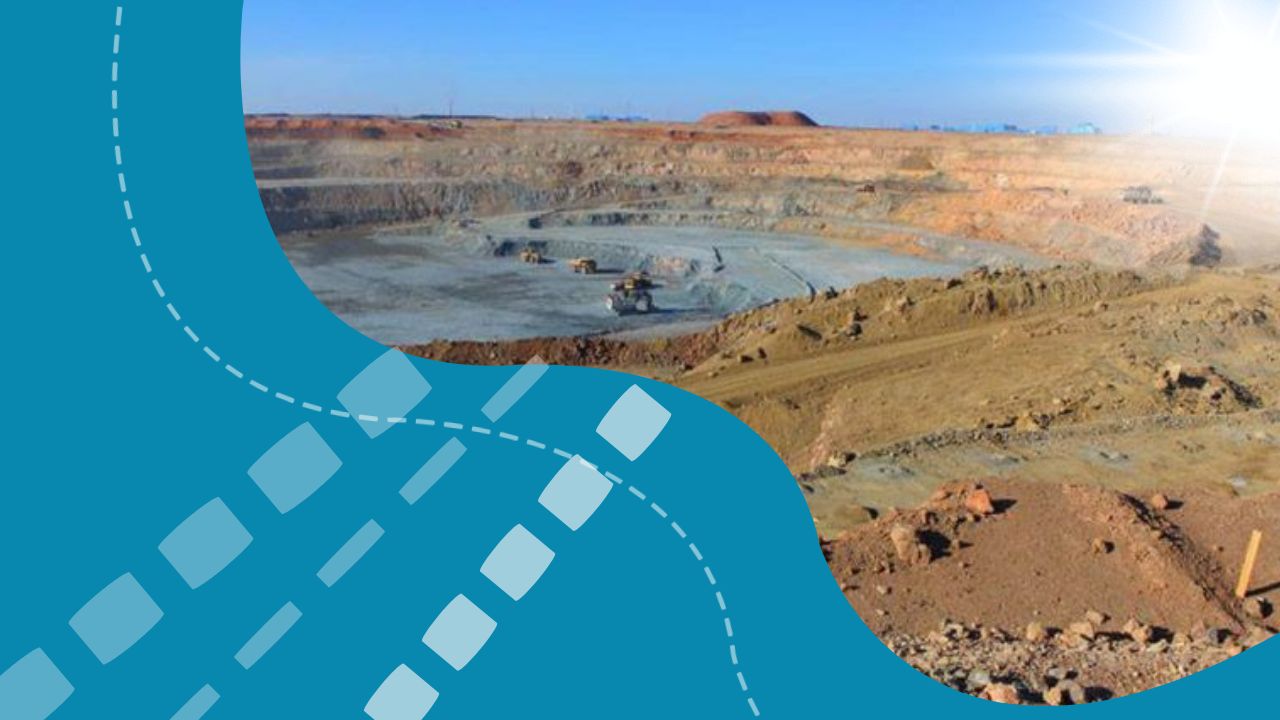
     

  • Locals living near old mines in Poland worry about increasing number of sinkholes

    Locals living near old mines in Poland worry about increasing number of sinkholes

    The area around the town of Trzebinia has seen 20 sinkholes appear in the past two years and locals feel the government is not doing enough to help.

    Residents in former mining areas of Poland are concerned about the increasing number of sinkholes in areas around closed mines.

    In the southern Polish town of Trzebinia, two decades after the closure of the local coal mine, residents live in fear that the ground will literally collapse under their feet.

    Twenty sinkholes have appeared in the region in the past two years.

    Watch Euronews correspondent Magdalena Chodownik’s report in the video.

  • German Company Considers Producing Sodium Cyanide in Egypt for Gold Mining

    German Company Considers Producing Sodium Cyanide in Egypt for Gold Mining

    The Egyptian Ministry of Petroleum announced that Germany’s CyPlus is interested in establishing a new production plant for Sodium Cyanide in Egypt that is used as part of the gold mining and extraction process.

    CyPlus is a leading company with advanced technology services and innovative solutions. It ensures safe use of cyanide production, transportation, and disposal.

    The company utilizes new innovative technologies to develop gold extraction and mining procedures.

    The working group will decide on the necessary procedures and find a suitable location in the Eastern Desert for the new production plant and will also work on researching the required technologies and local market needs.

    Sodium cyanide is a colorless sodium salt. It is prepared from sodium amide by heating it with carbon at 800 degrees. It is used in the treatment and extraction of gold.

    A press statement released by the Egyptian Ministry of Petroleum and obtained by Asharq Al-Awsat, said the German company has a “desire to establish a plant for the production of sodium cyanide.”

    Minister of Petroleum and Mineral Resources Tarek El-Molla met with Chairman of CyPlus Stefan Welbers on Wednesday to discuss the investment opportunities available to the company in Egypt.

    During the meeting, Molla stressed the need to localize industries for products complementary to the mining activity, citing the remarkable development in gold mining, the successful gold bid, and the entry of several international companies into the promising field.

    He indicated that the authorities are studying the feasibility of establishing such factories. He added that the ministry is working on a strategic plan to enhance mining activity and establish more factories to boost it, especially those importing products in foreign currency.

    The minister highlighted the importance of developing the industry sustainably and implementing green mining requirements. He stressed the need for increasing mining capabilities while working towards reducing environmentally harmful emissions.

    For his part, Welbers confirmed that the company provides safe and responsible uses of cyanide, starting from production, through transportation and circulation processes, to application and exchange.

    He indicated that CyPlus dedicates its capabilities to providing new solutions that boost productivity and innovatively develop the gold mining process.

    He praised the remarkable developments in the mining field in Egypt, saying it holds promising opportunities for investment.

  • Velocity agrees option to buy 75% of copper-gold project in Bulgaria

    Velocity agrees option to buy 75% of copper-gold project in Bulgaria

    August 9 (SeeNews) – Canada’s Velocity Minerals said on Wednesday that it agreed with Bulgarian company Zelenrok, a wholly-owned unit of Australia’s Raiden Resources, to receive an exclusive option for the purchase of 75% interest in the Kalabak gold and copper project in Bulgaria.

    The option for the acquisition is conditional on Velocity completing a total of 5,000 m drilling in the next five years and delivering an inferred mineral resource estimate for the property, the Canadian company said in a bourse filing. Financial details of the agreement were not disclosed.

    Raiden Resources will retain the remaining 25% interest in the project should Velocity decide to exercise the option.

    The Kalabak project is located in southeastern Bulgaria, close to Velocity’s Rozino gold deposit and the Ada Tepe gold mine owned by Dundee Precious Metals. The site has potential for epithermal gold-silver and porphyry copper-gold deposits, Velocity said.

    Geochemical screening as part of the site’s planned exploration is set to be completed this year, with drill testing of targets slated for 2024.

    In April, Velocity received approval from Canada’s TSX Venture Exchange for an amended binding agreement with Zelenrok to purchase in two stages up to 75% of the Zlatusha gold and copper project in Bulgaria.

    Eastern Europe-focused Velocity Minerals owns 70% interest in each of the Tintyava, Momchil and Nadezhda properties as well as 100% in the Iglika property in southeastern Bulgaria.

  • Bosnia and Herzegovina’s Coal Dependency: Environmental and Economic Implications

    Bosnia and Herzegovina’s Coal Dependency: Environmental and Economic Implications

    Bosnia and Herzegovina, a country in Southeast Europe, is heavily dependent on coal for its energy needs. The country is rich in coal reserves, which account for more than 60% of its total energy production. While this may seem like a boon for the nation’s economy, the reliance on coal has significant environmental and economic implications.

    Coal-fired power plants are the primary source of electricity in Bosnia and Herzegovina. The country has three major power plants – Tuzla, Kakanj, and Ugljevik – which are all coal-fired. These plants have been operating for decades and are responsible for the majority of the country’s greenhouse gas emissions. The emissions from these plants contribute to climate change, which has been linked to extreme weather events, rising sea levels, and other environmental problems.

    In addition to contributing to climate change, coal-fired power plants also release harmful pollutants into the air. These pollutants include sulfur dioxide, nitrogen oxides, and particulate matter, which can cause respiratory problems, heart disease, and other health issues. The World Health Organization (WHO) estimates that air pollution in Bosnia and Herzegovina causes approximately 44,000 years of life lost each year. This is a significant public health concern, as well as an economic burden on the country’s healthcare system.

    Despite the environmental and health risks associated with coal, Bosnia and Herzegovina continues to invest in new coal-fired power plants. In recent years, the country has signed agreements with Chinese companies to build two new coal-fired power plants – Banovici and Tuzla 7. These projects have been met with opposition from environmental groups, who argue that the country should be investing in cleaner, renewable energy sources instead.

    The continued reliance on coal also has economic implications for Bosnia and Herzegovina. While coal may seem like a cheap source of energy, the true cost of coal is much higher when considering the environmental and health impacts. Moreover, as the world moves towards cleaner energy sources, the demand for coal is expected to decrease. This could lead to a decline in the coal industry, which currently employs thousands of people in Bosnia and Herzegovina.

    Furthermore, the European Union (EU) has set ambitious targets for reducing greenhouse gas emissions and increasing the share of renewable energy in its member states. Bosnia and Herzegovina, as a potential candidate for EU membership, will need to align its energy policies with these targets. This could mean phasing out coal-fired power plants and investing in renewable energy sources, such as wind, solar, and hydropower.

    There are already signs that Bosnia and Herzegovina is starting to recognize the need for a transition to cleaner energy sources. In 2020, the country adopted a new energy strategy, which includes plans to increase the share of renewable energy in its energy mix. However, the strategy still relies heavily on coal, and it remains to be seen whether the country will be able to meet its renewable energy targets.

    In conclusion, Bosnia and Herzegovina’s dependence on coal has significant environmental and economic implications. The country’s coal-fired power plants contribute to climate change and air pollution, posing risks to public health and the environment. Moreover, the continued reliance on coal could hinder the country’s economic development and its prospects for EU membership. To address these challenges, Bosnia and Herzegovina needs to invest in cleaner, renewable energy sources and reduce its dependence on coal. This will not only benefit the environment and public health but also help the country to achieve long-term economic growth and stability.

  • Germany’s China strategy: An anchor at last?

    Germany’s China strategy: An anchor at last?

    The new strategy unveiled by Germany signals a fundamental shift in Berlin’s China policy. Whether it walks this tightrope remains to be seen.

    Germany’s China policy is often lamented as one “at sea, drifting without an anchor”. This may finally change after the recent release of Germany’s China strategy, which attempts to recalibrate relations with its top trading partner. The 64-page document follows Germany’s National Security Strategy released in June, outlining a revamp of the country’s security and economic outlook in an increasingly volatile geopolitical context.

    The China strategy reiterates the familiar balancing act of viewing China through the trinity of “competition, partner, systemic rival” although it does recognise that the rival elements have gained greater prominence now. The Russia-Ukraine conflict spurred a Zeitenwende or turning point in Germany, enabling the country to rethink its previous policies of engagement, which enabled lopsided dependencies on authoritarian states such as Russia and China. As German Foreign Minister Annalena Baerbock warned, Germany cannot afford to “pay more than 200 billion euros to get out of a dependency” again.

    The Russia-Ukraine conflict spurred a Zeitenwende or turning point in Germany, enabling the country to rethink its previous policies of engagement, which enabled lopsided dependencies on authoritarian states such as Russia and China.

    China’s aggressive actions in the South China Sea, increasing tensions in the Taiwan Strait, domestic repression and human rights violations, and Beijing’s deepening partnership with Moscow have also served as factors in this fundamental rethink. “China has changed. As a result of this and China’s political decisions, we need to change our approach to China,” reads the document.

    ‘De-risking’ is the buzzword

    The China strategy devotes a lot of attention to ‘de-risking’ from China—an issue at the forefront of debates in national capitals in Europe as well as at the European Union (EU) level in Brussels. The document cautions that “China strives to create economic and technological dependencies in order to then use them to achieve political goals and interests.” In this context, de-risking involves diversifying supply chains and trade partners and reducing dependencies in critical sectors such as raw materials and technologies, and in areas of semiconductors, pharmaceuticals, and batteries, amongst others.

    Diversifying away from China necessitates closer economic ties with other more ‘like-minded’ partners. In this regard, the document focuses on “global partnerships” in the Indo-Pacific region and with the United States (US), but also in Latin America and Africa. Long considered the weakest link in the EU’s revamped approach to China, the strategy reiterates that the German approach is embedded within the wider EU framework and also aims to expand Germany’s security cooperation with partners in the Indo-Pacific. However, given Berlin’s inability to live up to its increased defence spending pledges yet, its potential to contribute to security in the Indo-Pacific is questionable. 

    Long considered the weakest link in the EU’s revamped approach to China, the strategy reiterates that the German approach is embedded within the wider EU framework and also aims to expand Germany’s security cooperation with partners in the Indo-Pacific.

    Big talk, small stick?

    Despite all its talk, the document does not lay out specific incentives nor binding requirements for companies to de-risk or diversify away from China. Neither does it compensate companies for diversifying or penalise them for not doing so. In this manner, it more or less leaves the task or choice of de-risking to companies with a limited role for the government. This begs the obvious question of whether industry will follow through on these policies given how German companies, particularly those in the automobile sector, are heavily dependent on the Chinese market for their profits. China accounts for the sale of over a third of all vehicles produced by Mercedes Benz and BMW, and German carmakers are now facing competition from local Chinese carmakers such as Nio. Nothing captures this situation better than the remarks of an unnamed German official who said, “The cow is still giving milk. We are not ready to slaughter it yet.”

    The strategy also explicitly states that it would not bail out companies in the event of an escalation of geopolitical tensions such as in the Taiwan Strait. Besides, certain German companies are actually increasing their investments in China. German chemicals company BASF, for whom China comprises 15 percent of yearly sales, intends to invest 10 billion euros by 2030 in a facility in Zhanjiang, Southern China. The document also leaves out proposals to monitor progress on de-risking or diversification. It aims to enact export controls and scrutinise both inbound and outbound investments in China to protect transfers of sensitive technologies amidst wider security and human rights concerns, but it does not address how this would be done. A more potent initial draft of the strategy leaked in November last year, which included stress tests for companies to identify risks and manage resilience relating to China. But disagreements within the traffic-light coalition, with Chancellor Olaf Scholz’s Social Democrats’ more conciliatory approach towards China and Baerbock’s Greens’ more hawkish stance, led to the scrapping of these provisions in the final draft. In the absence of these important specifics, the document seems to merely pile rhetorical pressure on companies.

    Despite talk of diversification, German companies last year invested a record 11.5 billion euros in China and bilateral trade stood at almost 300 billion euros.

    While the strategy talks of protecting critical infrastructure, just last year Scholz allowed Chinese state-owned company COSCO to invest in the Hamburg port terminal despite strong opposition at home. Despite talk of diversification, German companies last year invested a record 11.5 billion euros in China and bilateral trade stood at almost 300 billion euros. Moreover, a lot of 5G networks in Germany are built using Huawei hardware. This year, Scholz laid out the red carpet for Chinese Premier Li Qiang in the latter’s first international trip, where, besides the inter-governmental consultations, the visit also included meetings with top German CEOs. However, there are signs of a changed approach such as the coalition’s decision to block Chinese bids for stakes in two German semiconductor firms Elmos and ERS Electronic. 

    Will actions follow words?

    Additional factors such as a weakening German economy, the increasing popularity of the far-right Alternative for Germany (AfD) threatening Scholz’s grip on power, and anxiety surrounding the 2024 American elections will further complicate the balancing act of getting tough on China while not jeopardising businesses and political power in the process. Although a Pew survey last year demonstrated that 74 percent of the German public viewed China negatively, this sentiment has traditionally failed to translate into policy both at the government and industry levels.

    The strategy does signal a fundamental shift in the way Berlin is thinking about and approaching its relationship with China.

    There are also important trade-offs that the strategy does not address while talking about reducing critical dependencies. For instance, it does not address the key question of where Germany would get its supplies of critical raw materials as well as technologies such as wind turbines and solar panels—both of which largely come from China and are necessary for Germany’s green transition.

    Yet, despite its shortcomings such as its ambiguity on policy measures, the strategy is resolute in its caricature of China and marks the formal end of Wandel durch Handel—the Merkel-era policy of “change through trade,” which was based on the premise that economic engagement would result in a more democratic and liberal China. The strategy does signal a fundamental shift in the way Berlin is thinking about and approaching its relationship with China. Whether actions will follow words in Europe’s economic powerhouse remains to be seen.