Website: Europe.com

  • Polish infrastructure too cramped for Ukrainian business – Metinvest commercial director

    Polish infrastructure too cramped for Ukrainian business – Metinvest commercial director

    The Polish infrastructure is too small for Ukrainian business and cannot replace the blocking of ports in the Black Sea by the aggressor, Dmytro Nikolayenko, commercial director of Metinvest, said in an interview with the Polish business publication WNP.PL.

    The commercial director of the company noted that the metallurgical and mining industry of Ukraine was previously export-oriented: the country exported 80% of metal products and iron ore raw materials. All logistical routes, including the railroad and ports, could handle it.

    At the same time, he recalled that Metinvest’s business has an international dimension. As an international mining and metallurgical group, the company has production facilities not only in Ukraine, but also in Bulgaria, Italy, the UK and the USA, has an extensive sales and distribution network – its products are sold in 95 countries. In addition, Metinvest has 20 offices around the world.

    “We exported products mainly through the Black Sea ports, such as Pivdenny, which is able to receive the largest capesize class merchant ships, as well as through the ports of Odesa and Mykolaiv. We sent cargo around the world from the Mariupol metallurgical plants Azovstal and Illich Steel Mill. Particularly noteworthy is the sea line from Mariupol to Italy, where our goods were shipped to the rolling mill. Container ships regularly transported slabs (semi-finished metal products) to Italy and the UK. We also sent products from Ukrainian rolling mills to our plant in Bulgaria. It was transported along the Dnipro River, and then along the Black Sea to the Bulgarian port of Burgas,” the top manager explained.

    He noted that the logistics component was well organized in the group, customers were provided with good service in terms of predictable delivery times. The company hired a number of vessels under various forms of charter contracts, such as bareboat (a vessel without a crew) and time charter (a vessel hired with a crew).

    However, the full-scale war directly affected the group and its vertical integration. Metinvest was forced to stop production in Mariupol, then operational control over the Mariupol enterprises was completely lost.

  • The Main Explosives Depot in the Zofiówka Section is now operational

    The Main Explosives Depot in the Zofiówka Section is now operational

    The new project plays a key role in the management of blasting agents by enabling the storage and dispensing of explosives.

    “The need to build the Main Explosives Depot at level 900 was related to the need to supply blasting agents to the areas of performing the planned opening and preparatory works at level 900, level 1080 under construction, and the area of dredging sinking the IIz shaft from level 900 to level 1080. Previously, the Explosives Depot was located at level 705 and its location significantly prolonged the transportation of explosives to the blasting site. The mine also had a mobile explosives depot, which, due to its limited storage capacity and the specifics of storing explosives, required significant work,says Piotr Pustelnik, head of the Borynia-Zofiówka-Bzie mine’s Blast Technology Department.

    The venture began with site selection and needs analysis, based on which a design was made. Then workings were excavated and a shotcrete, i.e. sprayed concrete, coating was applied. The final, very demanding stage was the adaptation of 638 m of excavated workings and the proper equipping of the depot to meet the requirements of the Polish Standard and applicable regulations. This scope of work turned out to be very diverse, including the construction of: stoppings, floor dinting and screed, construction of the rail track and installation of track turntables, structures for storing blasting agents, limestone coating, signal and lighting installation, and grounding installation.

    “The exemplary organization of the work, as well as the commitment of the employees and their innovation and efficiency were a key element in achieving the success of this project,” concludes Łukasz Szlązak, director of the Borynia-Zofiówka-Bzie mine.

    The Main Explosives Depot will serve both the Zofiówka and the Bzie Sections.

  • Adriatic Metals hails precious metals finds at Rupice

    Adriatic Metals hails precious metals finds at Rupice

    (Alliance News) – Adriatic Metals PLC on Wednesday gave an update on its Rupice northwest exploration which is part of the company’s Vares silver project.

    Adriatic Metals is a precious and base metals explorer and developer that owns the Vares silver project in Bosnia & Herzegovina and the Raska zinc deposit in Serbia.

    The company said it found 2.6 grams of gold per tonne, 409 grams of silver per tonne, about 12% zinc, 8.9% lead, 1.2% copper, 9% barium sulfate and 0.2% antimony in hole BR-30-23.

    Managing Director Paul Cronin said: “Additional exploration drilling, new geology, more tonnes at higher grades to the west of the current Rupice Northwest resource are adding significantly to the growth of Rupice. Faulting and folding have thickened and bent mineralization to vertical, with silver-gold-copper grades increasing in proximity to the deformation. Drilling will continue to define the western extent of RNW for a further resource update at the end of 2023.”

    Adriatic Metals rose 2.9% to 192.00 pence each on Wednesday morning in London.


  • European Lithium doubles Wolfsberg Project footprint on grant of new licenses

    European Lithium doubles Wolfsberg Project footprint on grant of new licenses

    European Lithium Ltd (ASX:EUR, OTCQB:EULIF) has taken another step toward becoming Europe’s first local producer of battery-grade lithium on being granted new mining licenses and extensions which double the footprint of the advanced Wolfsberg Lithium Project in Austria.

    A public hearing conducted by the Austrian Mining Authority has resulted in the new licenses and extensions, which come as the continent marches on in the strengthening transition to green energy.

    The company has been granted six new mining licenses while three existing licenses have been extended with one of the extensions applying to the existing Andreas field and two to the newly assigned Barbara field.

    Austrian fast-track

    European Lithium chairman Tony Sage said: “The grant of these mining licenses further reinforces our belief that Wolfsberg will be the first local producer of battery-grade lithium in Europe to fuel the green energy transition.

    “The Wolfsberg Project benefits from Austria’s robust and mature mining industry that reflects many of the aims of the EU’s proposed Critical Raw Materials Act, including a fast track for critical projects like ours.”

    Beyond existing resource

    Wolfsberg Project tenement map.

    EUR’s mining licenses now extend beyond the existing Wolfsberg lithium resource and almost double the project’s footprint.

    There are now 20 licenses covering the Wolfsberg Project, which almost double the footprint for the proposed underground mining operations.

    The licenses and extensions flow on from the Wolfsberg Project Definitive Feasibility Study (DFS) released in March 2023 in which mine planning and design incorporated an expanded resource.

    At the time, EUR identified several mining fields extending outside existing license areas that had the potential to be mined in the future.

    Since the DFS, the company applied for a new mining field, called Barbara, adjacent to the existing mining field called Andreas, which contains 11 mining licenses.

    The Barbara mining field provides the company with six new licenses along with the three extended licenses.

    READ: European Lithium strengthens critical minerals portfolio on securing Austrian projects with sample grades up to 3.98%

    European Lithium has also recently increased its Austrian critical minerals portfolio by securing other projects separate to Wolfsberg which have returned sample grades up to 3.98% and have potential to add to the company’s lithium bounty.

    “Significant upside”

    “The grant of the new mining licenses and license extensions provides significant upside to mining operations in the future,” the company’s CEO, Dietrich Wanke, said.

    “We are encouraged by this successful grant as we move toward operational readiness of the Wolfsberg Project,” he added.

  • Protests against expanding moldavite mining near České Budějovice

    Protests against expanding moldavite mining near České Budějovice

    Local inhabitants, environmental associations and the municipal council of Ločenice near České Budějovice are against the expansion of moldavite mining in the area. A private company wants to build a new quarry on thirty hectares of land believed to be rich in moldavite. Locals have been signing a petition against the plan and the Czech Environmental Inspectorate also has reservations. The inspectorate has asked the company MAWE CK, which wants to expand its activities in the area, to commission a study which will, among other things, assess the impact of further mining on the landscape. Moldavites are bottle-green gemstones found almost exclusively in Czechia, with minor deposits in neighboring Germany and Austria.

  • Ukraine: UMCC titanium raw materials exported to the USA

    Ukraine: UMCC titanium raw materials exported to the USA

    All the export deliveries of titanium raw materials by the United Mining and Chemical Company since the beginning of the full-scale Russian invasion have been to the end users in the USA and are used only for chemical processing, and not in the military complex.

    According to the State Property Funs, there is a number of factors preventing the export of titanium raw materials to the aggressor state, namely a three-level internal audit of contract terms and a counterparty, made by the UMCC itself, checking the contract terms and the counterparty by the Fund, obtaining the license to export ilmenite concentrate from the State Export Control Service and personal control in the destination place by authorised persons. Moreover, all contracts prohibit reselling the raw materials and there are strict sanctions for their breach.

    “You won’t believe how many procedures the UMCC has to go through when getting a contract. Thus, thinking that the Fund or other state institutions close their eyes and don’t see where the products are going is infantile,” the SPF deputy chairman Olexander Fedorishin has said. (Ukrainian metal)

  • Europe Is Embarking on a Mining Renaissance. Winning Over Locals Is Proving a Challenge.

    Europe Is Embarking on a Mining Renaissance. Winning Over Locals Is Proving a Challenge.

    COVAS DO BARROSO, Portugal—Tucked away in the mountains of northern Portugal, about two hours northeast from the country’s second-largest city of Porto, sits this idyllic farming village. It is home to under 200 people, most over the age of 60, with the surrounding region most famous for its Barrosão cattle, a protected species prized for its meat. The nearest town, Boticas, is a 20-minute drive away, and if you stand on the hilltop, the only sounds you hear are the cattle, song birds and insects.

    Covas, however, is set to play host to the green-energy transition in its rawest form. Just a third of a mile away from the houses of Covas do Barroso is one of Europe’s richest lithium deposits—the silvery metal used in electric-vehicle batteries—and a planned mining operation to dig out the mineral.

    Europe’s Mining Boom

    With demand for critical minerals surging, European governments want to exploit resources closer to home.

    Locals are worried about the environmental impact as well as the blight on the village presented by the mine. Speaking to locals, the word “mina” often draws a cringe, and a protest is scheduled later this month. “Our biggest opposition to the mine is that they want to destroy us,” said Nelson Gomes, president of Associação Unidosem defesa de Covas do Barroso, the local protest group. “The intensity of what they want to destroy, but also the proximity. It’s basically inside the village.”

    Governments and companies around the world are scrambling to find new sources of critical materials—and in doing so they are easing the approval process for projects that once took years or sometimes more than a decade to get off the ground. Additional supplies of metals like copper, nickel and lithium are going to be crucial to meet the growing demand for the energy transition—with the wiring, magnets, motors and battery cells used in green technologies such as electric vehicles, wind turbines and batteries for storage all requiring mined minerals.

    “No doubt there is a real demand story,” said Alex Gorman,mining analyst at U.K. investment bank Peel Hunt. “We are talking about a 35-fold increase in lithium demand and we do not have any large-scale lithium mines in Europe. It’s a massive problem.”

    But as governments fast-track approvals on such projects and struggle to convey the importance of efforts to secure materials for the green-energy transition, resistance is growing among locals like the Covas residents who stand to feel an impact and environmentalists who urge caution when moving forward with projects in sensitive ecosystems.

    Left: A stream dug by Nelson Gomes to manage the flow of water from the river over his farmland. Right: Nelson Gomes’s Barrosão cattle, a protected species.YUSUF KHAN/THE WALL STREET JOURNAL

    Race for resources

    The proposed Covas site is one of the nearly 50 mines now expected to open across Europe by 2030.In Germany, Vulcan Energy Resources is looking to open a lithium mine, harnessing a new technology for extracting the battery metal from brine. In Sweden, Copperstone Resources is hoping to reopen a brownfield mine site to extract the red metal, while Adriatic Metals has just started mining for silver and zinc in Bosnia, with more projects planned from Finland to Greece.

    “It’s definitely a [mining] renaissance,” said Rebecca Campbell, global mining and metals lead at law firm White & Case.“For many of us who have been working in the sector, it’s the first time we are seeing primary projects in Europe during our careers.”

    “We’re starting to now see material that’s on its way through the supply chain from European mine[s],” she added.

    The situation in Europe and the U.S. isstrikingly similar, according to Jayni Hein, of counsel at law firm Covington & Burling and former senior director for clean energy, infrastructure and the National Environmental Policy Act at the White House Council on Environmental Quality.

    “There’s an uptick in interest in domestic manufacturing and production in the U.S.,” driven by the passage of the climate law known as the Inflation Reduction Act in 2022, said Hein. She said the IRA and other acts have increased funds available for federal agencies to accelerate and improve permitting but noted that working with individual states and their legislatures remains a challenge. “We’re trying to foster a permitting landscape that is both efficient and responsible.”

    In Europe, the mining renaissance comes after years of nearly no new mining activity on the continent. Usually, opening a new mine takes 10 to 15 years, often because permitting can take years, according to Peel Hunt’s Gorman. She said a lack of staff with field knowledge has been an issue as well as negative attitudes toward mining in general.

    The Covas deposit

    In 2017 Savannah Resources, a London-listed mining company, identified the Covas deposit as a possible area to mine, hoping to cash in on green demand. Geological studies of the area stretching back to the 1980s had found possible lithium reserves. The project, however, seemed to have stalled after failing to get the backing of Portugal’s environmental agency.

    That changed this year. In May, Savannah Resources received permitting approval from the environmental agency allowing the company to move forward with pre-feasibility studies that include mining one small site to show how it would proceed with a full-scale operation. The approval happened to coincide with the European Union’s proposing critical-minerals legislation to speed up mine approvals across the bloc with various measures, including limiting environmental approval review times to two years.

    Left: A layer of spodumene within the host rock that Savannah Resources intends to mine. Right: Savannah Resources sample shed.YUSUF KHAN/THE WALL STREET JOURNAL

    For Savannah Resources, mining in the Portuguese hills for spodumene, the base rock recovered for lithium extraction, has become more attractive since the government updated its mining laws in 2021 to be more open to exploitation. The companyaims to dig four mine sites in the valley, with the largest 1,600 feet across, about the length of five football fields. Currently, Savannah Resources is mining the smallest of those sites, with some of the proceeds used in the local ceramics industry because the company hasn’t yet won approval to process lithium.

    “Some of the rock that’s being mined for spodumene—that is currently being mined for ceramics. Well, what we are doing instead of using it all for ceramics, is we’re taking the spodumene out and turning that into lithium hydroxide,” said Dale Ferguson, chief executive of Savannah Resources.Lithium hydroxide is used to make cathode materials for lithium-ion batteries.

    Locals worry the Covas river will be used by the mine. Savannah Resources, which has set up two offices in the municipality, has said it would strictly avoid that and instead build reservoirs to store rain water. But Gomes, the local opposition leader, is doubtful. Savannah Resources “will not take water from the river but they need to take it from somewhere. The river Covas springs 20 kilometers away, so they will take it before the river starts, even if not actually using the river.”

    Shifting sentiment?

    Local backlash against new mines isn’t uncommon. The industry has a long history of environmental destruction, poor relations with local communities and deadly disasters. In 2021, local opposition derailed Rio Tinto’s lithium project in Serbia, though the company is still confident the mine will open in some capacity at some point.

    However, governments want and need a secure supply chain of metals and minerals. Most critical minerals are processed in a relatively small number of countries with the threat made more apparent last month after China said it would introduce export restrictions to germanium and gallium—two critical minerals used to make semiconductors. Prices skyrocketed as consumers were suddenly unsure if they would have the raw materials needed to make chips for cars, phones and other tech.

    “There are minerals that are needed with the new green transition, resources that you did not need or have any use for before, which are now important for society, for nations, to have. It’s so much needed,” said Jessica Polfjärd, member of the European Parliament and Sweden’s Moderate Party.

    Polfjärd said that in Europe, attitudes in governments are starting to shift toward mining, adding that it is up to those lawmakers to help explain the benefits and need for exploiting mineral resources at home.

    Left: Local villagers have been protesting the opening of the mine. Right: The village of Covas do Barroso within the Serra de Dornela river valley.YUSUF KHAN/THE WALL STREET JOURNAL

    “There is always more public response when you start something new,” she said. “There is no difference if you want to have a mine or a shopping mall. To put something new in place—it’s harder than existing ones.”

    Despite the strong local opposition, Portugal still wants to mine its resources. “We have a responsibility to do so since we have the highest lithium resource [in Europe],” said Ana Fontoura Gouveia, Portugal’s secretary of state for energy and climate.

    Fontoura said that there is a possibility that the land for the mine, which is owned largely by the community and private owners, could be expropriated but she hoped an agreement would be reached instead. That view is echoed by Savannah Resources.

    “Portugal is a front-runner with adapting laws for environmental and social standards,” Fontoura said. “Critical raw materials have economic value and social value and we can fulfill that by high environmental and social standards. It’s important to convince [people] this is the way forward.”

  • The EU needs domestic critical minerals supply so the wheels don’t fall off

    The EU needs domestic critical minerals supply so the wheels don’t fall off

    Blessed are the cheesemakers

    Truth. And so Europe was undoubtedly thrust into a state of shock recently after hearing that 74 yr-old cheese casaro Giacomo Chiapparini was crushed to death under the wheels of his own parmesan.

    The cheese wheels – weighing in at 40kg each – fell in their thousands from the top of his warehouse after a shelf broke and it took firefighters 12 hours to retrieve Chiapparini’s body underneath his beloved Grana Padano.

    But that’s not the only shock lately for Europe – it’s facing a domestic raw material production crisis for a range of critical minerals it requires for EVs, clean energy production and other technologies.

    Moves such as China’s recent export restrictions of its monopoly on gallium and germanium – critical components in semiconductor chips – and high global demand have sparked the EU to hastily pass legislation to make its region more self-reliant in the mining, processing and recycling of such minerals.

    34 of them in fact. The EU’s Critical Raw Materials Act was enacted earlier this year to secure future supply for downstream processing and manufacturing of critical metals and minerals as it largely imports most elements from third-party countries outside the EU.

    Don’t let the wheels fall off

    European mining is old. Centuries-old. Yet nowadays, its homegrown mining is largely based on fossil fuel extraction and traditional mining of meagre amounts of gold and silver – importing most other minerals that are increasingly in demand as we pivot to net-zero emissions technologies.

    Past colonialism by the majority of European powers – where they pillaged natural resources and brought them back home – has manifested into the necessary importation of a range of raw materials from places like China, Africa, Russia and more for far too long.

    Thus creating a dependency on third-party nation-states outside of the EU for high-demand critical minerals.

    It may sound cheesy to say this, but this lack of domestic critical mineral production could mean Europe gets economically crushed by its past successes.

    Basically, if the EU doesn’t want the wheels to fall off its prestigious US$156bn (6.24% of total EU exports) car manufacturing sector and clean energy targets, it’s going to need to shore up stable supplies of these minerals in-house, otherwise OEMs are going to set up shop elsewhere.

    The good news is, they’re actually doing something about it.

    EU critical minerals mandate

    The Raw Materials Act sets these benchmarks along the strategic raw materials value chain and for the diversification of the EU supplies for:

    at least 10% of the EU’s annual consumption for extraction

    at least 40% of the EU’s annual consumption for processing

    at least 15% of the EU’s annual consumption for recycling

    and no more than 65% of the EU’s annual consumption from a single third country

    Lofty goals, as currently, China supplies the EU with 80% of its REEs and imports high percentages of other strategic minerals used in battery manufacturing, such as lithium, nickel, copper and cobalt.

    In March 2023, the European Union also proposed the Net Zero Industry Act, which aims to meet 40% of its needs for strategic net zero technologies using domestic manufacturing capacity by 2030.

    These technologies explicitly include battery and storage, and for batteries, the aim is for nearly 90% of the European Union’s annual battery demand to be met by EU battery manufacturers, with a combined manufacturing capacity of at least 550GWh in 2030, in line with the objectives of the European Battery Alliance.

    “The EU’s demand for base metals, battery materials, rare earths and more are set to increase exponentially as the EU divests from fossil fuels and turns to clean energy systems which necessitate more minerals,” the European Council says.

    “The EU green transition will require the build-up of local production of batteries, solar panels, permanent magnets, and other clean tech. Abundant access to a range of raw materials will be needed to address the corresponding demand.”

    Ergo, Europe is hungry to mine. And lucky for EU, there’s a bunch of ASX-listed explorers and mine developers looking to feed into its domestic supply chain.

    So who’s out there?

    In Austria, Battery Age Minerals (ASX:BM8) owns the Bleiberg project – once a major producer of zinc and lead; and at one point was among the largest primary germanium producers globally.

    The explorer’s now added germanium to its “to-do” list at Bleiberg, where gallium mineralisation has also been found through historical workings at the project, recently announcing an expansion of its tenements.

    “We are pleased to have secured additional ground adjacent to our existing Bleiberg Zinc-Lead-Germanium project,” BM8 MD Gerard O’Donovan said last month.

    Also in Austria, Tony Sage-backed European Lithium (ASX:EUR) is concentrating on its Wolfsburg hard rock lithium project, recently selling its non-core Australian tenement around the Mt Anketell iron ore deposit in the Pilbara, keeping it laser-eyed on battery commodities for the European market.

    Wolfsberg’s current MRE is 12.88Mt @ 1% Li2O and its DFS has highlighted the project’s economic viability – especially since it has an offtake agreement with BMW, a US$125m share subscription facility and an agreement with Saudi-backed Obeikan Investment Group.

    EUR is about ~65% financed, and is looking at finalising a funding package for infrastructure, the construction start and resource extension drilling at the Zone 2 prospect which is currently not included in the MRE.

    Exploring copper and gold at Sweden’s historic 1,000yr old Falun mine is Alicanto Minerals (ASX:AQI), which has recently received commitments to raise $3m to kickstart drilling at the project.

    Multiple high-priority targets have been identified, comprised of both copper-gold and zinc-copper-lead, especially along 3.5km of mineralisation where limited drilling was conducted last year.

    Alicanto has also been conducting step-out drilling at its Sala silver-zinc project, also in Sweden, which has a current resource of 9.7Mt, with recent re-assaying of historic cores showing 1.1m @ 1,326g/t silver, 0.8% zinc and 6.6% lead; as well as 3.9m at 737g/t silver, 1.2% zinc and 11.8% lead near the historic Bronäs mine.

    It seems like Sweden’s becoming a bit of a hotspot for mining again for ASX juniors looking to boost Europe’s green tech push.

    Zinc of Ireland (ASX:ZMI) has its eyes on zinc mineralisation at its Rathdowney project where it controls 75 prospecting licences across 2,500km2 with a trend that goes for a whopping 130km.

    Previously mined for zinc and lead, ZMI is looking to further exploration on the back of a 2020 MRE of 11.3Mt @ 9% Zn+Pb (7.8% Zn and 1.2% Pb) @ a 5% Zn equivalent cut-off.

    ZMI reckons it controls “arguably one of the most prospective land packages for high grade, large tonnage, Zn/Pb deposits in the world”.

    Samples are actively being taken at the Rathdowney trend and the explorer is assessing geochemical assays.

    Off to the Balkans now and precious metals explorer Adriatic Metals (ASX:ADT) is on a tear after releasing a 93% increase of the indicated and inferred MRE of its Rupice deposit – part of its Vares silver project in Bosnia and Herzegovina last month.

    It now stands at an impressive 21.1Mt @ 156g/t Ag, 1.2g/t Au, 4.3% Zn, 2.8% Pb, 0.4% Cu, 27% BaSO4 (reported above a cut-off grade of 50 g/t AgEq) for a contained 105Moz Ag, 789koz Au, 913kt Zn, 581kt Pb, 88kt Cu and 39kt Sb.

    The near-term producer says construction is 84% complete (as of June 30 this year) and first concentrate is expected in November.

    Based off the results, Adriatic is now raising US$30m to complete construction and prove up more resources.

    “Following a very successful exploration campaign and the recently announced MRE at Rupice and Rupice Northwest, we are pleased to announce an equity placing of US$30 million to fund an expanded and accelerated exploration programme in 2023 and 2024,” ADT MD Paul Cronin says.

    “Rupice and Rupice Northwest remain open and there are numerous regional targets such as Droskovac, SP1 and SP2 that have exciting prospects.

    “We believe this exploration programme will deliver impactful results by more aggressively testing priority targets across our emerging high-grade polymetallic district.”

    Finally – and staying in Bosnia and Herzegovina – Lykos Metals -LYK (ASX:) is making strides towards exploration approvals for its highly-prospective copper-gold tenements at the Sinjakovo project after being hamstrung by red tape.

    “After nearly two years of intensive negotiations, the Government of the Republic of Srpska has taken a decisive stance to protect foreign investments in geological exploration,” LYK CEO Milos Bosnjakovic says.

    “This represents a momentous step forward not only for our company but also for the economy of the Republic of Srpska, and the local municipalities where we have been actively engaged since listing and intend to conduct future exploration activities.”


  • Landfill mining project yields positive results in Spain

    Landfill mining project yields positive results in Spain

    An illegal hillside dumping ground for construction and demolition waste in Andalusia, Spain, has been reverted to its natural state through landfill mining.

    According to a paper in the International Journal of Environmental Engineering, almost 90% of the waste materials sitting at the site near the town of Dehesas Viejas were retrieved and found to be low-hazard and suitable for road construction projects or backfilling conventional landfill sites that have been mined.

    In a media statement, the paper’s lead author David Caro Moreno said that landfill mining is an emerging approach for the remediation of old waste sites. It allows for the reuse of valuable materials, such as plastics and metals that may have been dumped before recycling facilities were widely available. The process might also allow an entire brownfield site to be remediated sufficiently for development or even rewilding.

    For Caro Moreno and his co-authors, in places where mining of conventional, municipal landfill might be required, there is perhaps a greater need for segregation of the waste materials during the recovery process so that they can be reused or recycled. Their research, nevertheless, bodes well for clearing up other big fly-tipping or illegal landfill sites.

    “Landfill mining could become an effective approach to addressing the environmental hazards posed by old landfill sites. Moreover, it could offer a supply of raw materials, such as rare and difficult-to-source metals used in electronics,” the statement reads. “These could be fed into the industrial recycling and supply chains.”

    The researchers acknowledge that there are likely to be issues of contamination with hazardous materials in some landfills set for excavation and mining. However, with appropriate safety measures in place during the process, landfill mining has great potential for the reuse of erstwhile waste and the possibility of remediating sites either for development or repurposing as wildlife reserves, or simply ensuring that they revert to their natural state.

  • The EU needs domestic critical minerals supply so the wheels don’t fall off

    The EU needs domestic critical minerals supply so the wheels don’t fall off

    Blessed are the cheesemakers

    Truth. And so Europe was undoubtedly thrust into a state of shock recently after hearing that 74 yr-old cheese casaro Giacomo Chiapparini was crushed to death under the wheels of his own parmesan.

    The cheese wheels – weighing in at 40kg each – fell in their thousands from the top of his warehouse after a shelf broke and it took firefighters 12 hours to retrieve Chiapparini’s body underneath his beloved Grana Padano.

    But that’s not the only shock lately for Europe – it’s facing a domestic raw material production crisis for a range of critical minerals it requires for EVs, clean energy production and other technologies.

    Moves such as China’s recent export restrictions of its monopoly on gallium and germanium – critical components in semiconductor chips – and high global demand have sparked the EU to hastily pass legislation to make its region more self-reliant in the mining, processing and recycling of such minerals.

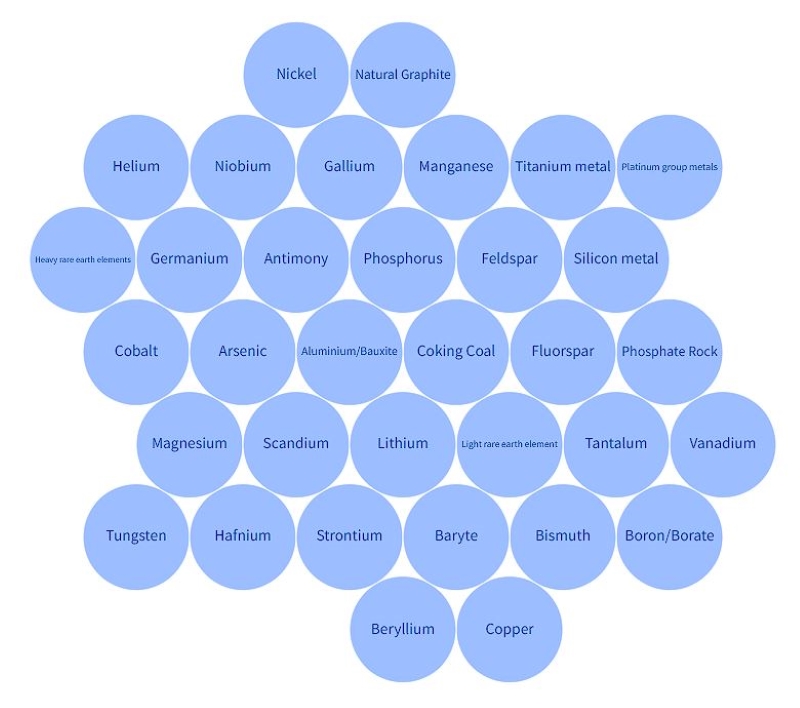
    34 of them in fact. The EU’s Critical Raw Materials Act was enacted earlier this year to secure future supply for downstream processing and manufacturing of critical metals and minerals as it largely imports most elements from third-party countries outside the EU. Let’s find out why:

    europe critical minerals (eur)
    Critical minerals the EU has mandated for domestic production and processing capabilities. Source: European Union.


    Don’t let the wheels fall off

    European mining is old. Centuries-old. Yet nowadays, its homegrown mining is largely based on fossil fuel extraction and traditional mining of meagre amounts of gold and silver – importing most other minerals that are increasingly in demand as we pivot to net-zero emissions technologies.

    Past colonialism by the majority of European powers – where they pillaged natural resources and brought them back home – has manifested into the necessary importation of a range of raw materials from places like China, Africa, Russia and more for far too long.

    Thus creating a dependency on third-party nation-states outside of the EU for high-demand critical minerals.

    It may sound cheesy to say this, but this lack of domestic critical mineral production could mean Europe gets economically crushed by its past successes.

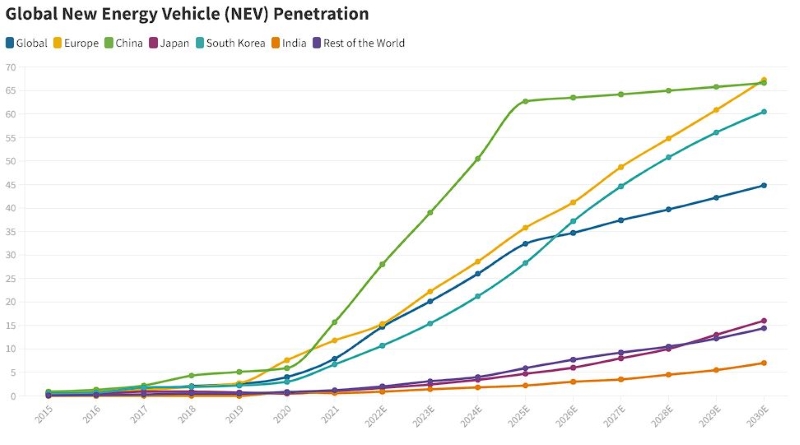
    europe ev asx (eur)
    Europe is set to become the global leader in EV penetration. Source: Citi.


    Basically, if the EU doesn’t want the wheels to fall off its prestigious US$156bn (6.24% of total EU exports) car manufacturing sector and clean energy targets, it’s going to need to shore up stable supplies of these minerals in-house, otherwise OEMs are going to set up shop elsewhere.

    The good news is, they’re actually doing something about it.


    EU critical minerals mandate

    The Raw Materials Act sets these benchmarks along the strategic raw materials value chain and for the diversification of the EU supplies for:

    • at least 10% of the EU’s annual consumption for extraction
    • at least 40% of the EU’s annual consumption for processing
    • at least 15% of the EU’s annual consumption for recycling
    • and no more than 65% of the EU’s annual consumption from a single third country

    Lofty goals, as currently, China supplies the EU with 80% of its REEs and imports high percentages of other strategic minerals used in battery manufacturing, such as lithium, nickel, copper and cobalt.

    In March 2023, the European Union also proposed the Net Zero Industry Act, which aims to meet 40% of its needs for strategic net zero technologies using domestic manufacturing capacity by 2030.

    These technologies explicitly include battery and storage, and for batteries, the aim is for nearly 90% of the European Union’s annual battery demand to be met by EU battery manufacturers, with a combined manufacturing capacity of at least 550GWh in 2030, in line with the objectives of the European Battery Alliance.

    “The EU’s demand for base metals, battery materials, rare earths and more are set to increase exponentially as the EU divests from fossil fuels and turns to clean energy systems which necessitate more minerals,” the European Council says.

    “The EU green transition will require the build-up of local production of batteries, solar panels, permanent magnets, and other clean tech. Abundant access to a range of raw materials will be needed to address the corresponding demand.”

    Ergo, Europe is hungry to mine. And lucky for EU, there’s a bunch of ASX-listed explorers and mine developers looking to feed into its domestic supply chain.


    So who’s out there?

    In Austria, Battery Age Minerals (ASX:BM8) owns the Bleiberg project – once a major producer of zinc and lead; and at one point was among the largest primary germanium producers globally.

    The explorer’s now added germanium to its “to-do” list at Bleiberg, where gallium mineralisation has also been found through historical workings at the project, recently announcing an expansion of its tenements.

    “We are pleased to have secured additional ground adjacent to our existing Bleiberg Zinc-Lead-Germanium project,” BM8 MD Gerard O’Donovan said last month.

    Also in Austria, Tony Sage-backed European Lithium (ASX:EUR) is concentrating on its Wolfsburg hard rock lithium project, recently selling its non-core Australian tenement around the Mt Anketell iron ore deposit in the Pilbara, keeping it laser-eyed on battery commodities for the European market.

    Wolfsberg’s current MRE is 12.88Mt @ 1% Li2O and its DFS has highlighted the project’s economic viability – especially since it has an offtake agreement with BMW, a US$125m share subscription facility and an agreement with Saudi-backed Obeikan Investment Group.

    EUR is about ~65% financed, and is looking at finalising a funding package for infrastructure, the construction start and resource extension drilling at the Zone 2 prospect which is currently not included in the MRE.

    Exploring copper and gold at Sweden’s historic 1,000yr old Falun mine is Alicanto Minerals (ASX:AQI), which has recently received commitments to raise $3m to kickstart drilling at the project.

    Multiple high-priority targets have been identified, comprised of both copper-gold and zinc-copper-lead, especially along 3.5km of mineralisation where limited drilling was conducted last year.

    Alicanto has also been conducting step-out drilling at its Sala silver-zinc project, also in Sweden, which has a current resource of 9.7Mt, with recent re-assaying of historic cores showing 1.1m @ 1,326g/t silver, 0.8% zinc and 6.6% lead; as well as 3.9m at 737g/t silver, 1.2% zinc and 11.8% lead near the historic Bronäs mine.

    It seems like Sweden’s becoming a bit of a hotspot for mining again for ASX juniors looking to boost Europe’s green tech push.

    Zinc of Ireland (ASX:ZMI) has its eyes on zinc mineralisation at its Rathdowney project where it controls 75 prospecting licences across 2,500km2 with a trend that goes for a whopping 130km.

    Previously mined for zinc and lead, ZMI is looking to further exploration on the back of a 2020 MRE of 11.3Mt @ 9% Zn+Pb (7.8% Zn and 1.2% Pb) @ a 5% Zn equivalent cut-off.

    ZMI reckons it controls “arguably one of the most prospective land packages for high grade, large tonnage, Zn/Pb deposits in the world”.

    Samples are actively being taken at the Rathdowney trend and the explorer is assessing geochemical assays.

    Off to the Balkans now and precious metals explorer Adriatic Metals (ASX:ADT) is on a tear after releasing a 93% increase of the indicated and inferred MRE of its Rupice deposit – part of its Vares silver project in Bosnia and Herzegovina last month.

    It now stands at an impressive 21.1Mt @ 156g/t Ag, 1.2g/t Au, 4.3% Zn, 2.8% Pb, 0.4% Cu, 27% BaSO4 (reported above a cut-off grade of 50 g/t AgEq) for a contained 105Moz Ag, 789koz Au, 913kt Zn, 581kt Pb, 88kt Cu and 39kt Sb.

    The near-term producer says construction is 84% complete (as of June 30 this year) and first concentrate is expected in November.

    Based off the results, Adriatic is now raising US$30m to complete construction and prove up more resources.

    “Following a very successful exploration campaign and the recently announced MRE at Rupice and Rupice Northwest, we are pleased to announce an equity placing of US$30 million to fund an expanded and accelerated exploration programme in 2023 and 2024,” ADT MD Paul Cronin says.

    “Rupice and Rupice Northwest remain open and there are numerous regional targets such as Droskovac, SP1 and SP2 that have exciting prospects.

    “We believe this exploration programme will deliver impactful results by more aggressively testing priority targets across our emerging high-grade polymetallic district.”

    Finally – and staying in Bosnia and Herzegovina – Lykos Metals -LYK (ASX:) is making strides towards exploration approvals for its highly-prospective copper-gold tenements at the Sinjakovo project after being hamstrung by red tape.

    “After nearly two years of intensive negotiations, the Government of the Republic of Srpska has taken a decisive stance to protect foreign investments in geological exploration,” LYK CEO Milos Bosnjakovic says.

    “This represents a momentous step forward not only for our company but also for the economy of the Republic of Srpska, and the local municipalities where we have been actively engaged since listing and intend to conduct future exploration activities.”

    While Alicanto, European Lithium, Battery Age Metals and Zinc of Ireland are Stockhead advertisers, they did not sponsor this article.