Website: Europe.com

  • Investors glimpse opportunity in Europe’s unloved mining shares

    Investors glimpse opportunity in Europe’s unloved mining shares

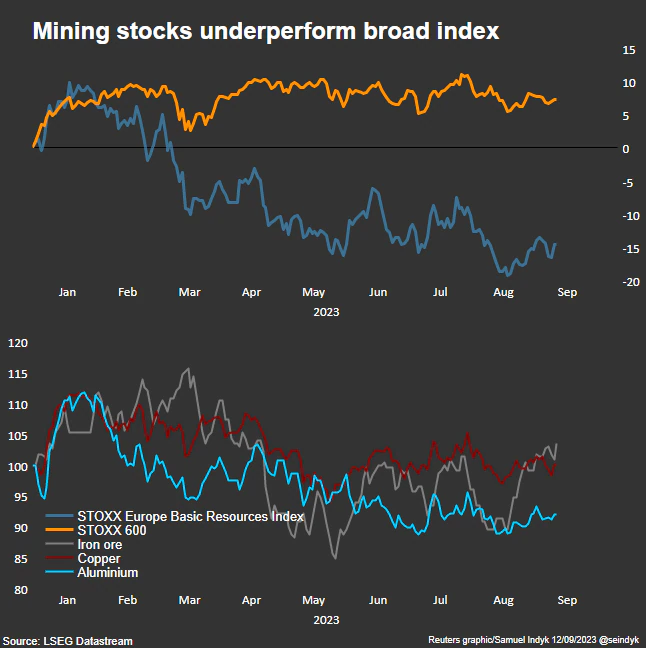
    The STOXX Europe 600 mining index has fallen 15% this year, making it the worst performing sector in the region by some margin, with second-placed real estate down 4.5% and the top-performing retail index up 27%. The metals and mining sector is typically used as a proxy for equity investors in Europe to gain exposure to China, given it is the world’s largest commodities consumer, and it has sunk along with China’s growth expectations.

    The world’s second-largest economy has been struggling after a brief post-Covid surge, dragged down by huge debt due to decades of infrastructure investment and a property downturn. Analysts forecast the economy will grow by just 5% this year, the slowest rate, outside of Covid years, since 1990.

    But Beijing in recent weeks has taken targeted steps towards supporting key pockets of its economy, lifting the mining sector off its 31-month lows. In the last month, the mining index has risen nearly 10% compared with a gain of just 2.5% for the wider STOXX 600.

    “China is building a wall of stimulus, but they’re doing it brick by brick,” said Nathan Sweeney, chief investment officer of multi-asset at Marlborough Investment Management.

    “At some point people will realize they have built the wall, but it just hasn’t come all at once.”

    In the last three months, China has relaxed rules around home purchases and borrowing, and cut key interest rates. There are also new tax relief measures for small businesses and private investment in some infrastructure sectors, for example.

    Sweeney says this wide range of measures could be a catalyst for an upturn in the metals and mining sector.

    The STOXX basic resources index trades at over a 20% discount to the STOXX 600. Miners trade at a 12-month forward price-to-earnings ratio of 9.8, compared to 12.3 for the market, according to LSEG Datastream.
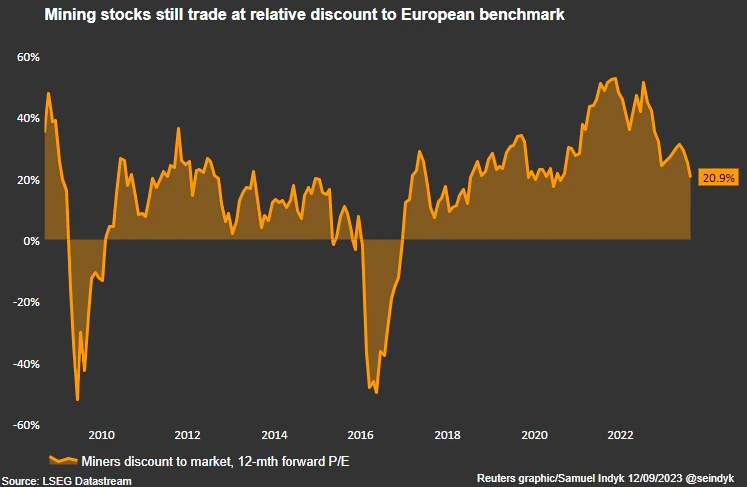
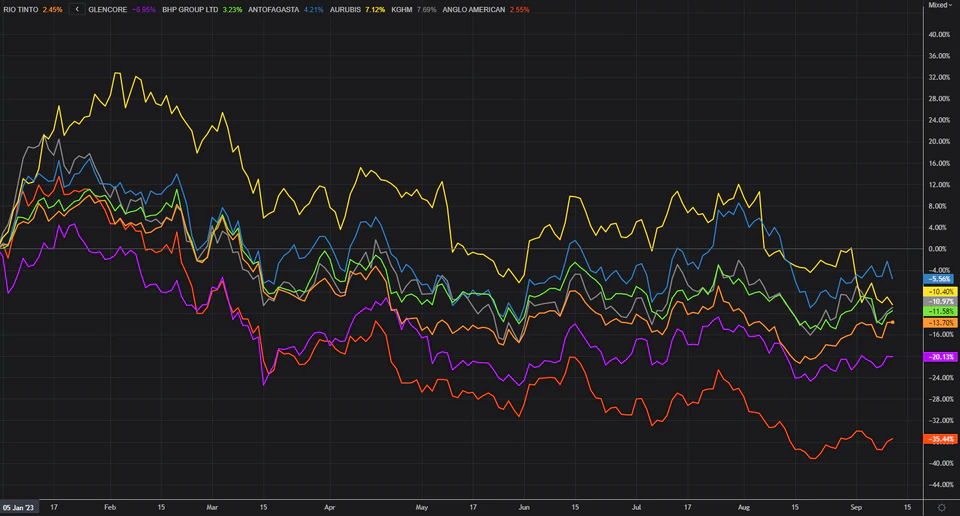
    Shares in some of the industry heavyweights have taken a battering this year. Glencore and Boliden have dropped by more than 20%, while Anglo American has lost 30%. The pan-European STOXX 600 benchmark meanwhile, is up 7.5%.

    Copper and iron ore have fared better. Three-month copper on the London Metal Exchange is flat for the year at $8,380 a tonne, while front-month Singapore iron ore futures are up nearly 9%.
    Considering China’s heft in the commodities world – Morningstar estimates it accounts for over 50% of refined copper demand and about 70% of the seaborne iron ore trade – some of that resilience should eventually seep into mining stocks, analysts said.

    “Obviously, the 800-pound gorilla from a primary metal demand perspective is China,” Peter Mallin-Jones, mining analyst at UK investment bank Peel Hunt, said.

    “I’m quite positive because I can see, certainly for the base metals, fairly significant demand drivers into markets that feel relatively tight,” he said.

    Sector is key to going electric

    Specifically, Mallin-Jones points to the global energy transition, as economies begin to decarbonize, which could bring a huge increase in demand from fast-growing nations such as India, Indonesia, Malaysia and Nigeria.

    Copper is the backbone of the electric and electronic industries and is essential in upgrading power grids, building solar farms, wind turbines and electric vehicles.

    The United States and China are expected to add record amounts of solar production capacity this year, with a projected extra 32 gigawatts and between 95 and 120 gigawatts, respectively.

    “That’s an enormous number and is a huge support for demand for copper and to an extent aluminium,” UBS metals and mining analyst Daniel Major said.

    Major does not believe stimulus in China will lead to the kind of explosion in commodities demand seen after 2008, when the country bounced back from the global financial crisis.

    We see measures limiting downside and creating stabilisation in aggregate commodities demand but not driving a very strong rebound,” he said, adding that he expects the demand outlook for iron ore to deteriorate alongside a slower global economy while the likes of copper and aluminium will likely benefit from the renewables boom.

    Accordingly, UBS has ‘sell’ ratings on diversified miners Rio Tinto and BHP Group and Major prefers companies with more direct exposure to copper.

    Antofagasta, Europe’s largest pure-play copper miner by market cap, Poland’s KGHM and copper recycler Aurubis are all down less than 12% this year, and have all relatively outperformed diversified miners Glencore, Rio Tinto and Anglo American, which have fallen between 14%-35%.

    “The reality is the sector now looks attractive and a lot of bad news is in the price,” Marlborough Investment Management’s Sweeney said.
  • Ukraine: first batch of uranium shipped to Canada

    Ukraine: first batch of uranium shipped to Canada

    Ukraine has shipped its first batch of uranium to Canada under an agreement signed between Energoatom and Cameco. The agreement presupposes the supply of all uranium extracted by Vostochniy Mining and Processing Works to Canada and its further conversion into natural uranium hexafluoride (UF6). Such a process is necessary to prepare uranium for its further…

  • G7 to announce Russian diamonds ban in 2-3 weeks

    G7 to announce Russian diamonds ban in 2-3 weeks

    The embargo, proposed by Belgium where the city of Antwerp is the world’s No. 1 one diamond trading hub, will come into effect in January, one of the government officials, who asked not to be named, told reporters in Brussels.

    If the ban on the multi-million dollar trade is announced as anticipated, this would lead to a split in the global diamond market as the G7 accounts for close to 40% of this market.

    “We’re talking about restructuring a global market” the official said, acknowledging that the system will not work perfectly right away and the G7 was still evaluating Belgium’s proposed plan.

    “Russia is the biggest supplier globally. With this system, we are cutting them out, leaving them in an inferior market with lower prices. We are slashing the financial flows from this sector.”

    Efforts to reduce Russia’s revenue from diamond exports and build on Washington’s existing sanctions on Russia’s Alrosa ALRS.MM, the world’s largest producer, have been under discussion among leaders of the G7 since last year.

    The EU bought 1.4 billion euros ($1.5 billion) worth of Russian diamonds last year, according to Eurostat, as it banned neither the gem imports nor blacklisted Alrosa.

    The EU has previously floated a ban of its own but Belgium was concerned that this would divert trading to other centres and away from Antwerp. Further, the EU on its own only accounts for 15% of the global market

  • Norway should call off deep sea mining plans, key ally says

    Norway should call off deep sea mining plans, key ally says

    Norway’s minority government should withdraw its proposal to open a vast Arctic offshore area to deep sea mining and call at least a ten-year moratorium on the activity, its key backer in parliament, said.

    Norway could become the first nation to make deep sea mining happen on a commercial scale if the country’s parliament approves a plan to open ocean an area larger than the United Kingdom to the new industry. The mining could provide a source for such metals as copper and rare earth elements for the transition away from fossil fuels.

  • Ukraine: DMZ coke output up in August 2023

    Ukraine: DMZ coke output up in August 2023

    In August, Dniprovskiy Iron and Steel Works decreased rolled metal output by 67.4% MoM, to 4.4 thousand tons. Coke manufacture dropped by 15.3%, to 25.8 thousand tons. Compared with August 2022, rolled metal production decreased by 64.7%, while that of coke grew 2-fold. The decrease was due to the repairs of the main machinery. In January-August, DMZ produced 74.1 thousand tons of rolled metal, up by 80.8% YoY, and 198.1 thousand tons of coke, up by 34%. (Ukrainian metal)

  • Ukraine: titanium ore exports down in January-August 2023

    Ukraine: titanium ore exports down in January-August 2023

    In January-August, Ukraine decreased exports of titanium-containing ore and concentrate by 96.4% YoY, to 7.83 million tons. Revenue fell by 84.8%, to $13.14 million. According to the State Customs Service, the main customers were Turkey (33.81% in monetary terms), Japan (24.43%) and India (7.76%). Ukraine did not import the products in the period. (Ukrainian metal)

  • Norwegian Mineral Strategy to ramp up production of materials crucial to global industry

    Norwegian Mineral Strategy to ramp up production of materials crucial to global industry

    In 2021, Norway was revealed to be the location of another large deposit of critical raw materials (CRM),1 as 240 million MT of phosphate, vanadium, and titanium were estimated to be in Storeknuten. This would already be a vast resource of three of the 30 critical raw materials, but since then has been shown by drilling operations to be as much as 910 million MT. The global economy, industry, and the current state of world politics mean that Norway has been presented with an opportunity to take a more prominent role in supplying much of the world’s industrial innovations. This includes the EU and the US, and stands to give Norway a lot more political and economic power in the coming years via developing green industries, increasing exports and growing the number of jobs in the Norwegian industry.

    As the name suggests, the EU defines critical raw materials as materials that are critical to industry. Generally speaking, this includes metals and minerals that cannot be replaced by a more common material, that have a significant supply risk, and if there is a disruption of supply, will have economic consequences. For Norway, this will include aluminium, copper, cobalt, zinc, and much more. With the EU moving towards less dependence on China, Russia and other countries for importing, Norway has become a key player in supplying these materials.

    CRM in Europe

    The shift towards greater production of CRMs comes from a variety of factors, and the EU plan, known as the Critical Raw Materials Act, has a number of objectives. This act, introduced in March 2023, seeks to strengthen the EU’s CRM capacity, reduce dependency, increase preparedness, and promote supply chain sustainability and circularity.2 The reduction of dependency essentially means the diversification of Europe’s supply of materials. Ideally, no more than 65% of one critical material is to be imported from one source. This would lead to several advantages, including the facilitation of manufacturing more green energy solutions, as well as the political advantages of not relying too much on one country’s source. With political tensions in China and the war in Ukraine with Russia, this would be a significant development for the EU and is a key cause of the Critical Raw Materials Act’s existence.

    Similarly, and since Norway is not an EU Member State, Norway has its own Green Industrial Initiative. This roadmap aims to increase investment and create jobs within green industries, as well as cutting pollution as it turns towards low-to-no emissions. Vital to this are critical metals and materials. Norway currently has a lot of these materials for not only themselves but also Europe.

    The Norwegian Mineral Strategy

    As such, Norway has had to change its strategy in terms of mining and processing these materials in order to keep up with the demand from the EU and themselves. In June, the Norwegian government unveiled the Norwegian Mineral Strategy. This strategy is a five-pillar process that aims to improve the Norwegian mineral industry and is a first step towards ‘the world’s most sustainable mineral industry.’3 Within this strategy are five key areas of focus.

    Faster implementation of mineral projects

    This is primarily concerned with the mapping of critical raw materials as well as reducing the time taken to process the mined materials. Obviously, this will reduce the time from mining the material or mineral to using it or exporting it for use, which in turn will reduce the time taken to develop green industries and grow profit for the economy.

    The mineral industry must contribute to the circular economy

    A circular economy is designed to minimise both the materials put in as well as the waste materials or pollution outputted. Norway’s circular economy is relatively low at 2.4% as of writing this, so an increase would be beneficial for green plans as well as profits. This will also decrease the cost of construction as material is recycled for use.

    A more sustainable mineral industry

    Similar to many countries and companies, Norway is aiming for its mineral industry to be zero emission or net zero by 2030. This will also specifically target the use of non-environmentally friendly chemicals in manufacturing processes. This will not only develop new industries as methods and constructions need to be updated or replaced, and therefore create new jobs, it will also benefit the planet and make the industry as a whole much more appealing to people conscious of the effects of industry on the planet.

    Private capital is a must

    Private capital will be key to funding these endeavours. Furthermore, all options will be explored to increase the profitability of mineral mining and processing, as well as increase the opportunities for communities, i.e. creating jobs. Altogether this aims to greatly stimulate the Norwegian economy.

    Norway will continue to supply international partnerships with green value chains

    This new strategy aims to change Norway’s global image to being a mineral nation and to further strengthen the ties between Norway and the rest of Europe in terms of trading critical materials. The mining industry has frequently overlooked value chains, leading to wasted resources and isolated operations, leading to miscommunication and bogged-down production.

    These five points constitute the Norwegian Mineral Strategy and are an excellent vision of Norway’s hope for its future in mining and processing critical raw materials. With these coming to fruition, Norway will occupy a spot of increasing power on the world stage.

    Europe’s position and Norway’s future

    As mentioned earlier, Europe currently has a tenuous relationship with China. The political issues in China under EU criticism range from the mistreatment of Uighur Muslims to China’s continued alliance with Russia after their invasion and sustained war in Ukraine. Yet, China is currently able to mine two-thirds of the 30 raw materials, giving them a dominating position in industrial endeavours.

    Similarly, Russia was a very contentious country even before the invasion of Ukraine, and most of Europe is on edge regarding a future with Russia. Still, Russia is in the top three countries for mining critical raw materials, with China at the top and the US between them. The EU being strong allies with just one of these three is a weak position, and one that they have started looking to rectify in recent years. Norway has an abundance of these materials and so it is easy to see how this will not only benefit the EU but Europe as a whole and especially Norway. With the EU diversifying their sources of critical raw materials, Norway stands to profit greatly from exporting to Europe, as well as its own industry developing both in economic terms and green industrial terms.

    All of these factors, along with the new Norwegian Mineral Strategy, mean that Norway may well be catapulted up in the ranks of top critical raw material exporters, and Norway itself will only benefit from this in profit and political power. The benefits to industry will also give the country a swathe of new jobs and the ability to develop green solutions and industries to benefit the world and humanity as a whole.


  • Vedanta ran “covert” lobbying campaign in India to weaken environment regulations

    Vedanta ran “covert” lobbying campaign in India to weaken environment regulations

    London-based mining and oil giant Vedanta ran a “covert” lobbying campaign in India to weaken environmental regulations during the pandemic, according to a new report by the Organised Crime and Corruption Reporting Project (OCCRP).

    In 2021, Vedanta’s chairman, Anil Agarwal, wrote a letter to the then Environment Minister of India, Prakash Javedkar, saying the government could add “impetus” to India’s “rapid” economic recovery by allowing mining companies to boost production by up to 50% without having to secure new environmental clearances. According to the OCCRP report, Agarwal further recommended that the change could be made with “a simple notification”.

    By early 2022, the Ministry of Environment, Forest and Climate Change loosened the regulations to allow mining companies to increase production by up to 50% without holding public hearings for the same.

    Such a move would mean the mining industry would not require new environmental approvals when increasing production. Further, doing away with public consultations also meant silencing the only recourse for local people to raise concerns about expansion and the consequent impact on their livelihoods.

    The report also reveals minutes from an internal meeting in 2021 that show officials raising concerns that loosening the rules would break the law and give a free pass to unrestrained mining in ecologically sensitive areas. However, by April 2022, the Environment Ministry published a memo that scrapped all requirements for miners to hold public consultations when expanding production by up to 40%, requiring only written feedback up to 50%.

    Benefits to Vedanta’s oil and gas subsidiary

    The favours to Vedanta allegedly extended beyond the mining industry to benefit one of company’s subsidiaries, Cairn Oil and Gas. In 2021, Cairn lobbied to scrap public hearings for oil exploration projects.

    As the government quietly followed the course of amending law without public consultation, Cairn received six oil projects in the northern deserts of Rajasthan to date. The OCCRP’s analysis of official data shows Vedanta was a key benefactor of the government’s push to boost domestic oil exploration, gaining rights to 62 of the total of 220 blocks put up for sale across the country between 2018 and 2022.

    Vedanta told the OCCRP that as “one of the leading natural resources organisations in India”, the company operated “with an objective of import substitution by enhancing domestic production in a sustainable manner”.

    Vedanta’s operations in India contributed more than $18bn (£14.26bn) in revenues in 2022. Despite the country’s climate and sustainability pledges to reach net zero and reduce carbon emissions, the report says that “experts who reviewed OCCRP’s findings say they show his [Narendra Modi] government has prioritised the interests of oil and mining companies over the fight against climate change”.

    Vedanta was earlier also caught up in the Niyamgiri land conflict in India’s Odisha state, where thousands of indigenous people prevented the company from destroying their sacred land.


  • Environmentalists fret over Portuguese green light for lithium mine

    Environmentalists fret over Portuguese green light for lithium mine

    The Romano lithium mine, proposed for Montalegre in Portugal’s northern district of Vila Real, has received a favourable conditional environmental impact statement from the Portuguese Environment Agency, but environmentalists are concerned about its impact.

    One of Portugal’s largest environmental associations, Zero, reacted on Thursday with concern about the viability of the Romano lithium mine in Montalegre, saying it was “absurd” to separate the project between the mine and the refinery, which will be subject to a separate Environmental Impact Assessment (EIA).

    “It’s worrying, and we’re talking once again about a project with high environmental, social and economic impacts, which is the subject of a favourable conditional opinion,” Nuno Forner from Zero told Lusa on Thursday.

    “This opinion has a particular aspect, which is that part of the mining annexes complex is going to be the subject of a separate process, which we think is absurd, to say the least,” Forner added.

    “Separating the project into several parts doesn’t make any sense,” he said.

    The Portuguese Environment Agency (APA) issued a favourable report regarding the mine.

    The APA’s decision is “favourable conditioned for mining and solution two (to the south-east of the mining area) for the location of the waste facility.”

    As for the location of the refinery, washing plant and administrative buildings, the report said “it should be further analysed under a separate procedure” and should preferably focus on the location corresponding to solution A if “the project’s incompatibility with the Montalegre Municipal Master Plan is overcome”.

    “We are concerned that the compensation and minimisation measures mention the possibility of the population being compensated in monetary terms so that they can buy another house or another plot of land or even be compensated for ending their agricultural activity,” said Forner.

    This, in his opinion, “clearly shows that this is a project with major impacts”, particularly on the social component, which “can hardly be minimised” and that “the solution will be to push people out of the area.”

    This is the second lithium project approved in Portugal after the favourable study conditioned on the Barroso mine (in May), proposed by Savannah for Covas do Barroso, in the neighbouring municipality of Boticas.

  • Pan Global Resources posts Honda and Zarcita drill results, Spain

    Pan Global Resources posts Honda and Zarcita drill results, Spain

    Both targets are located 4km north of the La Romana copper-tin-silver discovery where ongoing drilling is extending mineralization at Romana West. Three follow-up drill holes have been completed at the Cañada Honda copper-gold target and an additional 13 drill holes have been completed at the Zarcita copper target.

    “The follow-up drilling at Cañada Honda confirms copper-gold mineralization coincident with a gravity anomaly, and extends the copper-gold mineralization from surface to 600m down-dip where it remains wide open. The new results highlight additional gold potential in the hanging wall. The drilling is at the eastern end of a 2km long east-west gravity target, indicating potential for the mineralization to significantly expand, making this a compelling, high priority target for additional drilling,” said Tim Moody, president & CEO.

    Currently, drilling at Escacena is focused along the highly prospective western extension (Romana West) of the La Romana copper-tin-silver discovery. In addition to the 12 geophysical targets that are being sequentially prioritized for drill testing, exploration on the 5,760-hectare Escacena Project continues to identify new drill targets. Initial assay results from the first set of drill holes at Romana West are expected soon.

    Cañada Honda Highlights – New drill hole results include drill hole CHD05 that returned 20 metres at 0.5% copper, 0.8 g/t gold, 1.9 g/t silver, including 5.1 metres at 1.3% copper, 0.5 g/t gold, 3.9 g/t silver (reported July 4, 2023); and new results including 2 metres at 1.6 g/t gold.

    CHD06 returned 7 metres at 0.6% Cu, 0.8 g/t Au, 6.5 g/t Ag, including 3 metres at 1.1 g/t Au, 5.5 g/t Ag. CHD07 returned 5 metres at 1.1 g/t Au, 0.2% Cu, 2.3 g/t Ag.

    Surface rock samples ranged  up to 9g/t gold. There are new untested DHEM conductor anomalies

    The follow-up drill program included holes CHD05, CHD06 and CHD07. Drill hole CHD05, testing 150 metres down-dip from previous drill hole CHD04 and approximately 330 metres down-dip from a historical mine tunnel, confirmed copper-gold mineralization coincident with the targeted gravity anomaly. CHD06, located 100m east of CHD05, intersected copper-gold mineralization coincident with a DHEM target. Hole CHD07 tested a resistivity low anomaly 190 metres down-dip from CHD05. Each of the drill holes also intersected additional gold mineralization in the hanging wall.

    DHEM in holes CHD06 and CHD07 confirmed new off-hole conductor anomalies for future drilling to test the potential for stronger sulphide mineralization.

    Anomalous gold assays from 28 rock grab samples at Cañada Honda indicate a gold anomaly extending 200 metres west of the historical mine tunnel and up-dip from the recent drilling, with several samples reporting >0.1 g/t Au up to 9.0 g/t Au.

    “The recent exploration drilling and mapping at Zarcita has highlighted a 2.1km long trend with anomalous copper, lead, zinc, gold and silver. The highest potential remains centered on the historical Zarcita mine workings where drilling has intersected narrow intervals of higher-grade copper within a wider zone of stockwork and alteration. While untested down-hole electromagnetic (DHEM) conductors, gravity and IP anomalies define prospective targets for future campaigns at Zarcita, the Romana West and Cañada Honda targets are key near-term priorities,” said Tim Moody, president & CEO.

    New Zarcita drill hole results include drill hole ZAD05 that intersected copper mineralization from surface, including 14.45 metres at 0.2% copper before entering a 10.5-metre assumed historical mine cavity. ZAD06 returned 5.5 metres at 0.7% Cu from 106.2 metres, including 1.85 metres at 1.6% Cu, 0.15 g/t Au, 2.4 g/t Ag.

    The most promising results are from a 600-metre section of the 2.1km trend, coincident with the Zarcita mine workings. This includes thin bands of semi-massive and massive sulphide intervals within a wider zone of stockwork veining and chlorite-sericite alteration. DHEM in holes ZAD01 and ZAD05 identified untested off-hole and below-hole anomalies, representing potential nearby stronger sulphide mineralization.

    The Escacena Project comprises a large, contiguous, 5,760-hectare land package controlled 100% by Pan Global in the east of the Iberian Pyrite Belt. Escacena is located near operating mines at Las Cruces and Riotinto and is immediately adjacent to the former Aznalcóllar and Los Frailes mines where Minera Los Frailes/Grupo Mexico is in the final permitting stage with construction anticipated to start in 2023. The Escacena Project hosts the La Romana copper-tin-silver discovery and a number of other prospective targets, including, Romana West, Cañada Honda, Bravo, Barbacena, El Pozo, Zarcita, Hornitos, La Jarosa, Romana Deep, Romana North, and San Pablo.