Website: Europe.com

  • Romanian minister comes up with gold mining grant scheme amid Rosia Montana scandal

    Romanian minister comes up with gold mining grant scheme amid Rosia Montana scandal

    Marcel Bolos, the finance minister of Romania, has proposed a grant scheme for the non-ferrous mining sector to provide essential raw materials like copper to the struggling industry, as reported by Bursa.ro. This initiative, if implemented, aims to support the sector which has faced challenges in recent times.

    Of note is Bolos’s emphasis on including gold mining among the recipients of this scheme, which is particularly notable given the ongoing legal dispute surrounding the Rosia Montana gold mining project. The outcome of this litigation with Gabriel Resources, the company behind the Rosia Montana project, is still pending official confirmation, although unofficial negotiations for a resolution are reportedly ongoing.

    Bolos’s comments on the Rosia Montana project have drawn attention, especially considering the project’s controversial history and the involvement of various political parties. The minister has referenced substantial compensations demanded by Gabriel Resources, purported investments made by the company, and the possibility of a “non-financial settlement” to resolve the dispute. Bolos suggests that such a settlement, which could involve allowing the project to continue, might be more favorable to Romania than paying significant financial compensation.

    However, Romania Curata, an NGO opposing the gold mining project, provides additional context to Bolos’s statements. The NGO claims that Gabriel Resources holds a valid license for the Rosia Montana project and asserts that the company aims to remove the region from UNESCO’s protected sites list for Environmental, Social, and Governance (ESG) reasons. Romania Curata alleges that there may be hidden elements of corruption involved in potential agreements between the government and Gabriel Resources, with the government potentially seeking to frame any resolution as a ruling from the World Bank’s ICSID court to justify its actions.

    According to Romania Curata, the risk of Romania paying billions of dollars in compensation could make it more acceptable for the government to sell any resolution as a decision mandated by an international court rather than a negotiated agreement. The NGO contends that such a scenario could ultimately lead to Rosia Montana being excluded from UNESCO’s protected sites list.

    Overall, the situation surrounding the Rosia Montana project remains complex and politically charged, with multiple stakeholders and interests involved. The proposed grant scheme for the non-ferrous mining sector adds another layer to the ongoing debate about Romania’s mining industry and its future direction.

  • Newly created Critical Metals on track to construct EU’s first battery-grade lithium mine

    Newly created Critical Metals on track to construct EU’s first battery-grade lithium mine

    The debut of Critical Metals Corp (Nasdaq: CRML) on the Nasdaq, resulting from the merger between European Lithium (ASX: EUR) and Sizzle Acquisition Corp, experienced significant volatility. While Sizzle stock surged by 120% in after-hours trading on Tuesday, Critical Metals’ debut on Wednesday saw a 38% decline. However, by midday on Friday, CRML had rebounded, showing a gain of over 10%.

    Despite the initial turbulence, Critical Metals retains a significant stake in the Wolfsberg lithium project in Carinthia, Austria, valued at $1.2 billion. This project is poised to become the EU’s sole battery-grade lithium mine by 2027, according to Tony Sage, the executive chairman of Critical Metals.

    Sage remains optimistic despite the fluctuating share prices and current lows in lithium prices. The company has secured supply agreements with BMW and has partnered with Obeikan Investment Group to construct a lithium hydroxide plant in Saudi Arabia, a venture expected to be finalized by the end of March.

    Looking ahead, Sage is considering rare earths and uranium projects, both brownfield and greenfield, within the EU. European Lithium already holds a 7.5% stake in the Tanbreez rare earth project in Greenland, one of the largest rare earth projects globally.

    Critical Metals aims to supply BMW by 2027, following the completion of construction at Wolfsberg. Sage anticipates a favorable market environment at that time, as demand for lithium is expected to increase, potentially driving prices up.

    The construction of the hydroxide plant may prove to be more cost-effective than initially projected, with improved operational expenditure (OPEX) numbers compared to the original feasibility study for Wolfsberg conducted in 2023.

    Wolfsberg enjoys perpetual permits as long as work continues, positioning it as a key player in the EU’s lithium production landscape. This is particularly significant given the EU’s initiative to reduce dependence on China for critical raw materials.

    While some lithium projects in Europe have faced setbacks, such as Rio Tinto’s Jadar lithium project in Serbia, Critical Metals remains optimistic about its prospects, buoyed by the support of the Austrian government and the stability of its permits.

    In summary, despite initial market volatility and challenges faced by other projects, Critical Metals Corp is poised to play a pivotal role in Europe’s lithium supply chain, driven by the growing demand for lithium-ion batteries in the electric vehicle sector and the EU’s strategic objectives.

  • Financial support for Poland from the EU could revive the Central European steel market

    Financial support for Poland from the EU could revive the Central European steel market

    Last year, the European Commission reached an agreement on a recovery and resilience plan worth approximately 60 billion euros with Poland’s previous government, led by the nationalist Law and Justice (PiS) party. However, access to these funds, part of the EU budget for 2021-2027, was initially blocked due to concerns about changes made to Poland’s legal system. Following the election of a new government led by pro-European Prime Minister Donald Tusk in December, the first installment of around €5 billion of previously blocked EU funding was received. Additionally, an additional €6.9 billion has been applied for, with potential reforms paving the way for access to more funds. This injection of funds could significantly benefit the region’s steel mills. Poland’s recovery and resilience plan aims to use its multibillion-dollar funding to enhance residential housing for improved energy efficiency. Moreover, the Offshore Wind Fund seeks to catalyze private investment in large-scale renewable energy projects. While these developments may take time to materialize, they offer hope for a market revival. However, economic pressure persists. Steel market participants in Poland and neighboring Czech Republic have reported weak demand, particularly from key sectors like construction and automotive, largely due to reduced exports to Germany. In 2023, the German economy contracted by 0.3%, with indicators like the Hamburg Commercial Bank (HCOB) German construction sector PMI and manufacturing PMI reflecting ongoing challenges, despite some improvement in recent months. Although the steel sector in Poland and the Czech Republic remains fragile, signs of greater economic stability are emerging. Inflation rates have decreased in both countries, potentially paving the way for lower interest rates across Europe, stimulating construction and retail activity. However, an impasse between cautious purchasing behavior from buyers and the need for factories to maintain prices due to higher raw material costs has been observed. Limited domestic supply, exacerbated by production issues at Liberty Steel plants, has contributed to recent price increases. Overall, suppressed demand is expected to persist in the European steel sector in the near term. Nevertheless, the potential EU funding for Poland, coupled with hopes of lower interest rates, has improved sentiment regarding the market outlook.

  • Researchers just discovered a massive ‘jacuzzi bubbling with almost pure hydrogen’ — a lucrative source of clean energy

    Researchers just discovered a massive ‘jacuzzi bubbling with almost pure hydrogen’ — a lucrative source of clean energy

    Hydrogen is increasingly viewed as a promising alternative to fossil fuels due to its lack of carbon emissions when burned. However, traditional methods of hydrogen generation have been energy-intensive and environmentally harmful. Recently, researchers identified a significant reservoir of hydrogen in a mine in Albania, offering potential as a clean energy source. Located in the Bulqizë chromite mine near Albania’s capital, Tirana, this reservoir emits over 200 tons of H2 gas annually, making it one of the largest known flow rates of hydrogen. Despite its potential, the high concentrations of hydrogen in the mine have led to several explosions, resulting in fatalities and injuries. Lead researcher Laurent Truche described the reservoir as a remarkable find, transforming a mine gallery into a bubbling jacuzzi of nearly pure hydrogen. While hydrogen is highly flammable, if safely harnessed, this discovery could become a significant energy source. The rarity of large, natural hydrogen reservoirs underscores the uniqueness of this find. However, researchers suggest that areas with similar geological characteristics may harbor similar resources, opening avenues for further exploration. This discovery coincides with President Joe Biden’s initiative to invest $7 billion in hydrogen hubs across the US. These hubs aim to produce millions of metric tons of clean hydrogen annually by 2030, aligning with efforts to transition to sustainable energy sources.

  • How much gold does the UK own compared to other countries?

    How much gold does the UK own compared to other countries?

    Several countries around the world are stockpiling gold as a strategic reserve. Here’s a rundown of some of the key players and the amount of gold they hold:

    1. USA: The United States leads the pack with a massive 8,133.46 tonnes of gold bullion, stored in various depositories across the country, including the famous Fort Knox.

    2. Germany: Coming in second, Germany holds 3,352.65 tonnes of gold. Concerns during the Cold War led Germany to spread its gold reserves globally, with a significant portion repatriated in recent years.

    3. Italy: Italy holds slightly more gold than France, with 2,451.84 tonnes stored in vaults in Rome and abroad, managed by the Banca d’Italia.

    4. France: France has stockpiled 2,436.97 tonnes of gold, acquired largely during the 1950s and 1960s. Most of its reserves are held in vaults under the Banque de France in Paris.

    5. Russia: Russia has been aggressively increasing its gold reserves, currently holding 2,332.74 tonnes. This move is seen as a strategic effort to reduce reliance on the US dollar.

    6. China: China boasts 2,235.39 tonnes of gold, making it the world’s largest gold producer and a significant importer as well. The country’s reserves have been steadily increasing over the years.

    7. Switzerland: Switzerland holds 1,040 tonnes of gold, with the majority stored at home. The country’s reputation for financial stability has made it a preferred location for storing gold.

    These countries, among others, view gold as a valuable asset for diversifying their reserves and protecting against economic uncertainty.

  • EU’s First Battery-Grade Lithium Mine: Critical Metals Leads the Way

    EU’s First Battery-Grade Lithium Mine: Critical Metals Leads the Way

    Critical Metals, a newly established company, is set to construct the European Union’s first battery-grade lithium mine, the Wolfsberg Lithium Project, located in Austria. The project is expected to become a significant source of battery-grade lithium concentrate, filling a critical gap in the European electric vehicle (EV) battery supply chain. The mine is uniquely positioned to capitalize on its location in the heart of the EV supply chain, minimizing environmental impact by repurposing a former Austrian government-constructed lithium mine containing a substantial amount of battery-grade lithium. Furthermore, European Lithium has entered into a Memorandum of Understanding (MOU) for a key customer arrangement with BMW AG, potentially creating one of the largest direct pre-pays from an original equipment manufacturer (OEM) in Europe’s lithium mining industry. A definitive feasibility study is expected in early 2023, aiming to supply lithium concentrate at a commercial scale and be economically viable. 

    The European Union has set targets to dig up, recycle, and refine lithium, cobalt, and other metals it needs for its green transition. However, the bloc faces challenges in achieving these goals due to a shortage of new money, high energy costs, and local opposition. The Critical Raw Materials Act (CRMA), due to enter force in early 2024, aims to reduce the EU’s reliance on China, which dominates global mineral processing and has already threatened EU supply with export curbs. The CRMA aims to speed up the granting of project permits, but other obstacles remain, such as the need for cheaper energy and EU financing. 

    Several European lithium mining and refining projects are poised to launch commercial operations next year, supported by a push among original equipment manufacturers (OEMs) to regionalize their battery supply chains and reduce dependence on imported material. Based on existing plans, Europe’s annual lithium processing capacity is set to reach approximately 650,000 mt/year by 2028, with more than 20 projects currently advancing their mining and refining operations toward full-scale commercial production. The growth of Europe’s domestic lithium industry comes amid growing concern about an impending global shortfall in the supply of graphite, copper, cobalt, and nickel.

  • $154.38 Billion Power Play: How Central Asia, Ukraine, and Russia’s Mineral Wealth Shapes Global Geopolitics

    $154.38 Billion Power Play: How Central Asia, Ukraine, and Russia’s Mineral Wealth Shapes Global Geopolitics

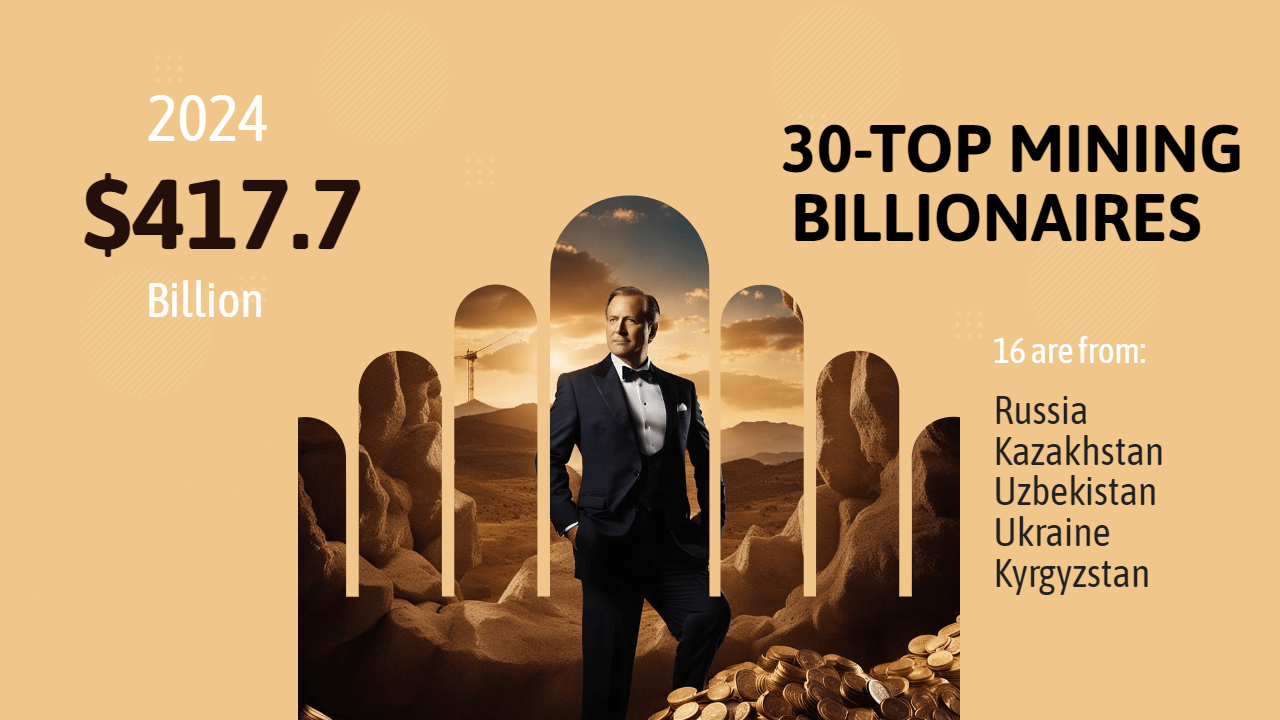
    30-top mining billionaires are worth $417.7 billion in 2024. 16 billionaires own their wealth to the mineral riches of Russia, Kazakhstan, Ukraine, Uzbekistan, and Kyrgyzstan

    Geopolitical Implications of Mining Billionaires’ Wealth in Central Asia, Ukraine, and Russia

    In a striking revelation, more than half of the world’s richest mining billionaires have amassed their wealth from their operations in Central Asia, Ukraine, and Russia. Collectively their net worth is $ 154.38 billion or nearly 37% of the $417.7 billion combined wealth of the world’s 30 top mining billionaires. This concentration of wealth and mineral resources in the region has significant implications for global commodity markets, especially in the current geopolitical climate.

    Amassing billions in the region’s mining and metals industry

    Central Asia, along with Ukraine and Russia, has been for decades a hub for mining activities, with 16 out of 30 billionaires making their fortunes in the sector. Prominent entrepreneurs like Vladimir Lisin, Vladimir Potanin and Alexey Mordashov from Russia, Alisher Usmanov from Uzbekistan, as well as Vladimir Kim from Kazakhstan, are among the top mining billionaires who have amassed substantial wealth from the region’s abundant natural resources. Their influence extends beyond their respective countries, impacting global markets and geopolitical dynamics.

    Impact on Commodity Prices and Supply Chains

    The current geopolitical environment, marked by high uncertainty and risks, has led to volatile commodity prices. The war in Ukraine has disrupted production and trade, causing surges in prices for energy, fertilisers, metals and grains. Russia’s expanding energy ties in Central Asia are part of its strategy to redirect exports from the West to Asia, following sanctions imposed due to its invasion of Ukraine. This redirection is deeply altering global supply chains and commodity prices.

    Geopolitical Implications

    The wealth of the region’s 16 mining billionaires is intertwined with the geopolitical landscape. Russia’s use of energy and transport infrastructure as a tool to enhance its influence in Central Asia has been evident, with the country building generating capacities and increasing supplies to the region. This has implications for energy security and political dynamics within Central Asia and beyond.

    Before the start of the war in Ukraine in 2022, the European Union and other economies were heavily dependent on Russian energy and commodities. Within the last two years, they have become particularly vulnerable to geopolitical shifts. The sanctions against Russia and the subsequent search for alternative markets have led to a complex web of economic and political relationships that is reshaping global commodity markets.

    The concentration of mining wealth in Central Asia, Ukraine, and Russia among a few individuals is not just an economic phenomenon but a factor with profound geopolitical and economic consequences. The current geopolitical tensions, coupled with the strategic manoeuvres of 16 mining billionaires and their home countries, are likely to continue to influence commodity prices and market dynamics for the foreseeable future.

    30 Richest Billionaires in Metals and Mining Industry in 2024

    1. Prajogo Pangestu: $48.5 billion (Indonesia)
    2. Gina Rinehart: $30.4 billion (Australia)
    3. Savitri Jindal & family: $30.3 billion (India)
    4. Germán Larrea Mota Velasco & family: $26.9 billion (Mexico)
    5. Vladimir Lisin: $26.0 billion (Russia)
    6. Iris Fontbona & family: $25.1 billion (Chile)
    7. Andrey Melnichenko & family: $25.0 billion (Russia)
    8. Vladimir Potanin: $23.7 billion (Russia)
    9. Alexey Mordashov & family: $22.9 billion (Russia)
    10. Andrew Forrest & family: $18.8 billion (Australia)
    11. Lakshmi Mittal: $16.4 billion (United Kingdom)
    12. Alisher Usmanov: $14.4 billion (Uzbekistan)
    13. Dang Yanbao: $13.1 billion (China)
    14. Roman Abramovich & family: $9.7B billion (Russia)
    15. Nicky Oppenheimer & family: $9.4 billion (South Africa)
    16. Iskander Makhmudov: $7.9 billion (Russia)
    17. Ivan Glasenberg: $7.8 billion (Switzerland)
    18. Andrei Skoch & family: $7.7 billion. (Russia)
    19. Pavel Tykac: $7.6 billion (Czech Republic)
    20. Zheng Shuliang & family: $7.3 billion (China)
    21. Viktor Vekselberg: $7.0 billion (Russia)
    22. Alexander Abramov: $6.4 billion (Russia)
    23. Wang Wenyin: $5.9 billion (China)
    24. Rinat Akhmetov: $5.7 billion (Ukraine)
    25. Vladimir Kim: $4.6 billion (Kazakhstan)
    26. Oleg Deripaska: $2.98 billion (Russia)
    27. Robert Friedland: $2.9 billion (Singapore)
    28. Alexander Machkevich: $2.4 billion (Kazakhstan)
    29. Patokh Chodiev: $ 2.1 billion (Kazakhstan)
    30. Ömürbek Babanov: $ 1.5 billion (Kyrgyzstan)

    Sources:

    https://ceoworld.biz/2024/02/29/richest-billionaires-in-metals-and-mining-industry-february-29-2024/
    https://www.forbes.com/
    Top 10 Richest People in Indonesia; Forbes December 2023 Version – En.tempo.co
    Ömürbek Babanov – Wikipedia

  • Peninsula seals uranium supply deal with European buyer

    Peninsula seals uranium supply deal with European buyer

    ASX-listed Peninsula Energy has announced a new sales agreement for the supply of 1.2-million pounds uranium yellowcake from its Lance projects, in Wyoming, to European nuclear fuel buyer Synatom.

    The agreement runs over six years, starting in 2028.

    “The strength of the uranium market dynamics in recent months has allowed Peninsula to consider adding sales commitments with improved pricing structures to our sales portfolio,” states MD and CEO Wayne Heili.

    The pricing structure is a blended approach, including both base price and market-priced components. The resulting pricing is projected to be well above the forecast production costs at Lance, as reported in the August 2023 life-of-mine model.

    The new contract is estimated to generate gross revenue of between $88-million and $117-million over the term.

    This new sales agreement brings the company’s total contractual sales obligation over the upcoming ten-year period to six-million pounds. The Lance project is projected to produce about 14.8-million pounds of uranium over the same six-year period

  • Tara Resources disputes a governmental ruling in Montenegro, putting forth arguments supported by evidence

    Tara Resources disputes a governmental ruling in Montenegro, putting forth arguments supported by evidence

    The arguments proposed by the working group for terminating the concession agreement that the state has with the company Brskovo Mine are factually inaccurate, do not correspond with the law, and are inconsistent with the Government’s policy over the past four years, stated Tara Resources.

    The company stated that they were granted the concession rights in 2018 and have since invested significant funds to fulfill all their exploration obligations, which the Government confirmed were met in June 2019.

    “The Government has already twice extended the deadlines in the concession agreement due to delays in completing the spatial planning process, as the concession agreement includes a clause that takes into account administrative delays,” the statement emphasizes.

    Tara Resources stated that the interdepartmental Government working group recommended to the Government to again extend the concession agreement in October of the previous year due to these delays, and to commence the collection of concession fees.

    They mentioned that the Government requested a concession fee of 650 thousand EUR, which the company paid in January, but there was no extension of the deadline.

    Tara Resources stated that the conclusions of the new working group, appointed by the Ministry of Energy and Mining, recommend the termination of the concession agreement, although nothing has changed since the last two extensions approved by the Government due to its own delays.

    “The arguments used are factually inaccurate and contrary to the last two extensions approved by the government and the recommendations of the working group,” said Tara Resources.

    As they stated, this exposes the Government to significant damages for violating the concession agreement, including damage within the bilateral investment treaty between Switzerland and Montenegro.

    “Tara Resources has fulfilled all its obligations and demonstrated the potential for significant new development for Montenegro, with the possibility of employing 550 people from the northern part of Montenegro and bringing significant economic benefits to the region and the country, while respecting the best practices in environmental and health protection in the EU, successfully implemented in other zinc mines in Spain, Portugal, and Sweden,” said Tara Resources.

    They emphasized that they are confident that what the working group suggested will prove to be factually illegal and incorrect, and that the Government will not adopt those conclusions.

    Tara Resources stated that they remain open to constructive dialogue with institutions.

  • Underground gold mining at Kumtor can provide hundreds of millions of additional dollars to the Kyrgyzstan’s budget

    Underground gold mining at Kumtor can provide hundreds of millions of additional dollars to the Kyrgyzstan’s budget

    The Kumtor deposit is one of the ten largest gold deposits in the world. The mine is located in the Issyk-Kol region in the permafrost zone at an altitude of 4,000 meters above sea level. Revenues from Kumtor account for roughly one-third of the state budget in Kyrgyzstan, with the mine producing about 17 tons of gold per year.

    “The feasibility study of the underground gold mining project developed by specialists speaks about its economic efficiency. According to preliminary data, with the help of an underground mining method, it will be possible to get 115 tons of gold. Taking into account the precious metal mined at the [site] by the open-pit method, this is a big step forward,” said Almazbek Baryktabasov, President of the Kumtor Gold Company. Mining underground will help the company reach gold of a higher-grade ore, he said, and as a result, the company will be able to increase its tax payments.

    Until its nationalization in 2021, the Kumtor mine was owned by Canadian company, Centerra Gold. Earlier, the Canadian owners tried to extract gold through shafts. However, gold prices did not render this profitable, as the shaft method is much more expensive than the open-pit mining. Over the past ten years, however, the price of an ounce of gold has risen by more than $700 and is currently trading at just over $2,000. Before Kumtor was expropriated, Centerra Gold spent approximately  $180 million dollars on research related to underground mining.

    Today, the authorities have allocated an additional mining site next to the one where gold ore is already being extracted. According to some reports, the new site contains a denser concentration of the precious metal per unit of ore. Currently, at Kumtor’s open-pit mine, it takes one ton of processed ore and more than 40 tons of extracted waste rock to produce 5-7 grams of gold. Underground mining could double that yield. Furthermore, underground mining is not as environmentally damaging as open-pit mining. For example, one of Kumtor’s main environmental concerns is the destruction of glaciers which literally hang over the edge of the open pit.