Kazakhstan has emerged as the world’s third-largest tungsten producer following the launch of the Bogutinskoye deposit, marking a significant shift in global supply dynamics. The development comes amid a sharp increase in tungsten prices, which surged by 557% by early March 2026 after China imposed export restrictions on the metal in February 2025.
According to recent analysis by Kursiv Research, tungsten concentrates entered Kazakhstan’s export portfolio for the first time in 2025. The country exported 3.7 thousand tonnes of tungsten ore and concentrates, generating $71 million in revenue, with all shipments directed to China. Despite its relatively modest ranking at 71st place in Kazakhstan’s export structure, tungsten has quickly become a strategically important commodity.
The Bogutinskoye project, operated by Zhetysu Tungsten and backed by Hong Kong-based Jiaxin International Resources Investment, has played a central role in this development. The processing plant produces a 65% concentrate, with total investment commitments reaching $450 million. Plans are also underway to develop downstream processing capacity, including a $100 million project to produce ammonium paratungstate, a higher-value tungsten product.
Data from the US Geological Survey confirms Kazakhstan’s rapid ascent in the sector. In 2025, the country produced approximately 2.4 thousand tonnes of tungsten (in metal equivalent), placing it behind China and Vietnam. The expansion of production capacity and ongoing investment projects are expected to further strengthen Kazakhstan’s position in the global market.
Tungsten’s strategic importance has grown significantly in recent years, particularly in the context of geopolitical tensions. The metal remains on the US list of critical minerals, essential for defence, construction, and high-tech manufacturing. China continues to dominate global supply, accounting for nearly 79% of production in 2025, while also tightening export controls in response to trade measures from the United States.
In response, the US has intensified efforts to diversify supply chains through international partnerships. A key development is the joint venture between Kazakhstan’s Tau-Ken Samruk and US-based Cove Capital to develop the Upper Kairakty and Northern Katpar deposits. The project, with an estimated investment of $1.1 billion, is expected to significantly boost Kazakhstan’s production of ammonium paratungstate and could position the country as the world’s second-largest producer of this material.
The agreement reflects broader geopolitical competition over critical minerals, with both Western and Chinese companies seeking access to Kazakhstan’s resource base. Analysts note that rising prices and supply restrictions have accelerated investment activity and heightened strategic interest in the region.
In parallel, Kazakhstan is strengthening state control over critical mineral resources, with legislative changes expected in 2026 to grant priority extraction rights to the national mining company. Private sector players are also advancing new projects, including the development of the Drozhilovskoye deposit with financing from the US Export-Import Bank.
As global demand for critical minerals continues to rise, Kazakhstan is positioning itself as a key supplier in an increasingly competitive and politically sensitive market.
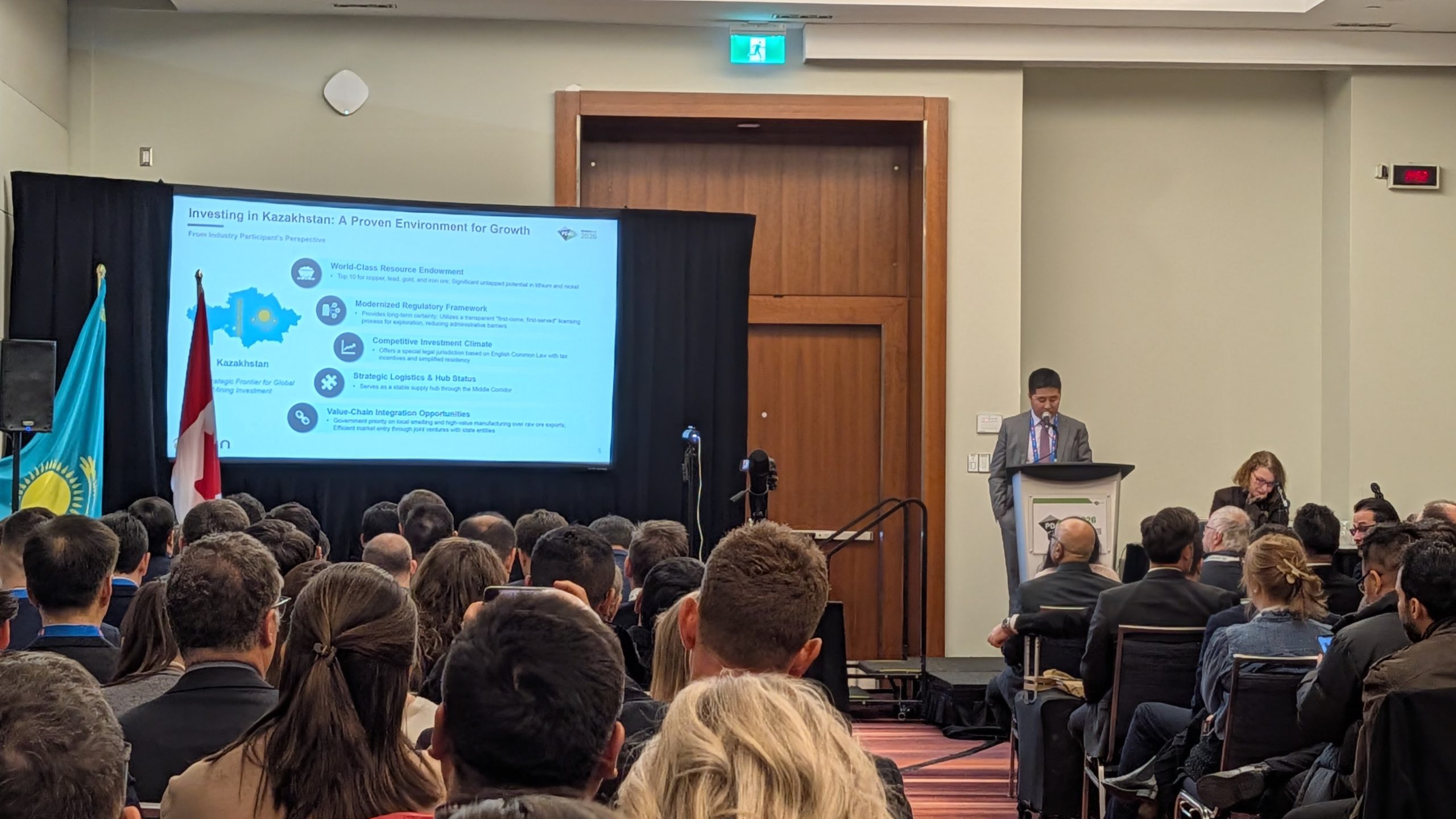
This year marked a significant milestone as the Kazakhstan Chamber of Mines took the lead as the official organiser of Kazakhstan Day — and what a resounding success the debut turned out to be!
Despite a packed PDAC schedule, the session drew an impressive crowd of over 130 industry leaders, investors, and exploration experts. The atmosphere in the room confirmed one thing: the global mining community is paying very close attention to Central Asia.
MINEX Forum was proud to support the event as the Official Media Partner, capturing the insights that are shaping the next wave of exploration in the region.
Key Highlights from the Plenary Session: The tone was set by Ruslan Baimishev, President of the Kazakhstan Chamber of Mines:
“Kazakhstan is entering a new era of exploration — driven by robust reforms, international partnerships, and the soaring global demand for copper and critical metals.”
We also heard high-level perspectives from H.E. Dauletbek Kussainov, Ambassador of Kazakhstan to Canada, and Iran Sharkhan, Vice-Minister of Industry and Construction.
Expert Insights & Project Showcases: The technical session, “Unlocking New Discovery Potential in Kazakhstan,” featured a stellar line-up including Tim Barry (Arras Minerals), Charlie Liu (Zijin Mining), Simon Cooper (Pallas Resources), and world-renowned experts Anna Fonseca and Professor Jeffrey Hedenquist.
The afternoon shifted to tangible opportunities, with project presentations from AMG Ltd, Kogadyr Gold, Taskora, and Muzbel. As Tim Barry aptly put it: “Kazakhstan offers unique opportunities for Canadian juniors to enter new jurisdictions — and the future looks bright.”
Kazakhstan is no longer just a “prospective” jurisdiction; it is rapidly becoming the territory where the next big copper success stories are being written.
Special thanks to the Kazakhstan Day partners:
General Sponsors: Aurora Minerals Group, NAC Kazatomprom, Pallas Resources.
Sponsors: Arras Minerals, TauGold Copper.
Missed the session? 📺 Watch the session recordings and download expert presentations at:
Lithium is increasingly being treated as a strategic resource in Europe, prompting efforts to develop domestic mining and processing capacity and reduce reliance on China’s dominant position in global supply chains.
China currently accounts for roughly two-thirds of global refined lithium production, a concentration that has raised geopolitical and industrial concerns within the European Union. With demand for lithium expected to grow significantly by 2030, driven by electric vehicles, energy storage and digital technologies, European policymakers are seeking to strengthen supply security.
Mining companies are advancing lithium projects across several European countries, including Portugal, Germany and Serbia. Portugal’s Barroso project has been designated as “strategic” under the EU’s Critical Raw Materials Act (CRMA), with production potentially starting later this decade. However, the project has faced opposition from local communities and environmental groups.
Serbia’s Jadar project, located outside the EU but of strategic interest to the bloc, is considered one of the most significant lithium developments in Europe. Industry estimates suggest it could supply a substantial share of regional demand, though progress has been delayed by political uncertainty and environmental concerns.
Germany is also exploring lithium extraction from geothermal brine resources, which could offer a lower-impact alternative to conventional mining methods. Recent discoveries in Saxony-Anhalt have been described by analysts as potentially significant, though further validation is required.
In parallel with mining development, European officials are considering broader policy measures, including the potential creation of strategic stockpiles of critical raw materials. The approach mirrors existing systems for oil and gas reserves.
The Critical Raw Materials Act, adopted in 2024, is central to the EU’s strategy. The legislation aims to accelerate permitting and investment in projects deemed strategic, including mining, processing and recycling. A significant proportion of the projects identified under the framework involve lithium.
Despite these efforts, industry experts note that Europe’s main challenge lies in building sufficient processing and refining capacity. Without this, domestically mined lithium may still need to be processed abroad, limiting the effectiveness of supply chain diversification.
Recycling is expected to play an increasingly important role in meeting future demand, particularly as battery waste volumes grow.
The push to secure lithium reflects broader concerns about supply chain resilience and industrial competitiveness. As global demand for battery materials continues to rise, Europe’s ability to develop a fully integrated lithium value chain will be a key factor in its energy transition and long-term economic strategy.
In February 2026, Swiss commodity trading group Mercuria Energy Group announced an eight-year strategic partnership with Kazakhstan’s mining and metallurgical company Kazakhmys, marking a shift toward deeper industrial collaboration between global traders and resource producers.
The agreement goes beyond a traditional financing arrangement and is structured as a long-term partnership combining Kazakhmys’ production capacity with Mercuria’s global trading and logistics infrastructure. The collaboration is expected to enhance access for Kazakh copper to international markets and modern trading mechanisms.
One of the key outcomes of the partnership is the expansion of Kazakhstan’s copper presence in global supply chains. Mercuria’s international network will facilitate integration of Kazakhmys’ output into long-term contracts with industrial consumers, providing more stable export channels and improving visibility over future demand.
The cooperation also предусматривает переход к международным механизмам ценообразования, основанным на глобальных товарных индексах. This approach is widely used in developed commodity markets and is expected to improve transparency in export operations, strengthen investor confidence and simplify взаимодействие с финансовыми и торговыми партнёрами.
As part of the agreement, Mercuria plans to establish a local office and marketing centre in Kazakhstan. The facility will serve as a hub for commercial operations, market analysis and risk management, supporting the development of modern trading infrastructure within the country.
The partnership is also expected to contribute to technological development in Kazakhstan’s mining and metallurgical sector. Areas of focus include improving processing efficiency, внедрение цифровых систем мониторинга и развитие решений по переработке отходов. In addition, cooperation with an international trading house is likely to facilitate knowledge transfer in areas such as commodities trading, risk management and hedging instruments.
Economic benefits are expected at both national and regional levels. The expansion of export operations and development of trading infrastructure may create new employment opportunities across logistics, services, analytics and equipment supply. For Kazakhstan’s industrial regions, where mining enterprises play a ключевую роль в занятости, such initiatives are seen as strengthening economic resilience.
The agreement comes amid rising global demand for copper, driven by electrification, renewable energy and digital technologies. In this context, the partnership between Mercuria and Kazakhmys is expected to strengthen Kazakhstan’s position in global supply chains for strategic metals and further integrate its металлургический сектор into the international trading system.
Uzbekistan has launched Copper Processing Plant No. 3 at the Almalyk Mining and Metallurgical Complex (AGMK), marking one of the largest industrial projects in the country’s mining sector.
The $2.7 billion facility, built on a 196-hectare site as part of the development of the Yoshlik-1 deposit, is designed to significantly strengthen Uzbekistan’s industrial capacity and deepen domestic processing of mineral resources.
🏗️ A megaproject in every sense The plant is capable of processing 60 million tonnes of ore annually and producing about 900000 tonnes of copper concentrate. This makes it not only one of the largest copper processing facilities in Central Asia, but also among the largest globally.
The scale is almost cinematic:
Steel structures used equal roughly 10 Eiffel Towers
Reinforced concrete volume comparable to 2.5 Burj Khalifas
International engineering leaders including Wood (Italy) and Worley (UK) were involved in the project, while technologies from Metso, FLSmidth, Weir Minerals and Siemens have been implemented.
⚙️ Smart factory powered by AI The plant is built as a fully digitalised operation:
Unified AI-based control system
10% reduction in energy consumption
15% lower production costs
10% increase in labour productivity
Daily copper concentrate output at AGMK will double from 2400 tonnes to 5000 tonnes once the plant reaches full capacity.
🌍 Resource base for a century Uzbekistan’s leadership highlighted the long-term resource strength underpinning the project. The Yoshlik-1 and Kalmakyr deposits contain:
45 million tonnes of copper
Over 5000 tonnes of gold
These reserves are expected to support the industry for at least 100 years. The deposits also include valuable by-products such as molybdenum, selenium, tellurium and rhenium — metals critical for high-tech and emerging industries.
📈 From raw materials to value chains President Shavkat Mirziyoyev emphasised a strategic shift from exporting raw materials to building full value chains.
Today, Uzbekistan already processes about 100000 tonnes of copper domestically, with plans to reach 240000 tonnes in the near term and continue expanding through new projects.
“Whoever builds a high value-added chain in copper will create the industry of the future,” the president said.
🚀 What comes next The project is just one piece of a much larger industrial expansion:
A new $2.5 billion copper smelter is under construction
Copper cathode production will rise from 148500 to 300000 tonnes per year
Gold output will increase from 20 to 33 tonnes
Silver from 161 to 203 tonnes
Molybdenum from 850 to 1700 tonnes
A fourth processing plant is already in early planning, which could boost these figures by another 50%.
By 2030, Uzbekistan aims to reach:
500000 tonnes of copper
175 tonnes of gold
500 tonnes of silver
15000 tonnes of uranium
💼 Economic and social impact The new plant alone will create over 6000 high-paying jobs, while the broader $22 billion pipeline of mining projects is expected to generate nearly 40000 jobs nationwide.
At the same time, environmental measures such as green landscaping and drip irrigation systems are being implemented under the “Yashil Makon” initiative, aiming to balance industrial growth with sustainability.
🎯 Big picture Uzbekistan is clearly shifting gears from a resource exporter to an industrial powerhouse — turning copper from a rock in the ground into a backbone of future industry, from energy grids to AI infrastructure.
Uzbekistan’s copper processing capacity is expected to reach 240000 tonnes this year, President Shavkat Mirziyoyev announced during the inauguration of Copper Processing Plant No. 3 at the Almalyk Mining and Metallurgical Complex (AGMK).
According to the president, processing volumes are set to continue growing over the next two to three years as new investment projects in the mining and metallurgical sector are implemented.
Mirziyoyev emphasised that global demand for copper is increasing rapidly as the metal becomes increasingly important for modern industry. Copper plays a critical role in sectors such as energy, electrical engineering, digital technologies, artificial intelligence and the development of green energy systems.
“Those who create a high value-added chain in the copper industry will effectively create the industry of the future,” the president said.
As an example of the country’s expanding mining potential, Mirziyoyev highlighted the Yoshlik-1 deposit. The project was previously considered technically complex and difficult to develop, but production is now rapidly ramping up.
The president said the mine is expected to produce around 20 million tonnes of ore this year. Over the next two years, output from the deposit is planned to increase to approximately 60 million tonnes.
The expansion of processing capacity at AGMK forms part of Uzbekistan’s broader strategy to strengthen its position as a major producer of copper and other strategic metals, while building higher value-added industrial supply chains.
Earlier, Kursiv Uzbekistan reported that Mirziyoyev officially launched the new copper processing plant at AGMK as part of the country’s industrial development programme.
Uzbekistan has identified major mineral reserves at the Yoshlik-1 and Qalmoqqir deposits, including an estimated 45 million tonnes of copper and more than 5,000 tonnes of gold, President Shavkat Mirziyoyev announced during the launch ceremony of Copper Processing Plant No. 3 at the Almalyk Mining and Metallurgical Complex (AGMK).
According to the president, the scale of these reserves is sufficient to supply Uzbekistan’s industrial sector with raw materials for at least the next 100 years.
In addition to copper and gold, the deposits also contain rare metals such as molybdenum, selenium, tellurium and rhenium, which could support the development of new high-tech and innovative industrial projects.
Mirziyoyev said the commissioning of the new processing facility significantly increases AGMK’s production capacity. Daily output of copper concentrate is expected to rise from 2,400 tonnes to approximately 5,000 tonnes.
The plant incorporates modern technologies supplied by companies from the United States, Germany, Russia, China and Finland. Operations will be managed through an integrated digital control system using artificial intelligence.
According to officials, the use of AI-driven monitoring and optimisation systems will reduce energy consumption by around 10%, lower production costs by 15% and increase labour productivity by roughly 10%.
The expansion of AGMK’s processing capacity forms part of Uzbekistan’s broader strategy to strengthen its mining and metallurgical sector while increasing value-added production from its domestic mineral resources.
Earlier, Kursiv Uzbekistan reported that the country’s gold and foreign exchange reserves recently exceeded $77 billion for the first time.
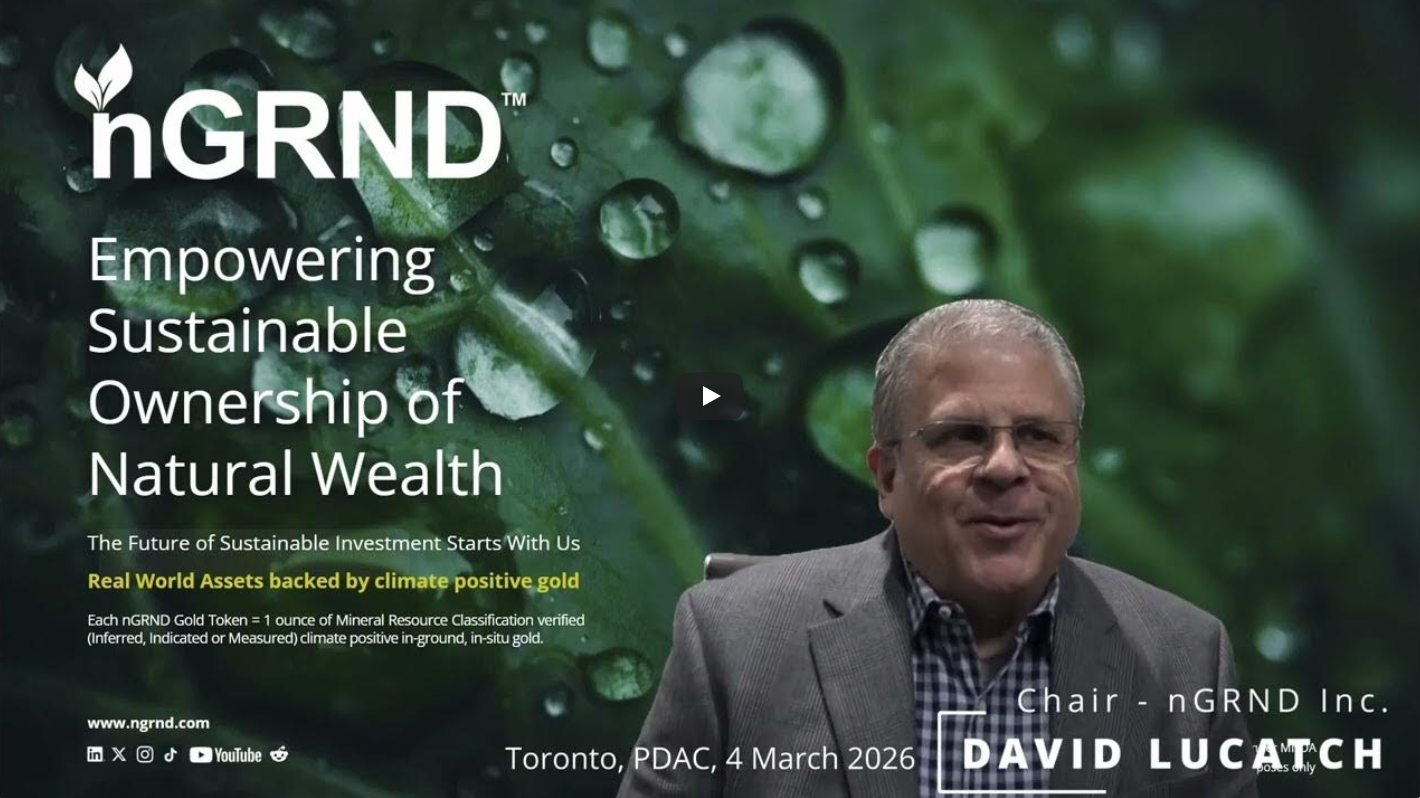
MINEX Forum Spotlights nGRND’s Vision for Sustainable Mining Finance at PDAC 2026
As a PDAC media partner for Europe and Central Asia, MINEX Forum continued to highlight innovations that can attract investment and accelerate the adoption of best-in-class technologies for sustainable mining. In its recent interview with David Lucatch, Chair of nGRND Inc., MINEX Forum explored a business model that challenges one of mining’s oldest assumptions: that value can only be unlocked by extracting metal from the ground.
nGRND, short for “in-Ground,” is advancing a novel concept built around the securitisation and tokenisation of verified in-ground gold reserves. The company’s vision is bold and deliberately provocative: to become “the world’s biggest resource company that doesn’t mine.”
A new way to unlock mineral value
In the interview, David Lucatch explained that nGRND is a land management and sustainability company working with gold discovery and exploration firms to monetise verified in-ground gold resources without physically mining them.
The company uses recognised technical documentation, such as NI 43-101 reports and other verified geological reports, to confirm the existence of gold resources. It then purchases those verified in-ground ounces from site owners and transforms them into a digital asset proposition for investors.
What makes the model distinctive is that it does not stop at the mineral resource itself. nGRND also seeks to integrate carbon, ESG and avoided mining programmes, creating an additional sustainability layer around the asset. In effect, the company aims to combine the enduring value of gold with the measurable benefits of reduced environmental disturbance, carbon impact mitigation and biodiversity protection.
This approach positions nGRND at the intersection of mining, environmental finance and blockchain-enabled asset structuring.
“We don’t just digitise gold — we redefine it”
nGRND describes itself as a company that is redefining how the world perceives, values and provides democratised access to natural wealth. Its proposition is centred on tokenising verified climate-positive in-ground gold reserves while integrating benefits from avoided mining and environmental restoration frameworks.
The company’s message is clear: gold can be reframed not merely as a mined commodity, but as a climate-positive, real-world asset. That framing is captured in its positioning:
Responsible innovation – Real-world value – Climate positive verified impact
This is a significant departure from the traditional mining investment thesis. Rather than focus solely on extraction, production growth and commodity cycles, nGRND is attempting to create value from preservation, optionality and sustainability.
Why gold, and why now?
David Lucatch made the case that gold is the ideal starting point for this model. He noted that roughly 93% of all gold is ultimately used as stored value—whether in jewellery, coins, bullion or central bank holdings—while only a small proportion is consumed for industrial or trade purposes. In his view, this makes gold uniquely suited to a system where the asset’s value can be recognised and monetised without immediate extraction.
For nGRND, the long-term opportunity is substantial. Lucatch said the company’s ambition is to monetise nearly 250 million ounces over the next decade.
That ambition reflects broader shifts in the global mining and investment landscape. Juniors and mid-tier explorers often hold significant resource inventories but struggle to convert those ounces into market value. Many trade at a fraction of the implied value of their resources, and raising capital to advance projects often leads to repeated equity dilution. nGRND’s model is designed to address precisely that problem.
Non-dilutive capital for explorers and developers
One of the strongest themes in the interview was the potential for nGRND to provide non-dilutive capital to exploration and mining companies.
Mr. Lucatch pointed out that many public companies may hold large resource bases while trading at only a few dollars per ounce in the ground. The more they raise through conventional financing, the more dilution they create for existing shareholders. By contrast, nGRND’s programme is intended to generate revenue by purchasing in-ground ounces and layering in future carbon and ESG value, thereby placing revenue on a company’s books without altering its capital structure.
That could be especially relevant for:
discovery and exploration companies
brownfield or retired assets
stranded deposits
projects that are currently uneconomic or inaccessible
properties constrained by environmental, geographic or regulatory factors
David Lucatch was clear that nGRND is not trying to interfere with active producers whose business depends on mining and selling gold. Rather, the company sees opportunity in assets where extraction may not make sense now—or for decades.
This opens an intriguing pathway for projects located under sensitive areas, near protected land, or in settings where mining would face high environmental or logistical barriers. In such cases, keeping the gold in the ground may itself become part of the value proposition.
The importance of jurisdictional stability
The success of such a model depends not only on geology, but also on geopolitics. Since nGRND’s premise is to keep resources in the ground over long time horizons—Lucatch referred to agreements of around 30 years with renewal features—the company must be confident that control over those resources can be maintained.
For that reason, nGRND is prioritising geopolitically stable jurisdictions. He noted that even previously attractive mining regions can become more uncertain over time, citing recent examples of nationalisation risk. For a company whose asset thesis depends on long-term preservation rather than near-term extraction, legal certainty and jurisdictional continuity are essential.
At present, nGRND is looking at opportunities involving Canadian, American, European, Australian, South American and South African companies, while remaining open to additional jurisdictions where the business model can be executed securely.
Global investor access through regulated token issuance
Another key part of the nGRND proposition is access to capital through digital markets. Lucatch said the company plans to launch its in-ground gold token to investors globally, excluding the United States and restricted jurisdictions. The investor base is expected to include both institutional and retail participants.
According to the interview, nGRND’s token issuance and generation partner is regulated in Dubai, and the structure is blockchain-based. The company believes this gives it a compliant route to market while offering broad international reach.
This matters because nGRND is not simply creating a mining finance instrument. It is attempting to build a bridge between real-world mineral assets, sustainability-linked value creation and digital finance infrastructure.
No direct competitor—yet
David Lucatch suggested that nGRND’s model is highly differentiated. While there are already businesses involved in tokenising physical gold, he argued that nGRND has not identified a direct competitor offering the same combination of:
verified in-ground gold monetisation
avoided mining and sustainability integration
compatibility with both private and publicly listed companies
non-dilutive financing potential
That combination could appeal to a market increasingly focused on ESG alignment, capital efficiency and alternative asset structures.
Relevance for Europe and Central Asia
For MINEX Forum audiences across Europe and Central Asia, the concept may be especially timely. The region includes a wide range of mining jurisdictions with large undeveloped or stranded mineral inventories, as well as governments and companies seeking new ways to attract investment while minimising environmental impact.
Lucatch indicated that Central Asia is still a new area for nGRND, but one the company is open to exploring. That leaves the door open for future engagement in a region where resource development, sustainability policy and foreign investment priorities increasingly intersect.
If the model proves scalable, it could offer a new option not only for companies seeking capital, but also for governments interested in balancing resource monetisation, environmental protection and long-term land stewardship.
A different future for mineral wealth
The significance of the MINEX Forum interview lies in the fact that nGRND is not merely proposing another financing instrument. It is proposing a different philosophy of resource ownership and value creation.
Instead of asking how quickly a gold deposit can be extracted, financed and sold, nGRND asks a different question: can the value of that resource be realised while leaving it in the ground?
That idea will undoubtedly attract scrutiny. Questions remain around market adoption, valuation frameworks, regulatory treatment and long-term execution. But the concept is difficult to ignore, particularly at a time when the mining sector is under pressure to decarbonise, reduce land disturbance and find more creative funding pathways.
For MINEX Forum, whose long-term objective is to promote investment and best-in-class technologies for sustainable mining, the conversation with David Lucatch reflects precisely the kind of innovation now reshaping the industry’s horizon.
nGRND’s ambition is striking, but its proposition is simple at its core: natural wealth does not always have to be extracted to be valuable.
If that idea gains traction, “the world’s biggest resource company that doesn’t mine” may become more than a slogan. It may become a new category in global mining finance.
French President Emmanuel Macron has called for Europe to reduce its reliance on Russian uranium supplies and diversify sources of nuclear fuel, pointing to several alternative producers including Uzbekistan.
Speaking at an international nuclear energy summit in Paris, Macron said Europe remains significantly dependent on Russian uranium and must accelerate efforts to diversify supply chains. Among potential alternative suppliers, he mentioned Uzbekistan, Kazakhstan, Mongolia, Canada and Australia.
Macron stressed that nuclear energy remains central to Europe’s long-term strategy for energy independence, economic decarbonisation and sustainable development.
The French president also announced that France will soon hold a meeting of its Nuclear Policy Council in Paris, where new decisions regarding the development of the country’s nuclear energy sector are expected to be adopted.
Uzbekistan has been increasing its uranium production in recent years. According to available data, the country produced about 7 000 tonnes of uranium last year, compared with around 4 000 tonnes in 2024.
The country’s total identified uranium reserves are estimated at approximately 139 000 tonnes. Uzbekistan is also planning to expand production through the development of four additional uranium deposits.
The renewed focus on alternative uranium suppliers comes amid growing concerns in Europe about the security of nuclear fuel supply as geopolitical tensions reshape global energy markets.
Mongolia is pushing to renegotiate the commercial terms of the massive Oyu Tolgoi copper mine, seeking earlier profit payments and a larger share of revenues from the project it co-owns with Rio Tinto.
The Mongolian government, which holds a 34% stake through state-owned Erdenes Mongol LLC., believes the current arrangement does not deliver sufficient economic benefits to the country. Officials are reportedly aiming to increase Mongolia’s share of returns to around 60% and accelerate dividend payments.
Rio Tinto acknowledged the discussions and said it remains committed to working with its partners to maximise the value of the project. “These discussions reflect our continued commitment to working together to achieve Oyu Tolgoi’s full potential for the benefit of all partners,” the company said in a statement.
Oyu Tolgoi is one of the world’s largest copper projects and a key asset in Rio Tinto’s long-term growth strategy as global demand for copper rises with the expansion of renewable energy, electrification and infrastructure linked to the energy transition.
Under the existing agreement, Mongolia is not expected to receive dividends until it repays a multi-billion-dollar loan from Rio Tinto that financed its share of the mine’s development costs. Those costs significantly exceeded early projections, potentially delaying dividend payments until the next decade.
Rio Tinto has invested heavily in expanding the underground operations at the mine. Copper production rose 61% last year as development progressed.
Relations between the partners have fluctuated in recent years. In 2022, Rio Tinto cancelled $2.4 billion of debt owed by Mongolia in what it described as a reset of the partnership, allowing the underground phase of the project to move forward.
However, tensions have resurfaced. Mongolia is currently pursuing a legal claim against Rio Tinto over alleged tax underpayments of roughly $450 million related primarily to depreciation accounting for the 2021 and 2022 tax years.
The renewed pressure also comes as Mongolia approaches national elections next year and commodity prices remain strong. Copper and gold prices are hovering near historic highs, increasing political scrutiny over how the country benefits from its mineral resources.
Oyu Tolgoi, which began production as an open-pit mine in 2011, is expected to become the world’s fourth-largest copper mine by 2030 once its underground expansion reaches full capacity.