Tag: World Bank

  • Bishkek Forum Highlights Transparency and Investment as Keys to Kyrgyzstan’s Mining Future

    Bishkek Forum Highlights Transparency and Investment as Keys to Kyrgyzstan’s Mining Future

    Government officials, business leaders, civil society representatives, and international experts gathered in the Kyrgyz capital for the “Dialogue on the Extractive Industry: Investment, Transparency, Development” forum, aimed at fostering an open exchange on the future of Kyrgyzstan’s mining sector.

    The event, organized by the Ministry of Natural Resources, Ecology and Technical Supervision of Kyrgyzstan with the support of the World Bank, the Extractive Industries Transparency Initiative (EITI), and consulting firm Data Lab, focused on advancing reforms to make the country a competitive and sustainable hub for critical mineral investment.

    According to the ministry, the forum’s main goal was to build a framework for cooperation grounded in transparency, accountability, and sustainability — principles vital for developing industries tied to the global energy transition.

    World Bank representative Brian Land emphasized that Kyrgyzstan needs deep and sustained reforms to attract exploration and mining investments, while Arkady Rogalsky, a data consultant for the Bank, noted that the EITI standard remains essential for building trust between government, business, and citizens by promoting openness, anti-corruption measures, and equal rules for all participants.

    At the conclusion of the discussions, participants adopted a resolution outlining future priorities:

    • The government was urged to continue reforms and strengthen coordination in preparation for the EITI 2027 validation.

    • The private sector was encouraged to enhance corporate responsibility and environmental transparency while promoting equal opportunities.

    • Civil society was called to engage more actively in public oversight and dialogue.

    • International partners were invited to support Kyrgyzstan in advancing transparency and sustainable growth.

    Deputy Director of the Kyrgyz Geological Service Ruslan Kalilov stressed that citizen participation and transparency are the cornerstones of trust, adding that the mining industry can become a driver not only of economic growth but also of social development.

    A dedicated session addressed gender inclusion in transparency practices. Data Lab presented a gender analysis of EITI implementation, highlighting the importance of women’s participation in decision-making and leadership roles. Gulnura Toralieva, head of Data Lab, noted that the goal is to foster a “culture of transparency” based on respect and openness, not merely to produce compliance reports.

    The forum concluded with a joint commitment to prepare Kyrgyzstan for the 2027 EITI validation and to continue collaborative efforts to strengthen trust and sustainable development within the extractive industry. As participants agreed, when government, business, and civil society work in concert — the whole country benefits.

  • MeetKazakhstan Forum Showcases Global Collaboration on Geological Exploration

    MeetKazakhstan Forum Showcases Global Collaboration on Geological Exploration

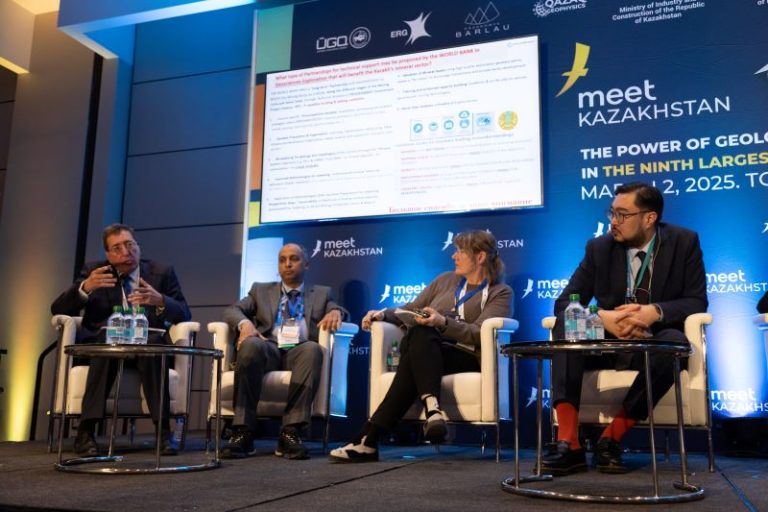
    Toronto, March 2, 2025 – At the PDAC-2025 Conference in Toronto, a standout session at the “Meet Kazakhstan: The Power of Geology in the Ninth Largest Nation” forum brought together top experts to discuss strategic partnerships in geological exploration. The panel, moderated by Mr. Kimmo Tiilikainen, Director General at the Geological Survey of Finland (GTK), highlighted the increasing global need for collaborative innovation and data-driven exploration in the mining sector.

    The session featured a distinguished lineup of speakers including Mr. Yerlan Galiyev, Head of the National Geological Survey of the Republic of Kazakhstan; Mr. Francisco Igualada, Senior Mining Specialist at the World Bank; Dr. Karen Hanghøj, Director of the British Geological Survey; Mr. Hassan Al-Marzouki, Director of Planning and Development at SGS; Mr. Christophe Poinssot, Deputy Managing Director of the French Geological Survey (BRGM); and Mr. Sven-Uwe Schulz, Head of Unit “Evaluation of Mineral Resources” at the German Mineral Resources Agency (DERA).

    Key Themes and Insights

    Throughout the session, panellists underscored the critical role of high-quality geological data—referred to by several speakers as “Geodat”— in attracting investments and advancing exploration. Mr. Galiyev presented Kazakhstan’s ambitious digitisation initiative aimed at transforming vast geological records into machine-readable formats. This initiative not only facilitates better resource estimation but also enables global stakeholders to easily access and utilise the country’s rich data repository.

    Dr. Hanghøj emphasised that modern geoscience must integrate traditional methods with advanced data management techniques to create robust geoinformation infrastructure. “The quality and accessibility of geological data are paramount in attracting investment and driving sustainable development,” she remarked.

    Panellists from Saudi Arabia, France, Germany, and the World Bank echoed this sentiment by discussing how collaborative platforms and technology partnerships could streamline the exploration process. Mr. Al-Marzouki shared challenges such as the shortage of data analysts and the need for enhanced digital tools, while Mr. Poinssot highlighted ongoing research into deep exploration technologies capable of probing up to one kilometre below the surface.

    International Partnerships and Future Prospects

    A recurring theme during the session was the importance of international cooperation. Discussions ranged from the benefits of open data exchange to building integrated value chains that span from raw material exploration to high-tech applications in the energy transition. Mr. Igualada of the World Bank stressed that long-term partnerships are key to unlocking the full potential of critical raw materials, supporting not only mining operations but also the broader economic ecosystem.

    The session concluded with a call to action for global stakeholders to invest in the digitisation and modernisation of geological services. As Mr. Galiyev aptly summarized, “Geological success is measured by the data we collect and share. By collaborating internationally, we can ensure that Kazakhstan and the Central Asian region become a vital bridge between established markets and emerging opportunities.”

    Looking Ahead

    With plans to host a dedicated MINEX Kazakhstan Mining and Exploration Forum in Astana on 9 & 10 April this year for Central Asian geoscience professionals, the session set the stage for continued dialogue and cooperation.