Tag: mining operations

  • Sasa Completes Major Raisebore Project to Enhance Mine Operations

    Sasa Completes Major Raisebore Project to Enhance Mine Operations

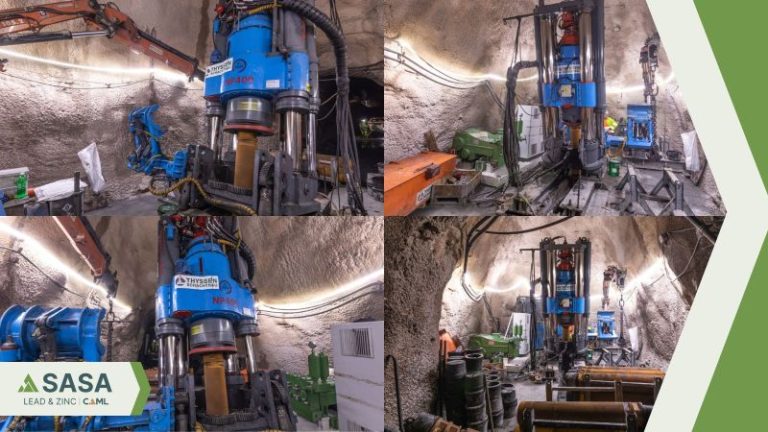
    Sasa has successfully completed a significant raisebore project that has delivered over 1.5 kilometres of ventilation raises, ore passes, and waste passes, marking a crucial step in supporting the mine’s long-term operational future. This extensive project is designed to improve underground ventilation, which is vital for maintaining a safe and efficient mining environment. Additionally, the new infrastructure will optimise the transport of ore and waste, facilitating smoother operations and enhancing access to future mining areas.

    The completion of this project is particularly important as Sasa continues its development towards the 700 and 600 levels of the mine. By improving ventilation and transport systems, the mine is poised to increase its productivity and operational efficiency. The enhancements are expected to not only support current mining activities but also lay the groundwork for future expansions and developments within the mine.

    As the mining industry faces increasing demands for efficiency and sustainability, projects like Sasa’s raisebore initiative highlight the importance of investing in infrastructure that supports both operational goals and environmental considerations. The successful execution of this project underscores Sasa’s commitment to advancing its mining operations while ensuring safety and sustainability are at the forefront of its development strategy.


  • Navoi Mining and Metallurgical Combine Reports Strong H1 2026 Results with 1.5 Million Ounces of Gold Production

    Navoi Mining and Metallurgical Combine Reports Strong H1 2026 Results with 1.5 Million Ounces of Gold Production

    The Navoi Mining and Metallurgical Combine (NGMK), a major mining enterprise in Uzbekistan, has released its operational results for the first half of 2026, demonstrating robust performance across key metrics. During the six-month period, the company produced 1.508 million troy ounces of gold, solidifying its position as a significant player in Central Asia’s precious metals sector. The monetary value of total production reached 86.2 trillion Uzbek som, reflecting both strong operational efficiency and favorable market conditions for gold during the reporting period.

    The company’s investment program showed substantial capital deployment, with 236.8 million dollars invested in development and expansion initiatives during the first half of 2026. This significant investment underscores NGMK’s commitment to modernizing its operations and enhancing production capacity. Additionally, the enterprise created 1,008 new jobs during the same period, contributing to employment growth in the Navoi region and supporting the broader economic development objectives of Uzbekistan’s mining sector.

    NGMK has also made notable progress on its localization program, producing domestically-sourced products valued at 808.7 billion som. Furthermore, the company procured approximately 4.2 trillion som worth of products through inter-industry industrial cooperation initiatives. These figures demonstrate the combine’s strategic focus on supporting local supply chains and fostering industrial integration within Uzbekistan’s economy, while maintaining operational excellence in gold production and processing.


  • Scania and LKAB Unleash “Sleipner”

    Scania and LKAB Unleash “Sleipner”

    Scania and LKAB have taken their collaboration to the next level with the introduction of a new fully electric 8×4 heavy tipper truck at LKAB’s Malmberget mine in northern Sweden. This groundbreaking vehicle, named “Sleipner” after Odin’s legendary eight-legged horse, is the first Scania electric truck to feature two steerable front axles. It has been designed to tackle the rigorous demands of mining transport, offering improved stability and load-bearing capabilities on tough mine roads.

    Sleipner represents a significant milestone in Scania’s commitment to electrifying heavy-duty transportation in challenging environments. With a total weight of 60 tonnes—38 tonnes of which is payload—the electric truck replaces its internal combustion counterpart, offering an eco-friendly alternative for transporting waste rock at LKAB’s mining operations.

    Powered by two MP20 battery packs with 416 kWh capacity, and a 400 kW electric motor, Sleipner has been built on Scania’s modular electric platform. This technology enables the vehicle to haul materials over a 5 km route with a 250-meter elevation gain while achieving substantial CO₂ savings. If successful, Sleipner could provide LKAB with a fully fossil-free solution for their transport needs, a major step in meeting their sustainability goals.

    “This vehicle is just the start of many more mining solutions to come,” said Tony Sandberg, Head of Scania Pilot Partner. The vehicle is the latest in a series of electric trucks operating at the Malmberget mine, demonstrating how Scania’s electric technology can be adapted for the toughest of environments.

  • Canadian Mining Company Black Iron Advances Iron Ore Project in Ukraine

    Canadian Mining Company Black Iron Advances Iron Ore Project in Ukraine

    Canadian mining company Black Iron Inc. has initiated the process of obtaining permits for iron ore extraction under its Shimanovskoye Iron Ore Project in Kryvyi Rih, Ukraine. According to documents obtained by Interfax-Ukraine, the company’s subsidiary, Shimanovskoye Steel LLC, has applied for authorization to mine iron ore from the northern section of the Shimanovskoye open pit.

    The proposed open-pit mine will span 660 by 390 meters and reach a depth of 80 meters, with plans to extract 4.5 million tons of ore annually. The total overburden volume is estimated at 5.13 million cubic meters, including 1.31 million cubic meters of ore. The project will operate year-round, leveraging nearby infrastructure, including rail, power, and port facilities.

    Black Iron has prioritized this venture through an investment agreement with the Ukrainian government. A critical hurdle remains obtaining a land plot managed by Ukraine’s Ministry of Defense, though discussions have progressed, and a preliminary compensation amount has been agreed upon.

    The company is also exploring additional potential projects and has a history of partnerships, including a 2013 agreement with Ukraine’s Metinvest group. While Metinvest later withdrew from the project, Black Iron continued development, citing the region’s rich resources and existing mining operations, such as ArcelorMittal’s iron ore complex, as key advantages.

    The Shimanovskoye Iron Ore Project is designed to produce premium iron ore with an iron content above 68%. Initial capital investment is estimated at $452 million for the first phase and $364 million for the second, with plans to build a plant capable of producing up to 8 million tons annually.

  • Polish Parliament Speaker Szymon Holownia Visits Budryk Mine

    Polish Parliament Speaker Szymon Holownia Visits Budryk Mine

    The Speaker of the lower house of the Polish Parliament, Szymon Holownia, recently met with miners working at the Budryk mine – part of Jastrzebska Spólka Weglowa (JSW). During his visit, Speaker Holownia learned about the operations of the mine and the entire JSW, which produces coking coal – a raw material on the EU’s list of critical raw materials necessary for steel smelting.

    Before visiting the mine, the Speaker underwent the necessary training to authorize him to go underground. He was then accompanied by Ryszard Janta, President of the JSW Management Board, Adam Rozmus, Vice-President of the JSW Management Board for Technical and Operational Matters, Krzysztof Baranowski, Director of the Budryk mine, and Wieslaw Chylek, Technical Director of the mine. Together, they descended to the 1290 m level via shaft VI, the deepest level in coal mines in Poland, where the temperature of the rock mass reaches almost 50°C.

    From the shaft, the group proceeded by suspended cable cars to the area of the Bw-3 longwall, the main purpose of the visit. After a 300 m walk from the passenger station, the Speaker of the Sejm and his attendants stood at the entrance of the Bw-3 longwall. It took several minutes to walk along the 200 m longwall, where mining was underway, followed by a march to the 1000 level and a trip to the surface.

    “What I saw today made a huge impression on me and will definitely stay with me. Visits such as this one teach respect and humility towards people who do a difficult and responsible job, who go down and up five days a week for 25 years. I hope that you will always be accompanied by luck and God’s protection,” said Szymon Holownia immediately after leaving the mine.

    “I did not come here to present plans or to spin a vision. I came to listen, to see the mining reality. What I learned from you today will be helpful in my work. Thank you for allowing me to spend this time with you. I hope this is not our last meeting. I have already heard tentative invitations related to Miners’ Day. If they are upheld, we will of course see each other again,” the Speaker added.

  • Prime Minister of Kyrgyzstan Visits Kumtor Gold Mine, Emphasizes Importance of Mining Operations

    Prime Minister of Kyrgyzstan Visits Kumtor Gold Mine, Emphasizes Importance of Mining Operations

    During a working trip to the Issyk-Kul region, Prime Minister and Head of the Presidential Administration of the Kyrgyz Republic, Akylbek Japarov, familiarized himself with the activities of the closed joint-stock company “Kumtor Gold Company.” A meeting was held with the management of the Kumtor enterprise, where Prime Minister Japarov emphasized the crucial importance for the state to ensure uninterrupted and efficient operation of the mine, as well as the fulfillment of all planned objectives. He then visited the machinery workshop of the enterprise to inspect the assembly of new excavators and refueling stations. The project for the automation of oil storage facilities and refueling stations at Kumtor allows for meticulous control over fuel consumption. Currently, over 800 different vehicles, machinery, and equipment are utilized to ensure uninterrupted mining at the site. Prime Minister Japarov also visited the main quarry of Kumtor, where mining operations are in full swing, including the implementation of an underground gold mining project. It’s worth noting that in February of this year, the underground gold mining project at the Kumtor deposit was launched, aiming to extract around 115 tons of gold. During the inspection of the gold mining plant, it was noted that new equipment has been installed, similar to an X-ray machine, enabling proper control of entries and exits from the plant premises. Additionally, it was announced that gold extraction from ore waste located in the mine’s tailings facility is planned to commence in 2026. Preliminary estimates suggest this could yield an additional 120 tons of gold. Furthermore, the 2023 results revealed that 13,567 tons of gold were extracted from the Kumtor deposit, with the company’s total revenue amounting to $848 million USD, and a net profit of $302.5 million USD. Prime Minister Akylbek Japarov, having familiarized himself with the Kumtor mine operations on-site, highlighted significant changes occurring for the state following Kumtor’s transition. Notably, last year, the country’s budget received 17.2 billion soms in taxes, social payments, and other fees, with over 99.9% of the workforce comprising local specialists.

  • Tau-Ken Samruk’s Plans for Lead-Zinc Production at Shalkiya Deposit

    Tau-Ken Samruk’s Plans for Lead-Zinc Production at Shalkiya Deposit

    Tau-Ken Samruk, the national mining company, is set to commence mining operations at the Shalkiya lead-zinc deposit in October 2024, with a target of producing 2.2 million tonnes of ore by the following year. Chairman Bakyt Chirchikbayev unveiled these intentions at the MINEX Kazakhstan 2024 forum, indicating considerations for utilizing third-party facilities for ore processing during the construction phase of their processing plant. Negotiations for ore processing at external facilities are in their final stages, with details to be revealed upon agreement finalization.

    Chirchikbayev provided updates on the construction progress of the mining and processing plant in Shalkiya, emphasizing the procurement of technological equipment. Discussions regarding the potential sale of the mine are ongoing, with Tau-Ken Samruk considering selling a controlling stake. Chirchikbayev mentioned the openness to selling anywhere between 51% to 100%, with negotiations ongoing with potential partners. The Shalkiya lead-zinc deposit, overseen by ShalkiyaZinc LTD JSC, a subsidiary of Tau-Ken Samruk JSC, is one of the largest globally. Construction of a lead-zinc mining and processing plant began in 2018, utilizing the substantial ore resources of the deposit, which holds around 112.9 million tonnes.

    The project aims to fulfill the demand for zinc and lead concentrates both domestically and internationally, with confirmed reserves supporting operations until 2051. The total project cost amounts to $650 million, with $295 million funded by the European Bank for Reconstruction and Development, guaranteed by the Samruk-Kazyna National Welfare Fund. Established in 2009, Tau-Ken Samruk JSC manages the state’s mining assets under the Samruk-Kazyna state fund.

  • AM Resources Corp Expands Mining Operations in Austrian Pegmatite Belt

    AM Resources Corp Expands Mining Operations in Austrian Pegmatite Belt

    AM Resources Corp has significantly broadened its mining operations with the acquisition of a sizable 1,500 square kilometer land package in the Austrian Pegmatite Belt, establishing itself as a distinctive lithium exploration player in the area. This strategic expansion affords the company access to more than a hundred pegmatites within the Frederick Property, strategically positioning it in close proximity to 14 battery plants. The decision to invest in Austria is in line with the company’s objective to capitalize on established geology, market accessibility, historical expertise, and a favorable mining regulatory framework.

  • Eurobattery Minerals AB Confirms Favorable Bedrock Conditions for Mining Operations in Finnish Hautalampi Project

    Eurobattery Minerals AB Confirms Favorable Bedrock Conditions for Mining Operations in Finnish Hautalampi Project

    Eurobattery Minerals AB, a mining company listed on the Swedish Nordic Growth Market (BAT) and German Börse Stuttgart (EBM), has announced positive research results regarding the bedrock conditions at its Hautalampi battery minerals mine project in Finland.

    The research, conducted as part of the environmental permit process, aimed to assess potential risks associated with groundwater movement in shear zones within the mine and deposit area. The analysis concluded that the shear zones align with the bedrock geology and revealed no significant dominant shear zones, indicating favorable conditions for future mining operations at Hautalampi.

    CEO Roberto García Martínez expressed confidence in the project’s prospects, citing the favorable geology as a key factor. He emphasized that the results further support Eurobattery Minerals’ goal of responsibly mining battery minerals to contribute to Europe’s self-sufficiency in critical raw materials for cleaner energy solutions.

    Eurobattery Minerals focuses on advancing nickel-cobalt-copper projects across Europe to address the growing demand for battery minerals and support the transition to sustainable energy.

  • The North Shuak gold deposit will be developed in the south of Kazakhstan

    The North Shuak gold deposit will be developed in the south of Kazakhstan

    The company Appak Minerals intends to put the North Shuak gold deposit in the Moiynkum district of the Zhambyl region into industrial operation. The plan for mining operations by the subsoil user was found on Kazakhstan’s Unified Environmental Portal.

    The North Shuak reserves were registered with the state in January 2023. The gold-bearing ore reserves were categorized as follows: proven reserves – 438 thousand tons (826 kg of precious metal with an average grade of 1.88 g/t), probable reserves – 288 thousand tons (533 kg of precious metal with an average grade of 1.85 g/t), inferred reserves – 162 thousand tons (323 kg of precious metal with an average grade of 1.99 g/t).

    Appak Minerals has not specified the year it will commence quarrying. It is only known that the mining plan is calculated for six years. The productivity of the future enterprise has been determined at 150 thousand tons of ore per year.

    For the project, the optimal processing technology has been selected – flotation enrichment. Concentrates with gold content of up to 43.6 g/t will be obtained at the flotation plant, with precious metal extraction rates of 90-92%.