
Tag: British Geological Survey

  • MeetKazakhstan Forum Showcases Global Collaboration on Geological Exploration

    MeetKazakhstan Forum Showcases Global Collaboration on Geological Exploration

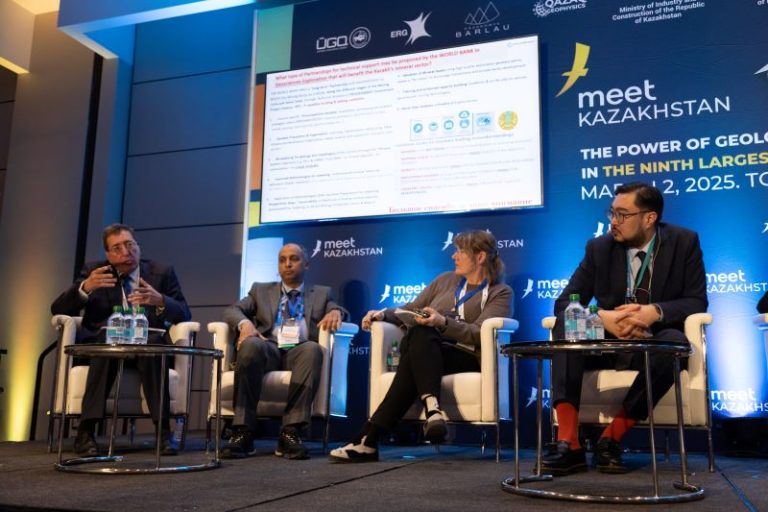
    Toronto, March 2, 2025 – At the PDAC-2025 Conference in Toronto, a standout session at the “Meet Kazakhstan: The Power of Geology in the Ninth Largest Nation” forum brought together top experts to discuss strategic partnerships in geological exploration. The panel, moderated by Mr. Kimmo Tiilikainen, Director General at the Geological Survey of Finland (GTK), highlighted the increasing global need for collaborative innovation and data-driven exploration in the mining sector.

    The session featured a distinguished lineup of speakers including Mr. Yerlan Galiyev, Head of the National Geological Survey of the Republic of Kazakhstan; Mr. Francisco Igualada, Senior Mining Specialist at the World Bank; Dr. Karen Hanghøj, Director of the British Geological Survey; Mr. Hassan Al-Marzouki, Director of Planning and Development at SGS; Mr. Christophe Poinssot, Deputy Managing Director of the French Geological Survey (BRGM); and Mr. Sven-Uwe Schulz, Head of Unit “Evaluation of Mineral Resources” at the German Mineral Resources Agency (DERA).

    Key Themes and Insights

    Throughout the session, panellists underscored the critical role of high-quality geological data—referred to by several speakers as “Geodat”— in attracting investments and advancing exploration. Mr. Galiyev presented Kazakhstan’s ambitious digitisation initiative aimed at transforming vast geological records into machine-readable formats. This initiative not only facilitates better resource estimation but also enables global stakeholders to easily access and utilise the country’s rich data repository.

    Dr. Hanghøj emphasised that modern geoscience must integrate traditional methods with advanced data management techniques to create robust geoinformation infrastructure. “The quality and accessibility of geological data are paramount in attracting investment and driving sustainable development,” she remarked.

    Panellists from Saudi Arabia, France, Germany, and the World Bank echoed this sentiment by discussing how collaborative platforms and technology partnerships could streamline the exploration process. Mr. Al-Marzouki shared challenges such as the shortage of data analysts and the need for enhanced digital tools, while Mr. Poinssot highlighted ongoing research into deep exploration technologies capable of probing up to one kilometre below the surface.

    International Partnerships and Future Prospects

    A recurring theme during the session was the importance of international cooperation. Discussions ranged from the benefits of open data exchange to building integrated value chains that span from raw material exploration to high-tech applications in the energy transition. Mr. Igualada of the World Bank stressed that long-term partnerships are key to unlocking the full potential of critical raw materials, supporting not only mining operations but also the broader economic ecosystem.

    The session concluded with a call to action for global stakeholders to invest in the digitisation and modernisation of geological services. As Mr. Galiyev aptly summarized, “Geological success is measured by the data we collect and share. By collaborating internationally, we can ensure that Kazakhstan and the Central Asian region become a vital bridge between established markets and emerging opportunities.”

    Looking Ahead

    With plans to host a dedicated MINEX Kazakhstan Mining and Exploration Forum in Astana on 9 & 10 April this year for Central Asian geoscience professionals, the session set the stage for continued dialogue and cooperation.

  • Kazakhstani National Geological Servey will receive assistance in avoiding mistakes

    Kazakhstani National Geological Servey will receive assistance in avoiding mistakes

    The British Geological Survey, with its extensive experience, will share its knowledge with its Kazakhstani counterparts. The collaboration between the British Geological Survey (BGS) and the National Geological Service (NGS) of Kazakhstan is set to be closely coordinated. During his visit to Astana, David Schofield, the director of BGS for international geological research, shed light on this international partnership.

    “The British Geological Survey is the world’s oldest organization of its kind. Our primary focus involves describing the geology of the United Kingdom, generating geological information, and disseminating it to stakeholders interested in natural resources. This includes data on water resources, construction-related information, as well as potential hazards like landslides. Consequently, we collaborate with various industries. Furthermore, we have a strong tradition of sending our geologists abroad to enhance geological services in other countries. The primary motivation behind our international efforts is global development and supporting the implementation of British trade and foreign policy,” shared the geologist.

    During their visit to Kazakhstan, BGS specialists engaged in fruitful discussions with their counterparts from the recently established National Geological Service of Kazakhstan.

    “The organization is relatively young and faces several challenges that need to be addressed. However, they have made a promising start. One area where we can offer assistance is in the digital transformation of a substantial amount of accumulated data. We can help bring this data into the digital realm and make it more accessible to a wider audience. We have accumulated considerable experience in this domain over the past 25 years, learning valuable lessons along the way. By sharing our experience, we hope that the NGS of Kazakhstan can avoid the mistakes we’ve unfortunately made. Additionally, we possess expertise in ore deposit analysis, hydrology, and other challenges, where our knowledge can be of value,” noted the specialist.

    Currently, the collaborating geological organizations are actively discussing potential areas of cooperation. Recognizing their shared objectives, BGS and NGS intend to establish a working plan for the next two to three years.

    According to the minerals.gov.kz website, the British Geological Survey plans to collaborate with “Kazakhstan Garish Sapary,” which operates a geological IT platform, as reported by inbusiness.kz.
    In the course of their conversation, the head of the National Geological Service (NGS) elucidated that this subsidiary of the geological committee acts as the national custodian of the state’s accumulated geological data. However, it does not possess any deposits, assets, or laboratories.

    Concerning the fees for the services provided by the National Geological Service, Erlan Galiev clarified that the pricing methodology is presently under discussion within the organization. He underscored that the calculation will now be based on the number of pages in the report, rather than solely on the report itself.

    “There are various approaches to assessing geological information. For instance, one could commence with historical expenses. Let’s say, back in the 1970s, an expedition was dispatched, wells were drilled, various operations were conducted, money was expended, and this report was created, subsequently submitted to the funds. Now, let’s assume we propose that 1% of the total cost of these activities should be the price of this report. It would not be just a million; considering the inflation that has transpired since then, it would be exorbitantly high, excessively expensive. We will not tread down that path, but merely for your comprehension, the value ascribed to geological information presently is abysmally low, simply catastrophic. The actual expenditure incurred far exceeds what a mining user pays for this report at present, rendering it a rather meager amount, allowing them to utilize the information freely. Therefore, we are currently contemplating and acknowledging that the provision of geological information should be streamlined, transparent, and expedited as much as possible. We are diligently working towards that goal,” expounded the esteemed NGS executive.

  • The First Congress of Geologists of Kazakhstan took place in Astana

    The First Congress of Geologists of Kazakhstan took place in Astana

    Today, in the esteemed capital of Kazakhstan, the inaugural and momentous gathering of domestic geologists took place under the esteemed auspices of the Ministry of Industry and Infrastructure Development of the Republic of Kazakhstan.

    The congress, aptly titled “Geological Service of Kazakhstan in the 21st Century: Status, Challenges, and Prospects,” provided a platform for the earnest discussion of pressing issues within the field. The primary objective of this esteemed event was to devise a collaborative plan of action, aimed at replenishing and advancing the nation’s mineral and raw material reserves, thereby propelling the national economy to new heights by 2029, while simultaneously securing a robust industrial foundation for the republic.

    During the grand opening ceremony of this prestigious congress, Iran Sharhan, the Acting Vice Minister of Industry and Infrastructure Development, underscored the vital role that the geological sector plays in comprehensively studying Kazakhstan’s environment and resources. Sharhan further emphasized that Kazakhstan’s mineral and raw material reserves must be meticulously developed to meet the long-term requirements of the nation’s economy.

    Distinguished individuals who graced the event with their presence included Galym Nurzhanov, the CEO of KAZAKHMYS BARLAU LLP; Serikbek Daukeev, an Academician of the National Academy of Sciences of the Republic of Kazakhstan and a Doctor of Geological and Mineralogical Sciences; Georgiy Freyman, a representative from the Academy of Mineral Resources of Kazakhstan; and Heroi Zholtaev, the esteemed Director of the K.I. Satpaev Institute of Geological Sciences.

    In his insightful address, Galym Nurzhanov shed light on the new challenges confronting the geology community today and passionately called for immediate participation and concerted efforts to address the industry’s issues. He underscored the imperative for collaborative endeavors between relevant authorities and the business community, as he firmly believed that such synergy would yield breakthroughs in geological exploration and foster a profound and positive impact.

    Fayaz Abytov, in a captivating presentation, unveiled an ambitious project to establish an International Center for Advanced Experience in Sustainable Natural Resource Management. This visionary project seeks to contribute to the realization of ecological and energy balance, as well as the sustainable management of resources.

    Notably, the congress identified prospective directions for the advancement of geological science and technology. Engaging presentations on geological exploration and digital technologies were thoughtfully discussed, alongside topics pertinent to fortifying interregional ties and fostering fruitful business cooperation.

    As a momentous outcome of this esteemed congress, a memorandum of understanding was signed between the British Geological Survey and the revered Kazakhstani National Geological Service. Through this agreement, both parties express their intent to exchange invaluable experiences in implementing cutting-edge technologies within the realm of geology, conducting regional geological research, and creating comprehensive geological maps and databases, thereby fostering a collaborative and mutually enriching relationship.

  • UK backs Ionic’s supply chain plans

    UK backs Ionic’s supply chain plans

    Ionic Rare Earths, listed on the ASX, has recently entered into a significant partnership agreement with Ford Technologies, Less Common Metals (LCM), and the British Geological Survey to establish a rare earth supply chain based in the UK, utilizing recycled magnets.

    Ionic’s subsidiary, Ionic Technologies, will employ recycling technology to produce high-purity, separated, and traceable rare earths from end-of-life magnets and swarf. These rare earths will be supplied to LCM for alloy production, which will then be converted into NdFeB magnets. Ford Technologies plans to use these magnets in the production of electric vehicles (EVs).

    The UK government has pledged £1 million in support for this partnership project, with an additional £1 million allocated for a feasibility study focused on the construction and supply side dynamics of a magnet rare earth recycling plant. This feasibility study will be conducted in collaboration with the British Geological Survey, and the funding will be provided under the UK government’s circular critical materials supply chains (CLIMATES) program.

    Tim Harrison, Managing Director of Ionic, expressed the significance of this initiative, emphasizing that it will accelerate the mining, refining, and recycling of critical magnet and heavy rare earths essential for energy transition, advanced manufacturing, and defense. He also highlighted Ionic’s strategy to establish a collaborative Western supply chain for rare earths in the UK and the European Union.

    Additionally, Ionic Technologies has received a CLIMATES grant from Innovate UK, further demonstrating their commitment to creating a sustainable supply chain for rare earths in partnership with Ford Technologies and LCM. Another CLIMATES grant will support Ionic Technologies in developing a business case and exploring the potential scale-up of a commercial magnet recycling facility in Belfast, in partnership with the British Geological Survey.

    It’s worth noting that Ionic Rare Earths also owns the Makuutu rare earths project in Uganda, further contributing to its involvement in the rare earths industry.