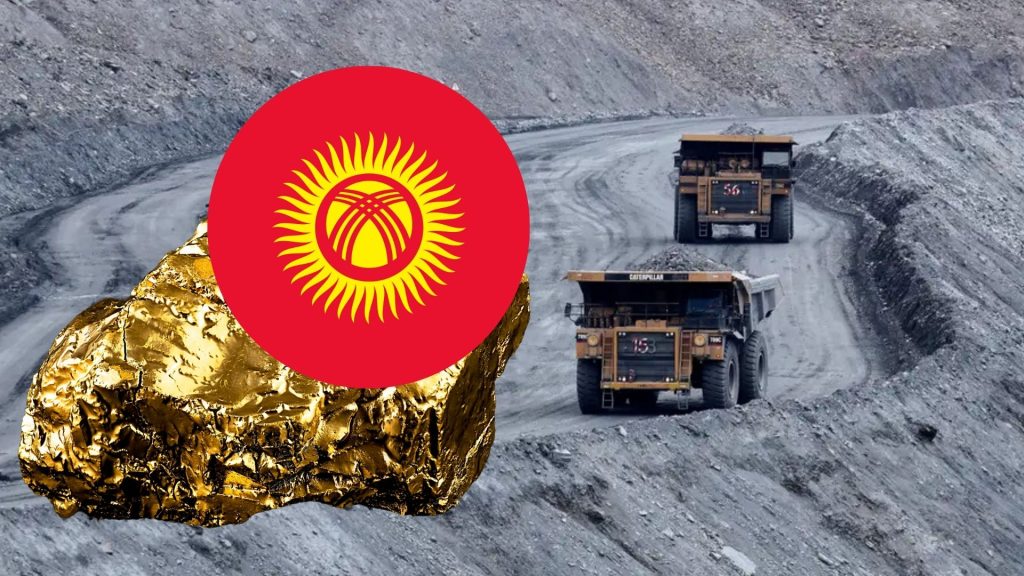
Three years ago, Kyrgyzstan and the Canadian company Centerra Gold inked an agreement to settle mutual claims. This landmark decision saw full control of the Kumtor gold mine revert to the Official Bishkek.
Background to the Kumtor Mine
The Kumtor Gold Company (KGC), a significant contributor to Kyrgyzstan’s GDP (around 10 per cent), was nationalised several years prior. Tensions surrounding the KGC escalated in May 2021 when the Kyrgyz cabinet introduced temporary external management. Before this, the Kumtor mine was operated by Centerra Gold Inc., a Canadian firm established in 2004 following a restructuring of assets from Cameco, a major global uranium producer. It was with Cameco that the government of independent Kyrgyzstan signed the general agreement for the Kumtorzoloto project in December 1992. Commercial gold production at the site commenced in 1997.
The path to nationalisation was long and debated. In April 2022, the settlement agreement with Centerra Gold Inc. was finally signed, resolving nearly three decades of periodic calls within Kyrgyzstan for the mine’s nationalisation. Notably, the current President Sadyr Japarov was a vocal advocate for this, having raised concerns about Kumtor’s privatisation as early as 2012 and leading a parliamentary commission to scrutinise the company, although the idea did not gain parliamentary support at the time.
“Nationalisation of Kumtor Was Necessary”
Gani Abdrasilov, a former advisor to the Kyrgyz Prime Minister, economic analyst, and member of the parliamentary commission on Kumtor, explained that in 2012, while preparing a report for the commission’s then-chairman, Sadyr Japarov, he analysed the economic activities of Cameco and Centerra Gold Inc., specifically examining financial flows and identifying alleged corruption schemes. According to him, international auditing firms were brought in, and they determined that the total lost profit at that point amounted to US$3.5 billion, encompassing both economic and environmental damages.
Speaking to DW, Mr Abdrasilov asserted that the nationalisation of Kumtor was essential and non-negotiable, as it concerned a national asset and the country’s image. “This is our deposit, which ranks seventh in the world in terms of gold reserves. And why should we give it to someone or operate as a joint venture?” he questioned.
Mr Abdrasilov believes the Kyrgyz authorities should again engage independent international auditors to recover the lost profits.
Two Sides to Kumtor’s Operations
In contrast, Ishimbay Chunuev, President of the Kyrgyz Society of Subsoil Experts and former Director of the State Agency for Geology and Mineral Resources, who worked at the gold mine for 17 years, sees two sides to the Kumtor issue. On one hand, it facilitated the training of local personnel, but on the other, the experience of dealing with the investor proved negative. He noted, however, “It’s easy to say now in hindsight. The finances there are huge – around US$800 million. About 450-500 million went into the construction of the road and the processing plant alone. We didn’t even have 100 million… The issue with investors is another matter, of course, but that involves politics and corruption.”
Mr Chunuev believes that production at Kumtor has continued post-nationalisation thanks to the national specialists who have been trained over nearly 30 years. He estimates that the mine’s reserves allow for operation until approximately 2040. However, he stresses that for more accurate assessments in the mining sector, Kyrgyzstan should join CRIRSCO (Combined Reserves International Reporting Standards Committee), an international public organisation that includes countries like the USA, Canada, Australia, the UK, China, Russia, Kazakhstan, Mongolia, and Turkey. He points out that this would enable Bishkek to implement international reporting standards for exploration results, mineral resource and reserve estimates.
Environmental Concerns Linger
Kaliya Moldogazieva, an independent environmental and health expert and a member of interdepartmental and state commissions on Kumtor, stated that the environmental community was primarily concerned about the state of the environment following the KGC’s nationalisation. Over the years of the mine’s operation, environmental incidents such as a cyanide spill into the Barskoon River and the impact of waste storage on the Lysyi and Davydov glaciers have occurred.
Ms Moldogazieva highlighted that gold extraction at the site continues to be via open-pit mining. “Around 17 tonnes of explosives are used daily. Even when the Canadians were here, experts and government bodies urged them to switch to underground mining, which is safer,” she recalled, adding, “Of course, now the profit from gold mining goes to the state, but what will be the environmental consequences?”
Ms Moldogazieva emphasised the need to develop a programme to prevent negative environmental impacts. She believes the government needs clarity on two aspects: the reclamation process and the mine closure concept, which should be updated every three years to reflect changes such as remaining resources or accumulated waste. Furthermore, she called for greater transparency and dialogue with the public, potentially through meetings or site visits to Kumtor for interested parties.
Changes in Kumtor’s Operations
In January 2025, changes occurred in the management of Kumtor Gold Company CJSC, with Buzurman Subanov appointed as the new President and Chairman of the Board by the board of directors. Previously, he served as the Deputy Chairman of Kyrgyzaltyn OJSC, a state-owned enterprise specialising in gold deposit development, which is now the sole shareholder of KGC.
DW reached out to KGC to inquire about the changes in the company’s operations since its transition to state ownership and the priorities of Mr Subanov in his new role.
“My main task as the head of the company is to ensure the smooth operation of all structural divisions of our enterprise to achieve the set goals,” Mr Subanov responded. He stated that KGC currently employs around 3,600 people, with an additional 1,000 specialists involved through contracting organisations. “After the foreign partners left the project, the working conditions of the company’s employees have not fundamentally changed. We have not cut salaries, nor have we cancelled other payments due to our employees,” he affirmed.
Regarding financial and production figures, KGC’s revenue from May 2021 to December 2024, since the introduction of external management and subsequent transfer of the Kumtor mine to state ownership, amounted to over US$3.4 billion, with a net profit exceeding US$1.2 billion. The company reported paying US$891.6 million to the state budget in taxes and other payments.
On the environmental front, KGC mentioned the commencement of a project for underground mining of gold-bearing ore, with an initial phase targeting the extraction of approximately 115 tonnes of gold. Looking ahead, the company intends to undertake a project to extract gold from the processed ore stored in the mine’s tailings facilities.
However, the management of KGC insists on a nuanced phrasing: “To say that the Kumtor mine was nationalised is fundamentally incorrect.” They clarify that it was not a nationalisation but a “return” of the Kumtor deposit to the ownership of the republic.