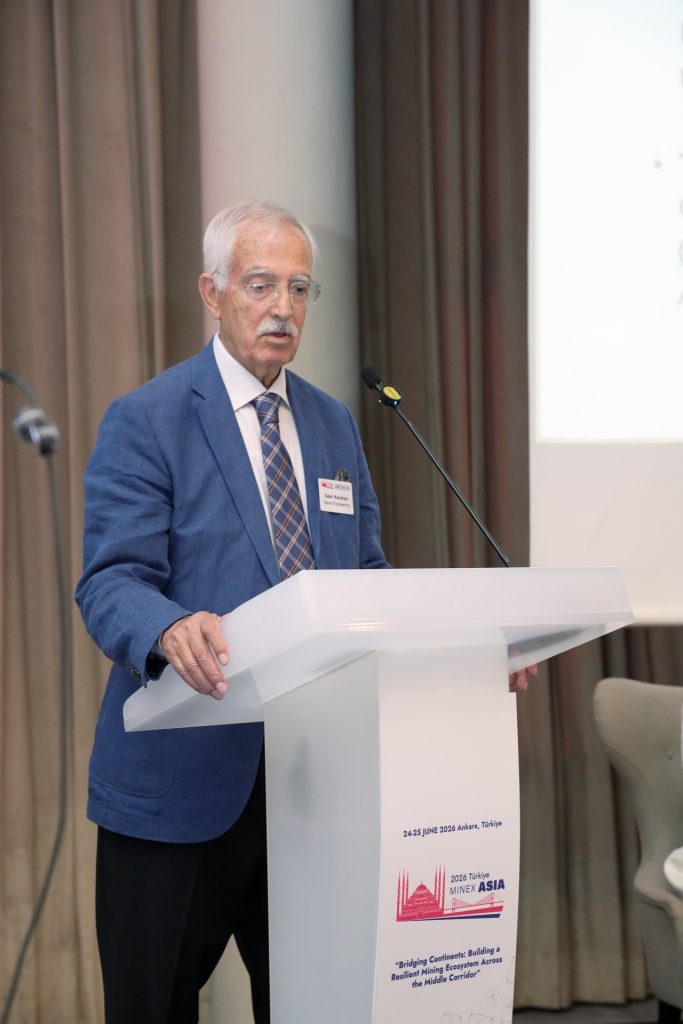
Sabri Karahan — General Manager, DAMA Engineering
Karahan delivers a historical account of how Turkish mining engineering developed from essentially nothing into a mature, exportable discipline. He starts with the Ottoman era (copper smelting using wind and water power in the Elazığ/Diyarbakır region) and traces the founding of MTA, Turkey’s exploration institute, established under Etibank in the 1930s, which drove early state-led mineral discoveries. He describes this as “high technology” for its time despite its primitive appearance by modern standards.
The turning point, he argues, was the 2000 reform of Turkey’s mining law, which put international and domestic companies on equal legal footing — the same rights to staking, licensing, and fees. This single change shifted exploration from an MTA-only activity into a genuinely international one, and coincided with Turkey’s adoption of modern industry standards: chain-of-custody practices, JORC and NI 43-101 reporting codes (and later a Turkish national code), and stronger environmental, health, and safety frameworks. He’s candid about the earlier baseline — recalling that in the early 1970s, tailings were dumped directly into the Tigris River, a practice unthinkable today.
He identifies the Bergama gold mine (2001) as a milestone — Turkey’s first cyanide heap-leach hydrometallurgical project and the origin of a still-controversial public narrative around cyanide, foreign companies, and gold mining, despite gold prices sitting near $250/oz at the time. From there, Turkish engineering firms built a working model: handle everything possible domestically, and bring in international partners specifically for identified gaps — first as co-designers, later purely as construction consultants, reflecting growing domestic capability.
Today, he notes, Turkey operates around 18 active gold projects, most engineered predominantly by Turkish firms using largely Turkish-made equipment and materials, and Turkish engineering companies are now active in Azerbaijan, Kazakhstan, and Bulgaria. He points to slope-stability monitoring and safety-conscious practices (due diligence, HAZOP studies, site rehabilitation) as further signs of maturity. Looking ahead, he describes Turkish process-engineering firms actively diversifying into critical minerals — citing early joint ventures targeting electrolytic magnesium and nickel — and closes by offering to share Turkish technology and best practices through partnerships across Europe, the Balkans, Central Asia, and Africa.