Month: April 2024

  • The “Daughter” of “Samruk-Kazyna” to start exploration this year at one of the largest tungsten deposits outside China

    The “Daughter” of “Samruk-Kazyna” to start exploration this year at one of the largest tungsten deposits outside China

    The “Daughter” of “Samruk-Kazyna” will begin an exploration of one of the largest tungsten deposits outside China this year. The National Mining Company “Tau-Ken Samruk” (“daughter” of “Samruk-Kazyna”) will start scientific research on the tungsten project Upper Kayrakty in the Shet district of the Karaganda region, said the chief business development officer of the company Nariman Absametov.

    “The final aspect of the tungsten ore project. Kazakhstan possesses the largest reserves adjacent to China, and we see tremendous potential in this direction… We plan to conduct research in this direction on the Upper Kayrakty project,” he said during the MINEX Kazakhstan -2024 forum.

    The company plans to develop and test heap leaching technology for tungsten ores.

    “To find good heap leaching technologies for tungsten ores directly. No one else is doing this yet, but we have similar technologies for copper, and I think they will be quite suitable conditions. For this, we will also conduct research this year,” Absametov said.

    The first stage in the form of large-scale laboratory research will take place this year already. According to him, in case of a positive outcome of this research, the company plans to move on to the second stage.

    The resource volume for the Upper Kayrakty project according to western JORC standards in the Measured+Indicated+Inferred categories amounts to 683.7 million tons of tungsten ore (712 thousand tons of tungsten trioxide in the ore). Upper Kayrakty is included in the list of deposits of strategic importance.

    In 2018, the chairman of the board of “Tau-Ken Samruk” Kanat Kudaibergen (now this position is held by Bakyt Chirchikbayev) announced that tungsten mining at the deposit was planned to start in 2022. Later, it was reported about the plans of the Chinese Xiamen Tungsten to become a strategic partner in the Kazakh tungsten project, however, in 2020, the key shareholder of the company did not approve the deal, as the State Property Supervision and Management Committee of China refused to approve the deal.

    Chirchikbayev said during the MINEX Kazakhstan -2024 forum that “Tau-Ken Samruk” received a positive conclusion from state expertise on the feasibility study for the tungsten project Northern Katpar and Upper Kayrakty.

    “For the tungsten project Northern Katpar and Upper Kayrakty, we literally at the end of March received a positive conclusion of state expertise on the feasibility study of the project and immediately distributed it to all interested partners through a ‘data room’ with whom confidentiality agreements have been signed. At the moment, this project is under consideration by several partners. Next, we will wait, implementing everything through the rules of project privatization,” Chirchikbayev noted.

    At the same time, Absametov mentioned another project.

    “For the exploration of rare earth metals – our project ‘Akbulak’. Its implementation. This is our license in the Kostanay region. We work here with the American company Cove Capital, which invests in Kazakhstan. Contractual conditions have already been signed, geological exploration work is starting – at least two to three years. we hope to find something significant,” he said.

    In early April, the press service of “Samruk-Kazyna” reported that the American Cove Capital and the national mining company “Tau-Ken Samruk” (“daughter” of “Samruk-Kazyna”) will jointly search for rare and rare-earth metals in the Akbulak area of the Kostanay region, near Arkalyk. The relevant agreement was signed by the parties on April 8.

    For joint work, American investors will create a joint venture together with “Tau-Ken Samruk” and “Kazgeology”. Cove Capital will fully finance geological exploration until reserves are put on the balance sheet.

    “Rare earths are very tricky materials. They can depend on the proportional ratio. Not all of them are very valuable. But everyone wants those rare earth metals where the necessary proportionate ratio already exists, and project costs are also important,” Absametov said.

    According to him, the company will answer these questions together with the American partner in the next three years.

    Earlier it was reported that the company KAZ Critical Minerals, owned by KAZ Resources (USA, a subsidiary of American Cove Capital), will conduct exploration of rare metals in the Gremyachinsky area of the Ulan district of the East Kazakhstan region without partnership with “Tau-Ken Samruk”.

    KAZ Critical Minerals received a six-year license for the exploration of solid minerals on June 5, 2023. In the materials for the public hearings on April 12, the company reported that the goal of geological exploration work on several blocks with a total area of 4.5 square km is to search for rare metal ores.
  • ГМК РК: приоритеты и тенденции развития

    ГМК РК: приоритеты и тенденции развития

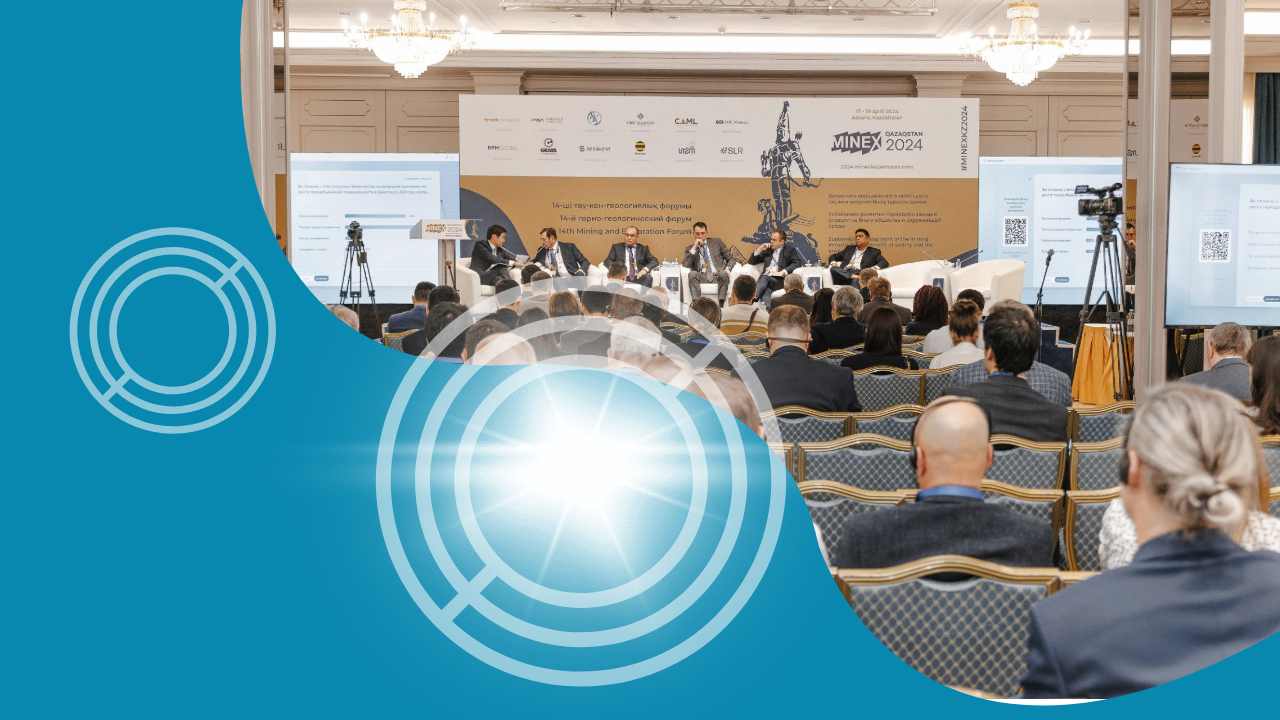
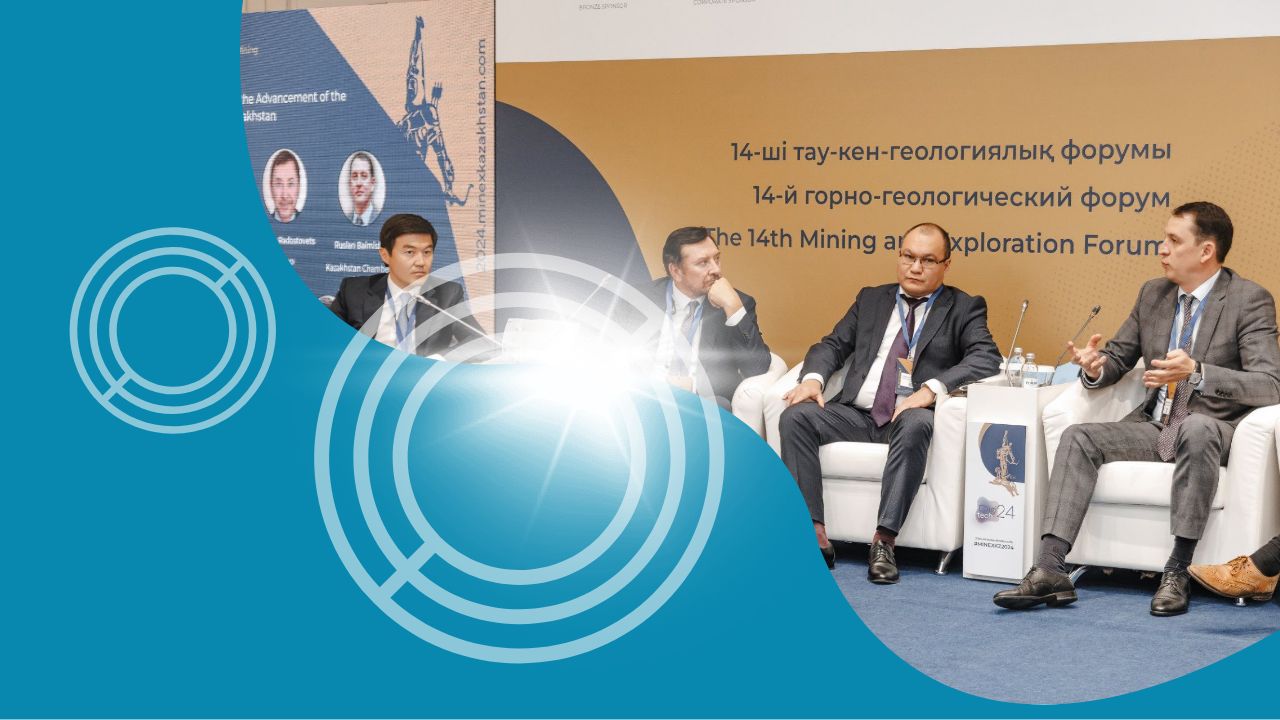
    В Астане 17-18 апреля 2024 года  состоялся 14-й горно-геологический форум MINEX Казахстан, посвященный теме «Устойчивое развитие горнодобывающей отрасли на благо общества и окружающей среды». В мероприятии участвуют более 450 специалистов из 235 компаний и организаций из Казахстана и 32 стран Европы, Центральной Азии, Северной и Латинской Америки, Африки, Юго-Восточной Азии, Ближнего Востока и Австралии.

    Более 50 казахстанских и международных компаний представляют на выставке форума передовые технологии разведки, добычи и переработки полезных ископаемых.  Выставку посетили около 1000 специалистов из Казахстана и зарубежья.

    Примечательно, что в текущем году в форуме принимает участие рекордное количество иностранных инвесторов, заинтересованных в поиске и разработке месторождений драгоценных металлов, меди, угля, лития и урана, а также редких и редкоземельных металлов.

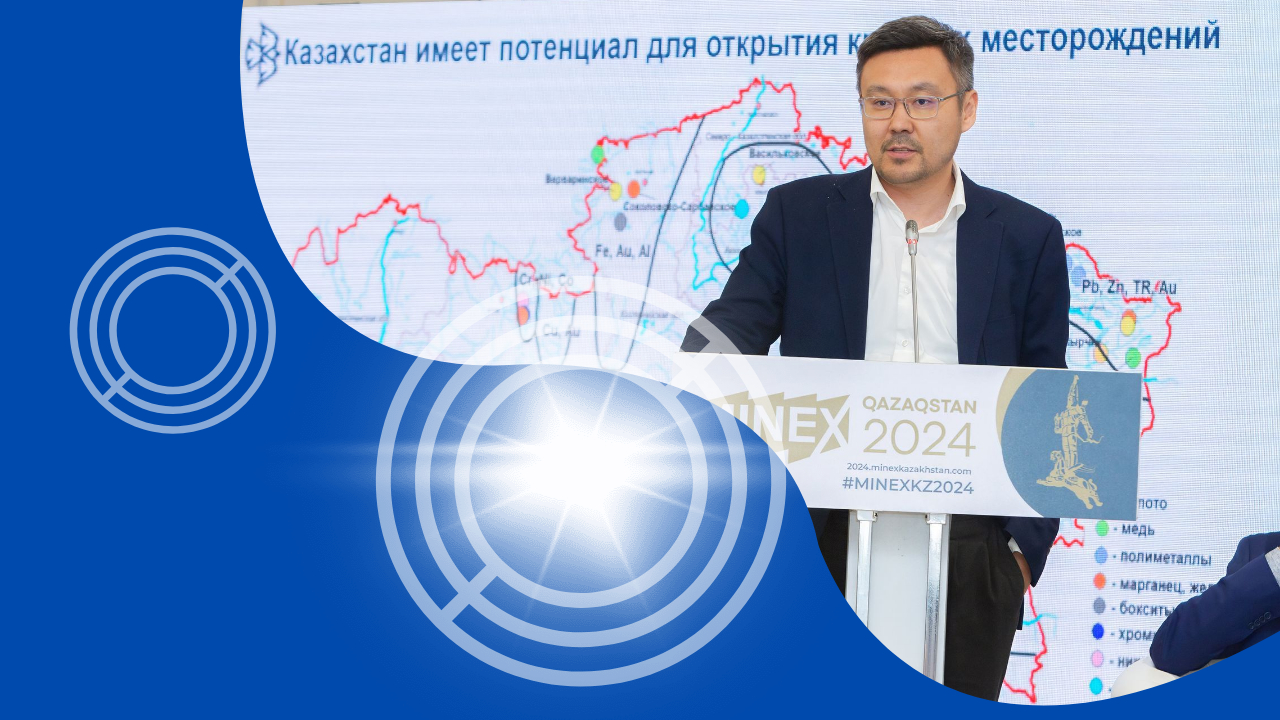
    На пленарной сессии форума о ключевых направлениях развития горно-металлургической промышленности в Казахстане рассказал исполнительный директор АГМП Николай Радостовец. В своем выступлении он остановился на таких актуальных задачах, как восполнение минерально-сырьевой базы, развитие внутристрановой ценности и переработка сырья.

    В условиях истощения минерально-сырьевой базы, снижения содержания полезных компонентов в руде необходимо увеличивать геологоразведочные работы, предоставлять стимулирующие меры для инвестиций в сферу геологоразведки. В этой связи руководитель ассоциации предложил пересмотреть алгоритм учета и налогообложения затрат на геологоразведку, а именно при успешной разведке уточнить редакцию Налогового кодекса для отнесения на вычеты всех расходов на геологоразведочные работы (ГРР) вне зависимости от выделения отдельных участков в новые контракты, а также установить вычет по корпоративному подоходному налогу расходов на ГРР по твердым полезным ископаемым через действующие контракты на добычу.

    По его словам, необходимо обеспечить возврат превышения НДС по расходам на ГРР независимо от результатов разведки и наличия экспорта ТПИ или продуктов переработки.

    — В Казахстане накопилось огромное количество техногенных минеральных образований, — продолжил спикер. – При этом мы перерабатываем около 11% тех объемов, которые ежегодно образуются. Ассоциация считает, что этот вопрос нужно решать введением не административных барьеров, а налоговых послаблений.

    Для стимулирования вовлечения в переработку ТМО он предложил закрепить в законодательстве ряд положений. Так, ТМО, принадлежащие недропользователю и не являющиеся недрами согласно Кодексу о недрах, не должны являться объектом для обложения налогом на добычу полезных ископаемых (НДПИ) и за их повторное размещение после переработки не должна взиматься плата за размещение. В отношении ТМО, принадлежащих государству и являющихся согласно Кодексу о недрах частью недр, добыча ТПИ должна производиться в установленном на сегодня порядке. При этом необходимо применение пониженной ставки НДПИ с целью стимулирования их переработки.

    Касаясь задач по развитию внутристрановой ценности, которые перед отраслью ставит Правительство, Н.В.Радостовец подчеркнул, что АГМП предлагает комплексный подход, который позволит в целом удовлетворить потребности отечественных товаропроизводителей, а также нивелировать риски для закупок недропользователей.

    — На днях мы планируем собраться на площадке НПП с отечественными товаропроизводителями и поставить вопрос о том, что по той продукции, которую могут производить казахстанские предприятия, мы будем заключать офтейк-контракты, — уточнил он. — Перечень, содержащий номенклатуру товаров, производимых в РК, либо производство которых возможно наладить в среднесрочной перспективе, мы готовы сформировать и утвердить. А по другим видам продукции у нас должна быть свободная закупка на стандартных условиях, возможно, из одного источника, поскольку это товары, которые в Казахстане не производятся.

    Исполнительный директор АГМП также заострил внимание на развитии переработки сырья в Казахстане, напомнив о принятых законодательных поправках, предусматривающих лицензирование экспорта металлов. Они вступят в силу в октябре текущего года. При этом лицензии на экспорт будут выдаваться только в том случае, если металлургические предприятия будут выполнять определенные обязательства и обеспечат потребности внутреннего рынка.  По словам спикера, ассоциация не является сторонником подобных административных методов, считает, что для развития переработки металлов и создания металлургических кластеров в Казахстане целесообразнее стимулировать предприятия к переработке природных ресурсов внутри страны, к примеру, при более высоких переделах снижать ставки НДПИ.

    — Я думаю, что Казахстан очень перспективен, — резюмировал Н.В.Радостовец. — Но наступил момент, когда в секторе нужны реформы. У нас есть понимание того, что нам делать. Нам очень важно, чтобы в новом Налоговом кодексе, который сейчас обсуждается, были учтены пожелания, которые мы сегодня озвучили. Мы полны позитива, несмотря на непростые условия по логистике, растущие социальные выплаты, и настроены на то, чтобы быть конкурентоспособными и достигать того уровня роста, который обозначил перед нами Глава государства.

    На вводимый лицензионный порядок экспорта сырья обратил внимание в своем выступлении и президент Казахстанской Горнорудной палаты Руслан Баймишев.

    — Мы обсуждали это вопрос с профильным министерством и понимаем его видение, — сказал он. — Нас убеждают, что геологоразведчикам не нужно переживать, это их не коснется. Хотя итоги этого запрета нам предстоит пожинать через 10-15 лет. Люди меняются, меняются нормативные акты, и есть риски, что в итоге эти запреты будут распространены на все полезные ископаемые.

    Горнорудную палату волнуют и требования к программам на разведку.

    — Инвестор тратит огромные деньги, и не совсем правильно, когда государство указывает, как нужно тратить эти деньги, — считают в палате. — Мы переживаем по поводу сохранения стандарта отчетности ГКЗ. Действующие компании работают по ней, — тут вопросов нет. Но концептуально закладывалось, что по действующим лицензиям компании должны переходить на мировые стандарты. Нам говорят, что это не коснется новых лицензий, но  юристы говорят обратное, что оно распространяется на всех.

    Кроме того, беспокойство вызывают вопросы, которые инициируются в целях улучшения инвестиционного климата. На самом же деле инициируются новые основания для отзыва лицензий, в том числе за неутверждение программы развития внутристрановой ценности или перемещение горной массы на территории лицензии. Хотя эти факторы не могут зависеть от недропользователей.

    — Инвестиционные соглашения, соглашения о переработке еще не заработали, — высказал мнение Р. Баймишев. – Еще не  было ни одного соглашения с объемом инвестиций в размере 50 млн долларов. Но их предлагают увеличить еще в 10 раз – до 500 млн долларов. Мы считаем, что это преждевременные шаги. Более того, мы считаем, что нужно стимулировать разработку более высоких горизонтов. Строительство шахт требует капитальных инвестиций и господдержки, — заметил выступающий.

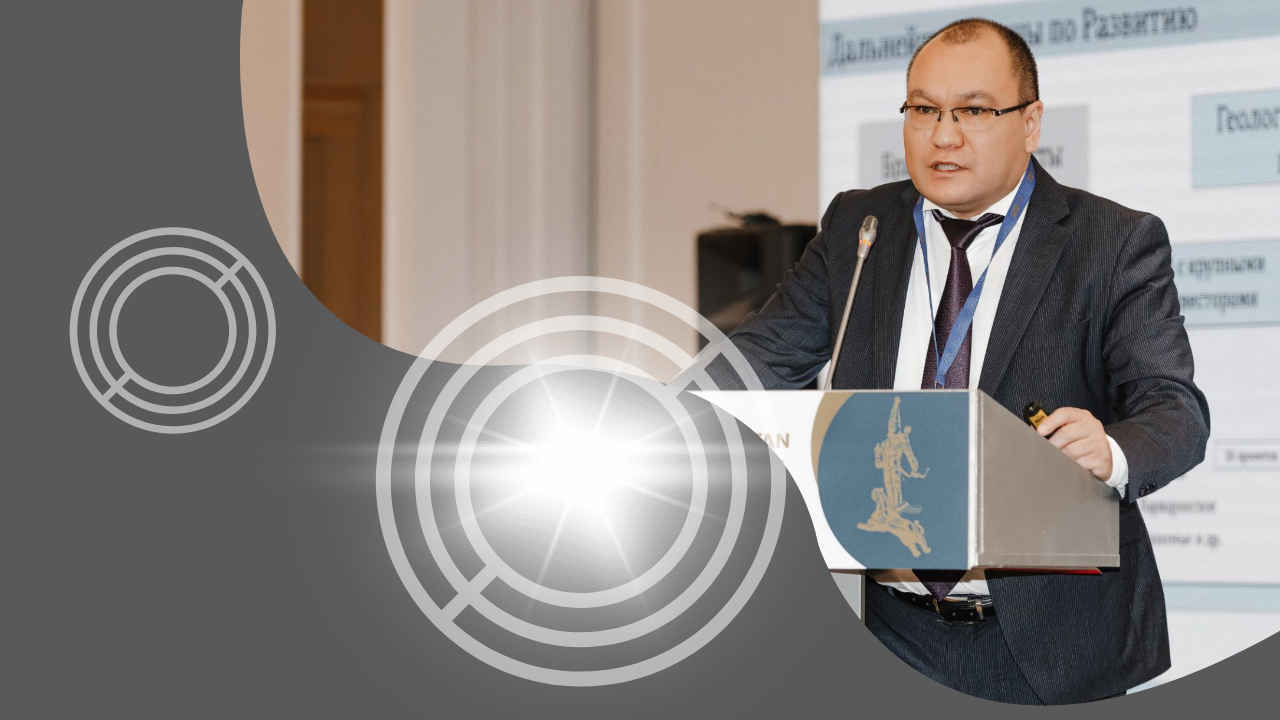
    В свою очередь председатель правления АО «Национальная горнорудная компания «Тау-Кен Самрук» Бакыт Чирчикбаев проинформировал о завершившемся в сентябре прошлого года процессе передачи в «Тау-Кен Самрук» 100%-го пакета акций АО «НГК «Казгеология». По его словам, в целях оптимизации процессов управления, оптимизации расходов двух компаний, исключения дублирующих функций, были проделаны такие шаги, как объединение функций, направленных на геологоразведку, и функций по реализации совместных проектов с иностранными партнерами. После объединения их функций портфель активов составляют 53 геологоразведочных проекта, с более чем 15 участниками проводится совместная работа.

    — Можно констатировать, что мы стали своего рода единым окном  для инвесторов геологоразведочной отрасли по развитию совместных проектов, и в развитии этих проектов мы видим себя миноритарным участником, чтобы не загружать такими требованиями квазигосударственные компании, чтобы гибче управлять компаниями. Мы считаем, что переход «Казгеологии» в состав компании «Тау-Кен Самрук» только укрепит функции квазигосударственного сектора в развитии горнорудной отрасли и позволит нам сосредоточиться на проектах геологоразведки, — отметил он.

    Б. Чирчикбаев подчеркнул, что в настоящее время геологи компании ведут работу по поиску перспективных направлений и уже зафиксировали несколько перспективных участков. «Тау-Кен Самрук» открыт для партнеров,  в том числе юниорских компаний, по развитию данных проектов.

  • Priorities and Development Trends of the Mining and Metallurgical Complex in the Republic of Kazakhstan

    Priorities and Development Trends of the Mining and Metallurgical Complex in the Republic of Kazakhstan

    The mining and metallurgical complex (MMC) plays a crucial role in the economy of the Republic of Kazakhstan. As we look ahead, several key priorities and trends are shaping the future of this sector.

    Sustainability is at the forefront of MMC development. The industry aims to strike a balance between economic growth, environmental protection, and social responsibility. Investments in modern technologies, waste management, and energy efficiency are essential for sustainable development.

    Speaking at MINEX Kazakhstan Forum in Astana Nikolay Radostovets, Executive Director of AGMP, discussed key development directions for the mining and metallurgical industry in Kazakhstan during the plenary session. He emphasized the need to replenish the mineral resource base, develop domestic value, and process raw materials.

    In response to the depletion of the mineral resource base and reduced mineral content in ores, Radostovets proposed increasing geological exploration efforts, offering tax incentives for investments in geological exploration. He suggested revising the accounting and taxation algorithm for exploration costs, allowing for tax deductions on all exploration expenses, regardless of whether separate areas are designated as new contracts. He also proposed reducing corporate income tax on exploration expenses for solid minerals through existing contracts.

    Radostovets also recommended ensuring the return of excess VAT on exploration expenses, regardless of exploration results and export sales of processed products.

    In addressing the issue of techno-genic mineral formations (TMF), Radostovets suggested introducing tax benefits instead of administrative barriers. He proposed exempting TMF from the mineral extraction tax and waiving placement fees for reused TMF after processing. For TMF owned by the state and considered part of the subsoil according to the Subsoil Code, he suggested applying a reduced mineral extraction tax rate to stimulate their processing.

    Regarding the development of domestic value, Radostovets emphasized the need for a comprehensive approach to meet the needs of domestic producers and mitigate risks for suppliers. He proposed forming and approving a list of goods produced in Kazakhstan or potentially producible in the medium term, with offtake contracts for these goods. For other products not produced in Kazakhstan, free procurement under standard conditions, possibly from a single source, would be implemented.

    Radostovets also highlighted the development of raw material processing in Kazakhstan, mentioning legislative amendments coming into force in October that require licensing for metal exports. These amendments will only issue export licenses if metallurgical enterprises fulfil certain obligations and meet domestic market needs. Radostovets believes that administrative methods are not ideal and suggested stimulating in-country processing of minerals by reducing the mineral extraction tax for higher processing rates.

    Radostovets concluded by expressing optimism about Kazakhstan’s potential but acknowledging the need for reforms in the sector. He emphasized the importance of considering the industry’s wishes in the new Tax Code currently being discussed.

    The introduction of a licensing system for raw material exports was also mentioned by Ruslan Baymishev, President of the Kazakh Mining Association. He acknowledged the government’s vision but expressed concerns about potential risks and the expansion of export restrictions to all minerals in the future. The association is also worried about the impact of new requirements for in-country value development programs and the potential for license revocation based on factors beyond the control of mining companies.

    Baymishev criticized the lack of operational investment agreements and processing agreements, emphasizing the need to stimulate the development of higher-level horizons and provide capital investments and government support for mining projects.

    Bakyt Chirchikbaev, Chairman of the Board of National Mining Company “Tau-Ken Samruk” informed attendees about the transfer of a 100% stake in “Kazgeology” NGK to “Tau-Ken Samruk” in September last year. He discussed the optimization of management processes, cost reductions, and the elimination of duplicate functions between the two companies. Following the merger of their functions, the portfolio now includes 53 geological exploration projects with over 15 partners.

    Chirchikbaev noted that “Tau-Ken Samruk” is now a single window for investors in the geological exploration sector, acting as a minority partner in joint projects to avoid overburdening quasi-state companies with excessive requirements. He believes that the integration of “Kazgeology” into “Tau-Ken Samruk” will strengthen the role of the quasi-state sector in the development of the mining industry and allow for a focus on geological exploration projects.

    Chirchikbaev also mentioned that the company’s geologists are currently exploring promising areas and have identified several prospective sites. “Tau-Ken Samruk” is open to partnerships, including with junior companies, for the development of these projects.

  • First Quantum Minerals разворачивает разведку в Казахстане

    First Quantum Minerals разворачивает разведку в Казахстане

    Канадская горнодобывающая компания First Quantum Minerals (FQM) расширяет свое геологоразведочное присутствие в Казахстане. Об этом в интервью inbusiness.kz в кулуарах XIV горно-геологического форума MINEX Kazakhstan 2024 в Астане рассказал менеджер по геологии ее казахстанского подразделения FQM Exploration Kazakhstan Джеймс Банярд.

    “First Quantum недавно создал компанию в Казахстане – в 2023 году, и мы приняли на работу в нашу команду пять казахстанцев в нашем офисе в Алматы. У нас есть два опциона на реализацию совместных проектов по геологоразведке с Pallas Resources, и сейчас мы стремимся выстроить наш геологоразведочный портфель здесь, в Казахстане. Вскоре наша команда приступит к летней деятельности, которая будет включать в себя картирование и геофизику по ряду проектов. Мы намерены продвигаться по ним, продолжая оценивать другие проекты и выстраивать стратегические партнерства по всей стране. Мы планируем присутствовать здесь в течение следующих пяти лет в рамках нашего регионального стратегического плана и посмотреть, какова деловая среда здесь, в Казахстане, а также мы надеемся, что сможем вести хороший бизнес и найти высококачественные медные проекты, в которые мы сможем инвестировать и чьим развитием сможем заниматься”, – отметил геолог в комментарии нашему изданию.

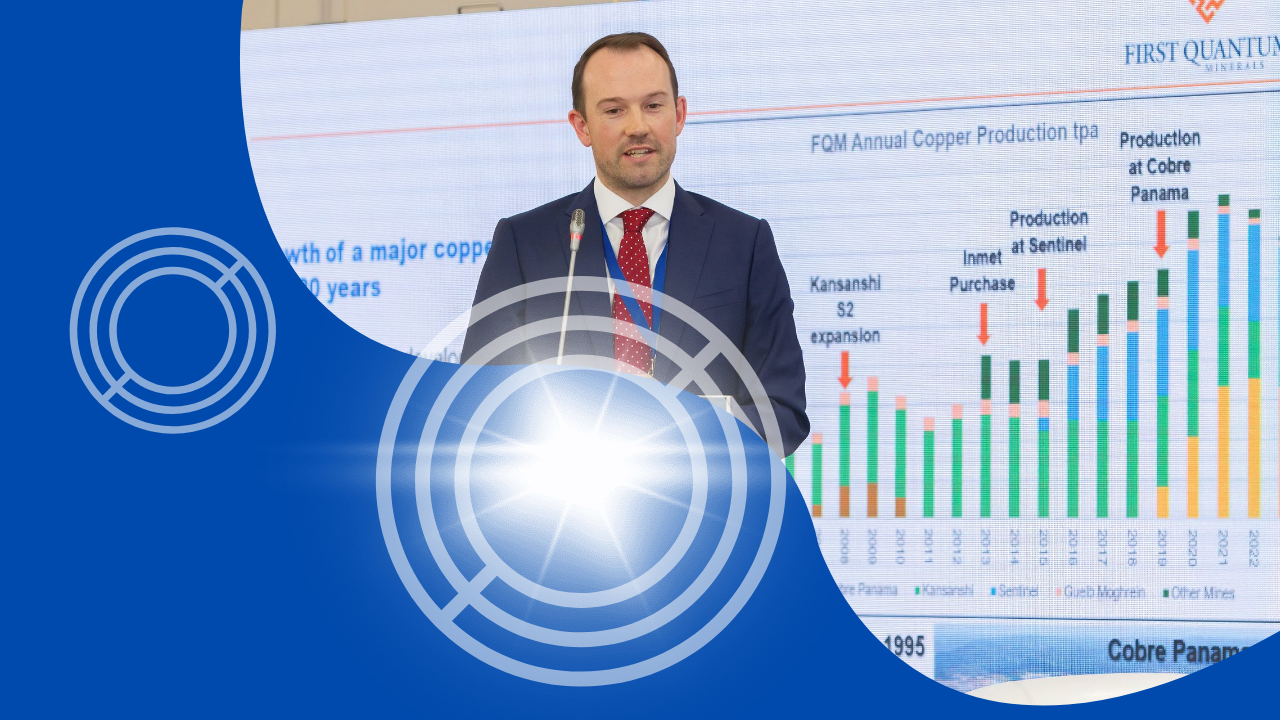
    По его словам, основная деятельность First Quantum Minerals в разных странах сосредоточена на медных проектах. В 2023 году канадская компания стала шестой по объему производства меди в мире, добыв около 700 тыс. тонн этого металла, отметил он позже в своем докладе на форуме. Кроме этого, у First Quantum Minerals есть добыча никеля на двух рудниках и извлечение золота в качестве попутного продукта в значительных объемах, сказал Банярд в беседе.

    Сейчас компания приценивается к казахстанскому рынку, обратив на него внимание после вступления в силу Кодекса о недрах в 2018 году. Теперь она изучает различные представленные ей проекты и открыта для предложений по ведению бизнеса с людьми с хорошими медными активами, пояснил представитель канадской компании.

    Кроме того, FQM Exploration Kazakhstan находится в процессе оформления нескольких лицензий на разведку в разных регионах Казахстана, по заявкам на которые в компании надеются получить одобрение в ближайшие несколько недель. В основном они будут охватывать участки на территориях, традиционно богатых на медно-порфировые месторождения и залежи меди в осадочных породах – площади Балхаш-Или, дуга Бозшаколь-Чингиз и бассейн Чу-Сарысу, уточнил геолог в разговоре. Для проведения аэрогеофизических работ FQM Exploration Kazakhstan сейчас изучает предложения потенциальных иностранных и казахстанских подрядчиков, среди которых есть компании Xcalibur Multiphysics и Qazaq Geophysics, входящая в группу “Казахмыс”.

    В марте Bloomberg писал, что китайская Jiangxi Copper владеет 18,4% акций First Quantum Minerals. В последние годы канадская компания столкнулась с проблемами при освоении медного месторождения Кобре Панама.

  • First Quantum Minerals Expands Geological Exploration in Kazakhstan

    First Quantum Minerals Expands Geological Exploration in Kazakhstan

    Canadian mining company First Quantum Minerals (FQM) is intensifying its geological exploration efforts in Kazakhstan. FQM, whose major shareholder is China’s Jiangxi Copper, is focusing on copper exploration within the country.

    In an exclusive interview with inbusiness.kz during the XIV Mining and Exploration Forum MINEX Kazakhstan 2024 in Astana, James Banyard, the Geology Manager of FQM Exploration Kazakhstan, revealed the company’s plans. “First Quantum recently established a presence in Kazakhstan in 2023 and hired five Kazakh professionals for our Almaty office. We have two options for joint geological exploration projects with Pallas Resources. Currently, we are building our geological portfolio here in Kazakhstan. Our upcoming summer activities will include mapping and geophysics across several projects. Over the next five years, we aim to evaluate other projects and establish strategic partnerships throughout the country. Our regional strategic plan aligns with a long-term presence in Kazakhstan, where we hope to find high-quality copper projects for investment and development,” he stated.

    Banyard emphasized that First Quantum Minerals primarily focuses on copper projects worldwide. In 2023, the Canadian company ranked sixth globally in copper production, extracting approximately 700,000 tons of this metal. Additionally, FQM is involved in nickel mining at two mines and produces gold as a byproduct in significant quantities.

    With the implementation of the 2018 Subsoil Code, First Quantum Minerals turned its attention to the Kazakh market. The company is currently evaluating various projects and is open to business proposals from individuals with promising copper assets. FQM Exploration Kazakhstan is also in the process of obtaining several exploration licenses across different regions of Kazakhstan. These licenses will cover areas traditionally rich in copper-porphyry deposits and sedimentary rock copper occurrences, including the Balkhash-Ili area, the Bozshakol-Chingiz arc, and the Chu-Sarysu basin.

    As the company explores the Kazakh market, it is actively considering potential foreign and local contractors for aerogeophysical work. Among these contractors are Xcalibur Multiphysics and Qazaq Geophysics, a subsidiary of the “Kazakhmys” group.

  • “Казгеология” держится за “золотую акцию” проекта “Теллур-Степок”

    “Казгеология” держится за “золотую акцию” проекта “Теллур-Степок”

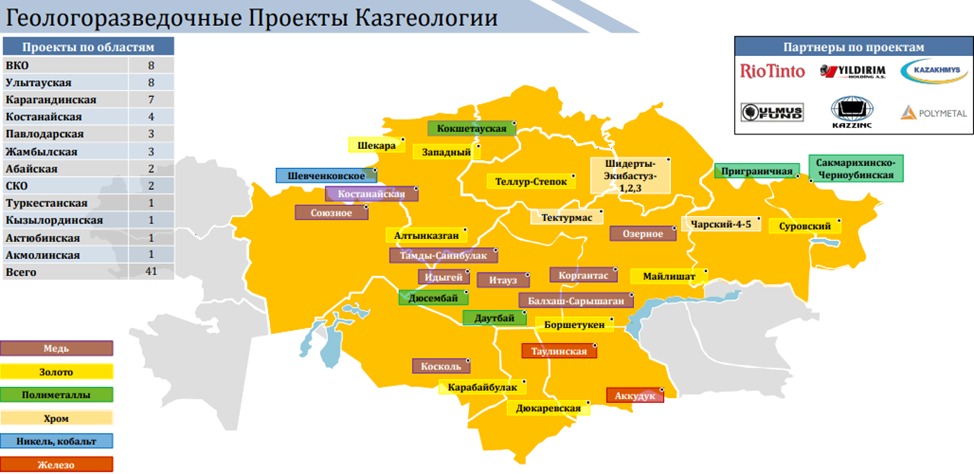
    Золотой проект “Теллур-Степок” сохраняется в портфолио нацкомпании “Казгеология”, недавно вошедшей в лоно госхолдинга “Тау-Кен Самрук”. Такая информация следует из презентации главы горнорудной группы Бакыта Чирчикбаева, продемонстрированной в ходе его выступления на тему “Планы развития АО “НГК “Тау-Кен Самрук” после присоединения активов АО “Казгеология” на XIV горно-геологическом форуме MINEX Kazakhstan 2024, передает inbusiness.kz.

    Источник: презентация “Тау-Кен Самрук” на MINEX Kazakhstan 2024

    Общий потенциал золотосодержащей площади Теллур-Степок ранее оценивался, по данным СМИ, в 440 тысяч унций, или 13,68 тонны золота. Это не очень большой объем, однако на участке Теллур среднее содержание драгоценного металла рассчитывалось в более чем 17 граммов на тонну руды. В 2012 году владельцем месторождений являлось ТОО “Акмола Голд”, которое позже стало известно благодаря своему участию в уголовном деле бывшего главы комитета геологии Базарбая Нурабаева. Концерн “Казахалтын” считал этот актив привлекательным в 2018 году.

    До недавнего времени права недропользования на Теллур-Степок принадлежали ТОО TS Minerals, где 25% долей владела “Казгеология”. В прошлом году министерство промышленности сообщило, что расторгло контракт на недропользование по этой площади.

    “ТОО TS Minerals ранее являлось обладателем права недропользования по контракту № 5519-ТПИ от 29 апреля 2019 года на разведку золотосодержащих полиметаллических руд на площади Теллур-Степок в Акмолинской области. В связи с истечением срока действия контракта 29 апреля 2023 года (п. 3 раздела 2, п. 72 раздела 21 контракта) министерством направлено соответствующее уведомление (№ 03-2-18/5648-И от 29.06.2023 года). ТОО TS Minerals не оспаривало вышеуказанное уведомление в судебном порядке. Данное месторождение планируется выставить на аукцион”, – информировало отраслевое ведомство в сентябре прошлого года.

    Между тем в кулуарах форума MINEX один из представителей минпрома отметил в разговоре, что по Теллур-Степок идет судебный процесс. Эту информацию подтвердил и руководитель “Тау-Кен Самрук”.

    “Я по Теллур-Степок пока не могу вам дать никакой комментарий, потому что, насколько я знаю, там есть ряд разбирательств, то есть это все ведется уполномоченным органом, и я бы не хотел сейчас никак вмешиваться в этот процесс”, – прокомментировал Бакыт Чирчикбаев вопрос корреспондента inbusiness.kz в ходе сессии “вопросы-ответы”.

    Добавим, что в презентации “Казгеологии” также значится печально известное месторождение Шевченковское, которое ранее принадлежало его бывшему недропользователю СП “Казкобальт”, где опять же 25% акций владела “Казгеология”. Именно из-за незаконной передачи Шевченковского был осужден бывший вице-министр индустрии Тимур Токтабаев. Само месторождение вернули государству, после чего его, по логике, должны были выставить на конкурентный аукцион в этом году. Недавно отраслевой источник корреспондента inbusiness.kz сообщил, что якобы Шевченковское планируют вернуть старым недропользователям, однако в минпроме опровергли эту информацию в ответе на запрос нашего издания.

    “Контракт №5574-ТПИ от 21 июня 2019 года на разведку никель-кобальтовых руд на месторождении Шевченковское был досрочно прекращен 30 января 2023 года. Информация, о том, что кобальтовое месторождение Шевченковское будет возвращено в правах бывшим недропользователям не соответствует действительности”, – проинформировали в минпромышленности посредством электронной платформы e-otinish.

    Естественным образом здесь возник вопрос, будут ли выставлены Шевченковское и Теллур-Степок на реально конкурентный электронный аукцион прав недропользования в этом году или нет? Если они были возвращены государству, то почему они были отражены в презентации проектов “Казгеологии” на форуме MINEX, или же там они значатся только из-за ее сохранившихся долей в 25%?

    “Во всех геологоразведочных проектах мы не планируем продать никакие доли, пока мы не поставим запасы на баланс, пока еще ни по одному из них запасы на баланс не поставлены”, – уточнил Бакыт Чирчикбаев в комментарии inbusiness.kz в кулуарах форума, отвечая на вопрос о том, будет ли “Казгеология” продавать доли в совместных предприятиях с Rio Tinto и Polymetal.

    Кстати, на днях корреспондент inbusiness.kz наконец-то получил ответ от “Тау-Кен Самрук” на запрос о том, были ли возвращены в бюджет около 172 млн тенге, незаконно полученные руководством “Казгеологии” в 2017-2019 годы. В обращении посредством электронной платформы e-otinish была также отражена просьба озвучить имена экс-руководителей геологоразведочной нацкомпании, получивших вознаграждение сверх меры, о чем неоднократно писало наше издание.

    “21 октября 2022 года РГУ “Департамент внутреннего государственного аудита по г. Астане Комитета внутреннего государственного аудита Министерства финансов РК” (далее – ДВГА) провел аудиторскую проверку АО “Казгеология” (далее – Общество) на предмет соблюдения норм законодательства РК при выплате заработной платы членам Правления Общества за период с 01.01.2017 по 31.03.2019. В соответствии с предписанием ДВГА от 15 декабря 2022 года Обществу было предписано возместить в доход бюджета сумму финансовых нарушений 169 541,5 тыс. тенге (согласно заключению контроля качества КВГА МФ РК от 23.12.2022 года сумма нарушений – 172 456 тыс. тенге). По итогам судебных процессов между Обществом и ДВГА, постановлением судебной коллегии по административным делам Верховного суда РК от 5 марта 2024 года решение Специализированного межрайонного административного суда г. Астаны от 23 февраля 2023 года по иску Общества к ДВГА об отмене предписания на устранение выявленных нарушений и об определении ответственных лиц, их допустивших, постановление судебной коллегии по административным делам суда г. Астаны от 23 мая 2023 года оставлено без изменения, кассационная жалоба Общества – без удовлетворения. В соответствии со статьей 453 Гражданского процессуального кодекса Республики Казахстан (далее – ГПК РК), постановление суда кассационной инстанции вступает в законную силу со дня его оглашения. Согласно статье 21 ГПК РК, вступившие в законную силу судебные акты обязательны для всех юридических лиц и подлежат исполнению на всей территории Республики Казахстан. В целях исключения неисполнения судебных актов, Общество возместило в доход бюджета сумму в размере 172 456 тыс. тенге. Досудебное расследование было прекращено прокуратурой города Астаны 5 апреля 2023 года в порядке статьи 35 части 1 пункта 2 Уголовного-процессуального кодекса Республики Казахстан”, – говорится в ответе “Тау-Кен Самрук” на вопросы нашего издания.

    При этом, несмотря на понесенные расходы в 172,4 млн тенге на возврат бюджету незаконно полученного в 2017-2019 годах экс-руководством “Казгеологии” денежного вознаграждения, в “Тау-Кен Самрук” отказались озвучивать имена бывших топ-менеджеров геологоразведочной нацкомпании, которые получили выплаты сверх меры. Хотя, по некоторым данным, в геологической отрасли достаточно широко известно, кто совершил это нарушение, причем некоторые из этих людей, допустившие переплату вознаграждения самим себе, до сих пор занимают высокие посты в известных частных геологоразведочных компаниях.

    “Наряду с этим сообщаем, что “Тау-Кен Самрук” инициировал проведение внешнего юридического аудита в отношении Общества и его активов, по итогам которого будут приняты соответствующие решения в соответствии с действующим законодательством и внутренними нормативными документами. При вышеуказанных обстоятельствах считаем нецелесообразным до подведения итогов внешнего юридического аудита озвучивать какие-либо персональные данные. В то же время информируем, что на сегодняшний день должностные лица Общества, упомянутые в аудиторском отчете ДВГА, не являются работниками Общества”, – информируют в горнорудном госхолдинге.

    Отметим, что параллельно перевариванию активов “Казгеологии” у “Тау-Кен Самрук” продолжается обратный процесс приватизации долгоиграющих активов горнорудного холдинга, развитием которых он занимался несколько лет. Так, к примеру, сейчас ведутся переговоры о продаже контрольного пакета цинкового проекта Шалкия в Кызылординской области, о чем ранее писал inbusiness.kz.

    “По части переговоров с партнерами – с теми, кто готов поучаствовать на покупку контрольного пакета, то есть от 51% до 100% мы готовы продать – здесь переговоры пока ведутся, и преждевременно говорить еще о том, кто там будет нашим соучредителем”, – сообщил Бакыт Чирчикбаев в ходе сессии “вопросы-ответы”, комментируя вопрос корреспондента издания.

    По его словам, добыча на Шалкие начнется в октябре этого года, несмотря на то, что обогатительную фабрику там планировалось достроить осенью 2025 года.

    “Для себя в планах мы ставим в октябре этого года приступить к добыче с выходом в следующем году на 2,2 млн тонн руды. Пока будет строиться своя фабрика, мы рассматриваем варианты толлинга, то есть переработки этой руды на сторонней фабрике”, – отметил Чирчикбаев.

    Сейчас компания заканчивает исследования и переговоры по переработке руды с цинкового месторождения на других мощностях, здесь можно предположить, что это будут фабрики “Казцинка”. Пока же на Шалкию поставляется технологическое оборудование, там ведутся горно-капитальные работы.

    Говоря о вольфрамовых проектах в Карагандинской области Северный Катпар и Верхнее Кайракты, глава “Тау-Кен Самрук” уточнил, что по ним в конце марта были получены положительные заключения госэкспертизы. Их разослали нескольким партнерам, с которыми имелись соглашения о конфиденциальности, для изучения и возможного дальнейшего участия в части приватизации.

    В беседе топ-менеджер также подтвердил, что кремниевый завод “Тау-Кен Темир” в Караганде, чья работа приостанавливалась несколько лет назад, сейчас находится на втором приватизационном этапе, в конце мая там могут появиться новые инвесторы. Годом ранее сообщалось, что его перезапуск в формате одной печи намечался на четвертый квартал прошлого года.

  • Kazgeologiya Retains Golden Stake in the Tellur Stepok Project

    Kazgeologiya Retains Golden Stake in the Tellur Stepok Project

    National company “Kazgeology” is holding on to the “golden project” of “Tellur-Stepoch” in its portfolio, which recently joined the state holding “Tau-Ken Samruk”. This information is based on a presentation by the head of the mining group Bakyt Chirchikbaev, which was shown during his speech on the topic “Plans for the development of AO “NGK “Tau-Ken Samruk” after the acquisition of assets of AO “Kazgeology” at the XIV mining and geological forum MINEX Kazakhstan 2024. The potential of the gold-bearing area Tellur-Stepoch was previously estimated at 440 thousand ounces or 13.68 tons of gold. However, the average content of precious metal on the Tellur field was calculated to be more than 17 grams per ton of ore. In 2012, the owner of the deposits was TОО “Akмоla Gold”, which later became known due to its participation in the criminal case of the former head of the geology committee Bazarbay Nuraev. The “Kazakhmys” concern considered this asset attractive in 2018. Previously, the rights to the use of subsoil on Tellur-Stepoch belonged to TОО TS Minerals, where 25% of the shares were owned by “Kazgeology”. However, last year, the Ministry of Industry announced that it had terminated the contract for the use of subsoil on this site. The mining department informed in September last year that the right to use subsoil on Tellur-Stepoch was planned to be put up for auction. However, there is also information that a legal process is being conducted on Tellur-Stepoch. This was noted by a representative of the mining industry at the MINEX forum and confirmed by the head of “Tau-Ken Samruk”. Bakyt Chirchikbaev, in a conversation with a correspondent of inbusiness.kz, said that he could not comment on Tellur-Stepoch because, as far as he knew, there were legal proceedings on this issue, and he would not like to interfere in this process. It is also mentioned in the presentation of “Kazgeology” the infamous Shchevchenkovskoye field, which previously belonged to its former subsoil user SP “Kazkobalt”, where “Kazgeology” also owned 25% of the shares. The Shchevchenkovskoye field was returned to the state after the illegal transfer, and it should have been put up for a competitive auction this year. However, there is information that the Shchevchenkovskoye field may be returned to its former subsoil users, but this information has been denied by the Ministry of Industry. Therefore, the question remains whether the Shchevchenkovskoye and Tellur-Stepoch fields will be put up for a real competitive electronic auction for the right to use subsoil this year or not. If they have been returned to the state, then why were they reflected in the presentation of “Kazgeology” projects at the MINEX Forum, or are they listed there only because of their retained 25% shares?

  • 14th MINEX Kazakhstan Forum in Astana: Sustainable Development in Mining Industry Takes Center Stage

    14th MINEX Kazakhstan Forum in Astana: Sustainable Development in Mining Industry Takes Center Stage

    Astana, Kazakhstan – The 14th Mountain Geological Forum, MINEX Kazakhstan, commenced its proceedings, focusing on the theme of “Sustainable Development of the Mining Industry for the Benefit of Society and the Environment.” Over 450 specialists from 235 companies and organizations spanning Kazakhstan and 32 countries across Europe, Central Asia, North and Latin America, Africa, Southeast Asia, the Middle East, and Australia are participating in the event.

    More than 50 Kazakhstani and international companies are showcasing cutting-edge technologies for prospecting, extraction, and processing of mineral resources at the forum’s exhibition. Attendance by approximately 1000 specialists from Kazakhstan and abroad is anticipated.

    Of notable significance this year is the record participation of foreign investors at the forum, demonstrating keen interest in exploring and developing deposits of precious metals, copper, coal, lithium, uranium, as well as rare and rare-earth metals.

    During the plenary session, the Executive Director of AGMP, Nikolai Radostovets, addressed the key directions for the development of the mining and metallurgical industry in Kazakhstan. He emphasized crucial tasks such as replenishing the mineral resource base, enhancing domestic value, and raw material processing.

    With the depletion of the mineral resource base and the decline in the content of useful components in ore, there is a pressing need to increase geological exploration activities and provide incentives for investments in geological exploration. In this regard, the association’s leader proposed revising the algorithm for accounting and taxing expenditures on geological exploration. Specifically, he suggested refining the Tax Code to allow deductions for all expenses on geological exploration regardless of the allocation of individual sites into new contracts, as well as establishing deductions for corporate income tax on expenditures for geological exploration of solid minerals through existing extraction contracts.

    To incentivize involvement in raw material processing, he proposed enshrining several provisions in legislation. These include exempting subsoil users’ non-extractive mineral resources from the mineral extraction tax (MET) and not levying fees for their re-placement after processing. Regarding non-state-owned mineral resources, extraction should proceed as per current regulations, with a reduced MET rate applied to stimulate their processing.

    Addressing tasks related to enhancing domestic value, Radostovets highlighted AGMP’s comprehensive approach aimed at satisfying the needs of domestic manufacturers and mitigating risks for subsoil users in procurement.

    “We plan to convene with domestic manufacturers at the NPP platform shortly and propose that for the products that Kazakhstani enterprises can produce, we will enter into off-take contracts,” he specified. “We are prepared to compile and approve a list containing the range of goods manufactured in Kazakhstan or those that can be produced in the medium term. For other types of products, we should have open procurement under standard conditions, possibly from a single source, as these are goods not produced in Kazakhstan.”

    The Executive Director of AGMP also underscored the development of raw material processing in Kazakhstan, recalling legislative amendments enacted for licensing metal exports. These amendments, effective from October of the current year, will only grant export licenses if metallurgical enterprises fulfill certain obligations and meet domestic market demands. He noted the association’s preference for stimulating enterprises to process natural resources within the country to foster the development of metal processing and the establishment of metallurgical clusters.

    “Investment agreements, processing agreements have not yet kicked off,” expressed R. Baimishev. “There hasn’t been a single agreement with an investment volume of $50 million. Yet, there are proposals to increase them by 10 times – up to $500 million. We believe these are premature steps. Furthermore, we believe it is necessary to stimulate the development of deeper horizons. Mine construction requires substantial investments and government support,” he observed.

    In turn, the Chairman of the Board of AO “National Mining Company “Tau-Ken Samruk” Bakyt Chirchikbayev provided an update on the completion of the transfer process of 100% of the shares of AO “NGC “Kazgeology” to “Tau-Ken Samruk” in September of the previous year. He outlined steps taken to optimize management processes, reduce costs, and eliminate duplicate functions, such as merging functions related to geological exploration and joint project implementation with foreign partners. Following the consolidation of these functions, their asset portfolio comprises 53 geological exploration projects, with collaboration involving more than 15 participants.

    “It can be noted that we have become a sort of unified window for investors in the geological exploration sector for developing joint projects, and we see ourselves as minority participants in the development of these projects to avoid burdening quasi-state companies with such requirements and to manage companies more flexibly,” he remarked.

    Chirchikbayev emphasized that the company’s geologists are currently exploring promising directions and have already identified several prospective sites. “Tau-Ken Samruk” is open to partners, including junior companies, for the development of these projects.

  • Tau-Ken Samruk’s Plans for Lead-Zinc Production at Shalkiya Deposit

    Tau-Ken Samruk’s Plans for Lead-Zinc Production at Shalkiya Deposit

    Tau-Ken Samruk, the national mining company, is set to commence mining operations at the Shalkiya lead-zinc deposit in October 2024, with a target of producing 2.2 million tonnes of ore by the following year. Chairman Bakyt Chirchikbayev unveiled these intentions at the MINEX Kazakhstan 2024 forum, indicating considerations for utilizing third-party facilities for ore processing during the construction phase of their processing plant. Negotiations for ore processing at external facilities are in their final stages, with details to be revealed upon agreement finalization.

    Chirchikbayev provided updates on the construction progress of the mining and processing plant in Shalkiya, emphasizing the procurement of technological equipment. Discussions regarding the potential sale of the mine are ongoing, with Tau-Ken Samruk considering selling a controlling stake. Chirchikbayev mentioned the openness to selling anywhere between 51% to 100%, with negotiations ongoing with potential partners. The Shalkiya lead-zinc deposit, overseen by ShalkiyaZinc LTD JSC, a subsidiary of Tau-Ken Samruk JSC, is one of the largest globally. Construction of a lead-zinc mining and processing plant began in 2018, utilizing the substantial ore resources of the deposit, which holds around 112.9 million tonnes.

    The project aims to fulfill the demand for zinc and lead concentrates both domestically and internationally, with confirmed reserves supporting operations until 2051. The total project cost amounts to $650 million, with $295 million funded by the European Bank for Reconstruction and Development, guaranteed by the Samruk-Kazyna National Welfare Fund. Established in 2009, Tau-Ken Samruk JSC manages the state’s mining assets under the Samruk-Kazyna state fund.

  • Proposals for Tax Amendments Aimed at Stimulating Mineral Recycling in Kazakhstan

    Proposals for Tax Amendments Aimed at Stimulating Mineral Recycling in Kazakhstan

    Nikolay Radostovets, the executive director of the Republican Association of Mining and Metallurgical Enterprises, has suggested resetting the tax rate on mineral extraction (NDPI) for the processing of technogenic mineral formations left after metal extraction. Speaking at the MINEX-2024 forum, Radostovets emphasized the need for tax incentives to stimulate the recycling of technogenic mineral waste. With over 60 billion tons of such waste accumulated in Kazakhstan, only about 11% is currently recycled annually. Radostovets proposed exempting the processing of these waste materials from NDPI, considering them as the property of the licensee after processing. Furthermore, he advocated for a reduced NDPI rate for processing state-owned waste materials.

    Additionally, Radostovets raised concerns about the licensing of metal exports, suggesting that licenses should only be granted if internal demands are met. He highlighted the challenge of aligning pricing policies with international standards to promote metal processing. The association also recommends clarifying tax regulations to allow deductions for all expenses related to geological exploration, irrespective of whether specific areas are designated in new contracts.

    Radostovets proposed that in cases of unsuccessful exploration, expenses should still be deductible from the annual income of non-contractual activities. He also suggested ensuring the reimbursement of excess VAT on exploration expenses regardless of exploration results or the presence of exports of solid minerals or processed products.