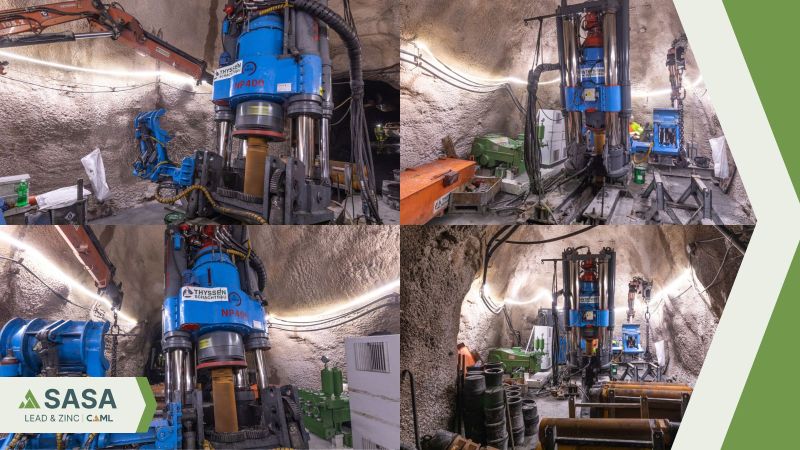
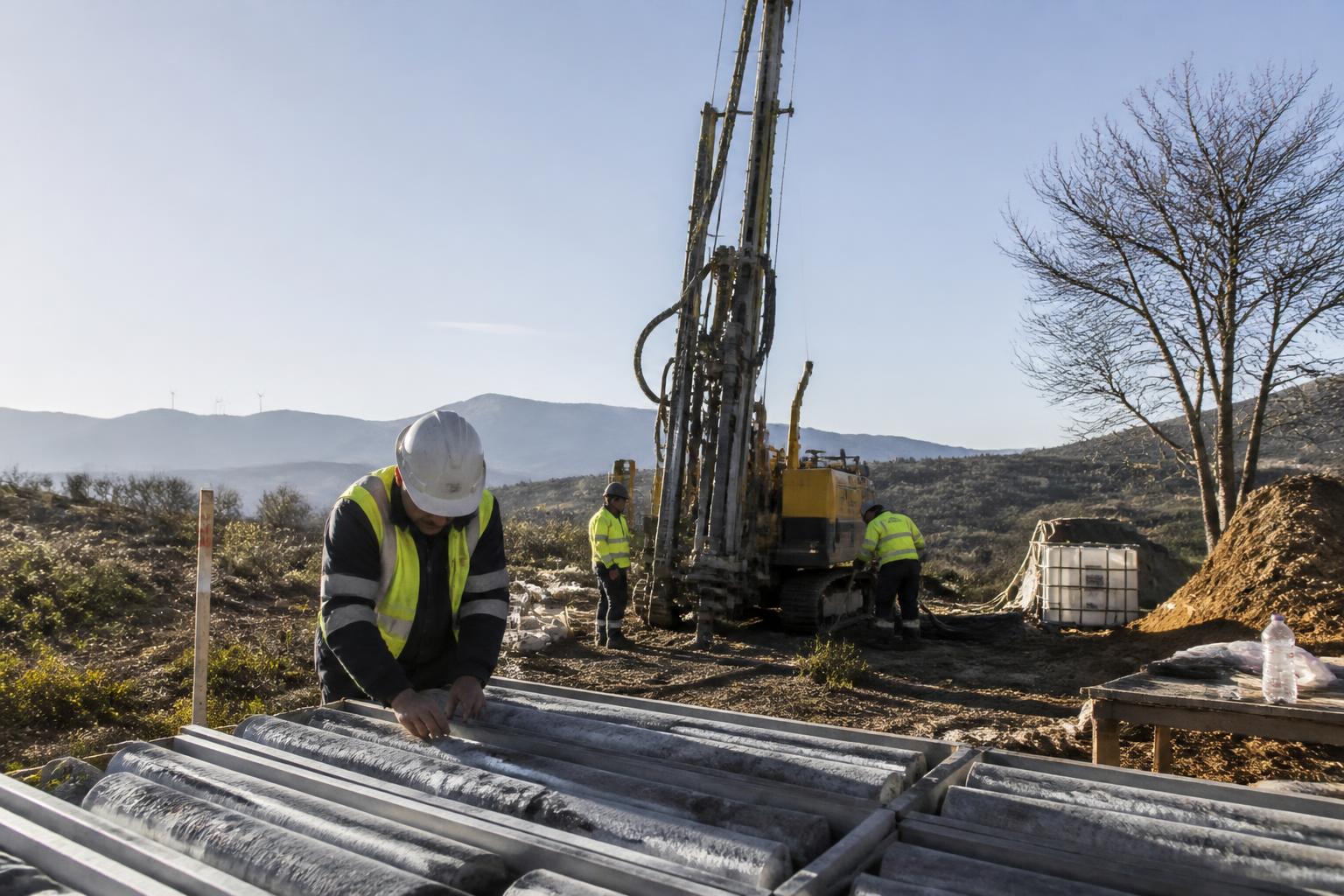
Sasa has successfully completed a significant raisebore project that has delivered over 1.5 kilometres of ventilation raises, ore passes, and waste passes, marking a crucial step in supporting the mine’s long-term operational future. This extensive project is designed to improve underground ventilation, which is vital for maintaining a safe and efficient mining environment. Additionally, the new infrastructure will optimise the transport of ore and waste, facilitating smoother operations and enhancing access to future mining areas.
The completion of this project is particularly important as Sasa continues its development towards the 700 and 600 levels of the mine. By improving ventilation and transport systems, the mine is poised to increase its productivity and operational efficiency. The enhancements are expected to not only support current mining activities but also lay the groundwork for future expansions and developments within the mine.
As the mining industry faces increasing demands for efficiency and sustainability, projects like Sasa’s raisebore initiative highlight the importance of investing in infrastructure that supports both operational goals and environmental considerations. The successful execution of this project underscores Sasa’s commitment to advancing its mining operations while ensuring safety and sustainability are at the forefront of its development strategy.
In a move to enhance its leadership in advanced materials, Europe has initiated several national calls for expressions of interest as part of the Important Projects of Common European Interest (IPCEI) on Circular Advanced Materials. This initiative, launched by multiple EU Member States, aims to foster innovation, sustainability, and circularity across strategic industrial value chains, thereby strengthening European industrial ecosystems. The announcement follows the 2024 EU Strategy on Advanced Materials for Industrial Leadership, which seeks to bolster the continent’s competitiveness and strategic autonomy in the global market.
The calls for expressions of interest are designed to prepare for the future IPCEI, which will be submitted for notification to the European Commission. Currently, national calls are open in several countries, including Italy, Austria, Spain, and Poland Additionally, Belgium and Slovenia have also launched calls, signalling a broad commitment across the region to enhance capabilities in advanced materials.
This initiative is expected to play a crucial role in the development of advanced materials that are not only innovative but also sustainable, aligning with the EU’s broader goals of environmental responsibility and economic resilience. By encouraging collaboration among nations and industries, the IPCEI aims to create a robust framework for advancing technology and materials that can meet the demands of a rapidly changing industrial landscape.
As Europe continues to position itself at the forefront of advanced materials technology, these funding opportunities represent a pivotal step towards achieving a more sustainable and circular economy. Stakeholders in the mining and materials sectors are encouraged to engage with these initiatives to leverage potential funding and collaboration opportunities that can drive innovation and growth in their respective fields.
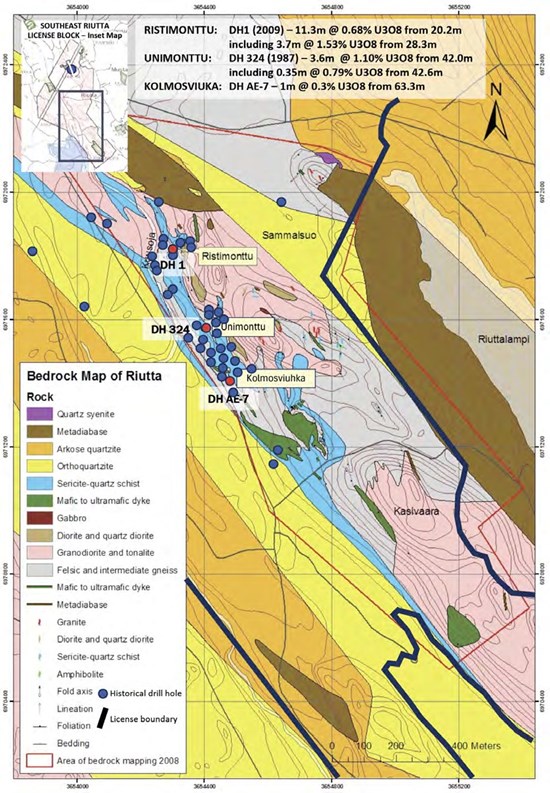
NordX Metals Corp. has announced promising assay results from a historical drill core resampling program at its wholly-owned Riutta project, located near Joensuu in eastern Finland. The results confirm significant shallow uranium mineralization, with the most notable finding being an intersection of 11.3 metres grading 0.68% U3O8 from a depth of 21.2 metres in drill hole AREVA DH1. This hole, drilled in 2008 by AREVA (now Orano), had previously gone unassayed due to the company’s global restructuring and a downturn in uranium prices. The core was later acquired by Mawson Resources, which reported a historical result in 2011 consistent with NordX’s recent findings.
In addition to the standout result from the Ristimonttu prospect, other notable intervals were identified, including 2 metres at 0.20% U3O8 and 1.75 metres at 0.033% U3O8 from other drill holes. The resampling program also revealed anomalous grades of copper and silver, indicating a potentially rich mineral environment. Jon Franklin, President and Director of NordX, expressed excitement over the results, highlighting the potential for significant near-surface uranium mineralization along a 3.6-kilometre trend at Riutta.
The Riutta uranium occurrence has a rich history, first discovered in 1958, with four exploration campaigns conducted over the years. Despite extensive drilling, only a limited number of holes have been drilled in recent decades. The project has yielded over 500 mineralized boulders, with many assaying above 1% uranium. The geological setting of Riutta is interpreted as a structurally controlled, low-temperature hydrothermal uranium system, suggesting further exploration could uncover additional resources.
The resampling was conducted under strict quality assurance protocols, ensuring the reliability of the assay data. The results have been reviewed by a qualified geologist, adding credibility to the findings. NordX aims to advance its exploration efforts at Riutta, capitalising on the confirmed mineralization to attract investment and support further development of the project.
In summary, the confirmation of significant uranium mineralization at the Riutta project marks a pivotal moment for NordX Metals, positioning the company for potential exploration success in Finland’s uranium sector. As the demand for uranium continues to grow, the results from Riutta could play a crucial role in meeting future energy needs.
In the latest edition of the Critical Matters Newsletter, the focus is on the evolving landscape of critical raw materials in Europe, particularly in light of the Critical Raw Materials Act (CRMA). This legislation aims to enhance the continent’s competitiveness and resilience by securing a reliable supply of essential raw materials necessary for the transition to a sustainable economy. The CRMA sets ambitious targets for 2030, including increasing domestic extraction, processing, and recycling of critical raw materials, while reducing dependence on single suppliers. However, as Europe transitions from setting these goals to actual implementation, significant challenges remain.
One of the primary hurdles is the lengthy and complex process of mineral exploration and mine development, which can take over a decade in Europe. Despite the CRMA’s provisions to expedite permitting for strategic projects, the reality is that many critical mineral resources have yet to be discovered. The article highlights the need for substantial investment in exploration, with estimates suggesting that the EU requires around €2 billion annually over the next five years to rebuild its exploration capacity. Currently, Europe accounts for only 3% of global exploration budgets, lagging significantly behind leaders like Canada and Australia.
The newsletter also underscores that investment alone is insufficient; a coordinated approach involving policies, institutions, and industry collaboration is essential for building a resilient critical raw materials ecosystem. Examples from countries like Ireland and Canada illustrate how long-term investment and supportive policies can enhance exploration and development capabilities. Ultimately, Europe’s success in securing critical raw materials will depend on how effectively it can integrate policy, investment, and innovation to create sustainable and circular value chains.
On 15 July 2026, Savannah Resources announced the completion of the Definitive Feasibility Study (DFS) for its Barroso lithium project located in Boticas, northern Portugal. This study confirms an initial mine life of 14 years, with a probable ore reserve of 20 million tonnes and an anticipated production of 2.56 million tonnes of spodumene concentrate. Spodumene concentrate is a crucial hard-rock lithium feedstock that battery chemical processors convert into lithium hydroxide for electric vehicle (EV) cells. The Barroso project is notable for holding Europe’s largest battery-grade spodumene resource, which was classified as a strategic project under the EU’s Critical Raw Materials Act in March 2025. This classification grants the project an accelerated 27-month permitting process, a significant advantage over potential new entrants.
Emanuel Proença, CEO of Savannah Resources, expressed his satisfaction with the publication of the DFS findings, highlighting it as a critical milestone in the project’s development. The DFS serves as the essential technical dossier required by banks and offtake partners before they commit capital to the project. Savannah Resources anticipates receiving a final environmental licence in the fourth quarter of 2026, with a final investment decision expected by the end of the year and first production slated for 2028. However, the timeline faces challenges, as the environmental licence decision has been delayed, with a ruling now not expected until late February 2027. This delay could push back the first production date and compress Portugal’s opportunity to emerge as the EU’s second large-scale lithium producer, following Finland’s Keliber.
The regulatory landscape adds further complexity to the project. A precautionary injunction had previously halted geotechnical fieldwork in June 2026, but this was lifted on 30 June 2026 after the Portuguese government declared the project of national and European strategic importance. Nevertheless, a separate legal challenge from community groups MiningWatch Portugal and ClientEarth is currently before the European Court of Justice, contesting the European Commission’s decision to keep Barroso on the strategic list. As Europe currently sources approximately 81% of its extracted lithium and 100% of its refined lithium from outside the continent, the Barroso project’s strategic location—less than 300 kilometres from five deep-water ports—positions it as a key player in reshaping the continent’s lithium supply chain. The success of the permitting timeline will be crucial in determining whether Portugal can secure its place in the upcoming cycle of EU battery-factory investment decisions.
I attend a lot of conferences on mining and critical raw materials. You probably do too. And if you have sat through as many of them as I have over the past 20+ years, you will have noticed a pattern: the diagnosis of Europe’s critical raw materials predicament has become a genre unto itself. Permitting is too slow. Capital is too shy. China is too dominant. Public consent is too fragile. Energy is too expensive. The Critical Raw Materials Act is too regulatory, or not regulatory enough, or the wrong kind of regulatory. Everyone leaves the room nodding gravely. Almost everyone leaves with no exit.
We are not convening the 10th MINEX Europe Forum to run that programme again.
We are looking for speakers with the expertise, the operating experience and – frankly – the imagination to move the conversation past the lament. If your contribution is a well-referenced argument that European mining is finished, that Brussels has broken the sector, or that the whole enterprise is a lost cause, we thank you in advance and respectfully suggest you will find a warmer welcome elsewhere. What we want at the MINEX Europe is people who can answer the harder question: what actually works, and how do we scale it?
The policy clock is ticking
On 3 December 2025, the Commission published the RESourceEU Action Plan, its acceleration package for the CRMA. At its centre sits a proposal for a European Critical Raw Materials Centre — a body with a genuinely operational mandate: developing systemic intelligence on primary and secondary CRM markets, monitoring strategic projects across their lifecycle, facilitating strategic stockpiles in coordination with Member States and industry, and undertaking joint purchasing and demand-supply matching for European buyers.
On 19 May 2026, the Commission opened a call for evidence and public consultation on the Centre, running until 29 July 2026. It named four policy options it will assess:
Facilitating access to public funding and private investment for CRM projects.
Strengthening the market position of European companies in global markets.
Supporting industry in mitigating the impact of supply chain disruptions.
Improving access to CRM market intelligence.
By the time we meet in Trim on 28 October, the consultation will have closed, and the Commission will be turning submissions into a legislative proposal. That is a live window. The Forum is a chance for the sector to articulate — on the record, in the room — what it actually needs from those four options rather than what it fears from them.
A few inconvenient truths we think are worth remembering
Before we get to the questions, a corrective for the doom-and-gloom reflex. The story of European mining is not the story it is often told to be.
European mining is, on a per-tonne basis, among the safest and least environmentally impactful in the world. Fatality and severe-injury rates in EU jurisdictions are an order of magnitude below those in most extraction hubs across Asia, Africa and parts of Latin America — a function of stringent occupational health and safety law, digital underground monitoring, and heavy automation.
Nordic and Iberian operations run on grids roughly 30% less carbon-intensive than the OECD mining benchmark, thanks to nuclear, hydro and wind. The EU's Best Available Techniques regime forces water, dust and effluent standards that most jurisdictions do not attempt. Extractive waste volumes remain a legitimate and unresolved challenge — we will not pretend otherwise — but the per-unit environmental performance of European operations is, by international comparison, exceptional.
And the prize is real. Europe is the world's second-largest consumer market, with annual household expenditure of roughly USD 9.6 trillion — larger than China's, and served by consumers with more than double the per-capita purchasing power of their Chinese counterparts.
That is not a marginal detail. It is the strategic case for reindustrialisation. Batteries, magnets, semiconductors, defence platforms, medical devices and clean-energy hardware are all built on critical raw materials — and they are all sold, in disproportionate measure, into European wallets. Bringing the value chain closer to that demand is the jobs argument, the tax-base argument and the sovereignty argument in a single package.
That is the ground we want us all to stand on. From there, the questions get harder.
The questions we want the Forum to answer
If you have credible, evidence-backed thinking on any of the following, we want you on the podium at the MINEX Europe in Ireland.
On the arithmetic. Eurometaux estimates Europe needs at least ten new mines, fifteen new processing facilities and fifteen recycling plants for strategic materials by 2030. Euromines puts the mining figure at 20–30 projects. No new mine has opened in the EU in fifteen years.
What is the credible pathway from that starting position to those numbers — not in slogans, but in project pipelines, permit timelines and capital structures?
On the CRM Centre itself. If the Commission proposes it in the second half of 2026, what should it actually do first?
Joint purchasing for which materials, on what terms? Strategic stockpiles held by whom, financed how, released under what triggers? Market intelligence at what granularity — and who inside the Centre has the mandate and the skills to interpret it?
We would rather debate this now, with the operators and off-takers in the room, than read the trade press about it in 2027.
On the mid-stream. Europe frequently has the rock, and increasingly has the gigafactory, but too often loses the value in between.
What does a European precursor-and-conversion industry look like when it is actually built, financed and offtake-secured? Who is doing it?
On China. The relationship is neither a partnership of equals nor a confrontation Europe can win by decoupling alone.
What does a mature, honest European strategy toward Chinese capital, Chinese technology and Chinese processing capacity look like — one that neither denies the dependency nor pretends it can be legislated away in five years?
On capital. Strategic project designation is a badge. It is not a cheque.
Where is the equity, the mezzanine, the offtake-linked debt and the blended public-private structure that actually gets a European lithium refinery or a rare-earth separation plant to financial close? Who has done it, and what can the rest of us learn?
On social licence. The safest mining regime in the world still struggles to get consent from the communities living above the orebody.
What is genuinely working — in Sweden, in Portugal, in Spain, in Ireland — to build durable local agreement rather than merely legal compliance?
On the recycling promise. 25% of strategic materials from secondary sources by 2030.
What does the honest scale-up curve look like, and where are the bottlenecks nobody wants to name at the industry breakfast?
What we are offering
A room of roughly 200 + senior participants from around 150 organisations across European and Global mining, downstream industry, finance and policy.
Bring evidence. Bring the operating scars. Bring a proposal that a colleague from another part of the value chain could act on the Monday after. Leave the funeral oration at home.
Presentation options and speaker registration are available on the website. To secure the current rate, please apply before 15 September 2026.
Europe faces an unprecedented raw materials crisis that policy targets systematically underestimate. By 2030, demand for energy metals are expected to explode. Lithium demand will increase five-fold. Cobalt will rise nine-fold. Nickel, manganese, and graphite will need twelve to fifteen times current supply levels. Yet Europe produces zero rare earth elements, controls less than one per cent of global lithium output and depends on a single country (China) for all rare earth processing and 90 per cent of permanent magnets. In February 2026, the European Court of Auditors warned directly: under current plans, Europe’s 2030 critical raw materials targets “appear out of reach.” Many strategically designated projects, the Court found, will struggle to secure supply by 2030. The crisis is not geological. Europe possesses abundant ore deposits. The crisis is not financial. The EU has committed 3 billion euros in 2026 alone. The crisis is political, regulatory, and social. It is a crisis of will, not of resources.
Primary Source: IEA Global Critical Minerals Outlook 2025
Europe’s Energy Metals Demand: The Trajectory (2025-2035)
Current Demand (2025) and Forecast Growth:
Primary Source: European Court of Auditors Special Report 04/2026
Lithium: 2024 global demand reached 1.1 million tonnes LCE (lithium carbonate equivalent); 2025 demand is approximately 200,000 tonnes lithium metal; 2030 forecast is 3 million tonnes LCE; 2040 forecast is 8 million tonnes LCE. Growth trajectory is 5-fold by 2030, 14-fold by 2040. Supply capacity by 2035 is expected at 4.4 million tonnes LCE (up from 1.5 million in 2025).
Copper: EV sector demand in 2025 is 1.7 million tonnes per annum (Mtpa); 2035 forecast is 4.3 Mtpa with annual growth rate of 10 per cent. IEA deficit warning shows 30 per cent supply shortfall by 2035. Current mine pipeline is insufficient to meet demand growth.
Nickel: Global demand growth has been 20 per cent (2020-2024). Forecast growth 2025-2035 shows 12-15 times increase needed. Current trajectory catches up with demand if planned projects proceed on schedule.
Cobalt: Global demand growth in 2024 was +6-8 per cent. Forecast growth 2025-2035 shows 9-fold increase. Chemistry shifts to high-nickel NMC and cobalt-free LFP are gaining share, but absolute demand is still climbing.
Graphite: Forecast growth 2025-2040 is 20-25 times increase. Market concentration shows China controls 90 per cent of synthetic graphite capacity. Supply risk is the highest among all critical minerals.
Rare Earth Elements: Forecast growth 2025-2040 is 20-25 times increase. Current supply chain shows 100 per cent of global processing in China. Europe’s production is zero.
Battery consumption in EU: 2025 shows 400 GWh; 2040 forecasts 4 times more (1,600 GWh). E-mobility share is 60 per cent (2025), rising to 80 per cent (2040).
Global Demand Growth Rates (2024): Lithium shows 30 per cent annual increase. Nickel, cobalt, graphite, and rare earths show 6-8 per cent annual increase.
Bottom line: Demand will outstrip supply for all raw materials beyond 2029-2030 unless new capacity is urgently built. Europe's current domestic production covers less than one per cent of this demand. For copper and lithium specifically, structural deficits are already projected for the early 2030s.
Primary Source: IEA Global Critical Minerals Outlook 2025
Europe’s Mineral Dependency: The Uncomfortable Map
Europe possesses one of the world’s richest geological endowments of energy metals. Yet across the continent, projects representing years of exploration, millions in investment, and genuine transformational potential sit stalled at the threshold of development. The continent has become dangerously dependent on a handful of countries for critical minerals.
Lithium: Current global mining supply is dominated by Australia (approximately 50 per cent), Chile (25 per cent), and China (10 per cent), with additional production from Argentina, Indonesia, and other countries. Europe’s domestic mining share is less than 1 per cent. For EU imports, Chile is the dominant source, accounting for roughly 78 per cent of European lithium needs (2020-2025). European companies with significant lithium projects include Imerys (France-headquartered, EMILI project in France targeting 34,000 tonnes annually), Savannah Resources (UK-listed, operating the strategically designated Barroso Project in Portugal), and Vulcan Energy (developing Direct Lithium Extraction in Germany’s Upper Rhine Valley using geothermal brines, targeting 24,000 tonnes annually).
Rare Earth Elements: Europe’s domestic production is zero. Global supply shows China at 100 per cent of processing; 98 per cent of magnet demand is met by Chinese imports (as of 2024). Secondary suppliers include Malaysia and Russia. European producers include LKAB (Sweden, largest known European deposit), Rare Earths Norway (Fen Carbonatite Complex), and REMHub project (24-partner Horizon Europe initiative) still in early stage. Geopolitical exposure: China imposed rare earth export controls in 2009, 2012, and expanded controls 2023-2025.
Cobalt: Current global supply comes from Democratic Republic of Congo (largest, approximately 50 per cent global), Russia, Australia, and China. Europe’s share is less than 1 per cent production. EU import dependency focuses on DRC (major source); refining is concentrated in China. European producers include Boliden’s Harjavalta smelter (Finland, largest nickel/cobalt refinery in Western Europe, 60,000+ tonnes annual output) and Eurobattery Minerals (Hautalampi mine, Scandinavia, development stage).
Nickel: Current global supply comes from Indonesia and Philippines (laterite ore) and Russia and Australia (sulfide ore). Europe’s share is less than 1 per cent. Refining concentration shows significant Chinese capacity; some European refining at Boliden and Norway’s Glencore Nikkelverk. Chemical shift risk: Low-nickel and cobalt-free battery chemistries (LFP) are gaining share to reduce supply risk, but absolute nickel demand is still rising.
Copper: Current global supply comes from Chile (23 per cent of EU imports), Democratic Republic of Congo (17 per cent), and Brazil (15 per cent). Europe’s share is approximately 1 per cent production (Boliden’s Aitik mine in Sweden, 90,000+ tonnes annually). Global supply risk shows IEA projects 30 per cent supply deficit by 2035; mined supply from announced projects falls short of 2035 demand, and structural deficit is emerging. Forecast shortfall is 19 million tonnes by 2050 if new mines and recycling capacity are not developed.
Graphite: Current supply shows China dominates natural graphite (60 per cent) and synthetic graphite (90 per cent). Europe’s share is trace (less than 1 per cent). Future concentration risk: China is expanding synthetic graphite capacity, locking in control. Geopolitical exposure: China has export-restricted graphite since 2023.
Manganese: Current supply comes from South Africa, Australia, and China. Europe’s share is less than 1 per cent. Dependency is high, concentrated in South Africa with geopolitical instability risk.
Primary Source: IEA Global Critical Minerals Outlook 2025
Battery consumption in EU: 2025 shows 400 GWh; 2040 forecasts 4 times more (1,600 GWh). E-mobility share is 60 per cent (2025), rising to 80 per cent (2040).
Global Demand Growth Rates (2024): Lithium shows 30 per cent annual increase. Nickel, cobalt, graphite, and rare earths show 6-8 per cent annual increase.
Bottom line: Demand will outstrip supply for all raw materials beyond 2029-2030 unless new capacity is urgently built. Europe's current domestic production covers less than one per cent of this demand. For copper and lithium specifically, structural deficits are already projected for the early 2030s.
Primary Source: Eurostat: International Trade in Critical Raw Materials
The Geopolitical Chokepoint: How One Country Controls the Transition
China’s dominance is not a detail in Europe’s minerals story; it is the story. Consider the architecture: Rare earths show 100 per cent of global processing with China holding over 98 per cent of magnet production. Graphite shows 60 per cent of natural graphite and 90 per cent of synthetic graphite capacity. Lithium processing shows substantial refining capacity with Chinese battery makers building supply chains inside the EU (gigafactories in Hungary, Germany, Spain; cell-to-cathode chains in Morocco targeting European carmakers under free-trade terms). Export controls have been weaponised: 2009 rare earth restrictions, 2012 repeat, 2023-2025 minerals and magnets. China’s expanded export controls continue to draw scrutiny from trading partners and may face re-examination. Pricing power is decisive: when the market is concentrated this severely, producers set terms. When one country controls 90+ per cent of processing, it controls supply security, not scarcity.
Europe’s minerals strategy is not a strategy for independence. It is a strategy for managed interdependence. Yet that interdependence is not being managed. It is being weaponised by others.
Portugal holds 60,000 tonnes of lithium reserves and hosts Savannah Resources‘ strategically designated Barroso Project, poised for final investment decision by end of 2026. France’s EMILI project (Imerys) is positioned to deliver 34,000 tonnes of lithium hydroxide annually. The Cínovec project in the Czech Republic represents Europe’s largest hard-rock lithium resource (7.45 million tonnes) with an annual target of 29,380 tonnes of battery-grade lithium hydroxide. Slovakia has announced a commercial lithium refinery (Volt Resources) for 2026. Norway’s Fen Carbonatite Complex hosts a March 2026 resource upgrade of 15.9 million rare earth oxide tonnes. Sweden is home to Europe’s largest known rare earth deposit (over one million tonnes of oxides) sitting with LKAB. Finland, Norway, and Sweden hold 104 cobalt deposits under exploration, with the Hautalampi mine representing one of Scandinavia’s largest undeveloped cobalt and copper assets. The Balkans, particularly Serbia, contain substantial lithium, copper and nickel resources, while Austria and Ukrainian partners are examining titanium and graphite joint ventures.
This is not a geological problem. It is a political, financial, and social one.
The Uncomfortable Truth
The European Commission’s Critical Raw Materials Act (which entered force May 2024) designated 47 strategic projects in its first round. The second wave, closing recently, received over 160 applications, doubling the portfolio. Strategic status promises much: expedited permitting, priority access to RESourceEU financing, single contact points, UNFC classification for bankability. Yet ask developers privately: does the label actually move money or permitting timelines? Germany’s Rock Tech Lithium secured all regulatory approvals and strategic designation. Yet it failed to secure the decisive subsidies from the German government. The pattern repeats across Europe. Policy creates narratives. Reality creates friction.
Here is what will determine whether Europe builds a minerals industry or assembles a filing cabinet of strategic designations:
The China Dilemma Will Not Wait. Europe depends on a single country for all of its rare-earth processing and 90 per cent of its permanent magnets. As of 2026, Europe produces zero rare earth elements domestically; 98 per cent of rare earth magnet demand is met by Chinese imports. RESourceEU projections suggest that even if every strategic project delivers, Europe will sit near 80 per cent dependent on China for magnets in 2030. The bottleneck is not the mine. It is the mill. European ore is shipped to China for refining, for want of domestic capacity, then reimported as finished material. The Rare Earth Industry Association (REIA) and the REMHub Horizon Europe project are building digital platforms and exploring new extraction technologies, but these initiatives are in their infancy. Parallel to this, Chinese manufacturers (CATL, EVE Energy, CALB) are building the supply chain inside the EU (gigafactories in Hungary, Germany, Spain, Portugal and a full cell-to-cathode chain in Morocco aimed at European carmakers under free-trade terms). The timer is running. China’s expanded export controls on magnets, precursors, and rare-earth materials continue to draw international scrutiny and may face re-examination. Easing restrictions invites dependence; narrowing them invites retaliation. This is not a technical problem. It is a strategic choice that Europe has not yet made honestly.
Social Licence Remains the Real Constraint. It is standard practice in European discourse to blame permitting delays and regulatory ambiguity. The real answer is more uncomfortable. Domestic projects continue to encounter resistance even when policymakers agree that critical raw materials are essential for climate, defence, and industry. Zinnwald, Jadar (Rio Tinto’s Serbian lithium project), and Cínovec have each faced or continue to face organised opposition, environmental scepticism, and community resistance. No permit timeline, no strategic label, no subsidy will materially shift that opposition unless mining regains public legitimacy on the ground. This requires radical rethinking: not communications management, but genuine commitment to shared value, transparency that admits unknowns rather than asserting certainty, and local participation that shapes projects from the earliest stages, not merely absorbs complaints at the end. Some European jurisdictions (Ireland among them) have moved further down this path than others. The question is whether the model can scale.
Financing Remains the Decisive Test. European mining and processing projects are being evaluated by investors on a fundamentally different calculus than their Australian, Canadian, or Chinese equivalents. Permitting uncertainty, cost inflation, timeline risk, commodity price exposure, power costs, technical complexity, and political durability are all on the table. Does strategic designation reduce that risk enough to attract institutional capital at scale? Evidence suggests it does not, at least not yet. Yet without that capital, without clear offtake agreements or government co-investment, projects advance to pilot stage and stall. The gap between a resource and a mine is not measured in metres of rock. It is measured in billions of euros and the willingness to risk them on European soil.
The Mid-Stream Is the Actual Constraint. Few commentators acknowledge this directly. Europe can develop lithium, cobalt, nickel, copper, and rare earths. It can build the mines. What it has not built, and what the Critical Raw Materials Act, for all its ambition, has not adequately addressed, is the refining, beneficiation, and mid-stream infrastructure. The European Court of Auditors confirmed this gap explicitly: planned European refining capacity will fall dramatically short of demand.
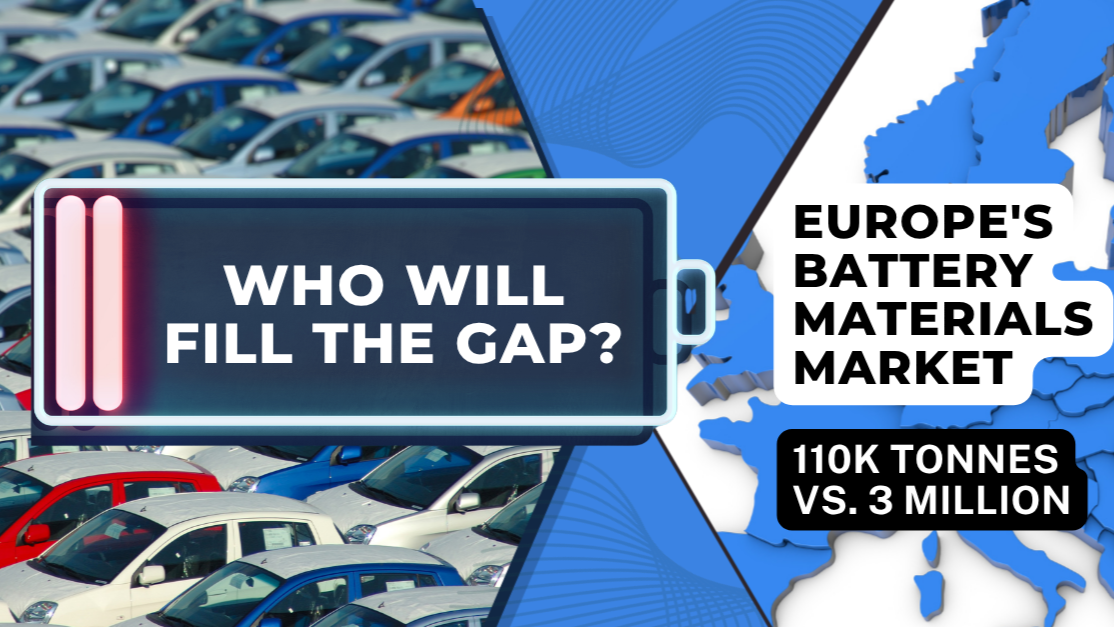
Current plans show only 110,000 tonnes of lithium compounds annually on the drawing board, against demand of 3 million tonnes by 2030.
Primary Source: European Court of Auditors Special Report 04/2026
This gap is the market opportunity. The companies that move fastest on three fronts will dominate European battery material supply through the 2030s: securing permits in 36 months rather than 8 years, reaching cost parity with China through renewable energy or Direct Lithium Extraction, and locking in multi-year ore supplies from Australia and Chile. Green Lithium in the UK has announced UK refinery commissioning for 2026 (50,000 tonnes per year). Volt Resources refinery in Slovakia is timed for 2026. Vulcan Energy’s geothermal DLE project targets first production in 2026-2027. These are beginnings. The developers moving fastest in 2026 and 2027 will capture long-term offtake agreements with European gigafactory planners and build competitive moats that second and third movers cannot replicate. The battery gigafactories ramping across Europe will demand reliable, adjacent processing capacity to hit cost targets. The first wave of refiners that succeed will supply the continent’s entire gigafactory ecosystem for the next decade.
The Regulatory Trap Europe Is Walking Into
Europe is simultaneously accelerating mining projects whilst tightening environmental constraints and now proposing chemical hazard classifications that will make those same projects difficult to permit and uncompetitive. This paradox will define the next 18 months.
The Lithium Toxic Classification Crisis. In April 2026, the European Chemicals Agency (ECHA) released a scientific assessment proposing to classify lithium carbonate, hydroxide, and chloride as Toxic for Reproduction, Category 1A. The International Lithium Association (ILiA) responded publicly that it is “gravely concerned,” having lobbied privately against the proposal for two years. The concern is not scientific pedantry. An overly stringent classification would make EU member states substantially less attractive for lithium mining and refining projects compared with non-EU competitors. Australia, Canada, Chile, Argentina, and the UK have all submitted assessments disagreeing with ECHA’s classification, demonstrating there is no global scientific consensus on the hazard. Yet the public consultation period runs April to June 2026, with ATP 22 implementation post-2026.
The timing is devastating. European projects have not yet begun production. Capital markets are already sceptical of timelines and costs. A chemical classification that elevates occupational exposure limits or triggers new regulatory requirements for handling and transport could easily tip investment decisions toward non-European sources, especially when competitors offer lower-cost jurisdictions without such restrictions. This is not environmental regulation. This is competitive disadvantage encoded in hazard classification.
The Battery Regulation Timeline. By February 2027, every battery in the EU market must carry a digital product passport (QR code) containing supply chain information, carbon footprint data, and conflict minerals disclosures. By end of 2027, recycling recovery rates must hit 50 per cent. By 2031, recycled lithium content in new batteries must reach 6 per cent; by 2036, 12 per cent. These targets are mechanically demanding and require supply-chain transparency that many mining projects have not yet built.
The Self-Sufficiency Illusion. A peer-reviewed study in Nature npj Materials Sustainability (Nykvist, June 2026) assesses Europe’s lithium self-sufficiency targets with rigour. The findings are sobering: recycled batteries will contribute only modestly to self-sufficiency targets, falling far short of policymaker expectations. Even assuming all designated strategic projects commence as planned, by 2036 European self-sufficiency ranges from 31 per cent to 78 per cent, a wide range reflecting sensitivity to battery lifetime assumptions. The implication is uncomfortable: Europe will remain heavily import-dependent, and policy targets on recycling content will not substantially close that gap.
The Environmental Standards Conflict. The European Commission’s push to accelerate permitting for strategic projects directly conflicts with the strict environmental protections Europe also prizes. The Commission is, in effect, lowering the same environmental standards it built its reputation on. The European Court of Auditors identified “lengthy and complex permitting” as a decisive bottleneck constraining Europe’s minerals strategy. As of 2026, 11 of the EU’s strategic mining projects overlap land within one kilometre of Natura 2000 biodiversity-protected areas, with three projects directly overlapping protected land. Eighty-five per cent of known European mineral deposits lie within or near environmentally protected areas. Strategic designation does not grant permits, weaken environmental standards, or override rights protections. What it does is create expectations that permitting will accelerate, expectations that collide directly with the legal obligations under the Habitats Directive, Birds Directive, and national environmental law.
Community Opposition as Regulatory Reality. Community opposition has emerged as the decisive constraint on new mining projects, not legislation, not finance, not geology. The Portuguese Barroso lithium project (Savannah Resources) is strategically designated, was granted a mining concession in 2020, and has become the subject of a European Court challenge on environmental grounds. Serbia’s Jadar project, backed by Rio Tinto’s capital and strategic designation, has encountered such sustained resistance that its feasibility is genuinely in question. These are not failures of regulation or finance. They are failures of legitimacy.
Supply Chain Due Diligence Requirements. By August 2025 (now passed), companies were required to disclose their corporate strategy on social and environmental risks in lithium, graphite, cobalt, and nickel supply chains, aligned with UN Guiding Principles and OECD Due Diligence frameworks. Miners will come under increasing scrutiny regarding operations, water use, tailings management, and community engagement. This is correct policy. It is also the kind of regulatory rigour that makes capital conservative and timelines uncertain.
The bitter irony: Europe has the geology, the strategic projects, the finance mechanisms, and the regulatory framework to build a domestic minerals industry. What it does not have is a coherent strategy for resolving the collision between the speed required to meet 2030 targets and the environmental rigour that European voters and courts demand.
Where Technology Might Break the Deadlock
Direct Lithium Extraction (DLE) offers a potential pathway through this regulatory trap. Unlike evaporation ponds, which consume roughly 500,000 gallons of water per tonne of lithium, DLE technologies aim to reduce water usage by up to 90 per cent, operating in closed-loop systems with zero liquid discharge. Vulcan Energy‘s 250 million euro EIB-funded project in Germany’s Upper Rhine Valley exemplifies the model: extracting lithium from geothermal brines whilst co-producing renewable heat and power, lowering both carbon footprint and surface impact.
Yet DLE carries a critical caveat: the technology remains largely unproven at commercial scale. Fresh water consumption requirements, which some DLE methods may demand in larger volumes than evaporative alternatives, have not been adequately quantified. In water-scarce regions, this could replicate the environmental problems DLE was designed to solve. Projects in Alsace, France, and the Upper Rhine Valley offer early evidence of viability, but evidence alone will not satisfy permitting authorities or community concerns.
The point for developers is clear: technology can matter. But it matters only when the case for it is made transparently, when uncertainty is acknowledged rather than asserted away, and when communities see benefit in participating in its development. The International Lithium Association (ILiA), established in 2021 as the industry’s voice on ESG and sustainability, has rightly prioritised uniform standards and sustainable practice across the global supply chain. The question is whether that commitment will translate into the kind of radical transparency and local engagement that European permitting now demands.
More importantly: the developers who move fastest on three fronts will dominate European battery material supply through the 2030s. These are the companies that simultaneously compress permitting timelines, reach cost parity with China through renewable energy or Direct Lithium Extraction, and secure long-term feedstock from Australia and Chile. The first wave of refiners that succeed in these three domains will capture long-term offtake agreements with European gigafactory planners and build competitive moats that second and third movers cannot replicate.
https://2026.minexeurope.com
MINEX Europe 2026: Europe’s Mining: Investable, Sustainable, Essential
The 10th edition of the MINEX Europe 2026 (28-30 October, Trim, Co. Meath, Ireland) brings together developers, financiers, policymakers, geoscientists, and operators to examine these dilemmas without slogans. The forum agenda is designed to probe the gap between ambition and execution: Can legislation rebuild European mining, or does it mainly move bottlenecks downstream? What is strategic designation worth when permitting still runs to years and financing remains prospective? Why does social licence matter more than permitting frameworks? Can Europe realistically compete on battery materials, or is dependence simply being relocated? What would a mature European strategy look like, one that manages interdependence honestly rather than promising independence it cannot build?
These are not comfortable questions. They require intellectual honesty from policymakers, capital providers, and developers alike.
The Speaking Opportunities at MINEX Europe Forum
MINEX Europe 2026 seeks contributors who can speak to these challenges with candour and evidence. Representations from industry associations (the International Lithium Association (ILiA), Euromines representing 54 commodities and 350,000+ workers, and the Rare Earth Industry Association (REIA)) are actively engaged in this conversation. The forum is an opportunity to move beyond position statements and examine the real mechanics of what works and what doesn’t.
Potential discussion areas include: Regulatory affairs and hazard classification. The ECHA lithium classification proposals present a case study in unintended competitive consequences. How should Europe reconcile legitimate safety concerns with competitiveness? Are occupational exposure limits being set on sound science or precaution? How do mining jurisdictions navigate divergent global standards?
Developers and project leads. Lithium, rare earths, cobalt, nickel, copper, precious metals. What are the real bottlenecks (permitting, financing, energy costs, technical complexity, community opposition)? What would move projects from feasibility to production?
Mid-stream and refining. Beneficiation capacity, lithium hydroxide production, rare-earth separation, magnet-making, battery-grade material production. Where is European capacity being built? What are the cost curves? How do you compete with incumbents?
Policy and government. Subsidy design, permitting harmonisation across member states, social licence frameworks, regional development strategies. How do you create conditions for investment without distorting markets? How do you address public legitimacy?
Financiers and institutional capital. What do investors actually evaluate when assessing European projects? Under what conditions do strategic designation and policy support reduce risk enough to justify capital allocation? What blended finance models work?
Chinese strategy and geopolitics. How does Europe manage relationships with China’s mid-stream dominance? Is diversification realistic, or an illusion? What does a mature interdependence strategy look like?
Technology, permitting, and ESG. Underground mining methods, digital technologies, water stewardship, tailings design, progressive rehabilitation, low-impact mine design. Can better engineering address opposition? Where do technical solutions hit the limits of legitimacy? Specific focus on Direct Lithium Extraction (DLE): is the technology commercially viable at scale? What are the actual freshwater requirements? Can DLE resolve water concerns or merely relocate them? How transparent should projects be about technical uncertainty?
Supply chain integration and circularity. From ore to battery to recycling. How do companies ensure security of supply? What role for digital product passports and traceability?
The Ireland factor. As host country, Ireland enters the Forum as a jurisdiction with established mining tradition and unexplored potential. What role can Ireland play in Europe’s minerals strategy?
The forum format is designed for working discourse, not theatre. Presentations are rigorous; panels are frank; the networking infrastructure supports the bilateral conversations that shape real outcomes. Previous editions have consistently moved capital, shaped policy, and forged partnerships.
Submit speaker proposals outlining your perspective on one of these challenges.
Closing date: 15 August 2026. Applications are reviewed on intellectual rigour, evidence, and candour, not on seniority or pre-existing prominence.
About the Author
Arthur Poliakov is founder of Advantix Limited and creator of MINEX Forum, a cross-border platform connecting over 50,000 mining and exploration professionals across Eurasia. With over 30 years of experience in international communications and events, Arthur specialises in bridging communication gaps and fostering dialogue on critical minerals, capital markets, and natural resources development. He believes that sustainable growth and strategic innovation require collaboration, transparency, and a willingness to challenge conventional thinking.
Primary Research & Data
ECA Special Report 04/2026
European Court of Auditors assessment of EU critical raw materials strategy, permitting bottlenecks, and mid-stream capacity shortfalls
Europe has written the rulebook for critical raw materials sovereignty. A new European Investment Bank study, produced with Dublin based Aurum Global Exploration, puts a number on what actually closing the gap will cost, and asks an uncomfortable question: who is going to pay for it, and are Europe’s own financial institutions even built to do so?
A target with no cheque attached
Legislation is the easy part. The Critical Raw Materials Act, in force since May 2024, tells the European Union exactly what sovereignty over its raw materials is supposed to look like by 2030: at least a tenth of annual consumption of strategic raw materials mined domestically, forty per cent processed within the Union, a quarter met through recycling, and no single third country supplying more than sixty five per cent of any one material at any stage of the chain. It is precise, ambitious and, on the evidence of a new technical report from the European Investment Bank, roughly an order of magnitude short of being funded.
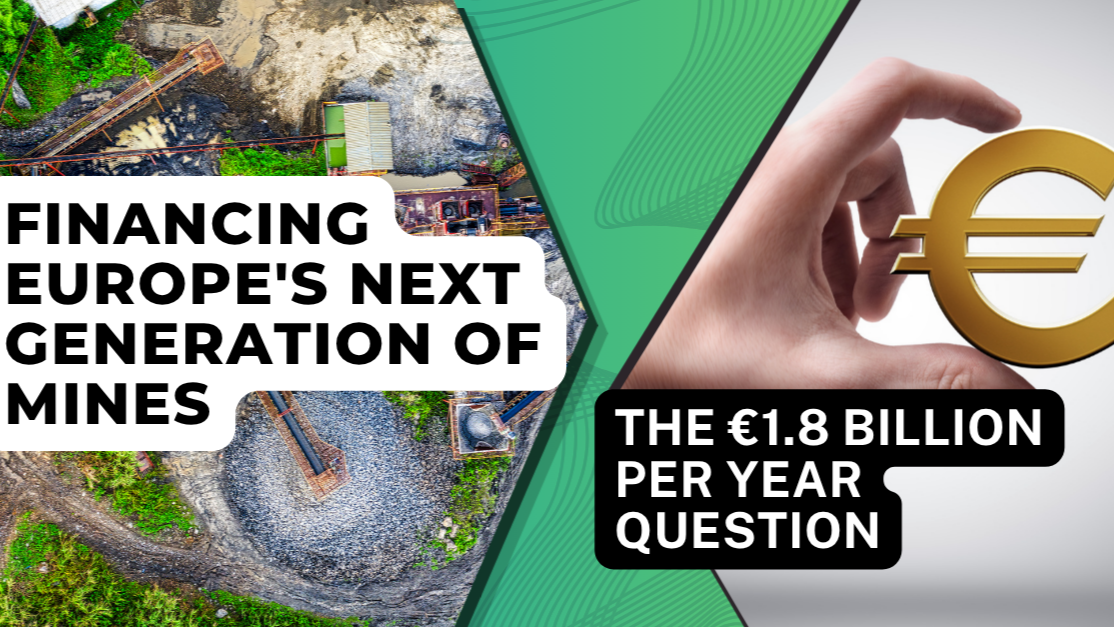
The report, Challenges and Solutions for Mineral Exploration in Europe, was prepared by the EIB working with Aurum Global Exploration, an Irish exploration and geoscience consultancy that has spent decades an Irish geoscience consultancy with decades of experience advising on global mine developments across multiple continents. Its headline finding is blunt. Meeting the Critical Raw Materials Act’s domestic extraction targets requires roughly two billion euros a year in mineral exploration spending across the Union over the next five years. Actual exploration spending across the EU’s twenty-seven member states has averaged around two hundred million euros a year over the past decade.
That is not a shortfall. It is a tenfold gap, and it sits at the very first stage of a value chain that European industrial policy is now betting its energy transition, its digital economy and a good part of its defence manufacturing on.
Put the number in a wider frame and it gets starker still. In 2024 Canada alone spent an estimated two and a half billion euros on mineral exploration, and Australia around one point nine billion. The European Union, twenty-seven countries with a combined economy larger than either, managed roughly three hundred and sixty million, about three per cent of the global exploration budget. On a per square kilometre basis, the Union lags Canada and Australia by a factor of six to seven. Only two per cent of global junior mining company spending and three per cent of major company budgets currently find their way into European ground. A continent that likes to think of itself as thoroughly mapped and mined out is, on the numbers, chronically under explored relative to its geological potential, and almost entirely absent from the capital markets that fund discovery everywhere else.
Why exploration is the hardest money to raise
It helps to understand why this particular stage of the mining life cycle is so difficult to finance, because the difficulty is structural rather than a failure of will.
The industry’s own model for this, the Lassonde Curve, tracks value and risk through roughly ten stages between the first geological survey and a producing mine, and the odds at the start are brutal: about one in ten thousand grassroots projects becomes a discovery worth defining, and one in a thousand discoveries becomes a mine. Grassroots and early-stage exploration typically run for three to nine years before a company even knows whether it has found anything, let alone whether that something can be built profitably.
Then comes what the industry calls the orphan period, the stretch after a discovery is confirmed but before a bankable feasibility study exists to de-risk it for conventional lenders. Valuations stagnate, economics remain uncertain, and traditional finance, built for cash flowing assets with predictable returns, has little appetite for the wait. It is precisely the stage where public capital is meant to crowd in private capital, and precisely the stage at which, on the EIB’s own admission, its standard instruments do not reach.
“The EIB Group has not financed upstream exploration at large scale, as the risk profile of exploration does not match the EIB Group’s standard loan products,” the report states, about as candid an acknowledgement as a development bank is likely to publish about its own institutional limits. Europe’s development finance architecture, in other words, was not built for the riskiest and most catalytic part of the very supply chain it is now trying to secure.
What the leaders do differently
The report benchmarks the Union against Canada, Australia, the United States, Chile, Japan and Namibia, and the contrast is instructive less for its detail than for its pattern.
https://2026.minexeurope.com/
Canada’s flow through share system, under which exploration companies can pass eligible expenses directly to investors as tax deductions, has consistently financed sixty-five to seventy per cent of all capital raised on Canadian exchanges for exploration companies. It is not a subsidy so much as a mechanism for shifting risk to investors who are compensated for taking it, and it sits alongside the Toronto Stock Exchange’s deep pool of specialist mining capital, over twelve hundred listed mining companies, and provincial grant programmes that co fund the earliest, highest risk field work. Australia pairs its own Junior Mineral Exploration Incentive with some of the best publicly funded precompetitive geoscience anywhere, reducing the guesswork explorers face before they commit capital at all.
The European Union has neither mechanism at meaningful scale. It has, instead, twenty-seven separate permitting regimes, patchy and inconsistently funded national geological surveys, and a junior mining sector that scarcely exists compared with Canada’s or Australia’s. Investor familiarity compounds the problem: institutional capital that has never operated in European mining defaults to treating the jurisdiction as unfamiliar and therefore risky, whatever the underlying geology actually shows.
Ireland and Finland are among the report's few genuine bright spots, both showing exploration intensity per square kilometre that rivals Canada and Australia, which only underlines how much untapped potential sits in the rest of the Union.
Financing the next generation of mines
So, what would it actually take to close a tenfold gap? The EIB report is candid that no single instrument will do it and lays out what already exists alongside what still needs to be built. On the existing side, the Bank provides corporate loans to raw materials companies across the value chain, public sector loans to national bodies running exploration incentive schemes and pre competitive geoscience programmes such as Ireland’s Tellus survey, intermediated lending through national investment funds, and project finance for mines that have already reached bankability, work the EIB describes as creating “a vacuum effect” that pulls projects through the pipeline by signalling that finance and construction are achievable once a project is proven. Advisory support through the InvestEU Advisory Hub could potentially help early-stage companies structure projects and assess risk before they ever approach a lender.
What is missing is capital that behaves like equity at the point where projects need it most. The Bank’s TechEU programme, seventy billion euros committed for 2025 to 2027 to fund innovative and high-risk ventures, is explicitly framed as the kind of instrument exploration needs, quasi equity, patient, tolerant of a long road to revenue, but it has not yet been extended to exploration specifically. The clearest working template currently available is JUMP, the European Bank for Reconstruction and Development’s Junior Mining Programme, a hundred-and-fifty-million-euro facility offering equity and quasi equity investment in early stage mining companies. Its limitation is coverage: JUMP currently reaches only twelve EU countries, representing twenty-seven per cent of the Union’s land area. Extending an equivalent facility across the remaining fifteen countries, the other seventy-three per cent, would require an estimated three hundred to five hundred million euros a year, using a public to private capital mobilisation ratio of one to between three and five.
That is a fraction of the two-billion-euro annual gap, but it is the kind of catalytic, first loss capital that the report argues could unlock the rest from private markets that currently will not go near European exploration alone.
Brussels has, in fact, already run one live experiment in what strategic status can and cannot buy, and two independent studies published since the EIB report itself have now put hard numbers on what that experiment actually taught. The Commission’s first call, opened in August 2024, led to sixty Strategic Projects being designated by March 2025, forty-seven of them inside the Union and thirteen in partner countries, each carrying priority permitting, a single national point of contact, and access to the EIB’s two billion euros a year, a further two billion through InvestEU for 2026 and 2027, and a billion from the Innovation Fund.
The European Court of Auditors’ special report on critical raw materials, published in February 2026, found that the Act itself provides no dedicated EU funding for strategic projects at all, that only two of the four annual selection calls it envisaged had actually been launched by November 2025, and that seven of nineteen projects examined in detail still lacked secured offtake agreements with EU customers. Most of the sixty are now aiming for production after 2030, the very year the status was meant to help them hit, and at least one designated project promoter has already filed for bankruptcy since selection. The think tank ODI reached a similar conclusion from a different angle in an analysis published in June 2026: it found no public evidence of financial commitment for around forty per cent of the sixty projects, identified public commitments totalling only about six billion euros and concentrated heavily in batteries and energy storage, and calculated that three out of four projects due to reach production between 2025 and 2027 are either behind schedule or simply unverifiable from public records. None of this means nothing has moved. Plants now opening in Estonia, Sweden and France prove that designation can convert into construction. But on the evidence gathered by the EU’s own auditors and by independent analysts since, that looks like the exception running close to schedule, not the rule. Strategic designation has proved necessary but nowhere close to sufficient. It opens a door to priority treatment; it has not reliably opened a door to finance.
The Commission does not appear to entirely disagree with that reading. In December 2025, after the EIB’s own report had gone to print, it adopted RESourceEU, an action plan built explicitly around getting money moving faster: three billion euros to be mobilised within twelve months for permanent magnets, batteries and defence critical inputs, alongside the EIB’s existing two billion euros a year, seven hundred million from the 2026 Innovation Fund and just under six hundred million for recycling through Horizon Europe. The Commission’s own assessment put the sum needed simply to push already mature projects to a final investment decision at around two billion euros; independent analysis from the Jacques Delors Centre think tank put the total needed to meet the Critical Raw Materials Act’s targets closer to ten billion euros, and noted that much of the headline three billion euro RESourceEU figure largely repackages funding that already existed rather than adding genuinely new capital. Whichever estimate proves closer to right, the direction of travel matters: eighteen months after the Act entered into force, Brussels has effectively conceded that legislation and designation were never going to be enough on their own.
https://2026.minexeurope.com/
There is a newer thread still. As part of delivering on RESourceEU, the Commission opened a public consultation on a proposed European Critical Raw Materials Centre, running from 19 May to 29 July 2026, closing only as this piece went to press. The Centre is being tested against four possible roles: joint purchasing, strategic stockpiling, raw materials market intelligence, and, most relevant here, facilitating access to public and private funding for critical raw materials projects. Nothing is decided yet, and a legislative proposal is expected later this year. But the fact that Brussels is now weighing whether a dedicated institution should exist specifically to widen access to project finance says as much as anything else in this report: that financing, not designation or legislation, remains the unresolved variable.
That record matters enormously right now, because a second call, launched in September 2025, drew more than a hundred and sixty applicants for assessment, a cohort that would roughly double the size of the portfolio overnight. Reporting on the sector since has suggested the underlying obstacles have not moved much. Officials quoted by specialist trade press this spring pointed to the same triad repeatedly: financing gaps that keep projects from becoming investment ready, price volatility that complicates long term planning, and a continuing scarcity of the long-term offtake agreements lenders want to see before they commit. Separate industry analysis of project capital structures suggests public institutions, the EIB and national promotional banks among them, rarely supply more than twenty to thirty per cent of what a European critical raw materials project actually costs to build, leaving the remaining seventy to eighty per cent to exactly the private debt and equity markets that have so far shown limited appetite for European mining risk. The honest questions for anyone financing mining deals follow directly from what the first wave actually taught. Which of the financing structures behind the projects that have moved can genuinely be repeated at twice the scale, and which were closer to one off deals unlikely to template onto a further hundred and sixty new applicants with their own geology, geography and risk profiles? Will the same quasi equity gap that appears to have stalled financing for parts of the first wave simply repeat itself, at double the size, unless RESourceEU’s own instruments prove to be more than repackaged commitments? And do the Commission and the EIB have the institutional capacity, four planned selection calls a year, only two delivered so far, to assess and fund this volume at the pace the Act’s own permitting deadlines demand?
These are not rhetorical questions. They are exactly the kind that belong in front of the people who will be asked to write the cheques.
The other half of the bill: modernising what Europe already has
Financing has tended to mean financing discovery, but Europe’s existing mines and their legacy waste represent a second, underappreciated capital call, and arguably a faster route to production than any greenfield discovery. The report’s own figures on where global exploration budgets actually go are telling: at the active mine stage, majors account for the overwhelming share of spending worldwide, because brownfield exploration around existing operations is cheaper, faster and dramatically less risky than starting from nothing. Every tonne of new reserve defined at an operating mine such as Boliden’s Tara, one of Europe’s largest zinc mines and in continuous production since 1977, extends mine life without the multi year lead time a new discovery requires.
There is a further, largely untapped resource sitting in Europe’s mining districts already: historic waste and tailings. Many of the continent’s older mines, worked before modern processing technology existed, left behind dumps and tailings that were never fully stripped of value, and that may now contain multiple critical raw materials recoverable using techniques that simply did not exist when the material was first mined. The EIB report is careful not to oversell this. Reprocessing economics are often marginal, sometimes loss making, and funding the research needed to establish which sites are viable is itself a call on capital. But it is precisely the kind of redevelopment opportunity that sits between exploration and full-scale mining, needs its own tailored financing, and could shorten the Union’s path to its 2030 targets far more than waiting on discoveries that are, on the report’s own numbers, ten years or more away from production even if capital arrived tomorrow.
Modernisation cuts a second way too. The EIB’s corporate loan facility already backs companies developing the equipment, sensor technology, software and artificial intelligence tools that make both new discovery and old-site reprocessing commercially viable, a signal that Europe’s development finance is beginning, cautiously, to treat exploration and processing technology as infrastructure worth funding in its own right rather than a private sector afterthought. And nowhere is the modernisation case more urgent than in processing. Europe’s battery gigafactory build out alone represents an estimated three hundred billion euros of investment demanding lithium, cobalt, nickel and graphite, yet the continent controls less than eight per cent of the refining capacity required to supply it. For a wide range of battery minerals, in other words, the binding constraint on European sovereignty is not what comes out of the ground at all. It is what happens to it afterwards, and that is a redevelopment and processing financing question as much as an exploration one.
A question worth putting to the room
Here is the uncomfortable thought this report leaves hanging, and it is worth stating plainly rather than leaving implied. The EIB’s own analysis argues, in its conclusions, that financial incentives deployed before the fundamentals are fixed will not work: streamlined permitting, credible geological data, and public legitimacy have to come first, or, in the report’s words, “the private sector will not crowd in” and money spent trying to force the issue will be wasted.
That is a genuinely awkward message for an investor audience to hear, because it implies that the immediate constraint on European mining is not, primarily, a shortage of capital at all. It is a shortage of investable projects, caused by permitting that still runs two to seven years against one to two elsewhere, by patchy geoscience, and by a public conversation about mining that has barely begun in most member states.
The more interesting question, then, is not simply how much capital Europe needs, though the tenfold number is real and worth sitting with. It is whether financiers, industrial offtakers and policymakers are willing to fund the unglamorous fundamentals, permitting reform, public geoscience, community engagement, alongside the exploration budgets themselves, or whether capital will keep waiting on the sidelines for projects that regulatory and social readiness alone can actually produce.
Aurum Global Exploration’s own work, built on decades spent taking Irish exploration expertise into jurisdictions across Europe, Africa, Australia and the Americas, is itself evidence that the skills to close this gap already exist within the Union. What has been missing is a financing architecture, and arguably a shared sense of urgency, equal to the geology.
Where this conversation happens next
https://2026.minexeurope.com/MINEX Europe 2026 runs from 28 to 30 October at the Knightsbrook Hotel Spa and Golf Resort in Trim, Co. Meath, under the theme Europe’s Mining: Investable, Sustainable, Essential, with a site visit to Boliden’s Tara Mines closing the Forum. The programme has been built to argue through exactly the questions raised above, not around them.
One strand of the discussion puts equity, private capital, strategic investors, debt, public support instruments and blended finance models directly in front of the people who deploy them, asking whether Europe’s policy frameworks are bankable enough to reduce risk, and what combination of capital genuinely moves a project from designation to construction, including the sixty Strategic Projects already under way and the hundred and sixty one now waiting their turn.
A second strand takes on modernisation and redevelopment: how European developers can capture the mid-stream opportunity in refining and processing, and secure the long-term offtake agreements that gigafactory planners are actively looking to sign, which is really the financing question sitting behind Europe’s eight per cent refining capacity problem. Both threads sit alongside sessions on what makes a European project permittable and financeable in the first place, and on why social legitimacy is itself an industrial and financial variable rather than a communications afterthought.
These conversations need voices that rarely sit in the same room: investors weighing European mining against every other jurisdiction they could deploy capital into, financiers structuring the debt and quasi equity instruments this report says are still missing, and industrial companies, battery manufacturers, defence contractors, processors, whose offtake commitments are themselves a form of project finance. If that is your seat at the table, MINEX Europe 2026 is where the case for European mining finance gets made or gets tested, and the Forum needs your voice in the room rather than in the audience. The call for speakers is open now.
Full details and the speaker application process are at 2026.minexeurope.com, or contact the Forum Secretariat at eu@minexforum.com.
The latest edition of the Critical Matters Newsletter highlights the evolving landscape of critical raw materials in Europe, emphasising the need for a comprehensive approach beyond mere regulation. The European Union’s Critical Raw Materials Act (CRMA) aims to enhance supply chain resilience and strategic autonomy, setting ambitious targets for domestic extraction, processing, and recycling by 2030. Key benchmarks include achieving at least 10% of annual consumption for extraction, 40% for processing, and 25% for recycling, while limiting dependence on single external suppliers to 65% for any strategic material.
However, the implementation of these goals faces significant challenges. The lengthy timelines for mine development, often extending 10 to 20 years, underscore the difficulty of discovering and developing new mineral resources. While the CRMA seeks to streamline permitting processes for strategic projects, the reality remains that legislative measures cannot hasten the exploration and development phases. Furthermore, the EU’s exploration investment lags significantly behind global leaders, with only 3% of global exploration budgets allocated to the region. To rebuild its exploration capacity, the EU is estimated to require around €2 billion annually over the next five years, a tenfold increase from current levels.
The newsletter also highlights successful examples from countries like Ireland and Canada, which demonstrate how long-term investment, supportive policies, and collaboration between government and industry can strengthen the critical raw materials ecosystem. Ireland, for instance, has become a leader in exploration drilling within the EU due to its transparent licensing system and fiscal incentives. The report concludes that achieving Europe’s critical raw materials ambitions will necessitate a coordinated effort involving investment, innovation, and policy alignment to create resilient and circular value chains across the entire ecosystem.
Umicore has submitted a position paper to the European Commission, advocating for the establishment of a Critical Raw Materials (CRM) Centre in Europe that transcends mere joint purchasing and stockpiling initiatives. The company emphasises the need for the CRM Centre to focus on enhancing Europe’s refining, transformation, and recycling capabilities, which are crucial for the continent’s long-term resilience in the face of global supply chain challenges. The paper outlines key recommendations aimed at ensuring that the CRM Centre effectively addresses the unique characteristics of various critical raw material markets.
Among the recommendations, Umicore suggests implementing a differentiated approach to joint purchasing and stockpiling, tailored to the specific needs of each CRM market. This approach would allow for more strategic investments through mechanisms such as offtake agreements, take-or-pay contracts, and contracts for difference. Additionally, the company highlights the importance of leveraging digital tools, such as Digital Product Passports, to enhance transparency regarding material flows and stocks within the European economy.
Furthermore, Umicore calls for the introduction of new ‘anti-leakage’ measures to ensure that critical raw materials already present in Europe are refined and upgraded domestically before being exported. This would not only help retain value within European supply chains but also bolster the continent’s overall economic resilience. The proposed CRM Centre is envisioned as a pivotal entity that will monitor material flows and recommend corrective actions to prevent leakage, thereby reinforcing Europe’s position in the global raw materials market.