Website: Europe.com

  • Bulgarian lead, zinc producer signs renewables PPA with Energy

    Bulgarian lead, zinc producer signs renewables PPA with Energy

    [vc_section][vc_row][vc_column][distance desktop_type=”30″][lvs][distance desktop_type=”30″][vc_btn title=”Source – Renewables Now” color=”sky” i_type=”material” i_icon_material=”vc-material vc-material-perm_device_information” add_icon=”true” link=”url:https%3A%2F%2Frenewablesnow.com%2Fnews%2Fbulgarian-lead-zinc-producer-signs-renewables-ppa-with-enery-826896%2F|target:_blank”][distance desktop_type=”30″][vc_column_text]Bulgarian lead and zinc producer KCM AD has signed a power purchase agreement (PPA) to procure green electricity from renewables developer Enery over a period of 12 years starting in 2024.

    The energy-intensive company will source electricity from a new solar power plant developed by Enery Element in Bulgaria, which is expected to produce almost 200 GWh a year. The exact capacity of the project and the amount of power supplies under the PPA were not specified.

    Enery is an Austrian-based developer operating in Central and Eastern Europe. Its majority-owned joint venture Enery Element has over 3 GW of renewables and battery projects under development in Bulgaria and Romania, according to the announcement.

    KCM AD, part of mining and metallurgical company KCM 2000 Holding, consumes nearly 400 GWh of electricity per year, with its consumption profile allowing a balanced mix of energy sources to promote sustainable energy supplies.

    The renewables PPA offers benefits such as long-term stability of electricity costs, reduced carbon footprint, and tailored terms to KCM AD’s operational demands and energy goals, the companies said.

    The contract was signed at KCM’s facilities in Plovdiv in the presence of Enery chief executive Richard Koenig and country manager and chief commercial officer Severin Vartigov.[/vc_column_text][distance desktop_type=”30″][/vc_column][/vc_row][/vc_section]

  • BHP buys Swedish explorer for A$9.8m

    BHP buys Swedish explorer for A$9.8m

    [vc_section][vc_row][vc_column][distance desktop_type=”30″][lvs][distance desktop_type=”30″][vc_btn title=”Source – Mining Weekly” color=”sky” i_type=”material” i_icon_material=”vc-material vc-material-perm_device_information” add_icon=”true” link=”url:https%3A%2F%2Fwww.miningweekly.com%2Farticle%2Fbhp-buys-swedish-explorer-for-a98m-2023-06-26|target:_blank”][distance desktop_type=”30″][vc_column_text]

     ASX-listed Ragnar Metals has reached an agreement with the exploration arm of mining major BHP to divest its wholly-owned subsidiary Ragnar Metals Sweden for A$9.8-million.

    The sale includes tenements and exploration licences over the Tullsta nickel project in Sweden.

    Ragnar said on Monday that the sale is expected to be complete by September 30, with the cash consideration to be paid by BHP Metals Exploration on completion. Deferred consideration, in the form of a 1% net smelter return royalty will be payable to Ragnar upon commencement of commercial production.

    BHP has the option to buy out the royalty for a further A$10-million.

    “The sale of Ragnar Metals Sweden AB, with the foundation Swedish licences to BHP, validates the company’s original strategy and the potential of the Tullsta nickel project,” said Ragnar executive director Eddie King.

    “This transaction provides exceptional value for the company with a substantial initial cash injection and exposure to production through the royalty. I am excited to continue working with BHP to finalise the transaction and then re-direct our attention to exploring further critical mineral opportunities in Sweden.”

    Ragnar on Monday also announced the acquisition of two new lithium projects in Sweden, with the company undertaking its first reconnaissance field programme to review the regional prospectivity on the tenure.

    “We are excited to expand our exploration portfolio with highly prospective lithium projects, in one of the World’s best mining jurisdictions. We believe Sweden’s lithium potential is still to be unlocked, so we remain very committed to continued success as one of Sweden’s most active and effective explorers for critical minerals,” said King.[/vc_column_text][distance desktop_type=”30″][/vc_column][/vc_row][/vc_section]

  • SKIET rejuvenates old mining town in Poland as green industry hub

    SKIET rejuvenates old mining town in Poland as green industry hub

    [vc_section][vc_row][vc_column][distance desktop_type=”30″][lvs][distance desktop_type=”30″][vc_btn title=”Source – The Korea Economic Daily” color=”sky” i_type=”material” i_icon_material=”vc-material vc-material-perm_device_information” add_icon=”true” link=”url:https%3A%2F%2Fwww.kedglobal.com%2Fesg%2FnewsView%2Fked202306260008|target:_blank”][distance desktop_type=”30″][vc_column_text]DABROWA GORNICZA, Poland – It was not long ago that Dabrowa Gornicza in Silesia Province struggled to bring back the old glory of a vibrant coal mining and steel production center.

    But the ninth biggest city in Poland, 300 kilometers from the capital Warsaw, does not have to dwell on its old fame anymore after it has revived as an electric vehicle industrial hub in Europe thanks to SK IE Technology Co. (SKIET), a South Korean electric vehicle material maker that broke ground on Europe’s first EV battery separator plant in the city with a population of about 120,000 in 2021.

    “The old mining town is being reborn as a green economic mecca centered around the EV battery,” Marcin Bazylak, mayor of Dabrowa Gornicza, recently told to The Korea Economic Daily at the city hall in the Polish city. “SKIET laid the groundwork for our city’s transformation into an eco-friendly economy.”

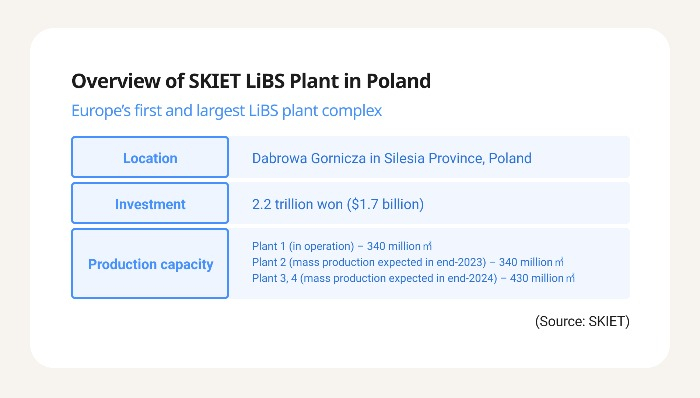
    SKIET has made a big bet on Poland, located in the very center of Europe, with an investment of 2.2 trillion won ($1.7 billion) to build Europe’s first lithium-ion battery separator plant.

    A separator is one of three key ingredients of batteries, together with cathodes and anodes, and makes up 10-15% of battery manufacturing costs.

    It electronically isolates layers between cathodes and anodes in a battery and serves as a channel where lithium ions move between positive and negative electrodes.

    (Graphics by Sunny Park)
    (Graphics by Sunny Park)

    The Korean company is currently running its first LiBS plant with an annual production capacity of 340 million square meters in the southwestern city of Poland.

    It aims to commence the commercial production of its second separator plant in the European country with a capacity of 340 million square meters by the end of this year while adding two more plants with a total capacity of 430 million square meters, slated for mass production in the end of 2024.

    When the fourth plant starts operating, SKIET will be able to churn out up to 1.54 billion square meters of separators from the facility, the largest separator output in Europe and equivalent to power about 2.05 million electric vehicles, according to the company.

    “We are proud of SK’s advance into our city, which is comparable to Neil Armstrong’s planting of an American flag on the moon,” said Mateusz Rykała, vice president of the Katowice Special Economic Zone near Dabrowa Gornicza. “Silesia Province is now famous for the automotive industry among Europeans.”

    CENTRAL BUSINESS AND COMMUNITY PARTNER

    Since its setup, SKIET Poland (SKBMP), SKIET’s Polish entity, has grown into a core business partner of the southwestern city in Poland.

    It has donated about 330 million won to three local vocational schools in Silesia Province as part of its community services.

    It has been a sponsor of the Michał Spisak International Music Competition organized by the Municipality of Dabrowa Gornicza and Zagłębie Palace of Culture for three years in a row.

    The company also donated about 120 books related to Korean culture, music, art and drama to a public library in Dabrowa Gornicza as part of the Public Library Supporting project.

    It has been actively participating in various other community services such as the donation of physical therapy equipment to senior care centers in the city and food and gifts to local orphanages on special days like Christmas.

    Of all, SKBMP’s blood donation drive in July 2021, when the Polish city grappled with a blood shortage in the face of the COVID-19 pandemic, made a specially good impression on the company, making the people in the city embrace the Korean company as a member of its community.

    “We have built trust among villagers as the company that can stand by them during hardship,” said Park Byoung_chul, CEO of SKBMP.

    “SK not only enhances the sustainability of the city but also plays a leading role in improving the image of Korean companies,” said Bazylak.[/vc_column_text][distance desktop_type=”30″][/vc_column][/vc_row][/vc_section]

  • LEAG is transforming coal plant into Germany’s largest energy storage system

    LEAG is transforming coal plant into Germany’s largest energy storage system

    [vc_section][vc_row][vc_column][distance desktop_type=”30″][lvs][distance desktop_type=”30″][vc_btn title=”Source – Balkan Green Energy News” color=”sky” i_type=”material” i_icon_material=”vc-material vc-material-perm_device_information” add_icon=”true” link=”url:https%3A%2F%2Fbalkangreenenergynews.com%2Fleag-is-transforming-coal-plant-into-germanys-largest-energy-storage-system%2F|target:_blank”][distance desktop_type=”30″][vc_column_text]LEAG has announced it would transform its lignite-fired thermal power plants and open-cast pits in eastern Germany into Europe’s largest green energy hub, with a capacity between 7 GW and 14 GW. The project will utilize wind and solar energy, innovative battery technology, and hydrogen. The initial phase involves a EUR 200 million investment to convert the Boxberg coal plant into the biggest renewable energy storage system in the country.
    LEAG, the second-largest producer of electricity from coal in Germany, plans to transform its complex of thermal power plants and coal mines in the Lusatia region in the eastern part of the country into the biggest green energy hub in Europe.

    Last week, the company estimated that by 2040, it would install between 7 GW and 14 GW of wind and solar energy capacity, along with up to 3 GWh of storage capacity and 2 GW for green hydrogen production. The transition is aimed at replacing 8 GW of coal power capacity.

    Pilot energy storage project at the Boxberg TPP site
    After closing the mines, the company plans to utilize the existing infrastructure for energy storage from renewable sources. LEAG is also considering the possibility of installing floating solar power plants, as some of the open cast coal mines will be turned into lakes.

    The company plans to utilize the existing infrastructure for storing energy from renewable sources after it closes the mines

    The company intends to invest EUR 1.5 billion in renewable energy by 2030 and aims to install wind farms and solar power plants with a total capacity of 7 GW on the mining sites.

    The largest battery system in the country is set to be installed at the location of its Boxberg power plant, situated on the border with Poland.

    LEAG has signed an initial agreement with American energy storage system manufacturer ESS Tech. The company claims its large duration energy storage (LDES) battery technology, utilizing iron, salt, and water, offers the lowest costs and that it is environmentally safe.

    LDES systems can provide electricity for at least ten hours at maximum operational power. The two companies are planning a 50 MW facility with a capacity of 500 MWh, alongside weaker lithium-ion batteries and hydrogen storage.

    The Boxberg thermal power plant is the first in line for the switch to renewable energy storage, with plans to make it operational by 2027. The 2.6 GW facility was commissioned in 1971.

    LEAG has announced that, along with its partners, it earmarked initial EUR 200 million and that it would seek additional investors as well as subsidies from the German government and the European Union. The entire project is estimated to cost EUR 500 million.

    Utility has 7 GW in renewables in project pipeline for 2030
    LEAG, owned by Czech companies EPH and PPF Investments, plans to connect a total of 7 GW of wind farms and solar parks to the grid before the end of the decade. The projects would occupy an area of 33,000 hectares or 330 square kilometers, on former coal mines. The energy giant estimates that it will require EUR 10 billion euros for the endeavors.

    Last year, the utility announced its pioneering project, GigawattFactory, for its first gigawatt of solar power, operational by early 2026. The construction is expected to cost over EUR 1 billion, it said. LEAG anticipates that over 1,000 employees would be directly or indirectly involved in the project, while its complex currently employs around 8,000 workers.

    The existing infrastructure in the coal complex facilitates the transition to green energy
    The existing power grid and other infrastructure can be utilized for the proposed thermal and electricity storage facilities on former open pit mines and closed coal plants.

    LEAG’s green energy hub is expected to provide the equivalent of up to 7% of the country’s current electricity demand.

    Government in talks with the business sector on achieving climate goals
    Germany is bound by law to phase out coal usage by 2038, but the governing coalition has promised to do so before the end of the current decade.

    The majority of coal power plant operators in Germany have already committed to shutting them down by 2030, and the government is also in negotiations with LEAG on the matter.

    Last autumn, the state achieved an agreement with RWE, Germany’s largest electricity producer, to close its coal-fired systems. Two plants with a combined capacity of 3 GW are scheduled to be shut down by 2030. In return, RWE obtained permission to extend the operation of two others, totaling 1.2 GW and originally set for closure in 2022, until March 2024.[/vc_column_text][distance desktop_type=”30″][/vc_column][/vc_row][/vc_section]

  • Taiwan, Poland agree to boost collaboration on EVs, hydrogen energy

    Taiwan, Poland agree to boost collaboration on EVs, hydrogen energy

    [vc_section][vc_row][vc_column][distance desktop_type=”30″][lvs][distance desktop_type=”30″][vc_btn title=”Source – Focus Taiwan” color=”sky” i_type=”material” i_icon_material=”vc-material vc-material-perm_device_information” add_icon=”true” link=”url:https%3A%2F%2Ffocustaiwan.tw%2Fbusiness%2F202306210025|target:_blank”][distance desktop_type=”30″][vc_column_text]Taipei, June 21 (CNA) Taiwan and Poland have signed two memorandums of understanding (MOUs) on electric vehicles and hydrogen energy, the Ministry of Economic Affairs (MOEA) said Wednesday.

    According to the MOEA’s Department of International Cooperation, the MOUs were signed by both sides during the 11th Taiwan-Poland Economic Consultations meeting in Warsaw Tuesday.

    The meeting was attended by Taiwan’s Deputy Minister of Economic Affairs Chen Chern-chyi (陳正祺) and Polish Secretary of State for Economic Development and Technology Grzegorz Piechowiak.

    The department said that under the MOUs, Taiwan and Poland would systematically enhance cooperation in the two fields.

    During the event, Piechowiak called for a Taiwan-Poland work team to further two-way collaboration on hydrogen energy development. He noted that bilateral trade grew 4.2 percent year-on-year to hit US$1.72 billion in 2022, the MOEA said in a statement.

    For his part, Chen touted Taiwan’s key position in the global supply chain and foresaw great potential for a strong economic partnership between the two countries based on their respective R&D strength and talent pools, the MOEA added.

    According to Chen, Taiwan hopes to cement its economic relations with Poland in part to diversify its market exploration efforts, while in part seeking to pave the way for it to initiate a mechanism with the European Union to push for trade and investments.[/vc_column_text][distance desktop_type=”30″][/vc_column][/vc_row][/vc_section]

  • DTEK attracts KPMG to cooperation to increase intl assistance to energy sector

    DTEK attracts KPMG to cooperation to increase intl assistance to energy sector

    [vc_section][vc_row][vc_column][distance desktop_type=”30″][lvs][distance desktop_type=”30″][vc_btn title=”Source – Interfax” color=”sky” i_type=”material” i_icon_material=”vc-material vc-material-perm_device_information” add_icon=”true” link=”url:https%3A%2F%2Fen.interfax.com.ua%2Fnews%2Feconomic%2F917853.html|target:_blank”][distance desktop_type=”30″][vc_column_text]DTEK has attracted the international auditing company KPMG to increase international donor assistance for the restoration of Ukraine’s energy sector, the energy holding said on its Telegram channel on Tuesday.

    “This will help increase the attraction of funds and equipment for the restoration of the energy infrastructure destroyed by Russia,” the company said.

    According to CEO of DTEK Maksym Timchenko, cooperation with KPMG builds trust in the company’s relations with donors.

    “DTEK’s international partners provide important support, and we are working to keep the light on during this war. DTEK has zero tolerance for any form of corruption, and our cooperation with KPMG builds trust in DTEK’s relationships with donors” Timchenko quoted by the company said.[/vc_column_text][distance desktop_type=”30″][/vc_column][/vc_row][/vc_section]

  • EU countries fail to agree position on electricity market reform

    EU countries fail to agree position on electricity market reform

    [vc_section][vc_row][vc_column][distance desktop_type=”30″][lvs][distance desktop_type=”30″][vc_btn title=”Source – EURACTIV.com” color=”sky” i_type=”material” i_icon_material=”vc-material vc-material-perm_device_information” add_icon=”true” link=”url:https%3A%2F%2Fwww.euractiv.com%2Fsection%2Felectricity%2Fnews%2Feu-countries-fail-to-agree-position-on-electricity-market-reform%2F|target:_blank”][distance desktop_type=”30″][vc_column_text]The EU’s 27 energy ministers failed to reach a common position on reforming the bloc’s electricity market on Monday (19 June), following disagreements over subsidies for backup coal power generation and the lifetime extension of existing nuclear power plants.

    The reform, tabled by the European Commission in March, seeks to avoid a repeat of last year’s energy crisis when record-high gas prices left consumers with soaring energy bills.

    It aims to lower consumer bills by relying less on short-term markets and promoting instead long-term contracts with renewable energy producers providing electricity at a lower cost.

    “Long and difficult negotiations on electricity market design today,” Swedish Deputy Prime Minister and Energy Minister Ebba Busch, who chaired the meeting, told journalists afterwards.

    “We have successfully agreed on two out of three parts of the electricity market design package,” she added.

    Ministers met in Luxembourg with the aim of greenlighting their stance ahead of negotiations with the European Parliament to finalise the law before the winter season.

    But while they agreed on a law to prevent market manipulation and tentatively agreed on some elements of market reform, they left with major outstanding issues.

    The rest of the reform is being sent back to EU ambassadors for further talks on elements such as contracts for difference, which regulate state aid for power generation projects, and capacity mechanisms, which remunerate backup suppliers to the grid.

    Derogation for coal subsidies

    One of the reasons why finding agreement was so difficult is that, unlike some debates, there is no clear split between countries. Instead, there are different blocking minorities that want different things, according to two EU diplomats.

    Blame has also been laid at the feet of the Swedish EU Presidency, with a third diplomat telling EURACTIV that there had been a waste of three hours while another criticised the Swede’s “mismanagement” in attempts to broker a deal.

    The diplomat pointed to the disruption caused on Friday (16 June) when the Swedish Presidency produced a new text including a derogation for coal subsidies via capacity mechanisms in a move seen as a way to appease Poland.

    The move needlessly opened a Pandora’s Box and pushed back progress on reaching the required majority, the diplomat told EURACTIV.

    Throughout the day, several countries voiced concerns about including a derogation for coal, including Luxembourg’s energy minister Claude Turmes, who said it was “really astonishing” and weakened Europe’s climate policies. He added that there was a big enough group of countries to block a text with this in.

    Asked about the coal proposal, Swedish Energy Minister Ebba Busch said ensuring Poland, which borders Ukraine, had stable power generation could help it support Ukraine with back-up power.

    Poland, which gets around 70% of its power from coal, could prolong its support scheme for coal plants, potentially until 2028, under the proposal.

    “For some of us, security means capacity markets,” Polish Climate Minister Anna Moskwa said earlier on Monday.

    In the room document circulated by the Swedish Presidency on Monday and seen by EURACTIV, the explicit derogation for coal has been removed. However, this is not the final text and may still be revised.

    According to one diplomat, the proposal will likely return to talks between ambassadors on Friday (23 June) but could require a couple more sessions to approve, making it unlikely to be agreed on until the Spanish presidency, which takes over in July for the next six months.

    Contracts for difference

    Another outstanding issue relates to contracts for difference, with France and Germany butting heads on this point.

    While France is looking at contracts for difference to support the lifetime extension of its existing fleet of nuclear power plants, Germany is adamantly against this.

    “We are fine with contracts for difference, in general, of course, but for existing generation, we feel that this could lead to market distortions as large parts of the markets could become inflexible and also to a distortion of the level playing field concerning the prices in Europe,” said Robert Habeck, Germany’s vice chancellor and minister for economy and climate.

    According to EU energy chief Kadri Simson, more work needs to be done on the wording regarding existing assets.

    “This is an important point because it has implications for investment promotion and for the single market and the level playing field among member states. So we decided that we need some more time to achieve a viable solution,” she explained.

    The reform will now return to the ambassador level, where further negotiations regarding the text will occur. Once this is complete, it can be approved by any meeting of EU ministers.

    [Edited by Frédéric Simon/Alice Taylor. Additional reporting from Reuters][/vc_column_text][distance desktop_type=”30″][/vc_column][/vc_row][/vc_section]

  • Deal focus: Poland wins huge Intel investment

    Deal focus: Poland wins huge Intel investment

    [vc_section][vc_row][vc_column][distance desktop_type=”30″][lvs][distance desktop_type=”30″][vc_btn title=”Source – Investment Monitor” color=”sky” i_type=”material” i_icon_material=”vc-material vc-material-perm_device_information” add_icon=”true” link=”url:https%3A%2F%2Fwww.investmentmonitor.ai%2Fnews%2Fdeal-of-the-week-poland-intel%2F|target:_blank”][distance desktop_type=”30″][vc_column_text]

    The deal

    US chipmaker Intel joined forces with the Polish Government on 16 June to announce a €4.2bn investment in the Lower Silesian region, in the west of the country close to the Czech Republic/Germany border. This comes as the EU ramps up its efforts to become self sufficient in the manufacturing of semiconductors in light of the shortage that occurred during the Covid-19 pandemic.

    Why it matters

    All foreign direct investment (FDI) projects are of value to the host country, but certain sectors are particularly sought after in the 2020s. Last week we highlighted Morocco’s announcement of Gotion High Tech’s $6.4bn EV battery plant – one such area that most countries in the world are looking to achieve ‘hub’ status – and this week we look at the semiconductor industry, the source of myriad government initiatives and countless trade visits. Intel’s announcement in Poland – one of the world’s FDI stars of the past couple of decades even before this project – is a big one for the country, and for the EU more widely.

    Of the deal, Investment Monitor chief economist Glenn Barklie says: “In 2021, we correctly predicted that Intel would put a new fab plant in Germany. We also suggested that it may choose several locations in Europe (which has been the case given investments in France, Ireland, Italy and Spain), with a more cost-sensitive operation being placed in eastern Europe.

    “The location of the new facility is a strategic choice. Miekinia, a small city located 26km to the west of Wrocław, allows access to Intel’s fabs in Magdeburg in Germany and its R&D facility in Gdańsk.

    “Although incentives are generally seen as the icing on the cake in terms of site selection, for Intel it is much more of a driving factor. The company has (re)negotiated further incentives to build its Magedburg operation – $11bn up from $7.4bn, due to rising construction and energy costs.”

    The incentives offered as part of this new announcement are as yet unknown, but they are expected to be substantial. Poland set out to win the deal in a way that evidently impressed the Intel hierarchy. “Poland was just a little bit hungrier to win this site,” were the worlds used by Intel CEO Pat Gelsinger at a news conference announcing the project.

    However, amid the fanfare there are still issues that will have to be addressed. Barklie continues: “With Poland still largely reliant on coal for its energy, it will be interesting to see how quickly the country can make the switch to renewables given Intel’s commitments to use 100% renewable energy by 2030. On this front, we have seen strong, recent growth in inbound renewables FDI in Poland, particularly onshore wind and solar power.

    “More generally, Poland is the leading location in central and eastern Europe for greenfield investments. It accounted for about 25% of FDI projects in the region in 2022. Therefore, it would be expected to at least make the shortlist for such a large-scale investment.

    “Other key drivers for semiconductor investments include skilled labour, both existing and incoming (via graduates from universities), innovation, infrastructure (transportation, IT, land/facilities) and utilities. The chosen location will have had to meet these factors.”

    This investment in Miekinia should also bring additional investment and job creation to the region as Intel’s suppliers follow.

    This Intel activity isn’t just a win for Poland, however. Barklie concludes: “In a wider context, the project is a huge win for Europe. Intel’s investments in Europe (more so the EU) offer at least some indication that the EU’s Chips Act is working. Many European countries will be hoping that several more tier-one chip manufacturers establish similar operations in the near future.”

    The detail

    Details of the deal are still emerging, particularly with regards to the public money used to entice Intel, but the company says the project will bring with it 2,000 jobs, with thousands more being created indirectly. As for the date when the site will be operational, the company’s statement says: “This facility will help meet critical demand for assembly and test capacity that Intel anticipates by 2027.” The deal continues a busy 2023 for Intel, as it has just invested $25bn in a new chip plant in Israel, also expected to be operational by the end of 2027.[/vc_column_text][distance desktop_type=”30″][/vc_column][/vc_row][/vc_section]

  • Polish coal asset spin-off would lure investors, Amundi says

    Polish coal asset spin-off would lure investors, Amundi says

    [vc_section][vc_row][vc_column][distance desktop_type=”30″][lvs][distance desktop_type=”30″][vc_btn title=”Source – Mining.com” color=”sky” i_type=”material” i_icon_material=”vc-material vc-material-perm_device_information” add_icon=”true” link=”url:https%3A%2F%2Fwww.mining.com%2Fweb%2Fpolish-coal-asset-spin-off-would-lure-investors-amundi-says%2F|target:_blank”][distance desktop_type=”30″][vc_column_text]

    Poland’s planned curve-out of coal assets from its utilities would attract new investors, Amundi’s Marcin Fiejka said in Warsaw on Tuesday.

    “Energy transformation is a low-hanging fruit,” Fiejka, head of EM CEEMEA Equity at Amundi, said at the Bloomberg Capital Market Forum. “Planned carve-out of coal assets should make Polish utilities attractive for new group of investors.”

    The government seeks to spin off coal-fired power plants from the country’s biggest state-controlled utilities later this year. The plan, which has been delayed by several months, will allow power companies to focus on green energy generation. It would also given them better access to international financial markets, where funding for carbon-heavy investments has been in decline.

    PGE SA, Tauron Polska Energia SA and Enea SA plan to spend tens of billions of zloty in the coming decade. Poland has said it needs to invest more than 1 trillion zloty ($245 billion) in the energy sector through 2040 to replace aging coal plants, which currently produce about 70% of its electricity.

    Coal-exposed companies, which also include PKN Orlen SA and JSW SA have 18% share in Warsaw’s benchmark WIG20 equity index. For Amundi, Polish capital market needs more blue-chips to attract capital inflows.

    (By Maciej Martewicz and Konrad Krasuski, with assistance from Maria Tadeo)

    [/vc_column_text][distance desktop_type=”30″][/vc_column][/vc_row][/vc_section]
  • Europe in danger of losing EV battery race, Court of Auditors says

    Europe in danger of losing EV battery race, Court of Auditors says

    [vc_section][vc_row][vc_column][distance desktop_type=”30″][lvs][distance desktop_type=”30″][vc_btn title=”Source – Reuters” color=”sky” i_type=”material” i_icon_material=”vc-material vc-material-perm_device_information” add_icon=”true” link=”url:https%3A%2F%2Fwww.reuters.com%2Fbusiness%2Fautos-transportation%2Feurope-danger-losing-ev-battery-race-court-auditors-2023-06-19%2F|target:_blank”][distance desktop_type=”30″][vc_column_text]

    BRUSSELS, June 19 (Reuters) – Europe is in danger of losing the race to become a global battery powerhouse as access to raw materials remains a major roadblock along with rising costs and fierce competition, a report by the European Court of Auditors (ECA) said on Monday.

    The report warned that the European Union may fail to meet climate goals as those efforts rely heavily on the uptake of electric vehicles run on batteries made up of a cocktail of metals ranging from cobalt to nickel and lithium.

    The ECA, the EU’s independent external auditor, said nearly one in five new cars registered in the bloc in 2021 had an electrical plug. Demand is set to jump with about 30 million zero-emission vehicles expected to hit European roads by 2030, and the sale of new petrol and diesel cars will be banned by 2035.

    However, the EU’s strategy has not taken into account the bloc’s ability to meet this new battery demand.

    “The EU aspires to become a global battery powerhouse to ensure its economic sovereignty but will it succeed? The odds are not looking good,” Annemie Turtelboom, who led the ECA audit, told reporters.

    “We are facing the risk that either the EU will miss its emissions goals for 2035 or that it will reach this target through imported batteries…which would harm European industry and come at very high prices from third countries.”

    The EU’s supply of raw materials is highly concentrated in a few countries with geo-political risks that could result in shortages. For five key materials, the EU’s import reliance was on average 78%, the ECA said.

    “The EU must not end up in the same dependent position with batteries as it did with natural gas from Russia,” Turtelboom said.

    Some two-thirds of the world’s cobalt is sourced from the Democratic Republic of Congo, 40% of natural graphite is from China and the EU is entirely dependent on imports of refined lithium. China accounts for 76% of global battery production capacity.

    Extraction in Europe will take too long. Portugal, which holds the bloc’s largest lithium reserves, does not expect production to start until 2026.

    Further, the ECA said the EU lags on cost-competitiveness in part due to high energy prices while the EU Commission’s data remains outdated and incomplete, and public funding remains uncoordinated leading to overlaps.

    Reporting by Julia Payne; Editing by Kirsten Donovan

    [/vc_column_text][distance desktop_type=”30″][/vc_column][/vc_row][/vc_section]