Website: Eurasia.com

  • Gold Ore Mining in Kazakhstan Increased by 14% in January 2025

    Gold Ore Mining in Kazakhstan Increased by 14% in January 2025

    The beginning of 2025 proved to be successful for Kazakhstan’s mining enterprises: in January, 3.42 million tonnes of gold-bearing ore were extracted, marking a 14.1% increase compared to the same period last year, according to a report by the Bureau of National Statistics.

    Gold concentrate production surged by 46.4% to 36,000 tonnes. However, due to the declining gold content in ores at major deposits, gold extraction showed a negative trend. As a result, companies produced 8.38 tonnes of unrefined and semi-refined gold, 16% less than in January 2024. Refineries produced 3.4 tonnes of gold, reflecting a 32.8% decline year-on-year.

    The situation is even more challenging for silver producers. The output of unrefined and semi-refined silver amounted to 32.55 tonnes, while refined silver production totaled 31.63 tonnes, both figures showing a 50% drop compared to the previous year.

    Meanwhile, Kazakhstan’s international reserves showed positive dynamics for the first time since September 2024. According to Zakon.kz, the growth was driven by an increase in net foreign exchange reserves, reaching $45 billion.

  • AGMK Receives ESG Rating of 3 from Sustainable Fitch

    AGMK Receives ESG Rating of 3 from Sustainable Fitch

    Sustainable Fitch has assigned JSC Almalyk Mining and Metallurgical Complex (AGMK) an ESG Entity Rating of 3 with an entity score of 56, highlighting both strengths and challenges in the company’s sustainability practices.

    The rating acknowledges AGMK’s sustainable development strategy, governance framework, and environmental policies, despite the inherent ecological impact of its mining and metallurgical operations. The assessment also considers the company’s alignment with global taxonomies, contribution to UN Sustainable Development Goals (SDGs), and integration of ESG principles into business operations.

    As one of Uzbekistan’s largest non-ferrous metals producers, AGMK exports copper, silver, and gold to over 17 countries. Its vertically integrated production covers exploration, mining, processing, and finished product creation. While essential for various industries, these activities result in high energy consumption, greenhouse gas emissions, and significant water and waste usage.

    On the environmental front, AGMK benefits from strong policies and a clean record of major incidents over the past three years, though Scope 3 emissions remain undisclosed. Socially, the company reports low employee turnover, but serious workplace accidents and limited gender diversity remain concerns. Governance-wise, AGMK is strengthened by an independent internal audit function, effective risk management, and a low CEO pay ratio in 2023, although independent directors are a minority on its board.

    Despite challenges, the rating reflects AGMK’s continued commitment to sustainability and corporate responsibility.

  • Savannah Resources to Resume Drilling at Barroso Lithium Project After Suspension Lifted

    Savannah Resources to Resume Drilling at Barroso Lithium Project After Suspension Lifted

    Savannah Resources (LON: SAV) will immediately restart fieldwork and drilling at its Barroso lithium project in Portugal after the government lifted a temporary suspension order.

    The British company had paused work earlier this month following a precautionary injunction filed by landowners challenging the government’s approval for Savannah to access land it does not own. However, authorities issued a “reasoned resolution” stating that delays would be costly and harmful to the public interest, according to Savannah’s statement.

    Despite the news, Savannah’s stock fell 1.02% to £4.36 per share in London on Friday, giving the company a £95 million ($120 million) market capitalization.

    Barroso’s spodumene deposit is Europe’s largest, with recent prospecting results indicating it could exceed the previously estimated 28 million tonnes of high-grade lithium. However, the project has faced strong local opposition, including protests, legal battles, and refusals to sell land. Approximately 24% of the required land is privately owned, while 75% consists of common land (“baldios”).

    First Lithium Output in 2027

    Savannah aims to build four open-pit mines to supply lithium for 500,000 to 1 million electric vehicle batteries annually. The company is targeting first production by 2027.

    Once operational, Barroso is expected to produce 1.5 million tonnes annually over a 14-year mine life, based on a 20.5-million-tonne resource at 1.05% lithium oxide.

  • Russian Stocks Surge as Speculators Bet on Trump Easing Sanctions

    Russian Stocks Surge as Speculators Bet on Trump Easing Sanctions

    Shares of United Co. Rusal International PJSC—one of the few Russian companies still traded on major global exchanges—saw a 15-fold surge in trading activity this week, as investors speculated that Donald Trump might seek to ease sanctions on Russia.

    Trading volume in Hong Kong jumped to an average of 4.2 million shares per day, compared to just 250,000 in January, reflecting renewed interest in Russian assets. Rusal’s stock price has surged nearly 50% this month, reaching levels last seen in April 2022, shortly after Russia’s invasion of Ukraine.

    “Trump looks hell-bent on getting back in business with Russia,” said Kamil Dimmich, partner at North of South Capital. However, he noted that his firm does not invest in Russian stocks.

    Despite Rusal’s stock rally, the company still faces significant trade barriers. The US has a 200% tariff on Russian aluminum imports, while the EU is moving toward a full ban. The London Metal Exchange no longer accepts newly produced Russian metal, and even if sanctions were relaxed, Trump’s February tariff on all aluminum imports would still apply.

    Meanwhile, most Russian firms remain shut out of international markets, with some—like Ros Agro and Ozon—turning to listings in Kazakhstan, a nation Moscow considers “friendly.”

  • Putin Calls for Accelerated Lithium Mining as Russia Seeks Self-Sufficiency

    Putin Calls for Accelerated Lithium Mining as Russia Seeks Self-Sufficiency

    Russian President Vladimir Putin has urged the country to expedite the development of its domestic lithium and rare earth mineral deposits, citing the strategic importance of these resources for high-capacity battery production and advanced technologies.

    Speaking at a conference in Moscow, Putin criticized the country’s delay in mining lithium, stating, “We still do not mine lithium. And how can we develop without it? But we can do it. And we could have done it 10 or 15 years ago.”

    Russia possesses an estimated 1 million tons of lithium reserves, according to the United States Geological Survey (USGS), with Russian estimates placing lithium oxide reserves at 3.5 million tons. However, prior to the conflict in Ukraine, the country relied on lithium imports, which have been severely disrupted by Western sanctions. As a result, Moscow has intensified efforts to extract its own lithium and aims to eliminate imports of the metal and other rare earth elements by 2030.

    Additionally, Russian forces are advancing toward one of Ukraine’s largest lithium deposits, further underscoring the geopolitical significance of these critical minerals in the ongoing conflict.

  • European Industries Set for a “Made in Europe” Lithium Revolution

    European Industries Set for a “Made in Europe” Lithium Revolution

    Brussels, Belgium – In a bold call for industrial self-reliance, Guillaume Delacroix, Senior Vice President Performance Minerals EMEA & APAC at Imerys and Chairman of Imerys British Lithium, has spearheaded a push for more “Made in Europe” initiatives in the lithium and automotive sectors. Speaking during a high-level discussion in Brussels alongside Executive Vice-President Stéphane Séjourné and other leaders from the battery ecosystem, Delacroix emphasized Europe’s untapped potential in the green and mobility transitions.

    Delacroix outlined a clear three-pronged strategy for enhancing Europe’s role in global value chains:

    Financial Support for a Mining Renaissance: Advocating for increased funding to revive and modernize Europe’s mining industry, a critical step towards reducing dependency on external resources.
    Local Content and Carbon Footprint Incentives: Urging the implementation of measures that promote local sourcing and environmentally responsible practices, thereby strengthening domestic supply chains.
    Regulatory Reforms Aligned with Business Needs: Calling for regulations that not only safeguard the environment but also enable industry players to innovate and compete on the global stage.

    Central to these initiatives is Imerys’ pioneering #EMILI lithium project in France, which exemplifies the company’s commitment to driving the transition towards sustainable, home-grown industrial solutions. As the world leader in specialty minerals, Imerys is poised to leverage its expertise to serve the burgeoning demands of the automotive industry and beyond.

    Delacroix’s remarks come at a pivotal time, as European nations seek to balance economic growth with the imperatives of energy independence and environmental sustainability. By fostering a robust, locally driven supply chain, Europe is positioning itself to not only meet domestic needs but also to contribute significantly to global green transitions.

    The Brussels discussion underscored a shared vision among industry leaders: a future where European innovation, supported by strategic investments and progressive regulatory frameworks, propels the continent to the forefront of the global lithium and automotive markets.

  • Central Asia Metals Ranked Among Top 10 AIM-Listed Companies for Dividend Yield

    Central Asia Metals Ranked Among Top 10 AIM-Listed Companies for Dividend Yield

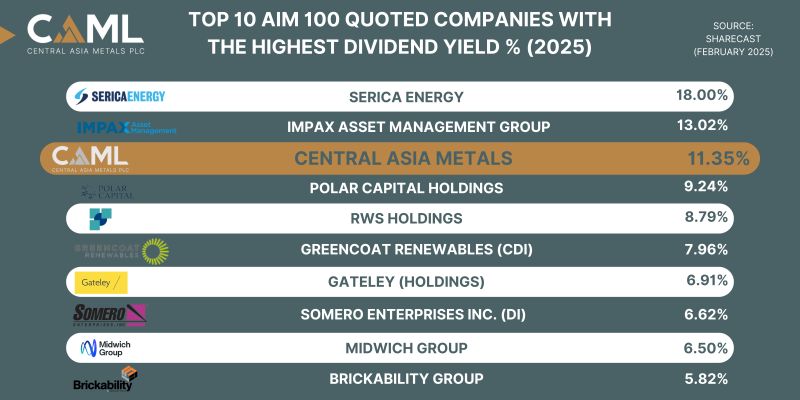
    Central Asia Metals plc (AIM: CAML), a leading mining company listed on the AIM market, has been recognised as one of the top 10 AIM-quoted companies with the highest dividend yield percentage as of February 2025. This achievement underscores the company’s commitment to delivering strong returns to its shareholders.

    For the fiscal year 2023, CAML declared a total dividend of 18 pence per ordinary share, reflecting its robust financial performance and shareholder-focused strategy. Additionally, for the first half of 2024, the company maintained its interim dividend at 9 pence per ordinary share, consistent with the same period in the previous year.

    CAML’s current dividend yield stands at an impressive 11.66%, placing it well above both the industry average of 4.6% and the top quartile of UK market dividend payers at 5.93%. This high yield highlights CAML’s attractiveness to income-focused investors, despite its high payout ratio of over 100%, which indicates dividends are not fully covered by earnings but are supported by strong cash flow coverage.

    The company operates key mining assets, including copper production facilities in Kazakhstan and zinc and lead operations in North Macedonia. Its consistent dividend payments over the years have made it a standout performer on AIM, a market known for its growth-oriented smaller companies.

  • Mining cannot be ‘greened’ outcry against Barosso lithium mine in Portugal

    Mining cannot be ‘greened’ outcry against Barosso lithium mine in Portugal

    Barroso, Portugal – A proposed lithium mining project in the scenic Barroso region has sparked fierce opposition from local communities and environmental advocates, who warn that the venture could inflict irreversible damage on one of Europe’s rare Globally Important Agricultural Heritage Systems (GIAHS).

    The project, led by Savannah Resources and its international partners, aims to transform an inactive feldspar and quartz concession into four expansive open-pit lithium mines, with production now projected to begin in 2027. Spanning a total concession area of 593 hectares, the mining operations threaten to disrupt a delicate agro-ecosystem that supports small-scale pastoral farming and preserves unique cultural traditions.

    Critics argue that the environmental risks far outweigh any potential economic benefits. In 2022, the Portuguese Environmental Agency (APA) rejected the initial Environmental Impact Assessment (EIA), citing “very significant and irreversible negative impacts” on the landscape, water resources, and local biodiversity. Although a revised EIA was later issued under conditional approval, local authorities and community groups have mounted legal challenges, arguing that the project endangers the region’s cherished GIAHS status and undermines Portugal’s international environmental commitments.

    Residents describe a climate of intimidation surrounding the project. Opposition groups claim that the mining company has employed aggressive tactics—including 24/7 private security patrols and the deployment of the Republican National Guard—to silence dissent and pressure locals into submission. “The community is being treated as if we were criminals, with our rights and our lands under constant threat,” said a spokesperson from Associação Unidos em Defesa de Covas do Barroso.

    Environmental experts also warn of severe ecological consequences. The project could strain local water supplies by diverting up to 600,000 m³ per year from local springs, jeopardize river habitats, and risk catastrophic failure of tailings storage facilities during extreme weather events. Moreover, the anticipated surge in greenhouse gas emissions could multiply the current carbon footprint of the municipality several times over, contradicting regional climate goals.

    Over 4,600 citizens have signed a petition opposing the mining project, and municipal bodies have passed formal resolutions condemning the plan. The controversy has also reached national parliamentary debates, highlighting broader concerns about how resource extraction projects are approved and monitored in Europe.

    As legal battles continue and protests intensify, the future of the Barroso lithium mine hangs in the balance—a stark reminder of the clash between the global demand for lithium, driven by energy transition imperatives, and the imperative to protect fragile ecosystems and traditional ways of life.


  • East Hope Group to Build Major Industrial Park in Kazakhstan, Investing Over $12 Billion

    East Hope Group to Build Major Industrial Park in Kazakhstan, Investing Over $12 Billion

    Chinese conglomerate East Hope Group (EHG) has announced plans to construct a large-scale industrial park in Kazakhstan, focusing on non-ferrous metallurgy and advanced mineral processing technologies. The project was revealed by the press service of Kazakh Invest, the national investment company that facilitated negotiations between EHG and Kazakh authorities.

    A tripartite agreement has already been signed between the Chinese investor, Kazakhstan’s Ministry of Foreign Affairs, and the Ministry of Industry and Construction. EHG is set to invest over $12 billion to establish metallurgical production facilities in the country. The company has registered a subsidiary in Kazakhstan and is currently evaluating potential sites for construction across various regions.

    The project is expected to create up to 10,000 new jobs at different stages of its development. While specific details about the products to be manufactured in the industrial park remain undisclosed, EHG is a prominent player in the global market for aluminum and other non-ferrous metals. The goods produced in Kazakhstan are planned to be exported to Europe, Central Asia, and China.

    According to Yerzhan Yelekeev, Chairman of the Board of Kazakh Invest, the project will help localize production, introduce cutting-edge processing technologies, and strengthen Kazakhstan’s position as a leading exporter of non-ferrous metals.

  • Kazakhstan Sees Significant Growth in Coal Production and Industry Revenue in January

    Kazakhstan Sees Significant Growth in Coal Production and Industry Revenue in January

    Kazakhstan’s mining sector experienced a notable surge in January, with mineral extraction reaching 10.08 million tons, marking a 12.9% increase compared to the same period last year. According to the Bureau of National Statistics of Kazakhstan, coal production accounted for 9.7 million tons, reflecting a 14.7% year-on-year growth, while lignite extraction declined to 380,700 tons, an 18.8% dropfrom January 2023.

    The production of coal concentrate also showed positive trends, with 292,700 tons processed in the country’s enrichment plants during the first month of the year, a 4.7% increase compared to the previous year. In monetary terms, the industry’s output rose to 52.29 billion tenge, representing a 16.7% growth from 2023. This growth has significantly contributed to Kazakhstan’s industrial production index, which stood at 101.3% compared to January 2023.

    During a February meeting of the Ministry of Industry and Construction, industry stakeholders reviewed last year’s performance, outlined plans for 2025, and discussed preparations for the heating season. The domestic market currently requires 7.9 million tons of solid fuel, with 7.53 million tons already supplied. Additionally, coal reserves at storage facilities have increased to 476,000 tons.

    It is worth noting that industry players have previously expressed opposition to transitioning under the management of the Ministry of Energy.