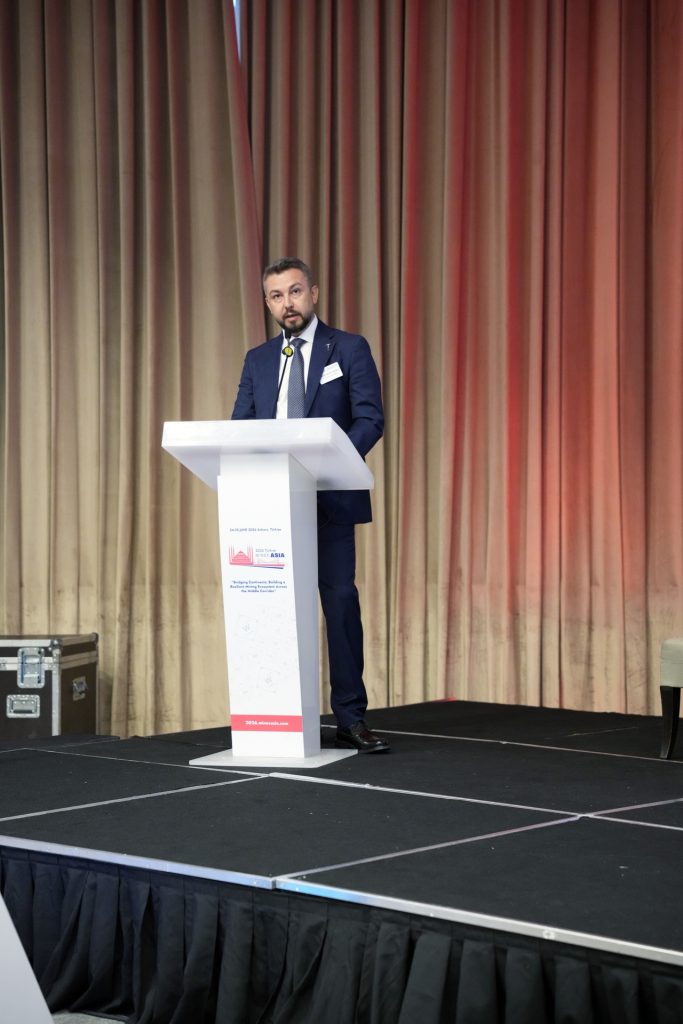
Ahmet Serkan Sarıtaş introduced Türk Gold Corp (formerly Koza Gold Enterprises), describing it as Turkey’s first wholly domestically-capitalized gold mining company, founded in 2005, with 30% of its capital publicly listed on Borsa Istanbul since 2010. He noted the company rebranded to its current name in 2025 and now operates as a strategic national asset within the portfolio of the Turkey Wealth Fund. He cited the company’s scale: 2,553 specialized employees, operations spanning 41 provinces, and 231 active licenses, framing this footprint as evidence of the company’s commitment to converting Turkey’s mineral potential into economic value.
He situated gold mining within the broader narrative of energy transition, electrification, AI, and digitalization, arguing that reliable mineral resources underpin all of these transformations — electric vehicles, battery technology, AI infrastructure, renewable energy systems, and defense industries. He argued that minerals have consequently evolved beyond simple economic commodities to become fundamental elements of economic security, industrial policy, and strategic independence, making the creation of reliable, sustainable, and diversified supply chains a top national priority.
He positioned Turkey favorably within this new landscape, citing the country’s roughly $3.5 trillion mineral potential, strong industrial infrastructure, developed logistics network, skilled workforce, and long mining history as preparing it for a stronger role in the global mining ecosystem. He argued that future competitive advantage will belong not simply to countries possessing mineral resources, but to those capable of converting those resources into knowledge, technology, industry, and sustainable development — emphasizing that investment in geological knowledge, scientific research, human capital, and advanced technology serves as the guarantee of future resource security, alongside environmental responsibility, social awareness, and good governance principles.
He addressed Turkey’s “strategic” mining characterization directly, clarifying that this should not be understood as economic isolation, but rather as strengthening domestic capabilities while simultaneously deepening international cooperation and building resilient supply chains — with Turkey’s position at the center of the Middle Corridor serving as a natural bridge between Europe and Asia, valuable not just as a logistics route but as a platform for investment, technology transfer, and high-value industrial clustering.
He described Türk Gold’s approach as reducing Turkey’s external dependency and contributing to narrowing the current account deficit, while measuring success not solely by gold output volume but by employment generation, local supply chain development, and social investment in the regions where the company operates — framing mining’s success as ultimately measured by contribution to quality of life rather than metal tonnage alone.
He highlighted several human capital initiatives: the company’s first-time sponsorship of Teknofest Mining Technology competitions, establishment of an R&D center, international scholarship programs, and dedicated scholarships for students entering mining-related university programs. He closed by identifying four themes he expects to shape the sector going forward: intensifying global competition for critical minerals, transformative impact of AI and digital technologies, rising environmental and social expectations, and growing importance of international cooperation and resilient supply chains — positioning Turkey as aiming to be among the leading countries shaping this future.