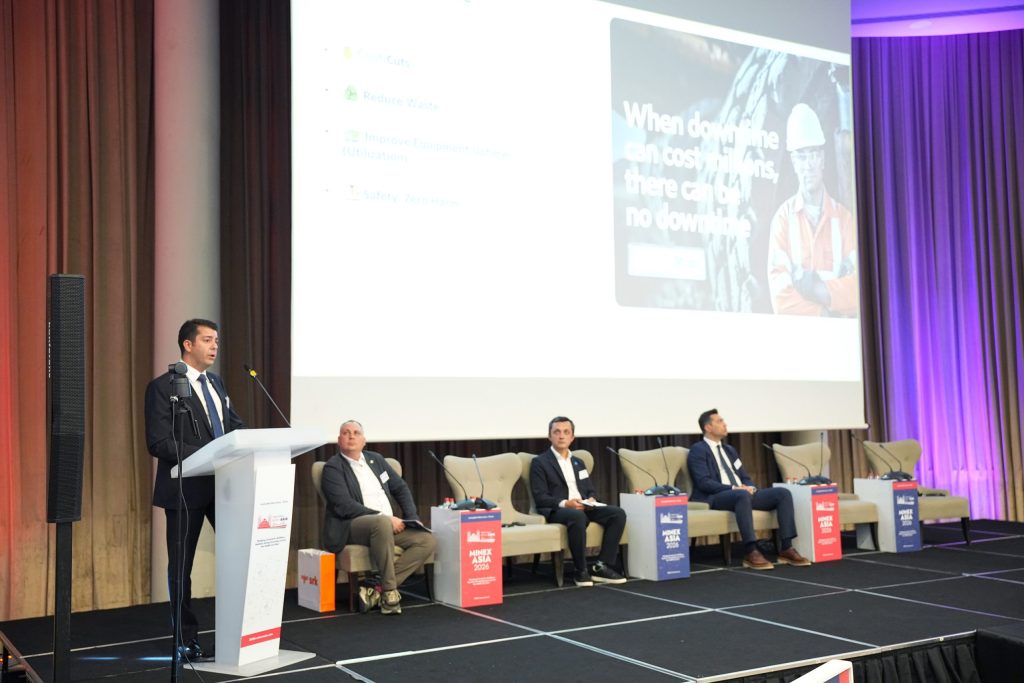
Burak Köse’s presentation closed the “From Ore to Application” session, following talks on Uzbekistan’s technopark model and ExxonMobil’s lubrication technology. Based on the chapter markers provided in the source material, his talk covered geometallurgy’s role in the critical raw materials value chain, progressing through several structured topics: an introduction to geometallurgy as a discipline, the construction of geometric (ore body) models, economic optimization based on those models, and worst-case scenario analysis — likely addressing how processing plants and investors can stress-test recovery and economic assumptions against unfavorable geological or operational conditions.
Given ARGETEST’s stated focus on mineral processing and R&D, and the placement of this talk alongside SGS’s earlier mineralogy presentation (Tomas Hrstka’s talk on applied/automated mineralogy for de-risking projects), it’s likely Köse’s presentation reinforced similar themes: that laboratory analysis and geometallurgical modeling generate the quality data offtakers and investors require, and that this data-driven approach accelerates product development while reducing technical and financial risk in critical minerals projects — consistent with the session’s stated framing that “value chain integration in Central Asian mining is not a distant ambition” but something achievable with technology deployed today.
Unfortunately, without an English transcript or translation of the actual spoken content, a detailed, accurate summary of Köse’s specific arguments, data, case studies, or conclusions cannot be responsibly provided. If a translated transcript or additional source material becomes available, I’d be glad to produce a complete summary matching the depth of the other speaker profiles.