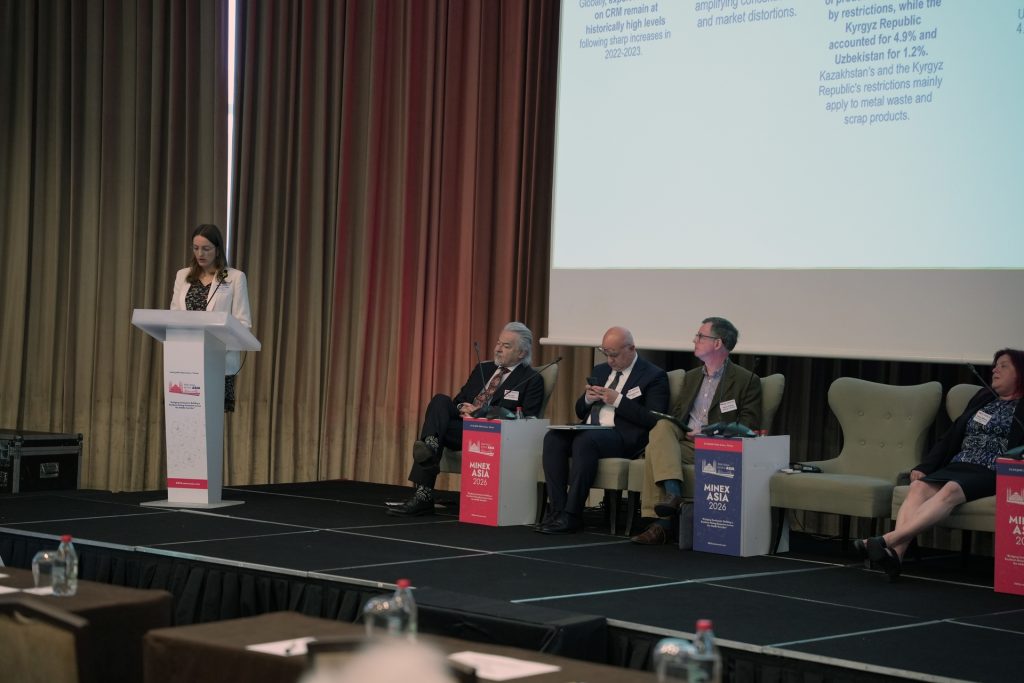
Celeste Lagora Tullon — OECD
Lagora Tullon presents OECD’s work on Central Asia’s CRM landscape, framing the core question not as whether the region has mineral potential (widely accepted) but how to convert that potential into secure, transparent, higher-value supply chains. She gives country-by-country snapshots: Kazakhstan is the largest, most diversified producer and closest to international reporting standards; Kyrgyzstan has a concentrated, gold-heavy profile with a new (late-2025) CRM strategy but contradictory policy signals around state ownership and export restrictions; Tajikistan holds major antimony reserves (already exported to the EU) but lags on regulatory modernization; Turkmenistan remains hydrocarbon-focused with underexplored mineral potential; Uzbekistan combines strong resources with ambitious reforms opening to foreign investment under continued state oversight. Her broader conclusion: governance, regulatory stability, and transparency matter as much as geology.
She then introduces a new EU-funded (Global Gateway) project examining three bottlenecks to converting Central Asia from a raw-material exporter into a processing economy: (1) transport infrastructure still geared toward bulk commodities — only 11% of Kazakhstan’s freight stations can handle containers, a problem for higher-value, time-sensitive CRM shipments; (2) trade policy volatility — export restrictions on CRM are rising globally, and Central Asian economies (Kazakhstan, Kyrgyzstan, Uzbekistan) are part of that trend, undermining investor predictability; (3) insufficient processing/refining capacity, which limits value capture and leaves the region dependent on external (mainly Chinese) processing hubs. The project will survey mining-sector stakeholders and produce a ministerial-level report by mid-next year.
#CentralAsia #CriticalRawMaterials #GlobalGateway #MiddleCorridor #OECD #MiningIndustry #SupplyChainSecurity