Website: Kazakhstan.com

  • Pallas Resources Unveils Thick Copper Outcrop at Merke and Launches Drilling at Glubokoe

    Pallas Resources Unveils Thick Copper Outcrop at Merke and Launches Drilling at Glubokoe

    London, 3 September 2025 — Pallas Resources has announced the discovery of a substantial outcropping copper zone at its Merke and Lugovoe licences in southern Kazakhstan, alongside the commencement of first drilling at the Glubokoe Project in the western Chu-Sarysu Basin. Both developments mark significant milestones in the company’s strategic alliance with Ivanhoe Mines.

    Fieldwork at Merke has revealed a 20-metre-thick copper-bearing horizon within fractured carbonate rocks, exposed in a historic pit. The discovery confirms visible surface mineralisation, including malachite and azurite, and strongly supports the structural model guiding exploration. According to the company, the mineralisation is thought to be structurally controlled, with fractures and faults serving as conduits for copper-bearing fluids.

    The Lugovoe licence, recently granted to the Pallas–Ivanhoe partnership, extends prospective stratigraphy by a further 40 kilometres to the west. Early reconnaissance has already identified surface copper mineralisation, with fold zones appearing to act as structural traps. Upcoming work will focus on detailed structural mapping, complemented by high-resolution magnetic surveys to trace mineralisation beneath cover.

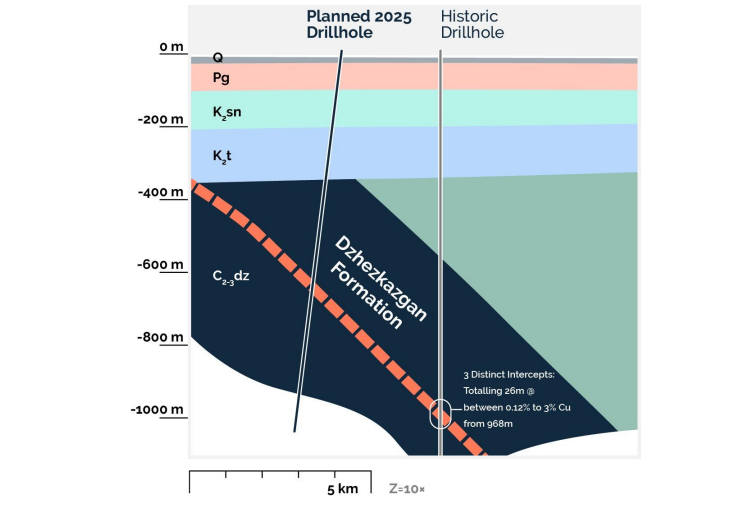
    Meanwhile, drilling has commenced at Glubokoe, a 2,500 km² project in the western Chu-Sarysu Basin. The programme will comprise five diamond drill holes, each between 800 and 1,000 metres deep, totalling around 4,200 metres. The first hole is targeting extensions of mineralisation first recorded by Soviet geologists in the 1980s, where three copper-bearing intervals were intersected over a total of 26 metres, with grades ranging from 0.12% to 3% copper.

    Simon Cooper, Chief Executive of Pallas Resources, described the start of drilling as a “key milestone,” coming less than a year after the partnership with Ivanhoe Mines was formalised. Results from the current campaign are expected by late December and will help inform a planned 15,000-metre drilling programme in 2025.

    The Chu-Sarysu Basin is recognised as the world’s third-largest sediment-hosted copper province, already hosting more than 27 million tonnes of discovered copper, with the US Geological Survey estimating a further 25 million tonnes yet to be found.

    Pallas holds over 16,000 km² in the basin, making it the leading explorer in this emerging copper district. Under the terms of the alliance, Ivanhoe Mines will sole-fund $18.7 million during the initial phase, with the option to invest up to $115 million over four years.

  • Mining Turns to Waste Reprocessing, AI, and Bio-Tech to Meet Global Copper and Critical Metal Demand

    Mining Turns to Waste Reprocessing, AI, and Bio-Tech to Meet Global Copper and Critical Metal Demand

    The global pivot away from fossil fuels is creating unprecedented demand for copper and other critical minerals, but the mining industry faces a daunting challenge: falling ore grades, scarce new discoveries, and project timelines that can stretch over a decade. To bridge the gap, miners are reviving old waste, deploying advanced processing technologies, and turning to artificial intelligence.

    Between 1910 and 2010, an estimated 100 million tonnes of copper were discarded into tailings ponds, according to Germany’s Fraunhofer Institute. These legacy deposits are now being seen as a resource. Rio Tinto has already extracted scandium and tellurium from waste streams, while Hudbay Minerals is evaluating re-mining opportunities at its closed Flin Flon mine in Canada. Australia’s Cobalt Blue Holdings is studying pyrite tailings as a potential sulphur source, and India’s Hindustan Zinc has committed $438 million to process 10 million tonnes of tailings per year at its Rampura Agucha mine.

    At the same time, miners are working to reduce waste from new operations. Glencore’s ISAMill and Albion Process are enabling higher recovery rates with lower water use, while US bio-tech firm Allonnia has developed D-Solve, a microbial process that removes impurities like magnesium. At the Eagle nickel mine in the US, Allonnia is piloting a system that boosts nickel grades by 18% while cutting impurities by 40%.

    Artificial intelligence is becoming a central driver of efficiency. BHP uses generative AI and digital twin technology at its Escondida copper mine in Chile to optimize blasting, blending, and mill performance. Freeport-McMoRan, working with McKinsey, trialed AI at its Baghdad mine in Arizona, achieving a 5–10% increase in copper production. Rolling this out across its US operations could add 90,000 tonnes of copper annually — equivalent to a new $1.5 billion processing plant, but without the decade-long construction timeline.

    The push to reprocess waste, integrate bio-engineering, and apply AI represents a quiet revolution in one of the world’s oldest industries. If successful, it could transform mining from one of the planet’s most polluting activities into a cleaner, more efficient sector — ensuring that the energy transition has the metals it needs.

  • Kazakhstan and US Forge Strategic Alliance in Rare Earth Exploration

    Kazakhstan and US Forge Strategic Alliance in Rare Earth Exploration

    Kazakhstan’s state mining company, Tau-Ken Samruk, and US-based Cove Capital are set to begin geological exploration at the Akbulak site in the Kostanai Region, targeting the discovery of rare earth elements in a significant international venture.

    “This initiative reflects our commitment to modernising industry and infrastructure while building a research base capable of supporting high-technology sectors,” said a spokesperson for the Samruk Kazyna Sovereign Wealth Fund.

    The exploration forms part of a wider strategic partnership between the firms, focusing on advancing high-potential industries. In line with this, Kazakhstan aims to overhaul its production capabilities, introduce advanced processing technologies, and further strengthen its scientific foundation.

    According to the Ministry of Industry and Construction, rare and rare-earth metals contribute 2.4% of the nation’s metallurgy output. Since 2018, the government has allocated 67 billion tenge (£114 million) to support the industry. Large-scale geological surveys are ongoing, with 25 sites across 100,000 square kilometres and 38 promising mineral deposits identified in 2024 alone.

    Currently, Kazakhstan produces a wide array of strategic metals including beryllium, tantalum, niobium, scandium, titanium, rhenium, and osmium, with by-products such as bismuth, antimony, selenium, and tellurium. Technologies for extracting gallium and indium are also in place. Future economic opportunities are seen particularly in the production and recycling of battery materials, heat-resistant alloys, semiconductor materials, and permanent magnets.

  • Labour Costs Climb in Kazakhstan’s Mining Sector Amid Industry Expansion

    Labour Costs Climb in Kazakhstan’s Mining Sector Amid Industry Expansion

    Kazakhstan’s mining industry is seeing a notable surge in labour costs as companies compete for skilled workers in a tight labour market. Official figures reveal that wages in the sector are outpacing the national average, a trend that is putting upward pressure on operational expenses for mining firms.

    According to data from the Bureau of National Statistics (BNS), the average nominal salary in the mining and quarrying sector reached 888,900 Tenge (approximately $1,650 USD) in the second quarter of 2025. This makes it the second-highest paying industry after the financial sector. This rise is particularly pronounced when compared to the broader economy, with nominal wages in mining increasing by 12.9% in the first half of the year, while the national average grew by 10.7%.

    This overall average, however, is skewed by high salaries in the oil and gas subsector. For example, workers in crude oil and natural gas extraction earn an average nominal salary of 1.4 million Tenge (approximately $2,600 USD). In contrast, those in coal mining and metal ore extraction earn significantly less, at 673,100 Tenge (approximately $1,250 USD) and 698,000 Tenge (approximately $1,290 USD), respectively.

    Mining companies are facing pressure to offer competitive salaries to attract and retain talent, especially in physically demanding and high-risk roles. Vacancies for underground miners on job sites like Enbek.kz and Hh.kz offer salaries ranging from 165,300 to 500,000 Tenge (approximately $300 to $925 USD), with experienced roles like mine foreman and driller commanding salaries between 400,000 and 500,000 Tenge.

    While nominal wages provide a statistical average, they often don’t reflect the reality for most workers. The most common or modal salary is typically much lower, often only 30-50% of the nominal figure. In 2024, the modal salary in the mining sector was 372,600 Tenge (approximately $690 USD), approximately 43% of the nominal average of 866,500 Tenge (approximately $1,600 USD), closely aligning with the current salary offers for entry-level positions.

    Despite the challenges of rising costs, the increase in wages also reflects a growth in purchasing power. Real wages in the mining industry grew by 2.3% in the first half of 2025, significantly higher than the 0.3% growth seen across the wider economy.

  • Online Auction for Gold-Bearing Pirali Site in Navoi Region Closes with Record Bid

    Online Auction for Gold-Bearing Pirali Site in Navoi Region Closes with Record Bid

    Tashkent, Uzbekistan — An online auction for the right to conduct geological exploration at the gold-bearing Pirali site in Navoi region has concluded with a record-breaking bid, according to the official website of the E-auksion platform.

    The bidding process, which began on the morning of August 21, lasted 23 hours and 29 minutes, with a total of 461 bids placed. The winning bid was submitted by NBK 111, offering 99.09 billion soums—24 times higher than the starting price.

    Winner and Company Background

    According to the Unified State Register of Enterprises and Organizations (EGRPO), NBK 111 was registered in Tashkent in May 2024 and specializes in the mining of non-ferrous metal ores. The company’s charter capital stands at 1.005 billion soums. A 40% stake in NBK 111 is owned by Chinese citizen Zhang Qian, while the remaining 60% is controlled by Nurmahmad Pulatov. Pulatov also holds significant stakes in other enterprises, including a 90.7% share in Quwwatt Group (glass production in Jizzakh) and a 100% stake in BEEK Electro (electrical appliance manufacturing). All three companies share the same contact phone number, indicating potential business ties.

    Site Details and Gold Reserves

    The Pirali site covers an area of 484 hectares and is located in the Navbahor district, approximately 20.5 kilometers northwest of Zafarabad settlement and 38.5 kilometers north of the city of Navoi. Preliminary estimates suggest that the site contains gold reserves of around 2.4 tons.

    Recent Auction Activity

    This week has seen significant activity in the auctioning of major gold deposits in Uzbekistan. The Temirchi site in Navoi region was sold for 67.78 billion soums, while the Terekli site near Almalyk saw its price surge nearly 20-fold to 81.8 billion soums.

    The successful auction of the Pirali site underscores the growing interest in Uzbekistan’s mineral resources and the competitive nature of the country’s mining sector.

  • Astana and Amman to Establish Joint Venture for Uranium Development in Jordan

    Astana and Amman to Establish Joint Venture for Uranium Development in Jordan

    Tuesday, 27 August 2025

    Kazakhstan and Jordan have announced plans to create a joint venture for the development of uranium deposits in Jordan. The agreement was revealed by Nurlan Zhakupov, Chairman of the Board of the “Samruk-Kazyna” Sovereign Wealth Fund, during a press briefing on Wednesday.

    According to Zhakupov, the joint venture will be established between Kazatomprom, Kazakhstan’s national uranium company, and Jordan’s national uranium company. The agreement, signed during the visit of Jordan’s King Abdullah II, is a legally binding document that outlines the creation of the joint venture by the end of 2026.

    Scientific and Industrial Collaboration

    Under the agreement, both parties will conduct scientific research and pilot industrial work to assess the extractability and enrichability of uranium in Jordan. If the results are positive, the joint venture will be finalized by the end of 2026, with Kazatomprom holding a 70% stake and the Jordanian company owning the remaining 30%.

    Kazatomprom, the national operator for uranium exports and related products in Kazakhstan, operates under the management of the “Samruk-Kazyna” fund. The company is responsible for the export of uranium, rare metals, nuclear fuel for power plants, and specialized equipment.

    Previous Agreements and Future Prospects

    In February 2025, Kazatomprom and the Jordan Uranium Mining Company (JUMCO) signed a memorandum of cooperation to jointly study projects related to uranium exploration and mining in Jordan. The decision to collaborate was made during the fifth meeting of the Kazakh-Jordanian intergovernmental commission at the end of 2024.

    The establishment of this joint venture underscores the strategic cooperation between Kazakhstan and Jordan in the nuclear energy sector, with both countries aiming to leverage their resources for mutual economic benefit.

  • Kazatomprom to Lower Uranium Production in 2026 Amid Market Uncertainties

    Kazatomprom to Lower Uranium Production in 2026 Amid Market Uncertainties

    Friday, 22 August 2025 – Kazakhstan’s national atomic company, Kazatomprom, the world’s largest producer of natural uranium, has announced a significant reduction in its planned production for 2026. The company will lower its output by approximately 10% from previous targets, stating that current market conditions do not provide sufficient incentive to return to its 100% production levels at this time.

    The decision was announced alongside the company’s consolidated financial results for the first half of 2025. CEO Meirzhan Yussupov stated that while the long-term price for uranium has remained stable at around US$80 per pound, proving that “fundamentals remain strong,” the company does not view the current supply-demand balance and existing uncovered demand as sufficient to justify a return to full capacity.

    The reduction will decrease Kazatomprom’s nominal production level (on a 100% basis) from 32,777 tU (around 85 million pounds U₃O₈) to 29,697 tU. This cut, which amounts to roughly 8 million pounds, is expected to reduce the world’s primary uranium supply by about 5%. The majority of this production adjustment is attributed to the JV Budenovskoye project.

    Kazatomprom’s announcement comes despite a positive first half of 2025, which saw a 13% year-on-year increase in production to 12,242 tU (on a 100% basis). The company’s whole-year production guidance for 2025 remains unchanged. Kazatomprom also confirmed that its sulphuric acid supplies, a key reagent for its in-situ leach mining process, are estimated to be stable for 2026.

    In his statement, Yussupov also highlighted the potential for a new domestic market for the company’s output, pointing to Kazakhstan’s plans to build nuclear power plants. With each plant requiring about 400 tonnes of uranium annually, this could translate to a cumulative demand of 72,000 tonnes over the lifetime of three plants, potentially creating a new allocation for a portion of the company’s production.

  • Kazakhstan’s RG Gold Expands Operations, Safety Standards, and Workforce Development Amid Booming Mining Sector

    Kazakhstan’s RG Gold Expands Operations, Safety Standards, and Workforce Development Amid Booming Mining Sector

    Kazakhstan’s mining industry is thriving as rising gold and commodity prices drive exploration, investment, and legislative reform. Among the country’s leading players, RG Gold is charting a growth path that blends operational expansion, safety leadership, and employee development while preparing for its transition into a global gold operator.

    Deputy CEO and CFO Marat Shaimardanov said recent government reforms, including a new royalty-based tax code and deregulation of mining laws, have spurred fresh activity. “There’s a lot of deregulation happening for the mining industry, which is reflected by its current increased activity,” he noted.

    Operational Growth and Heap Leach Revival
    RG Gold has restarted its heap leach operations after exploration revealed remaining potential, buoyed by higher gold prices. The site is expected to run for another five years. Meanwhile, the company’s carbon-in-pulp (CIP) plant, built in 2022, has been upgraded from 5 Mtpa to a 7.2 Mtpa run rate, with plans to stabilize at 7+ Mtpa by 2026. Exploration has also expanded resources to more than 10 million ounces, with reserves rising from 450,000 oz to 4 million oz in less than eight years.

    The firm is expanding its tailings storage facility, identifying new nearby deposits, and improving environmental compliance through a new oxygen plant. It is also preparing to transition from outsourced mining to owner-operated fleets to boost efficiency and safety.

    Safety and Cultural Transformation
    Shaimardanov stressed that safety remains a cornerstone of RG Gold’s strategy. The company has tripled its safety department headcount and changed its reporting culture to encourage incident disclosure without penalizing staff KPIs. “Even our CEO was once stopped at site for not wearing the correct gloves,” he said, underlining a culture where safety applies to all, from top management to contractors.

    Local and Workforce Engagement
    RG Gold prioritizes local contractors for both essential and non-essential services, strengthening ties with surrounding villages and SMEs while sourcing international partners only for specialized needs such as SGS lab testing.

    Employee development has also advanced, with personal development plans, international training programs, and partnerships with universities. The company supports professional associations, including a geotechnical engineering network now recognized internationally. Staff turnover has dropped sharply from 19% to 5% in just two years.

    Looking Ahead
    With construction projects delivered on schedule and ore reserves expanding, RG Gold is now focused on sustaining operational quality, ensuring smooth shareholder transitions, and pursuing new gold tenders. “It’s really about sustaining the business, raising the bar in operational quality, retaining employees, and taking our expansion to the next level,” Shaimardanov said.

  • Kazakhstan’s Mining Industry Grows 8.5% in First Seven Months of 2025

    Kazakhstan’s Mining Industry Grows 8.5% in First Seven Months of 2025

    Kazakhstan’s mining industry recorded an 8.5% increase in output in January–July 2025, according to figures presented at a government press conference on the country’s socio-economic performance.

    The official website of the Prime Minister noted strong results from companies extracting hydrocarbon raw materials: oil production rose by 11.9%, while gas output increased by 14.3%. Coal enterprises also posted gains, with fuel production up 10.6% despite ongoing logistical challenges.

    The manufacturing sector also saw positive momentum, expanding by 6.1%. Minister of National Economy Serik Zhumangarin highlighted ongoing efforts to diversify the economy and deepen raw material processing. Over the reporting period, machinery production rose by 14%, oil refining by 8.6%, and chemical manufacturing by 6%.

    Investments in fixed capital increased by 16.1% overall, with particularly strong growth of 38.7% in manufacturing.

  • Kazakhstan Eyes Industrial Revolution Through Waste Mineral Reprocessing

    Kazakhstan Eyes Industrial Revolution Through Waste Mineral Reprocessing

    Kazakhstan is sitting on more than 55 billion tonnes of technogenic mineral formations (TMFs) — the result of decades of intensive mining and mineral processing. But while this massive reserve of industrial waste is growing by 300–700 million tonnes annually, only 11% is currently being recycled, far behind the 70–80% reprocessing rate in developed countries.

    TMFs — tailings, slags, ashes, and waste rock — often contain valuable residual metals such as copper, zinc, and rare earth elements. As traditional ore reserves diminish, these “wastes” present a significant opportunity to recover critical resources and reduce environmental harm.

    President Kassym-Jomart Tokayev has highlighted the importance of moving from accumulation to utilization of TMFs. Reprocessing could not only ease ecological pressure, but also fuel industrialization, support single-industry towns, create jobs, and help diversify the national economy.

    Experts warn, however, that current legislation lacks clarity. TMFs are simultaneously classified as both waste and subsoil resources, meaning they are taxed like raw mineral output but lack a clear legal framework for extraction and reuse. Calls are growing for reforms to reclassify certain TMFs as secondary resources under Kazakhstan’s Environmental Code.

    The Ministry of Industry and Construction has begun an inventory of TMFs and is working on a roadmap to support rare and rare earth metal sectors. Officials are considering simplified licenses for TMF processing and legal changes to allow removal of TMFs from residential areas.

    At the same time, industrial players are already investing in practical solutions. Qarmet is advancing 10 reprocessing projects worth over $137 million, while ERG Recycling processes over 1 million tonnes of TMFs annually, developing new materials for construction and metallurgy.

    Experts emphasize that unlocking the full potential of TMFs requires tax incentives, green investment, and robust science-business-government coordination. Kazakhstan’s new Tax Code includes a reduced mineral extraction tax rate (0.1 coefficient) for materials recovered from TMFs, signaling progress.

    Ultimately, stakeholders agree that TMF reprocessing must become core industrial policy. “It’s not just a technological issue — it’s a matter of national importance,” said Gulnara Bizhanova of Atameken. With soaring global demand for metals and a drive toward green energy, Kazakhstan could evolve from a raw material exporter into a producer of high-tech, value-added goods.