Website: Europe.com

  • Poland’s KGHM sees extra viable mining pits at its biggest mine in Chile

    Poland’s KGHM sees extra viable mining pits at its biggest mine in Chile

    [vc_section][vc_row][vc_column][distance desktop_type=”30″][lvs][distance desktop_type=”30″][vc_btn title=”Source – Nasdaq (Reuters)” color=”sky” i_type=”material” i_icon_material=”vc-material vc-material-perm_device_information” add_icon=”true” link=”url:https%3A%2F%2Fwww.nasdaq.com%2Farticles%2Fpolands-kghm-sees-extra-viable-mining-pits-at-its-biggest-mine-in-chile-0|target:_blank”][distance desktop_type=”30″][vc_column_text]GDANSK, May 18 (Reuters) – Poland’s largest ore miner KGHM Polska Miedz KGH.WA can verify four more viable mining pits in its flagship Sierra Gorda copper and molybdenum mine in Chile, vice president of the company’s management board for international assets Miroslaw Kidon said on Thursday.

    “We can verify and identify another four pits, which are of similar size to our current pit,” said Kidon on a conference call.

    He added that the company and a team of geologists suspected the newly identified pits might be in reality “one big super-pit”.

    Sierra Gorda, in which the Polish miner holds a majority stake, produced nearly 19 thousand tonnes of payable copper in the first quarter, 21% less than in the same quarter last year.

    Kidon explained that the decline was caused by a lower content of the metal in the ore, but underlined the company’s commitment to the mine.

    “Sierra Gorda became our flagship project, we constantly work to improve financial results and value of this company…”, he said.

    Another foreign mining operation that sustained a drop in its output was the Robinson copper mine in Nevada, U.S. whose quarterly output declined by an annual 63% to 5.3 thousand tonnes of payable copper.

    The fall was mainly due to extreme weather conditions, including record high snowfall, whose melting led to flooding of the mine’s communication routes.

    Kidon said he did not expect the mine to hit its yearly production goal, as the unit under which the mine operates has so far achieved only about 14% of its output target.

    “At the moment, I can only say that we expect non-execution of budget production volume for Robinson,” he said.

    He added, however, that it was too soon to make output predictions with certainty.

    (Reporting by Mateusz Rabiega and Anna Banacka; Editing by Jan Harvey and Christina Fincher)[/vc_column_text][distance desktop_type=”30″][/vc_column][/vc_row][/vc_section]

  • SK Group interested in renewable energy projects in Montenegro

    SK Group interested in renewable energy projects in Montenegro

    [vc_section][vc_row][vc_column][distance desktop_type=”30″][lvs][distance desktop_type=”30″][vc_btn title=”Source – SeeNews” color=”sky” i_type=”material” i_icon_material=”vc-material vc-material-perm_device_information” add_icon=”true” link=”url:https%3A%2F%2Fseenews.com%2Fnews%2Fsk-group-interested-in-renewable-energy-projects-in-montenegro-govt-823431|target:_blank”][distance desktop_type=”30″][vc_column_text]May 18 (SeeNews) – South Korean manufacturing and service conglomerate SK Group is interested in investing in renewable energy projects in Montenegro, the government in Podgorica said on Thursday.

    The primary focus will be on renewable energy sources such as offshore wind farms and floating solar power plants, the Montenegrin government said in a press release after a meeting of prime minister Dritan Abazovic with representatives of SK Group.

    A team of engineers will soon arrive in Montenegro in order to carry out a preliminary study and mark the best locations for a renewable eneregy project, the government said.

    The South Korean group expressed its readiness to invest in projects in Montenegro after a meeting with Abazovic during the World Economic Forum in Davos in January.

    Established in 1953, SK Group comprises diverse multinational manufacturing and service companies, which, combined, have $139 billion (128.6 billion euro) in global annual revenue and more than 100,000 employees worldwide.[/vc_column_text][distance desktop_type=”30″][/vc_column][/vc_row][/vc_section]

  • Aurubis accident in Germany causes three fatalities

    Aurubis accident in Germany causes three fatalities

    [vc_section][vc_row][vc_column][distance desktop_type=”30″][lvs][distance desktop_type=”30″][vc_btn title=”Source – Recycling today” color=”sky” i_type=”material” i_icon_material=”vc-material vc-material-perm_device_information” add_icon=”true” link=”url:https%3A%2F%2Fwww.recyclingtoday.com%2Fnews%2Faurubis-fatalities-hamburg-germany-copper-nitrogen-leak%2F|target:_blank”][distance desktop_type=”30″][vc_column_text]Hamburg, Germany-based metals producer Aurubis AG says what it calls a serious industrial accident at its smelter site in Hamburg has caused three employee fatalities. The incident occurred on Thursday, May 11, with two employees dying that day and the third about four days following the incident.

    States Aurubis, “A nitrogen leak occurred during regular maintenance at the Primary Smelter Plant East. The three Aurubis employees were directly exposed. Rescue workers and the plant fire department were immediately deployed.”

    Comments Aurubis CEO Roland Harings, “We are deeply saddened by this terrible tragedy. Our hearts go out to their loved ones and everyone else affected. We want to express our deepest sympathy.” Harings said there was an internal memorial service for the deceased employees at the Hamburg plant on Tuesday, May 16.

    Aurubis says it is working closely with regional authorities as they conduct a detailed investigation into the root cause of the accident. “An update will be provided as soon as the investigation is complete and reliable information is available,” states the firm.

    On its website, Aurubis describes its Hamburg Primary Smelter Plant as its “biggest site,” with more than 2,000 employees producing cathodes, wire, continuous cast shapes, precious metals and specialty products such as sulfuric acid and iron silicate stone at the facility. “Today, the plant is one of the most modern and environmentally friendly copper smelters in the world,” writes the firm.

    The plant is labeled as a primary smelter, but in its 2023 sustainability report Aurubis says scrap also is melted at its flagship facility in Hamburg. “Though [our] primary smelters utilize copper concentrates as their main feed material, they also use copper scrap to a certain extent,” writes the company.

    Aurubis says a sizable 2022 investment was undertaken in part “for the expansion of recycling capability and optimization of the flow chart in Hamburg,” and by late 2025, the smelter will have the “capacity to process around 32,000 additional tons of recycl[ed] material.”

    In the United States, Aurubis operates a copper and brass sheet production plant in Buffalo, New York, and is in the process of building a $690 million scrap-fed secondary smelter “specializing in multimetal recycling” near Augusta, Georgia.[/vc_column_text][distance desktop_type=”30″][/vc_column][/vc_row][/vc_section]

  • Ukraine’s critical minerals and Europe’s energy transition

    Ukraine’s critical minerals and Europe’s energy transition

    [vc_section][vc_row][vc_column][distance desktop_type=”30″][lvs][distance desktop_type=”30″][vc_btn title=”Source – gov.ua” color=”sky” i_type=”material” i_icon_material=”vc-material vc-material-perm_device_information” add_icon=”true” link=”url:https%3A%2F%2Fwww.kmu.gov.ua%2Fen%2Fnews%2Fpotentsial-ukrainy-u-sferi-krytychnykh-kopalyn-vazhlyvyi-dlia-zelenoho-perekhodu-vsiiei-ievropy-ruslan-strilets|target:_blank”][distance desktop_type=”30″][vc_column_text]

    For the first time, a joint meeting of the Cabinet of Ministers of Ukraine and the European Commission College was held in Kyiv, during which Ruslan Strilets, Minister of Environmental Protection and Natural Resources of Ukraine, spoke about Ukraine’s important role in implementing green technologies in Europe.

    He said that Ukraine had deposits of 21 out of 30 minerals essential for the EU, including lithium, graphite, cobalt, zinc, etc. Ukraine’s victory in the war against the aggressor is important for the raw material security of the entire continent. Our country, which accounts for only 0.4% of the world’s land area, contains 5% of global mineral resources. Today, more than 2,000 mineral deposits are in occupied territories, with a total value of more than USD 12 trillion.

    “The Ministry of Environmental Protection and Natural Resources is consistently pursuing the work initiated by Prime Minister of Ukraine Denys Shmyhal and Vice-President of the European Commission Maroš Šefčovič back in 2021 by signing a Memorandum of Understanding on a Strategic Partnership on Raw Materials. Despite active hostilities, Ukraine continues to develop the legal framework for investment, deepen cooperation with partners and fulfill international obligations to achieve sustainable development goals. russian armed aggression has not hindered progress in our relations,” Ruslan Strilets said.

    Among the results of cooperation between Ukraine and Europe:

    A European-Ukrainian working group has developed amendments to the Roadmap for 2023-2024. It is expected to be signed.

    A Memorandum of Cooperation was signed between the Ukrainian Geological Survey and the EBRD, which would help modernize the system of geoinformation management. This includes development of the National Geological Data Portal and the digitization of geological reports. We expect to receive a final positive decision from the EBRD to provide funds for these purposes in the near future.

    The Government of Ukraine, together with the European Commission, held a first business forum where Ukrainian companies presented their portfolios on the development and extraction of lithium, graphite, rare earth elements, and zinc. The goal was to attract investors and loans from European financial institutions. We expect that Ukrainian projects will be identified as strategic for Europe as a whole.

    According to the Minister, an important step should be Ukraine’s integration into the draft EU Raw Materials Strategy until 2030.

    “We expect to get the European Commission’s decision in the next quarter. We share common values and strategic goals of the EU, including with regard to the extraction of critical raw materials. I thank our friends and partners from the European Commission for their unprecedented support for Ukraine. I am personally grateful to Maroš Šefčovič for his help in building a modern Ukraine,” Ruslan Strilets emphasized.[/vc_column_text][distance desktop_type=”30″][/vc_column][/vc_row][/vc_section]

  • Metinvest considers strategic partnership with Italian companies in Ukraine

    Metinvest considers strategic partnership with Italian companies in Ukraine

    [vc_section][vc_row][vc_column][distance desktop_type=”30″][lvs][distance desktop_type=”30″][vc_btn title=”Source – World Crunch” color=”sky” i_type=”material” i_icon_material=”vc-material vc-material-perm_device_information” add_icon=”true” link=”url:https%3A%2F%2Fworldcrunch.com%2Fbusiness-finance%2Flithium-mines-in-europe%23toggle-gdpr|target:_blank”][distance desktop_type=”30″][vc_column_text]

    Metinvest Group intends to work with the Ukrainian government and Italian businesses on the post-war reconstruction of Ukraine. 
    Metinvest considers issues of a strategic partnership with Italian companies in Ukraine, the company CEO Yuri Ryzhenkov has said at the Ukrainian Restoration Conference in Italy.

    “Ukraine lost manufacture of slabs and rails because of the destroyed plants in Mariupol. This is a problem since Italy was a major consumer of Ukrainian slabs. On the other hand, this is an opportunity to restore Ukraine, as these are the most obvious spheres that need investments. One of the first projects of the plan to restore Ukraine, published last year, contains initiatives, where Italian businesses can participate. And that’s where Metinvest is prepared to cooperate with them,” he said.

    Moreover, together with Italian companies Metinvest strives to improve the technological level of metallurgical manufacture in Ukraine and become a part of the green transformation of the European industry. In particular, this concerns the expansion of the manufacture of DR-pellets, the main raw materials for more environmentally friendly metallurgical manufacture using electric arc furnaces. Metinvest considers cooperating with DRI d’Italia, a joint venture of InvItalia and CEIP Scarl.

    [/vc_column_text][distance desktop_type=”30″][/vc_column][/vc_row][/vc_section]

  • KGHM works towards deploying a first NuScale Voygr SMR power plant in Poland

    KGHM works towards deploying a first NuScale Voygr SMR power plant in Poland

    [vc_section][vc_row][vc_column][distance desktop_type=”30″][lvs][distance desktop_type=”30″][vc_btn title=”Source – nucnet.org” color=”sky” i_type=”material” i_icon_material=”vc-material vc-material-perm_device_information” add_icon=”true” link=”url:https%3A%2F%2Fwww.nucnet.org%2Fnews%2Fkghm-becomes-second-company-to-ask-for-nuclear-decision-in-principle-4-3-2023|target:_blank”][distance desktop_type=”30″][vc_column_text]

    Polish copper and silver producer KGHM Polska Miedź SA has submitted an application to the country’s Ministry of Climate for a decision-in-principle on the construction of a small modular reactor (SMR) power plant.

    KGHM lodged the application on 14 April – the same day that Polskie Elektrownie Jądrowe applied for a decision-in-principle on the construction of Poland’s first large-scale nuclear power plant.

    The decision-in-principle is the first decision in the administrative permit process for investments in nuclear power facilities in Poland that an investor can apply for, KGHM noted. It said obtaining the decision-in-principle is “an expression of the state’s support for the implementation of a given project and entitles one to apply for a number of subsequent administrative decisions, such as the siting decision or the construction permit, among others”.

    “Until the completion of the administrative procedure, KGHM will not provide information on the progress of the proceedings and details of the application,” the company added.

    In February 2022, KGHM signed a definitive agreement with NuScale Power of the USA to initiate work towards deploying a first NuScale VOYGR SMR power plant in Poland as early as 2029. In July, KGHM submitted an application to Poland’s National Atomic Energy Agency (NAEA) to evaluate NuScale’s SMR technology and prepare a site study. Under a task order signed in September, NuScale will continue to support KGHM’s application to the NAEA through activities including drafting additional preliminary safety analysis reports and coordinating with the NAEA. The task order also sets the stage for the subsequent tasks in the Early Works Agreement as proposed by NuScale to KGHM.

    The VOYGR nuclear power plant project that Poland will develop, in cooperation with NuScale, will have six modules, each with an installed capacity of 77 MWe. NuScale’s SMR technology is the first to have gained approval from the US Nuclear Regulatory Commission, in August 2020. NuScale offers VOYGR plants in 12, four and six-module configurations.

    KGHM aims to diversify its energy sources. By 2030, 50% of the electricity used by KGHM will come from its own sources, including nuclear and renewables.

    “KGHM is one of the largest Polish companies and at the same time one of the largest energy consumers in the country,” said KGHM President Tomasz Zdzikot. “That is why our involvement in energy projects, among which the nuclear project is of primary importance, is obvious. This is a project which will guarantee the stability of our operations in the future.

    “Taking into account the scale of KGHM’s demand, the company’s energy transformation towards renewable sources and nuclear reactors will also be an important element of the entire Polish energy mix.”

    Government backing for SMRs

    On 17 April, Orlen Synthos Green Energy announced it had shortlisted seven locations in Poland for further geological surveys to host SMR plants based on GE Hitachi Nuclear Energy’s BWRX-300, for which it holds the exclusive right in Poland.

    The announcement was made during a conference organised by the Orlen Group to discuss the implementation of its strategic plans in the area of ​​nuclear energy.

    Speaking at the conference, Polish Prime Minister Mateusz Morawiecki said: “Our future depends on a prudent programme of building nuclear energy in Poland, the future of the energy sector in Poland, but also the future of industry and the future of economic development. The atom, and especially the so-called ‘small atom’, is a very good way to quickly replenish our resources. Poland needs cheap and clean energy sources. We are modernising the Polish energy sector in order to provide such sources in the shortest possible time”.

    He noted that through the installation of one SMR reactor, it will be possible to save EUR100-200 million annually on CO2 emissions by not having to purchase CO2 emission allowances.

    “It also means more income for communes, powiats and local governments, not only in large cities, but also in smaller cities and towns that need it. Not only clean heat energy, clean electricity, but also income for municipalities,” Morawiecki said. “It is also new jobs, hundreds of thousands of jobs, not only in construction, but also the creation of a whole new sector of industrial production in the broader sense of the word. It is a great success because it means new jobs, technology transfer, great development opportunities for small and medium-sized Polish companies”.


    A model of a NuScale SMR (Image: KGHM)[/vc_column_text][distance desktop_type=”30″][/vc_column][/vc_row][/vc_section]

  • Five Polish coal regions to transition from coal

    Five Polish coal regions to transition from coal

    [vc_section][vc_row][vc_column][distance desktop_type=”30″][lvs][distance desktop_type=”30″][vc_btn title=”Source – European Commission ” color=”sky” i_type=”material” i_icon_material=”vc-material vc-material-perm_device_information” add_icon=”true” link=”url:https%3A%2F%2Fec.europa.eu%2Fcommission%2Fpresscorner%2Fdetail%2Fes%2Fip_22_7413|target:_blank”][distance desktop_type=”30″][vc_column_text]Silesia has the largest hard coal mining in the EU and will gradually move away from coal extraction and coal combustion.

    At the end of 2022 Commission has adopted all five Polish Operational Programmes with Territorial Just Transition Plans (TJTPs). These TJTPs are worth more than €3.85 billion under the Just Transition Fund (JTF) to support a just climate transition in the coal regions of Silesia, Małopolska, Wielkopolska, Lower Silesia and Łódzkie.

    €2.4 billion for Silesia and Western Małopolska

    Silesia has the largest hard coal mining in the EU and will gradually move away from coal extraction and coal combustion. This will also have an effect on part of Western Małopolska. These regions will therefore receive the majority of funding through the JTF in Poland. With a budget of around €2.4 billion for Silesia and Western Małopolska, this EU funding will assist the region’s inhabitants and support them during the transition to a green economy, with new job opportunities and cleaner air.

    The Fund will specifically support the local economic diversification by investing in small and medium-sized businesses (SMEs) working on renewable energy, clean mobility and other green sectors.

    To restore environmental damage from the mining activities, the JTF will also invest in rehabilitation and decontamination of 2,800 ha of post mining areas in line with the polluter pays principle.

    To help reduce energy bills and to allow citizens to benefit from stable, ecological, and affordable energy sources, the Fund will invest in Western Małopolska in the energy efficiency of public buildings and of housing, including by supporting home insulation, rooftop solar installations, and heat pumps.

    The JTF will also invest in the training of 100,000 workers many of whom currently work in the fossil fuels sector and equip them with new skills to work in renewable and climate neutral industries. 27,000 new jobs are expected to be created in Silesia directly as a result of the just transition plan measures.

    €415 million for Wielkopolska

    The Konin subregion of Wielkopolska will receive €415 million for its ambitious plan to transition away from its lignite mining industry and lignite power plants.

    Thanks to the help of the EU, Konin will turn the page on lignite extraction. It will decontaminate and reconvert the degraded area to focus on renewable energy production, including the production of green hydrogen. EU grants will also support the development of a circular economy and invest in increasing energy efficiency through building insulation.

    Moreover, the Fund will support training and reskilling activities for 5,500 workers in the lignite industry.

    €581.5 million for Lower Silesia

    In Lower Silesia, the Wałbrzyskie subregion will receive €581.5 million to phase out coal.

    The Fund will invest in the diversification of the local economy with the creation of new SMEs and start-ups especially in green sectors.

    A more diversified economy will help creating 1,000 new green jobs in carbon-neutral sectors and will invest in the local educational infrastructure. Investments will be made in renewable energies such as solar energy, the replacement of obsolete boilers and better insulation of buildings.

    €369.5 million for Łódzkie

    Next to coal mining, the Łódzkie region also hosts the biggest single emitter of CO2 in the EU, the lignite power plant in Bełchatów. Poland has committed to reduce substantially lignite extraction and combustion capacity in the region by 2030.

    €369.5 million of EU funding will be invested in new business infrastructure for local SMEs and in research laboratories, as well as in energy efficiency and renewable energy deployment.

    The Fund will further support workers currently employed in the Bełchatów power plant as well as in mining and related sectors. These workers will be trained with new skills to be ready for new green jobs.

    Finally, the JTF will also support measures to decarbonise the local transport by, for example, by investing in new electric buses.

    Background

    The JTF supports territories that are particularly affected by the transition towards a climate-neutral economy. The Territorial Just Transition Plans (TJTPs) identify these territories with the Commission during the negotiations of the 2021-2027 Partnership Agreements and the associated programmes. The Commission approved the Partnership Agreement with Poland in June 2022.The TJTPs, developed in close consultation with local partners, identify the challenges and development needs in each territory, and the objectives to be met by 2030. They also identify the planned actions with specific governance mechanisms.

    The approval of TJTPs opens the door to dedicated financing under the other two pillars of the Just Transition Mechanism (JTM): a just transition scheme under InvestEU and a Public Sector Loan Facility for Just Transition that combines Commission grants with European Investment Bank loans. The JTM is a key tool to ensure that the transition towards a climate-neutral economy happens in a fair way, leaving no one behind. It provides targeted support to help mobilise around €55 billion over the period 2021-2027 in the most affected regions. Lastly, the Just Transition Platform helps to accelerate the just transition by involving all stakeholders helping them to share experiences and best practices.

    Under the 2021-2027 Common Provisions Regulation, Member States must fulfil so-called horizontal and thematic enabling conditions in the implementation of Cohesion Policy programmes. One of the enabling conditions requires compliance with the EU Charter of Fundamental Rights. When preparing their programmes, Member States have to assess whether the enabling conditions are fulfilled. The Polish authorities have indicated in their self-assessment that they do not currently comply with the enabling condition on the Charter. Therefore, the Commission cannot reimburse expenditure related to the parts of the programme concerned, until the conditions are fulfilled. Member States must ensure that these conditions remain fulfilled during the whole programming period. The Commission is in dialogue with Poland to ensure that the requirements of the enabling conditionality are fully met.[/vc_column_text][distance desktop_type=”30″][/vc_column][/vc_row][/vc_section]

  • Poland becomes the second largest lithium battery producer

    Poland becomes the second largest lithium battery producer

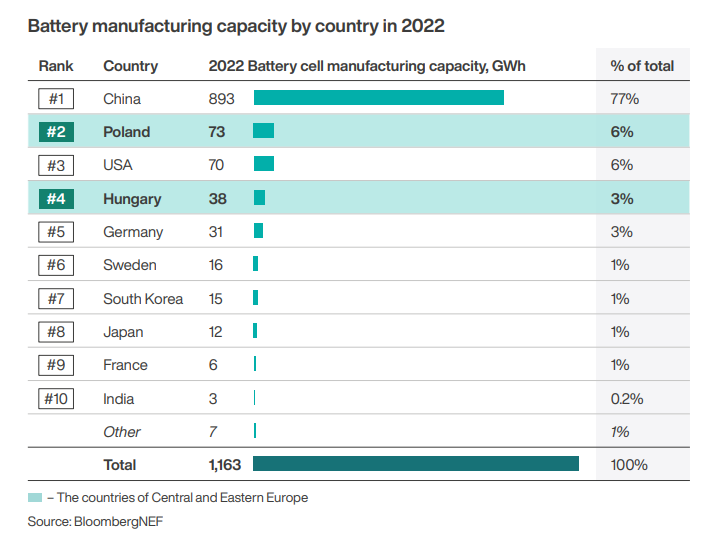
    [vc_section][vc_row][vc_column][distance desktop_type=”30″][lvs][distance desktop_type=”30″][vc_btn title=”Source – notesfrompoland.com” color=”sky” i_type=”material” i_icon_material=”vc-material vc-material-perm_device_information” add_icon=”true” link=”url:https%3A%2F%2Fnotesfrompoland.com%2F2023%2F04%2F06%2Fpoland-overtakes-us-to-have-worlds-second-largest-lithium-ion-battery-production-capacity%2F%23%3A~%3Atext%3DEastern%2520Europe%2520Newsletter-%2CPoland%2520overtakes%2520US%2520to%2520have%2520world’s%2Clithium%252Dion%2520battery%2520production%2520capacity%26text%3DAfter%2520a%2520series%2520of%2520investments%2Cthe%2520world%252C%2520behind%2520only%2520China.|target:_blank”][distance desktop_type=”30″][vc_column_text]After a series of investments in lithium-ion battery manufacturing, Poland’s production capacity rose to 73 GWh in 2022, overtaking the US to become the second largest in the world, behind only China.

    Poland now has 6% of the world’s total production capacity, compared to 14% of all European countries combined, notes the Polish Alternative Fuels Association (PSPA) in a report published this week based on data from BloombergNEF. They are, however, well behind China, which has 77% of global capacity.

    Source: Europe runs on Polish lithium-ion batteries, Polish Alternative Fuels Association

    However, the PSPA warns that, with fierce competition in the sector, Poland is set to fall to sixth place in global manufacturing by 2027 as other countries invest in producing the rechargeable lithium-ion battery that power electric vehicles.

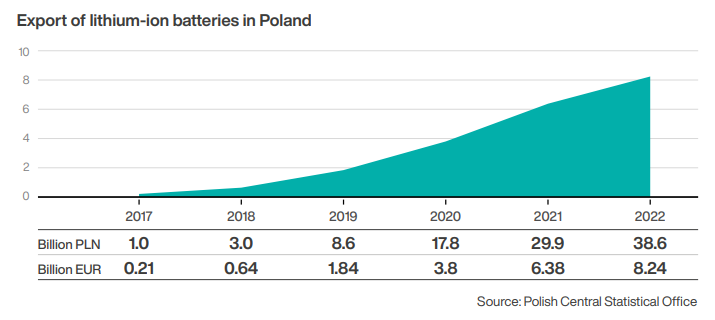
    Recent years have shown, nevertheless, that the sector’s growth in Poland is robust. The value of exports in the battery sector increased 38-fold over the last six years from around 1 billion zloty (€0.21 billion) in 2017 to 38.6 billion zloty (€8.24 billion) in 2022.

    That meant it accounted for 2.4% of all Polish exports, according to data from Statistics Poland (GUS), a state agency.

    Source: Europe runs on Polish lithium-ion batteries, Polish Alternative Fuels Association

    This growth has been achieved thanks to the major investments by foreign companies that have decided to open factories focused on batteries or electromobility in Poland.

    Poland is currently home to the largest car battery factory in Europe, launched by LG Energy Solution in Biskupice Podgórne near Wrocław, and Europe’s largest factory for energy storage systems, launched by Swedish battery manufacturer Northvolt in Gdańsk.

    Other leading companies in the battery sector investing in Poland include Korean SK Nexilis and German Mercedes-Benz. Poland is also Europe’s largest exporter of electric buses.

    As well as manufacturing sites, companies have started to open technology centres in Poland focused on developing electromobility, with Swedish car manufacturer Volvo announcing a new technology hub in Kraków last month.

    According to PSPA, in order to further strengthen the potential of the battery sector in Poland and the region action is needed in three areas: increasing domestic capacity for the necessary raw materials to produce cells and battery components; developing qualified human resources; and increasing innovation in the supply chain.

    The report shows, however, that strengthening the European value chain for lithium is currently a major challenge.

    While Europe has significant lithium resources, “many commercial mining operations are still in the pipeline, including in the Czech Republic, Serbia and Romania”, said Aleksander Rajch of PSPA, one of the report’s co-authors, quoted by the Polish Press Agency (PAP).

    According to Polish Geological Institute (PIG), however, there is “no prospect of finding” lithium reserves in Poland.

    “In order to accelerate the launch of new mining and processing capacities of battery sector raw materials in Poland, it is necessary to simplify administrative procedures,” said Rajch.

    “It is also important to implement incentives for the development of battery reuse and recycling technologies in order to create a closed cycle of production, operation and disposal,” he added.


    Main image credit: LG Energy Solution press pack[/vc_column_text][distance desktop_type=”30″][/vc_column][/vc_row][/vc_section]

  • Czechia-Poland dispute over coal mine settled, but locals still suffer

    Czechia-Poland dispute over coal mine settled, but locals still suffer

    [vc_section][vc_row][vc_column][distance desktop_type=”30″][lvs][distance desktop_type=”30″][vc_btn title=”Source – Euractiv” color=”sky” i_type=”material” i_icon_material=”vc-material vc-material-perm_device_information” add_icon=”true” link=”url:https%3A%2F%2Fwww.euractiv.com%2Fsection%2Fpolitics%2Fnews%2Fczechia-poland-dispute-over-coal-mine-settled-but-locals-still-suffer%2F|target:_blank”][distance desktop_type=”30″][vc_column_text]Czech and Polish political heads have settled the dispute over the coal mine Turow, but inhabitants of villages near the open-pit mine still face problems, EURACTIV.cz reports.

    Czechia and Poland officially settled the long-term dispute by signing an agreement in February 2022. Part of this agreement was the withdrawal of the lawsuit Czechia filed against Poland in reaction to Polish authorities’ decision to expand operations at the massive lignite mine close to the Czech border.

    The issue was politically resolved, even from the point of view of Czech President Petr Pavel, who recently visited Poland.

    “Both sides commented on the dispute over the Turów mine in the sense that it is closed,” the presidential office told EURACTIV.cz.

    The agreement included the construction of an underground barrier, completed in February 2022, which should protect local water sources. However, Czech organisations do not consider the agreement or the constructed barrier as a solution because it does not work well in practice.

    Czech Geological Service, responsible for monitoring the impact of the mine, confirmed to EURACTIV.cz that the barrier had brought no positive effects to the Czech territory so far.

    Another problem is a lack of information. While the agreement should secure Czech authorities access to data about the Turów mine, including its impact on water levels, not all information is available.

    “The problem is that some of the information, the key ones, Poland has labelled as ‘trade secrets’ and banned their publication. Thus, the Czech Environment Ministry refuses to give us this information,” Milan Starec from the local organisation Association Uhelná explained.

    Greenpeace has a similar opinion. “The excuses of trade secrets or even intellectual property are absolutely absurd,” said Greenpeace Czech Republic spokesperson Lukáš Hrábek, adding that local people and environmental organisations are not asking about the economic aspects of coal mining.

    “In this case, the ministry is more friends with the Polish mining company than its own citizens, whom it should be protecting. It’s shameful,” Hrábek added.

    The Czech Environment Ministry told EURACTIV.cz it disagrees with the criticism. The Ministry admits that it cannot publish some of the information demanded; however, it publishes all the information that Czech law allows to be disclosed.

    (Barbora Pištorová, Aneta Zachová | EURACTIV.cz)[/vc_column_text][distance desktop_type=”30″][/vc_column][/vc_row][/vc_section]

  • Polish coal miners protest EU methane reduction regulations

    Polish coal miners protest EU methane reduction regulations

    [vc_section][vc_row][vc_column][distance desktop_type=”30″][lvs][distance desktop_type=”30″][vc_btn title=”Source – apnews” color=”sky” i_type=”material” i_icon_material=”vc-material vc-material-perm_device_information” add_icon=”true” link=”url:https%3A%2F%2Fapnews.com%2Farticle%2Fcoal-miners-poland-protest-eu-4b4d7eb67a66fb393c8bdb14a852430c|target:_blank”][distance desktop_type=”30″][vc_column_text]

    WARSAW, Poland (AP) — Polish coal miners angered by a European Union directive aiming to reduce methane emissions protested noisily Friday before the EU office in Warsaw saying it will deprive them of their jobs.

    Some 300 miners chanted “Thieves” and used smoke flares and sirens to draw attention to their protest in the downtown area of Poland’s capital. Traffic was temporarily closed in the area.

    Protesting miners from the Solidarity 80 union said recent climate recommendations for the 27-member EU that call for a significant reduction of methane, starting in 2027, would force most of the nation’s mines to close, with the loss of tens of thousands of jobs.

    The majority of Poland’s mines have a high presence of methane gas that gets released in the coal extraction process. That also leads to serious mining accidents as methane becomes explosive when mixed in low proportions with oxygen.

    Located in the southern Silesia region, the coal mines are among Poland’s major employers, offering some 77,000 jobs in the nation of 38 million.

    [/vc_column_text][distance desktop_type=”30″][/vc_column][/vc_row][/vc_section]