Website: Europe.com

  • ERMA and Greenland Resources mark a successful partnership advancing responsible mining in Europe.

    ERMA and Greenland Resources mark a successful partnership advancing responsible mining in Europe.

    Outstanding collaboration supporting ESG standards and EU circularity. 

    The Malmbjerg molybdenum project, exemplifying responsible mining practices with top-tier Environmental, Social, and Governance (ESG) standards, will supply high-quality molybdenum to meet a substantial portion of Europe’s demand. Notably, among the world’s largest molybdenum producers—China, USA, Chile, Peru, Mexico— Greenland leads in education and health spending as a percentage of GDP and boasts the lowest poverty rates.


    The outstanding collaboration with ERMA has allowed Greenland Resources to sign documentation on offtake agreements directly with six major EU metallurgical steel and chemical companies as well as secure letters of intent to finance the Malmbjerg molybdenum project capex from AAA credit-rated financial institutions like the Export and Investment Fund of Denmark (EIFO) among other development banks, and commercial banks like Deutsche Bank AG. ERMA has also played an important role in securing documentation with major European and Canadian mining equipment suppliers like Danish FLSmidth A/S and Austrian Doppelmayr Transport Technology GmbH.

     Malmbjerg molybdenum project will answer 25% of Europe’s total molybdenum demand.

    Molybdenum is a fundamental element in the manufacturing of all clean renewable energy technologies such as wind, geothermal, solar, and hydro, as well as in the manufacturing of most mining equipment, making it vital for Europe’s Green Transition. Currently, China produces around 45% of world’s molybdenum while the EU is the second largest molybdenum user worldwide and has no production of its own. Greenland Resources will be able to supply some 25% of Europe’s total molybdenum demand for over 20 years from a responsible EU source with one of the highest-grade and clean molybdenum deposits in the world.

     As global demand for molybdenum continues to soar, its prices have surged, making it one of 2023’s top-performing metals. The London Metal Exchange reported a closing price of US$23.95/lb Mo on Sept.22, nearly 33% higher than the base case price used in the Company’s NI 43-101 Feasibility Study.

    Naaja H Nathanielsen, Greenland’s Minister of Finance, Minerals, Justice and Gender Equality, underscores Greenland’s unique advantage in providing a high-quality, easily accessible Molybdenum supply chain to Europe, while prioritising responsible mining: 

     “Greenland is committed to fostering responsible mining ventures that not only tap into our abundant natural resources but also prioritise the well-being and empowerment of our local communities. It’s crucial that we set a benchmark for Environmental, Social, and Governance (ESG) standards while maintaining our competitive advantage. Projects such as the Malmbjerg project with proximity to Europe and high-quality ore serve as a model of responsible mining practices, and they hold immense importance for our region in terms of growth and job creation.”

     Strengthening cooperation and training between Canadian and Greenlandic Inuit communities.

    In June, Greenland Resources expanded its support to Ittoqqortoormiit, the nearest community to the Malmbjerg project. This included a boost in financial support and mining training, enhancing internet infrastructure, and allocating funding to strengthen culture and education initiatives. In addition, Greenland Resources recently signed an MOU with Nuna Group of Companies, a world class Canadian majority Inuit-owned civil construction company that specializes in Arctic construction and contract mining operations. This will add to the cooperation and training between Canadian and Greenlandic Inuit communities.

     Bernd Schäfer, CEO and Managing Director of EIT RawMaterials, expresses his enthusiasm for this impactful collaboration: “The partnership between ERMA and Greenland Resources is a great example of a win-win scenario. We are excited about the development of multi-country value chains for this indispensable raw material, and our commitment in seeking global partners goes far beyond this project. EIT RawMaterials and ERMA, together with the European Commission, are actively engaging in dialogue with partners including the upcoming Strategic Partnership on responsible raw materials value chains between the European Union and Greenland.” 

     Dr. Ruben Shiffman, Executive Chairman of Greenland Resources, highlights the collaboration’s achievements, including capex finance support from financial institutions, successful off-take documentation with prominent European steel and chemical companies, and with leading mining equipment suppliers.

     “ERMA’s support has been instrumental in our success. Recently, in the presence of the Prime Minister of Belgium, we signed terms with Molymet, the world largest molybdenum roaster, to convert our molybdenite concentrate in Belgium to ferromolybdenum, molybdenum oxide, and ammonium dimolybdate and sell them directly to the EU steel and chemical industry. We expect a significant percentage of our 2022 Feasibility Study US$820 million capex to come from EU and Canadian financial institutions. Also, over US$300 million on mining equipment will be sourced from the EU and a similar amount from Canada.”

  • Poland issues environmental permit for first nuclear power plant

    Poland issues environmental permit for first nuclear power plant

    PEJ, the Polish government company that is progressing its policy to deploy up to six reactors at multiple sites in the country by 2040, submitted the environmental impact assessment (EIA) report for the first plant to GDOŚ on 29 March 2022. GDOŚ is an expert institution responsible for environmental protection and control of the investment process.

    The EIA report examined the environmental impact of constructing and operating a plant with a generating capacity of up to 3750 MWe in the area of ​​the municipalities of Choczewo, Gniewino and Korkowa in the province of Pomerania. PEJ said the final EIA report complied with the provisions of the decision of GDOŚ, which in 2016 defined the scope of the environmental report in relation to the considered location variants and their technical sub-options, as well as in relation to the infrastructure accompanying the power plant.

    The draft decision was reviewed by the Director of the Maritime Office in Gdynia, the State Sanitary Inspector for the Pomorskie Voivodeship, the Director of the Regional Board of Water Management in Gdańsk of the State Water Holding Wody Polskie, the President of the Polish National Atomic Energy Agency, and the Minister of Climate and Environment.

    GDOŚ has now issued its final decision, which PEJ said is “a key permit obtained in the investment process, as subsequent administrative approvals, including the location decision and the construction permit, must be consistent with the terms and conditions contained in the decision on environmental conditions”.

    The obtained decision on environmental conditions determines the site variant for the first nuclear power plant in Poland, at the Lubiatowo-Kopalino site in the Choczewo municipality. It also defines the conditions of using the environment at the stage of development and operation of the facility, requirements concerning the environment protection necessary to be included in the design documentation, requirements for counteracting the effects of industrial accidents, and it also imposes an obligation of the reassessment of environmental impact, as part of the procedure for issuing the construction permit.

    The decision was preceded by national and transboundary consultations with 14 countries that applied for participation in this procedure. The national consultations, held from 20 July to 18 August 2023, included all residents of Poland, who could review the documentation and submit their comments and conclusions. The transboundary consultations were held from September 2022 until July 2023. As part of the procedure, relevant protocols were signed with all the countries involved, including four protocols signed after intergovernmental expert meetings held under Article 5 of the Espoo Convention, which contributed to closing the process within the assumed timeframe.

    “The issued decision on environmental conditions is one of the most important stages in the permitting process and brings us significantly closer to the start of the construction of the first nuclear power plant in Poland,” said PEJ President Mateusz Berger. “It defines the conditions that must be met in order to execute a nuclear investment project in compliance with environmental regulations and requirements on both the national and international level.”

    PEJ – a special-purpose vehicle 100% owned by the State Treasury – has already obtained a decision-in-principle issued by the Ministry of Climate and Environment confirming that the company’s investment is in line with the energy policy implemented by the state. In August, it applied to the head of the Pomeranian Voivodeship for a location decision for the plant.

    The Polish government selected the Westinghouse AP1000 reactor technology for construction at Lubiatowo-Kopalino in Pomerania in November 2022.

    Westinghouse and Bechtel have just signed a formal agreement to partner on the design and construction of the plant. They expect to sign an engineering services contract with PEJ within the next week.

  • Ukraine has successfully dispatched its inaugural consignment of uranium, sourced from the esteemed Eastern Mining and Processing Plant to Canada

    Ukraine has successfully dispatched its inaugural consignment of uranium, sourced from the esteemed Eastern Mining and Processing Plant to Canada

    Regrettably, it is disheartening to acknowledge that Russia still maintains considerable control over a substantial portion of the global uranium market. This vexing situation poses challenges when it comes to imposing sanctions, given the numerous contractual agreements that various companies have with Russian entities for uranium supply. Nevertheless, we remain resolute in our efforts to displace them from this market and bolster uranium production within Ukraine,” emphasized the Minister.

    In light of this collaborative endeavor, the initial batch of Ukrainian uranium, diligently extracted from the esteemed VostGOK facility, has been expertly loaded and dispatched to Canada.

    Furthermore, Ukraine has been granted a credit guarantee by the esteemed UK government, amounting to a noteworthy £192 million, as part of a fruitful partnership with Urenco. This credit guarantee has been extended to support Energoatom in availing uranium enrichment services.

    The Minister also shared the uplifting news that merely a few days ago, the maiden shipment of nuclear fuel, thoughtfully developed by the esteemed American company Westinghouse Electric Sweden AB in close collaboration with accomplished Ukrainian specialists from the esteemed National Atomic Energy Company Energoatom, was seamlessly loaded into the VVER-440 reactor at the illustrious Rivne Nuclear Power Plant.

  • Ukrainian titanium leader Velta retains Hatch to design new US manufacturing facility

    Ukrainian titanium leader Velta retains Hatch to design new US manufacturing facility

    “This new partnership brings Velta one step closer to bringing our revolutionary titanium powder technology to the US market, which is dangerously over-reliant on foreign supply chains,” Velta chief executive officer Andriy Brodsky said. “Hatch’s expertise in optimizing metallurgical facility design and operation will help Velta meet the enormous, unmet US demand for quality titanium. We’re ready to get to work.”

    Velta is currently engaged in an intensive site selection process. The facility Hatch has been retained to help design will become one of only a small number of US facilities producing titanium after decades of declining domestic production. The capacity of the new facility is being designed to produce upwards of 1,000 tonnes of titanium powder per annum with the potential to scale.

    Hatch is an engineering and project implementation consultancy with experience in various metal and minerals projects, including various TiO2 projects globally.

  • In the realm of the United Kingdom, the suspension of the liquidation process for Ganberg and Gexior companies has transpired

    In the realm of the United Kingdom, the suspension of the liquidation process for Ganberg and Gexior companies has transpired

    In terms of the project’s ownership, the state has consistently retained its stake as a “stable entity,” with a controlling interest of 51% held by “Kazatomprom.” However, the remaining portion of the company, SGHK, has experienced a change in ownership.

    The establishment of TOO “SP Budenovskoye” in 2015 marked its primary objective of exploring and extracting uranium from sections 6 and 7 of the Budenovskoye deposit, which currently resides in the Turkestan region. This partnership was officially registered in 2016, with two initial owners: 51% attributed to the national company “Kazatomprom” and 49% under the ownership of TOO “Stepnogorsk Mining and Chemical Plant” (SGHK).

    During the year 2016, SGHK found itself under the ownership of Singaporean enterprise Rosdale PTE Ltd, originating from the British Virgin Islands.

    In May of 2017, the government of Kazakhstan granted permission to Rosdale PTE Ltd to divest SGHK to two other legal entities. Ganberg UK Ltd acquired a majority share of 60%, while Gexior UK Ltd secured a minority share of 40%. Both of these structures were hastily formed just prior to the planned transaction on March 1, 2017, and were registered within the same jurisdiction, namely the United Kingdom. Notably, they shared a common parent structure by the name of Degevol UK Ltd, which was established a mere day before its subsidiaries, on February 28, 2017. Consequently, Vasily Anisimov and Yakov Klebanov emerged as the newfound co-owners of the uranium deposits.

    In the month of December 2022, yet another shift in ownership occurred for SGHK. This particular transaction stirred up a scandal within Kazakhstan’s information sphere, as SGHK was transferred to AO “Uranium One Group” and AO “YATC Logistic Center.” Both of these joint-stock companies are integral components of the state corporation known as “Rosatom.”

    It is worth mentioning that certain structures within “Rosatom,” such as “Rusatom Overseas,” which is responsible for promoting “Rosatom” projects beyond national borders, have been subjected to stringent Western sanctions. Furthermore, Alexey Likhachev, the head of “Rosatom,” finds himself under the weight of these sanctions as well. Given the vulnerable position of the Russian corporation, concerns have arisen within Kazakhstan.

    Currently, “Kazatomprom” holds the lion’s share in uranium extraction within Kazakhstan, accounting for 55%, while “Rosatom” holds a 21% stake as of the conclusion of 2022. With the commencement of production at SP “Budenovskoye,” it is anticipated that “Rosatom’s” share in the nation’s total production will increase by at least 10%, as stated by Abzal Narymbetov, the author of the Energy Analytics Telegram channel.

    Narymbetov further highlights that if “Rosatom” becomes the target of anti-Russian sanctions, it may prove challenging for “Kazatomprom” to market its own product. This, in Narymbetov’s view, constitutes the “main and most significant” risk arising from the change in ownership of the Budenovskoye deposit.

    Looking ahead, six months subsequent to the sale of SGHK, in June 2023, all three aforementioned companies – Ganberg UK Ltd, Gexior UK Ltd, and Degevol UK Ltd – initiated the process of deregistration, effectively dissolving themselves. However, in August, the liquidation proceedings were halted by the UK’s Companies House in response to a lodged protest.

    In an attempt to shed light on the initiator of the suspension and the rationale behind it, “Kursiv” reached out to Companies House. Regrettably, the registrar’s press service declined to provide any commentary on matters pertaining to specific companies, deeming such information to be confidential.

    The editorial team of “Kursiv” also made inquiries to Vasily Anisimov and Yakov Klebanov (via their respective companies based in Russian and Kazakhstani jurisdictions) regarding the fate of Ganberg UK Ltd, Gexior UK Ltd, and Degevol UK Ltd. However, no responses were received at the time of reporting.

    According to the information available on the Companies House website, there exists a multitude of reasons for filing objections, although an exhaustive list of these grounds is not provided.

    Oleg Degtyarev, the director of the esteemed British law firm Law Firm Ltd., elucidated on the matter, stating that “Examples of reasons for objecting to the removal of a company from the register include not being notified of the company’s decision, believing that the information in the company’s application is inaccurate, and intending to take legal action against the company. You must have evidence supporting your objection, such as invoices or bills showing that the company owes you money.”

    He noted that initiators of objections can be founders and employees of the company, as well as creditors. “This can also include British government agencies, such as HMRC (tax authority),” explained Degtyarev.

    When asked whether the suspension could be related to the sanctions status of certain structures and the head of “Rosatom,” my database does not provide specific information regarding the liquidation suspension of Ganberg and Gexior companies in the United Kingdom or their ownership of the Budenovskoye uranium deposit. It is advisable to consult reliable news sources or official statements for the latest information on this topic.

    Now that the liquidation process of the companies has been suspended, they must take steps to resolve the disputed issues before the deregistration process can resume.

    “This may involve negotiations with the objecting party, settling outstanding debts, or providing additional information to the registrar,” says Oleg Degtyarev.

    The party that raised objections also needs to be proactive. “They must confirm their actions or provide acceptable evidence of progress in resolving the unresolved issues,” the lawyer enumerates. “This evidence should be obtained at least two weeks before the expiration of the objection period.”

    The objection period has a lifespan of six months. It needs to be renewed, or else it will automatically expire.

  • Investors glimpse opportunity in Europe’s unloved mining shares

    Investors glimpse opportunity in Europe’s unloved mining shares

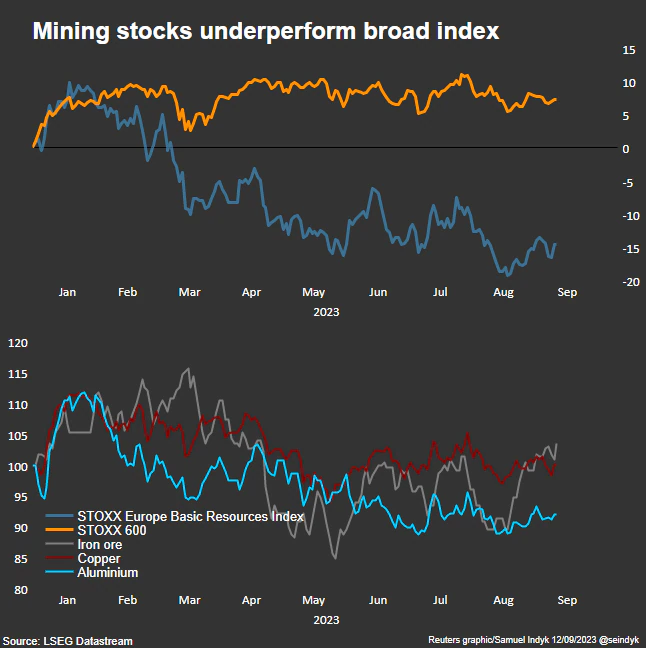
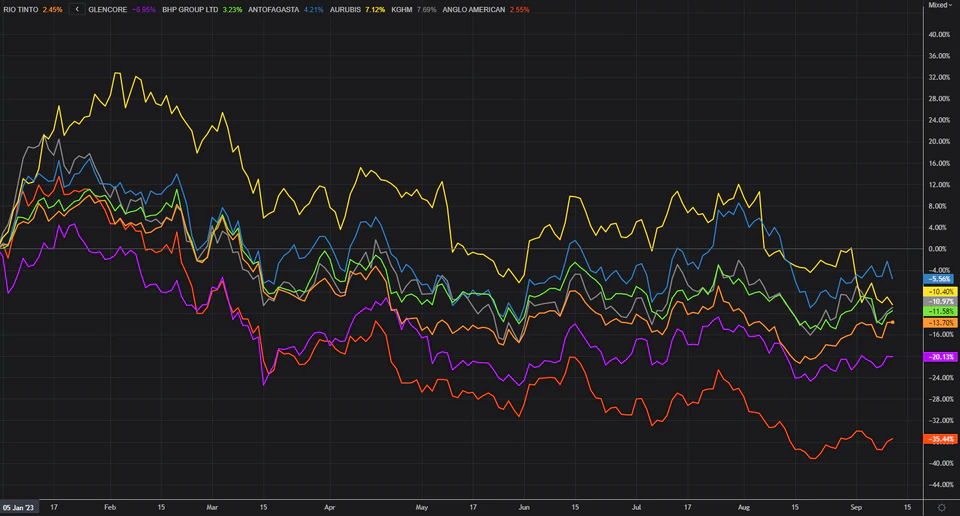
    The STOXX Europe 600 mining index has fallen 15% this year, making it the worst performing sector in the region by some margin, with second-placed real estate down 4.5% and the top-performing retail index up 27%. The metals and mining sector is typically used as a proxy for equity investors in Europe to gain exposure to China, given it is the world’s largest commodities consumer, and it has sunk along with China’s growth expectations.

    The world’s second-largest economy has been struggling after a brief post-Covid surge, dragged down by huge debt due to decades of infrastructure investment and a property downturn. Analysts forecast the economy will grow by just 5% this year, the slowest rate, outside of Covid years, since 1990.

    But Beijing in recent weeks has taken targeted steps towards supporting key pockets of its economy, lifting the mining sector off its 31-month lows. In the last month, the mining index has risen nearly 10% compared with a gain of just 2.5% for the wider STOXX 600.

    “China is building a wall of stimulus, but they’re doing it brick by brick,” said Nathan Sweeney, chief investment officer of multi-asset at Marlborough Investment Management.

    “At some point people will realize they have built the wall, but it just hasn’t come all at once.”

    In the last three months, China has relaxed rules around home purchases and borrowing, and cut key interest rates. There are also new tax relief measures for small businesses and private investment in some infrastructure sectors, for example.

    Sweeney says this wide range of measures could be a catalyst for an upturn in the metals and mining sector.

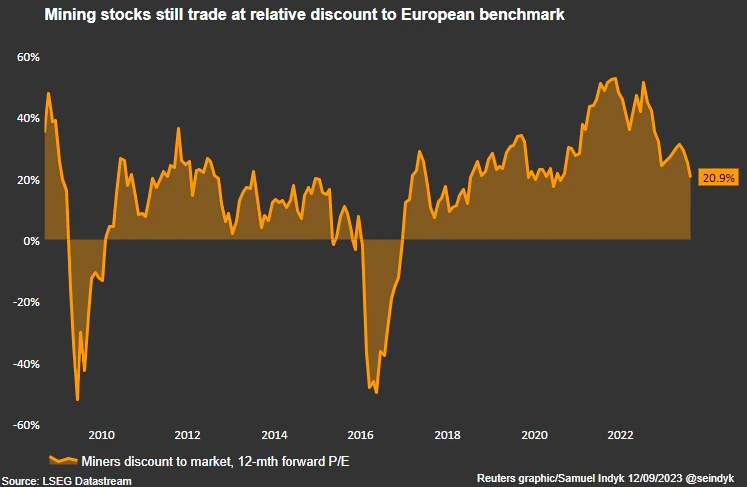
    The STOXX basic resources index trades at over a 20% discount to the STOXX 600. Miners trade at a 12-month forward price-to-earnings ratio of 9.8, compared to 12.3 for the market, according to LSEG Datastream.

    Shares in some of the industry heavyweights have taken a battering this year. Glencore and Boliden have dropped by more than 20%, while Anglo American has lost 30%. The pan-European STOXX 600 benchmark meanwhile, is up 7.5%.

    Copper and iron ore have fared better. Three-month copper on the London Metal Exchange is flat for the year at $8,380 a tonne, while front-month Singapore iron ore futures are up nearly 9%.

    Considering China’s heft in the commodities world – Morningstar estimates it accounts for over 50% of refined copper demand and about 70% of the seaborne iron ore trade – some of that resilience should eventually seep into mining stocks, analysts said.

    “Obviously, the 800-pound gorilla from a primary metal demand perspective is China,” Peter Mallin-Jones, mining analyst at UK investment bank Peel Hunt, said.

    “I’m quite positive because I can see, certainly for the base metals, fairly significant demand drivers into markets that feel relatively tight,” he said.

    Sector is key to going electric

    Specifically, Mallin-Jones points to the global energy transition, as economies begin to decarbonize, which could bring a huge increase in demand from fast-growing nations such as India, Indonesia, Malaysia and Nigeria.

    Copper is the backbone of the electric and electronic industries and is essential in upgrading power grids, building solar farms, wind turbines and electric vehicles.

    The United States and China are expected to add record amounts of solar production capacity this year, with a projected extra 32 gigawatts and between 95 and 120 gigawatts, respectively.

    “That’s an enormous number and is a huge support for demand for copper and to an extent aluminium,” UBS metals and mining analyst Daniel Major said.

    Major does not believe stimulus in China will lead to the kind of explosion in commodities demand seen after 2008, when the country bounced back from the global financial crisis.

    We see measures limiting downside and creating stabilisation in aggregate commodities demand but not driving a very strong rebound,” he said, adding that he expects the demand outlook for iron ore to deteriorate alongside a slower global economy while the likes of copper and aluminium will likely benefit from the renewables boom.

    Accordingly, UBS has ‘sell’ ratings on diversified miners Rio Tinto and BHP Group and Major prefers companies with more direct exposure to copper.

    Antofagasta, Europe’s largest pure-play copper miner by market cap, Poland’s KGHM and copper recycler Aurubis are all down less than 12% this year, and have all relatively outperformed diversified miners Glencore, Rio Tinto and Anglo American, which have fallen between 14%-35%.

    “The reality is the sector now looks attractive and a lot of bad news is in the price,” Marlborough Investment Management’s Sweeney said.

  • Ukraine: first batch of uranium shipped to Canada

    Ukraine: first batch of uranium shipped to Canada

    Ukraine has shipped its first batch of uranium to Canada under an agreement signed between Energoatom and Cameco. The agreement presupposes the supply of all uranium extracted by Vostochniy Mining and Processing Works to Canada and its further conversion into natural uranium hexafluoride (UF6). Such a process is necessary to prepare uranium for its further…

  • G7 to announce Russian diamonds ban in 2-3 weeks

    G7 to announce Russian diamonds ban in 2-3 weeks

    The embargo, proposed by Belgium where the city of Antwerp is the world’s No. 1 one diamond trading hub, will come into effect in January, one of the government officials, who asked not to be named, told reporters in Brussels.

    If the ban on the multi-million dollar trade is announced as anticipated, this would lead to a split in the global diamond market as the G7 accounts for close to 40% of this market.

    “We’re talking about restructuring a global market” the official said, acknowledging that the system will not work perfectly right away and the G7 was still evaluating Belgium’s proposed plan.

    “Russia is the biggest supplier globally. With this system, we are cutting them out, leaving them in an inferior market with lower prices. We are slashing the financial flows from this sector.”

    Efforts to reduce Russia’s revenue from diamond exports and build on Washington’s existing sanctions on Russia’s Alrosa ALRS.MM, the world’s largest producer, have been under discussion among leaders of the G7 since last year.

    The EU bought 1.4 billion euros ($1.5 billion) worth of Russian diamonds last year, according to Eurostat, as it banned neither the gem imports nor blacklisted Alrosa.

    The EU has previously floated a ban of its own but Belgium was concerned that this would divert trading to other centres and away from Antwerp. Further, the EU on its own only accounts for 15% of the global market

  • Norway should call off deep sea mining plans, key ally says

    Norway should call off deep sea mining plans, key ally says

    Norway’s minority government should withdraw its proposal to open a vast Arctic offshore area to deep sea mining and call at least a ten-year moratorium on the activity, its key backer in parliament, said.

    Norway could become the first nation to make deep sea mining happen on a commercial scale if the country’s parliament approves a plan to open ocean an area larger than the United Kingdom to the new industry. The mining could provide a source for such metals as copper and rare earth elements for the transition away from fossil fuels.

  • Ukraine: DMZ coke output up in August 2023

    Ukraine: DMZ coke output up in August 2023

    In August, Dniprovskiy Iron and Steel Works decreased rolled metal output by 67.4% MoM, to 4.4 thousand tons. Coke manufacture dropped by 15.3%, to 25.8 thousand tons. Compared with August 2022, rolled metal production decreased by 64.7%, while that of coke grew 2-fold. The decrease was due to the repairs of the main machinery. In January-August, DMZ produced 74.1 thousand tons of rolled metal, up by 80.8% YoY, and 198.1 thousand tons of coke, up by 34%. (Ukrainian metal)