Website: Eurasia.com

  • Kazakhstan’s Mining Sector Boosts Local Industry with 70 Contracts Worth 39.6 Billion Tenge

    Kazakhstan’s Mining Sector Boosts Local Industry with 70 Contracts Worth 39.6 Billion Tenge

    From 2020 to 2024, mining companies in Kazakhstan have signed 70 contracts worth a total of 39.6 billion tenge to purchase products from domestic manufacturers, according to the country’s Ministry of Industry and Construction. This initiative is part of a broader effort to strengthen ties between the mining sector and local industries, including machine-building, metallurgical, metalworking, and chemical enterprises.

    Over the past five years, the ministry has facilitated the signing of 353 long-term agreements valued at 226.1 billion tenge between mining companies and local suppliers. These contracts cover a wide range of products, such as pumping equipment, valves, transformers, conveyor systems, automation tools, metal structures, wheels, rubber-metal linings, lime, reagents, and spare parts.

    Additionally, light industry enterprises have been supplying specialized clothing, footwear, and personal protective equipment (PPE) to mining operations. The majority of these offtake contractsare concentrated in the East Kazakhstan, Karaganda, Pavlodar, and Aktobe regions. The East Kazakhstan region leads in the number of agreements, largely due to the presence of two major mining companies, KAZ Minerals and Kazzinc.
  • Uzbekistan Boosts Rare Metal Exploration and Production with $2.6 Billion Investment

    Uzbekistan Boosts Rare Metal Exploration and Production with $2.6 Billion Investment

    Uzbekistan has announced a major push into the exploration and production of rare metals, unveiling 76 new industry projects worth a combined $2.6 billion. The initiative, detailed on the official website of the country’s president, highlights Uzbekistan’s ambition to become a key player in the global race for strategically important resources.

    President Shavkat Mirziyoyev recently reviewed a report from the Ministry of Mining and Geology, which revealed that Uzbekistan has identified deposits of over 30 rare metals, including lithium, tungsten, molybdenum, germanium, and vanadium. Over the next three years, the government plans to significantly increase funding for geological exploration and scientific research to enhance the extraction of these valuable resources.

    A key focus will be on improving the extraction of rare metals from ore deposits and industrial waste, as well as developing high-value-added production. One example is the processing of waste from the Ingichka tungsten mine, which began producing concentrates in mid-2024. Additionally, 18 similar projects aimed at recovering rare metals from industrial byproducts are already in the pipeline.

    To support these efforts, Uzbekistan will establish technoparks in the Samarkand and Tashkent regions, areas rich in tungsten and molybdenum reserves. The country also plans to build new laboratories, training centers, and leverage international expertise to advance enrichment technologies.

  • Greenland Faces $11.5 Billion Lawsuit Over Rare Earth Mining Ban

    Greenland Faces $11.5 Billion Lawsuit Over Rare Earth Mining Ban

    A legal battle is unfolding between Greenland’s government and Australian mining company Energy Transition Minerals (ETM) over the halted Kvanefjeld rare earth mining project. The Greenlandic authorities banned uranium mining in 2021 due to environmental concerns, effectively blocking the proposed $7.5 billion open-pit mine near the town of Narsaq. ETM, which had already invested over $100 million in the site, is now suing for $11.5 billion, arguing that the ban constitutes expropriation.

    Greenland has a history of pollution from past mining operations, with toxins still affecting marine life decades later. The government, led by the Inuit Ataqatigiit party, insists that protecting the environment and public health must come first. However, ETM, backed by litigation finance firm Burford Capital, argues that Greenland’s shift in policy unfairly deprived investors of expected profits.

    The case, which hinges on an investor-state dispute settlement (ISDS) mechanism, highlights a growing global trend where corporations sue governments over environmental regulations. Experts warn that such claims could pressure smaller nations into reversing environmental policies.

    As arbitration proceedings progress, Greenland remains firm in its stance. “They try to bully us and make us feel small. That’s not going to happen,” says Greenland’s mining minister, Naaja Nathanielsen. Meanwhile, Narsaq residents remain divided—some fear the mine’s impact on water and ecosystems, while others see economic opportunity. The case’s outcome could set a precedent for how environmental policies withstand legal challenges from the mining industry.

  • Kazakhmys Denies Allegations of Illegal Export of Rare Earth Metals

    Kazakhmys Denies Allegations of Illegal Export of Rare Earth Metals

    Kazakhmys Corporation has officially denied media reports alleging the illegal export of copper ores and concentrates without proper analysis and the concealment of rare earth metal content. The company stated that all its products undergo strict quality control, and in cases where copper concentrates are exported, independent chemical analyses are conducted in world-class laboratories such as SGS Kazakhstan.

    Kazakhmys also emphasized that it does not engage in the targeted extraction of rare earth metals. Small amounts of rare metals are recovered from production waste and processed at state-owned and private enterprises within the country, in full compliance with legal regulations.

    The company assured that its operations are entirely transparent and are closely monitored by the relevant authorities. Kazakhmys supports enhanced government oversight of raw material exports and is open to cooperation with authorities for any necessary inspections.

  • Uzbekistan’s Hidden Mining Giant Steps onto the Global Stage at PDAC 2025

    Uzbekistan’s Hidden Mining Giant Steps onto the Global Stage at PDAC 2025

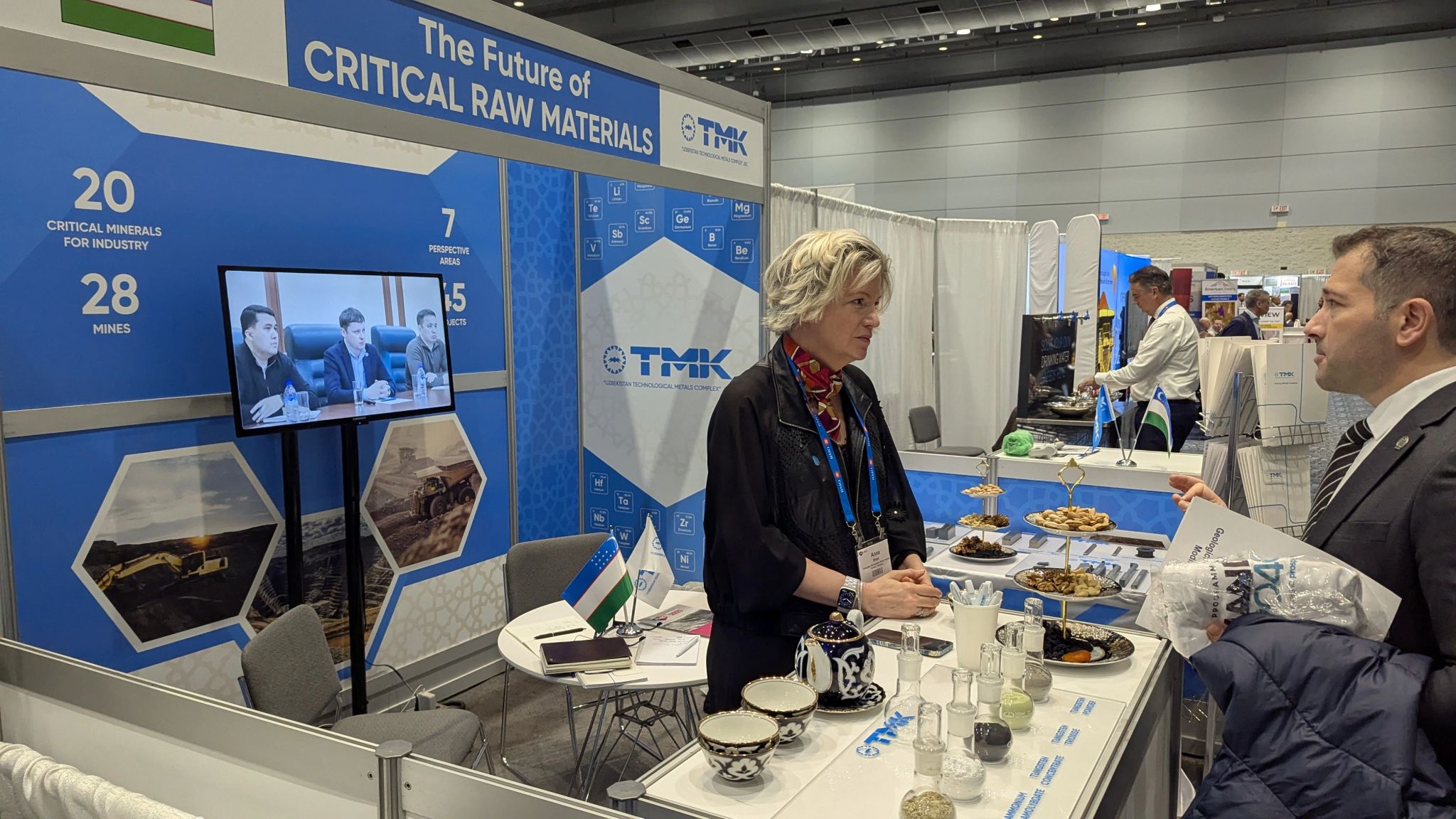
    One of the most intriguing newcomers at PDAC this year is UzTMK, a mining and metallurgical powerhouse from Uzbekistan that many have yet to hear about—despite its origins dating back to 1956.

    As an integrated producer of critical materials, UzTMK is gaining attention from the U.S. and European nations looking to secure their supply chains for industries such as automotive, renewable energy, infrastructure, healthcare, aerospace, and defense.

    During a TSX-hosted presentation, UzTMK shared its ambitious vision: expanding its existing infrastructure to create Central Asia’s largest diversified cluster for mining and processing rare earth elements, tungsten, and other strategic materials.

    With $200 million in funding, the company is poised to:
    ✅ Establish the largest R&D and Analytical Center for critical raw materials in Central Asia
    ✅ Expand mineral exploration programs
    ✅ Construct a state-of-the-art metallurgical plant using low-energy powder and nanotechnology

    Already under construction, the new facility is set to launch by 2028, with UzTMK’s market valuation projected to hit $2 billion.

    Meanwhile, Ukraine’s Critical Raw Materials deal, expected to be signed this Friday in Washington, could unlock the largest geological exploration program in decades—but with security and infrastructure challenges, it could take 15–20 years before production begins. In contrast, Uzbekistan’s strategic investment and tech partnerships could deliver production in just three years.

    UzTMK’s vision for Central Asia’s largest critical raw materials hub will be showcased at the MINEX Central Asia Mining and Exploration Forum in 2025, offering attendees a firsthand look at its mining operations and metallurgical facilities.

    Stay informed on the latest mining developments across 30 nations in Central Asia, the Caspian region, Mongolia, the Caucasus, and Europe—sign up for the Eurasian Mining Digest at www.minexforum.com.

  • U.S. and Ukraine Reach Initial Deal on Critical Minerals Investment

    U.S. and Ukraine Reach Initial Deal on Critical Minerals Investment

    The United States and Ukraine have reached an initial agreement to jointly invest in Ukraine’s critical minerals sector. The framework, which still requires further negotiations, establishes a reconstruction investment fund with shared U.S.-Ukraine ownership. Under the terms, Ukraine will contribute 50% of future revenues from state-owned mineral, oil, and gas assets to the fund, excluding existing operations like Naftogaz and Ukrnafta.

    The goal of the agreement is to attract private sector investment to develop Ukraine’s vast mineral resources, but significant hurdles remain. Ukraine lacks modern geological mapping of its rare earth deposits, and key infrastructure, including energy grids, has been severely damaged by war. Additionally, security risks and political uncertainty may deter long-term investors.

    Unlike previous proposals, the deal does not require Ukraine to use its mineral wealth to repay U.S. military aid, nor does it provide security guarantees. Instead, it assumes that U.S. financial stakes in Ukraine’s resources will create an incentive for continued support. However, tensions between President Trump and President Zelensky over Ukraine’s wartime policies could complicate future negotiations.

    While the agreement signals the U.S. administration’s focus on securing critical minerals, its success will depend on overcoming economic and geopolitical challenges in the region.

  • Kazakhstan Showcases Its Geological Potential at PDAC 2025 in Toronto

    Kazakhstan Showcases Its Geological Potential at PDAC 2025 in Toronto

    The Prospectors & Developers Association of Canada (PDAC) 2025, the largest international mining convention, has officially opened in Toronto. The event brings together key industry leaders, investors, and government representatives from around the world.

    As part of the exhibition, Kazakhstan inaugurated its national pavilion, highlighting the country’s geological potential. The opening ceremony was attended by Deputy Minister of Industry and Construction Iran Sharkan, AIFC Governor Renat Bekturov, Kazakhstan’s Ambassador to Canada Dauletbek Kusainov, and PDAC Vice President Karen Rees.

    One of the key events on the first day was the international forum “Meet Kazakhstan: The Power of Geology in the Ninth Largest Nation.” Speaking at the session, Deputy Minister Iran Sharkan emphasized Kazakhstan’s rich geological heritage and mineral resources, including lithium, niobium, and tantalum.

    “Kazakhstan has a strong history in geological exploration and mining. We are committed to creating favorable conditions for investment and cooperation with both local and international partners. We actively adopt new exploration and mining technologies, while also prioritizing environmental sustainability in resource extraction and processing,” he stated.

    The panel featured leading global experts in the mining and metallurgy sector, including Canada’s Deputy Minister for Lands and Mineral Resources Rinaldo Genti, Cove Capital founding partner Pini Althaus, Neo Performance Materials VP of Corporate Development Vasileios Tsianos, Hatch Minerals Managing Director Konrad Blake, and European Commission Deputy Head of Mission Madalina Ivanica.

    PDAC 2025 will run until March 5, with the Kazakh delegation actively engaging in meetings with partners and representatives from major mining companies.

  • Kazakhstan to Launch Five New Non-Ferrous Metallurgy Projects

    Kazakhstan to Launch Five New Non-Ferrous Metallurgy Projects

    Kazakhstan is set to commission five new projects in the non-ferrous metallurgy sector this year, with a total investment of 42.5 billion tenge. The initiative is expected to create approximately 1,300 permanent jobs, according to the QazIndustry project monitoring and analysis directorate.

    Among the new ventures are the production of gold dore alloy, cathode copper, and aluminum profiles. Once operating at full capacity, these projects are projected to generate 35.5 billion tenge in annual output, including 4.5 billion tenge worth of exports and 31 billion tenge in import substitution.

    Last year, the sector saw the launch of 10 projects worth 139.4 billion tenge, creating over 1,500 jobs. These included the production of gold dore alloy, refined copper sheets, aluminum rod, refined lead, and copper and aluminum ingots. The total production capacity of the newly launched projects is estimated at 117.2 billion tenge, with 71.7 billion tenge allocated for exports and 45.5 billion tenge for the domestic market.

    Currently, 36 projects worth approximately 2.2 trillion tenge are under development in the non-ferrous metallurgy sector. These projects are expected to generate over 9,800 permanent jobs, with around 7,600 in rural areas and 2,200 in urban centers. Once fully operational, they will contribute an estimated 2.1 trillion tenge in production output, including 1.2 trillion tenge in exports and 900 billion tenge in import substitution.

    The Karaganda region leads in the number of ongoing and planned projects in this sector. Non-ferrous metallurgy remains one of Kazakhstan’s key industrial sectors, driven by the country’s rich reserves of copper, zinc, nickel, lead, aluminum, gold, silver, and other valuable metals.

  • U.S. Shifts Strategy to Secure Critical Minerals, Following China’s Playbook

    U.S. Shifts Strategy to Secure Critical Minerals, Following China’s Playbook

    For decades, while China strategically secured minerals worldwide, the United States rarely used foreign policy to obtain the resources it needed. However, under President Donald Trump, this approach has shifted dramatically. Within the first 40 days of his term, Trump expressed interest in acquiring Greenland for its rare earths, annexing Canada for its uranium and copper reserves, and securing control over Ukraine’s rare earths and titanium in exchange for continued U.S. support.

    The fate of the Ukraine minerals deal remains uncertain following a heated exchange between Trump and Ukrainian President Volodymyr Zelensky. While Zelensky insists he is ready to sign the agreement, Trump has expressed doubts about its viability. Regardless of the outcome, experts argue that integrating mineral diplomacy into U.S. foreign policy is essential for national security. However, without significant government investment and diplomatic efforts—mirroring China’s approach—this initiative may fall short.

    The U.S. holds less than 2% of global reserves for rare earths, graphite, cobalt, and nickel, making collaboration with resource-rich nations critical. In contrast, China has strategically positioned itself as a global leader in mineral processing, importing vast quantities of raw materials to dominate industries like electric vehicle manufacturing.

    The draft agreement with Ukraine proposes a joint fund to manage revenue from Ukraine’s natural resources. However, the lack of modern geological data on Ukraine’s mineral deposits raises questions about the economic viability of these resources. Developing a mine and separation plant could cost between 500millionand1 billion, a risky investment without up-to-date surveys.

    To succeed, the U.S. must increase funding for geological mapping, invest in infrastructure in mineral-rich regions, and provide financial support to mitigate risks for private mining companies. Without these steps, the U.S. risks falling further behind China in the global race for mineral security.

  • Ferrexpo Shares Surge Amid Ukraine’s Move to Nationalize Poltava Plant

    Ferrexpo Shares Surge Amid Ukraine’s Move to Nationalize Poltava Plant

    Shares of UK-based iron ore producer Ferrexpo (LON:FXPO) jumped over 13% on Friday following reports that the Ukrainian government is seeking to nationalize its key asset, the Poltava Mining and Processing Plant. The move comes amid allegations of fund misappropriation linked to illegal mining activities.

    The State Bureau of Investigations has filed an appeal with the High Anti-Corruption Court to transfer 49.5% of the plant’s authorized capital to state ownership. In addition, authorities have frozen the plant’s assets as investigations continue. Ferrexpo, however, stated that it has not received any formal notification regarding these claims and is working closely with its legal team to assess the situation.

    The stock’s sharp rise suggests a mixed response from investors. While some may perceive the nationalization effort as a political maneuver rather than a direct financial threat, others speculate that short sellers covering their positions contributed to the surge. Ferrexpo’s stock had previously been under pressure due to the ongoing war in Ukraine and operational uncertainties.

    Despite the uncertainty, the global iron ore market remains resilient, and Ferrexpo’s long-term assets—including its significant reserves and 50-year mine life—continue to attract investor interest.