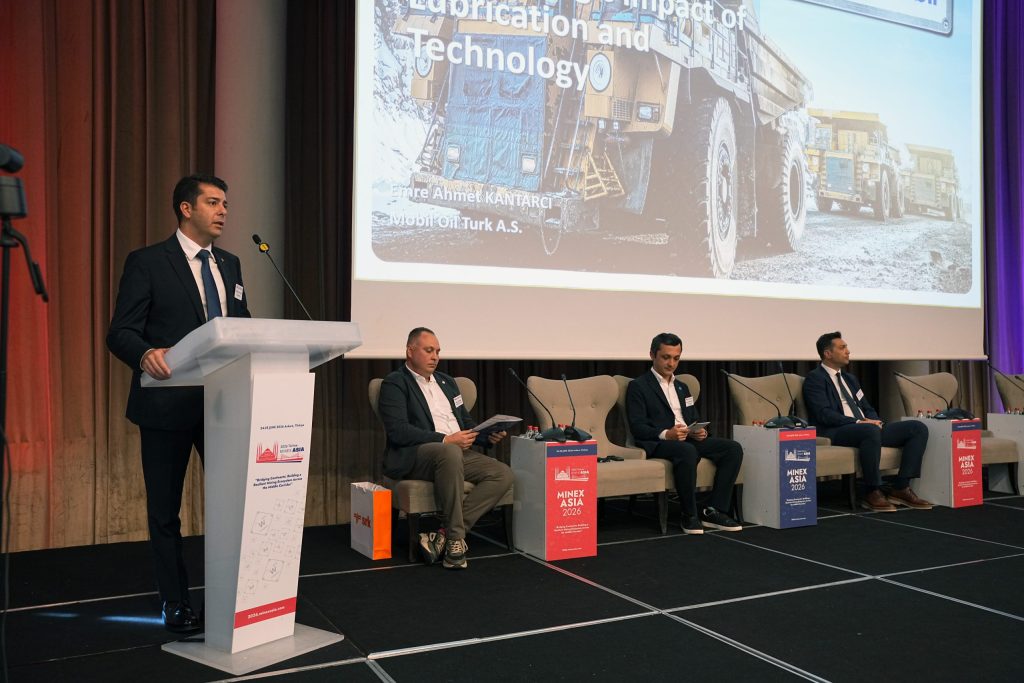
Emre Ahmet Kantarcı opened by introducing ExxonMobil as an integrated global energy company — the world’s largest publicly traded oil and gas company and largest base oil producer — operating across six continents with a presence in 47 countries and over 70,000 employees. He focused specifically on the Mobil lubricants brand, noting its 150-year history, presence in 161 countries, 21 blending plants worldwide (including one in Turkey), 11 quality-testing laboratories, and more than 35,000 OEM equipment approvals.
He gave brief historical context on ExxonMobil’s presence in Turkey, tracing operations back 121 years to an original Istanbul branch, with the current blending plant — purchased originally from the Ottoman Empire — converted to lubricant production in 1956 and still operating at the same site today. He described the company’s reach into Central Asia as indirect, operating through regional distributors and channel partners across Kazakhstan, Uzbekistan, Azerbaijan, Georgia (which also covers Armenia), Kyrgyzstan, and Turkmenistan (which also covers Tajikistan), supplied via a major blending plant plus imports from Europe, the US, and Egypt.
The core of his presentation focused on how optimized lubrication directly impacts mining economics. He framed the value proposition around increasing equipment uptime, reducing unplanned downtime, improving margins per ton, and maintaining safety standards. He noted ExxonMobil operates lubricants at its own mining sites — including the largest open-pit operation in Canada and one of the world’s largest lithium deposits — giving the company direct operational testing experience before recommending products to clients.
He introduced the concept of “optimized oil drain intervals,” explaining that while OEM-recommended intervals typically range from 250 to 4,000 hours depending on equipment, ExxonMobil works with clients to extend these intervals — in some cases up to 30,000 hours — through tailored product selection. He cited a concrete example: extending oil change intervals from 500 to 1,000 hours on a modest fleet could generate roughly $96,000 in savings, alongside reduced labor and disposal costs.
He presented cost-structure data showing that while energy and fuel costs dominate mining operating expenses (with the ore-hauling fleet consuming the largest share), maintenance represents only about 20% of total operating cost, and lubricants within that maintenance budget represent just 5% — yet lubricant choice can have outsized impact. He cited data showing that switching transmission lubricant from mineral to synthetic oil could reduce fuel consumption by roughly 4-5%, translating to approximately $1.3 million in annual fuel savings for a 30-truck fleet — far exceeding the incremental cost of the premium lubricant itself. He referenced published customer case studies showing significant savings across engine oils, hydraulics, transmissions, and greases.
He closed by describing ExxonMobil’s engineering services offering: on-site assessments of client equipment and operational bottlenecks, oil sampling and analysis, regular staff training for maintenance teams, and a sensor-based monitoring partnership (with Poseidon) enabling continuous, hourly equipment monitoring. He illustrated the value of this monitoring with an example involving thickener equipment, where lubrication failure can cause costly ore blockages — arguing that modest monitoring investment can prevent much larger operational losses.