Region: Kazakhstan

  • Kazakhstan Emerges as Washington’s Key Central Asian Partner in Critical Minerals Race Against China — But Partnership Needs Depth Beyond Dialogue

    Kazakhstan Emerges as Washington’s Key Central Asian Partner in Critical Minerals Race Against China — But Partnership Needs Depth Beyond Dialogue

    Kazakhstan has become a focal point of the United States’ effort to build a non-Chinese critical minerals supply chain, with a combination of vast geological endowment, political will and recent high-level investment commitments elevating the Central Asian nation’s strategic profile in Washington’s resource diplomacy — even as analysts warn that the partnership remains tilted toward dialogue over concrete industrial action.

    The backdrop is a decade-long escalation between the US and China that has placed critical minerals at the centre of global trade competition. China controls approximately 60% of global critical mineral production and 85% of processing capacity, and supplied over half of US demand for 24 critical minerals and 90% of rare earth element demand in 2024. Beijing has repeatedly deployed that dominance as a trade weapon, imposing progressive export controls on gallium, germanium, graphite, tungsten, tellurium, molybdenum, indium and bismuth during periods of tariff escalation. The vulnerability those controls expose has made diversification of mineral supply chains a strategic imperative for Washington.

    Kazakhstan occupies a compelling position in that diversification effort. The country holds 21 of the 50 minerals classified as critical by the United States — including uranium, copper, chromite, gold, titanium, tungsten and rare earth elements — and may contain the world’s third-largest rare earth reserves. Mining accounts for 12% of GDP. In 2025, Kazakhstan allocated $127 million to geological exploration, more than any other Central Asian state.

    The bilateral architecture has developed rapidly. The US launched the C5+1 Critical Minerals Dialogue in 2024 to foster cooperation across the Central Asian region from exploration through processing, and held a US-Kazakhstan Strategic Energy Dialogue the same year, backed by a signed memorandum of understanding. Kazakhstan joined the Minerals Security Partnership Forum alongside major economies including the EU, Australia and Japan.

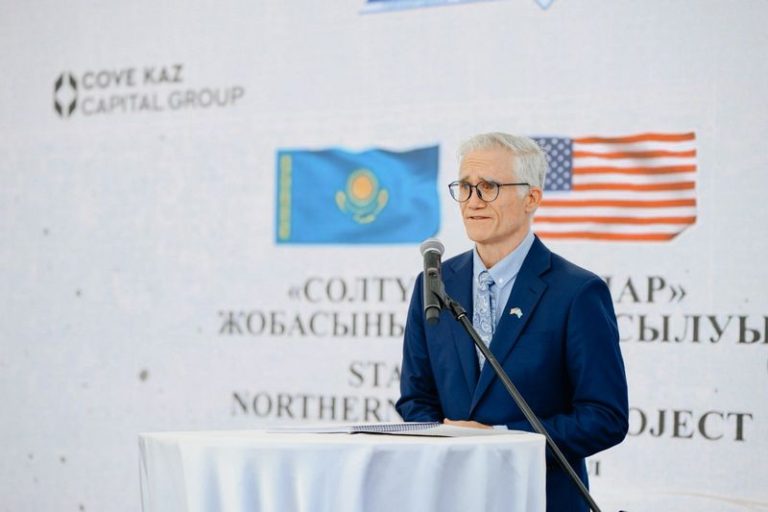
    The most tangible commitment came at the C5+1 Summit in Washington in November 2025, when US investment firm Cove Capital agreed to allocate $1.1 billion to the development of Kazakhstan’s largest tungsten deposits at Upper Kairakty and North Katpar, backed by $900 million in Export-Import Bank financing — a level of government support that signals genuine strategic commitment rather than diplomatic gesture.

    Yet the overall pattern remains uneven. Most US-Kazakhstan minerals engagement has focused on frameworks and agreements rather than operational projects. The US currently accounts for only 5% of Kazakhstan’s critical minerals exports, compared with 27% going to China and 16% to Russia. Analysts argue that to meaningfully compete with China’s embedded position — built through decades of direct investment, engineering capacity, infrastructure integration and offtake arrangements — the US must move beyond resource extraction agreements toward integrated projects that include geological exploration, processing capacity development, technology transfer and downstream industrial linkages.

    President Kassym-Jomart Tokayev has publicly emphasised the importance of US cooperation in developing Kazakhstan’s critical minerals sector, and the Kazakhstani government’s own interest in diversifying away from Chinese and Russian market dependence aligns with Washington’s goals. Whether the partnership translates into durable industrial outcomes will depend on whether bilateral agreements are upgraded to include financing commitments, timelines, technology transfer provisions and enforcement mechanisms comparable to the more detailed frameworks the US has established with Australia and Japan.

  • Kazakhstan’s Copper Sector: Strategic Asset in a Tightening Market

    Kazakhstan’s Copper Sector: Strategic Asset in a Tightening Market

    Kazakhstan rarely commands the attention its copper endowment deserves. Producing roughly 900,000 tonnes annually from 35 million tonnes of registered reserves, it accounts for approximately 4% of global copper output — a share comparable to many of the names that dominate industry headlines. Yet Western investment community engagement with the sector remains shallow relative to the opportunity, and the geological case for what remains undiscovered is, if anything, more compelling than the production figures alone suggest.

    At a recent British-Kazakh Society webinar on copper in Kazakhstan — convened jointly with the Embassy of Kazakhstan in London and the UK Department of Business and Trade — geologists, exploration executives, and market analysts gathered to examine the sector in detail. The discussion made one thing clear: Kazakhstan’s copper story is not simply one of existing production. It is one of a sector arriving at a structural inflection point at precisely the moment the global market needs it most.

    The Resource Base

    Kazakhstan’s copper reserves are concentrated in two mature producing provinces. The Zhezkazgan deposit in central Kazakhstan is one of the great sediment-hosted copper systems on earth, developed since the post-war Soviet era and still the backbone of national production. Eastern Kazakhstan contributes largely through complex polymetallic deposits, of which Aktogai — a world-class porphyry system — is the most prominent. Together these provinces underpin an annual output of around 900,000 tonnes, placing Kazakhstan comfortably among the world’s significant copper producers.

    The registered reserve figure of 35 million tonnes, however, almost certainly understates the country’s true endowment. USGS analysis of undiscovered global copper potential consistently identifies central and eastern Kazakhstan as among the most prospective territories on earth for porphyry copper systems. Two distinct porphyry belts cross the country. The younger Valerianov Belt connects, across the Uzbek border, to the super-giant Kalmakyr deposit; that belt, within Kazakhstan, remains largely undrilled. A substantial portion of central Kazakhstan lies beneath Aral Sea basin sediments with no surface outcrop and minimal modern exploration coverage. What has been found is not broadly what exists.

    The Data Opportunity

    Unlocking Kazakhstan’s exploration frontier depends significantly on data — and here, material progress is underway. The National Geological Service has scanned 97.5% of its Soviet-era archive, a vast repository of maps, drill logs, and technical reports accumulated over decades of intensive geological work. An AI and OCR programme now underway aims to render that material machine-readable by mid-2027, and a unified digital subsoil platform will eventually integrate it with online licensing and compliance functions.

    The Soviet geological archive has long been one of Central Asia’s most underleveraged assets — rich in detail, largely inaccessible to modern analytical methods. As that changes, the information barrier that has historically complicated early-stage investment decisions in Kazakhstan will begin to fall. The same technology has implications for Uzbekistan, Mongolia, and other jurisdictions carrying similar archival burdens.

    The Exploration Dynamic

    Despite over 3,500 active exploration licences — a market that has grown dramatically since Kazakhstan’s current mining code opened competitive licence pegging — major mining companies outnumber junior explorers among active operators. This is structurally unusual for a jurisdiction at Kazakhstan’s stage of geological maturity. Seventy percent of the world’s mineral discoveries are made by junior companies. The early-stage risk capital that drives discovery is underdeveloped relative to the opportunity.

    That is beginning to shift. Aurora Minerals Group, a Kazakh-rooted exploration services company with international technical partnerships, has spent years systematically de-risking early-stage copper targets — culminating in First Quantum Minerals taking an earn-in position on the Lakeside porphyry project in the northern Balkhash district. A second project targeting sediment-hosted copper in the Tenis Basin, an analogue setting to the Zhezkazgan deposit, is entering its first field season on ground only recently opened by the government for exploration. The model — patient local knowledge combined with international technical and capital partnerships — is one the market needs more of.

    Market Dynamics and Kazakhstan’s Position

    The global copper market is broadly balanced today, but the trajectory is clear. A supply deficit of around 140,000 tonnes is expected this year, widening materially into next. Exchange stocks, inflated by the US tariff distortion that pulled copper from China and Europe into COMEX warehouses at premiums of up to $3,000 per tonne above LME, are elevated but unwinding. Underneath the short-term noise, the structural picture is one of tightening supply against demand that governments and industries across the developed world are now treating as a strategic priority rather than a market variable.

    Kazakhstan sits well within that supply picture. It produces 24 of the 36 minerals identified in the UK’s critical minerals strategy. Its copper is exported into global supply chains that are increasingly subject to scrutiny over reliability and geopolitical exposure. The Astana International Financial Centre provides an internationally anchored legal framework. There is explicit political will to support long-term foreign investment — not extractive engagement, but sustained industrial partnership.

    The friction points are real: dual reserve reporting systems under GKZ and KAZRC create disclosure complexity for internationally oriented investors; permitting timelines warrant attention; and Kazakhstan’s position between China and a reengaging Western investment community requires careful navigation. None of these are disqualifying. All are manageable with the right local knowledge and structuring.

    The copper market’s structural shift is not speculative. The demand is real, the supply constraint is real, and the timeline for bringing new production online is unforgiving. Kazakhstan, with a large established production base, a geologically compelling frontier, and an improving investment environment, is one of the few jurisdictions that can contribute meaningfully to closing that gap — if the engagement comes early enough to matter.

  • Ferrexpo Suspends London Stock Exchange Listing as Ukraine Iron Ore Producer Races to Complete $100 Million Rescue Raise

    Ferrexpo Suspends London Stock Exchange Listing as Ukraine Iron Ore Producer Races to Complete $100 Million Rescue Raise

    Ferrexpo has suspended the listing and trading of its shares on the London Stock Exchange with effect from 7:30 a.m. on 1 May, as the Ukraine-focused iron ore producer failed to complete a planned capital raise and publish its 2025 annual financial results by the deadline it had previously set itself.

    The suspension will remain in place until the company completes its audit, publishes its annual report and financial statements for 2025, and implements a financing solution — with no certainty provided on when, or whether, trading will resume. “There is no certainty regarding the expected timing of the lifting of the suspension of listing and the resumption of trading in shares, if it happens at all,” Ferrexpo said in its statement.

    The company has received indicative, non-binding expressions of interest from institutional investors in a potential recapitalisation of more than $100 million, but was unable to finalise the transaction before the end of April. Ferrexpo has described an equity raise of at least $100 million as the only viable solution to meet current obligations and provide sufficient working capital for the next 18 months. Without a successful financing outcome, the group has sufficient available cash only until approximately the end of August 2026. The company previously warned that failure to complete the fundraise could force it to file for insolvency.

    The financial crisis has unfolded against a backdrop of severe operational disruption. In the first quarter of 2026, Ferrexpo reduced iron ore production by 72% year-on-year to 592,750 metric tonnes, and by 45% compared to the previous quarter, as Russian attacks on Ukraine’s energy sector largely suspended production activities. A limited resumption at reduced capacity occurred only at the end of February.

  • AltynGold Celebrates ‘Transformational’ 2025 as Production and Profits Soar

    AltynGold Celebrates ‘Transformational’ 2025 as Production and Profits Soar

    AltynGold (ALTN), the Kazakhstan-based gold miner, has reported a “transformational” set of annual results for the year ending 31 December 2025. The company saw a massive surge in financial performance, driven by a 50% increase in processing capacity at its flagship Sekisovskoye mine and a significantly higher global gold price.

    The miner’s production figures exceeded expectations, with gold poured rising 44% to 53,852oz, comfortably beating the full-year target of 50,000oz. This operational success, coupled with a realised gold price of US$3,474/oz (up 42% year-on-year), saw AltynGold’s revenue jump by 82% to US$175.4m.

    Financial Highlights at a Glance

    • Net Profit: Increased by 135% to US$62.0m.

    • Adjusted EBITDA: Doubled to US$101.4m.

    • Net Debt: Reduced significantly by US$31.3m to US$18.5m.

    • Safety Record: Achieved its fifth consecutive year without a lost-time incident.

    Looking ahead, AltynGold is poised for further growth. Management is currently evaluating plans to at least double mining capacity at Sekisovskoye to 2.0–2.5Mte per annum, which would elevate the company to mid-tier producer status with an output exceeding 100,000oz in the medium term. Additionally, the company is progressing its application for a production licence at the adjacent Teren-Sai exploration project, with approval expected in 2026.

    With the company deleveraging rapidly and cash generation remainng strong, the Board is also keeping the introduction of a dividend policy under review. Analysts have noted that the company’s valuation remains “extremely attractive” compared to its peers, with the current share price of 1,140p nearly matching the net present value of cash flows from existing operations alone.

  • Czech Companies Expand Kazakhstan Footprint With Car Assembly, Heat Exchangers and Uranium Talks Across Six New Agreements

    Czech Companies Expand Kazakhstan Footprint With Car Assembly, Heat Exchangers and Uranium Talks Across Six New Agreements

    Czech businesses are broadening their industrial and energy presence in Kazakhstan, with projects spanning vehicle assembly, manufacturing and nuclear fuel supply taking shape as bilateral economic ties deepen.

    Škoda Auto is advancing an $8.2 million initiative to assemble vehicles locally in Kazakhstan, while industrial company BBS plans to launch heat exchanger production by the end of 2026 with an estimated investment of $9 million. Both projects reflect a wider pattern of Czech industrial firms seeking manufacturing footholds in Kazakhstan’s growing economy.

    In the energy sector, Czech utility giant ČEZ Group is exploring long-term collaboration with Kazatomprom, Kazakhstan’s national nuclear company, including uranium supply agreements previously signed between the two parties. The talks come as European utilities accelerate efforts to diversify uranium procurement away from Russian suppliers following the war in Ukraine.

    Six cooperation agreements were signed between Kazakh and Czech companies at the forum, covering potential joint ventures in energy, transport, machinery production and insurance — a signal of broadening commercial ambition beyond individual project deals.

    Officials noted that growing Czech interest is contributing to a broader uptick in foreign direct investment in Kazakhstan, which rose 14.4% in 2025 to $20.5 billion, with a significant portion directed toward new greenfield projects.

  • Kazakhstan Launches Eight New Non-Ferrous Metal Projects in 2026 as 34-Project Pipeline Targets 17,000 Jobs and 6.9 Trillion Tenge in Investment

    Kazakhstan Launches Eight New Non-Ferrous Metal Projects in 2026 as 34-Project Pipeline Targets 17,000 Jobs and 6.9 Trillion Tenge in Investment

    Kazakhstan is accelerating the development of its non-ferrous metals sector, with eight new industrial projects set to launch this year attracting investments of approximately 80.1 billion tenge and creating more than 1,500 permanent jobs, according to the Ministry of Industry and Construction.

    The country holds significant deposits of copper, zinc, nickel, lead, aluminium and precious metals, and is now moving to maximise the industrial value extracted from those resources through a structured programme of processing capacity expansion.

    In Karaganda Region, production of copper cathode has already begun at a facility that received 8 billion tenge in investment and currently employs 512 specialists. New production lines for copper rod and cable, aluminium powder and unalloyed aluminium bars are planned to come online before the end of 2026.

    Six further non-ferrous metallurgy projects are at an active implementation stage, including facilities for doré alloy production and aluminium billets and profiles. These are expected to be commissioned in 2027 and 2028, with combined investment exceeding 532.1 billion tenge and around 800 new jobs — approximately 140 of them in rural areas.

    A further 34 projects are at the planning and development stage, targeting production of gold and silver doré bars, nickel matte, unalloyed aluminium, tungsten, lead and zinc. This pipeline would require a total of 6.9 trillion tenge in investment and is projected to create 17,100 jobs across the sector.

    Key industrial sites will be concentrated in Kostanai, Pavlodar, Karaganda and Abai regions — locations chosen to leverage local raw material resources and stimulate the growth of related industries, while consolidating Kazakhstan’s position as a leading non-ferrous metals producer in the region.

  • Altynalmas Flags National Bank Gold Monopoly as Key Risk in AIX IPO Prospectus as Company Targets 750,000 Ounce Output by 2035

    Altynalmas Flags National Bank Gold Monopoly as Key Risk in AIX IPO Prospectus as Company Targets 750,000 Ounce Output by 2035

    Kazakhstan’s second-largest gold producer Altynalmas has identified the National Bank of Kazakhstan’s statutory right to purchase all refined gold produced in the country as a material risk to its business, according to the prospectus published ahead of the company’s initial public offering on the Astana International Exchange.

    Under Kazakhstan’s Law on Precious Metals and Precious Stones, the National Bank holds a legislated priority right to buy all refined gold produced domestically before it can be exported or sold to third parties. In practice, Altynalmas delivers virtually all of its output — in doré bar form — to the state refinery, with the refined gold then sold to the National Bank at prices linked to the monthly average LBMA gold price in US dollars, converted at the official dollar-tenge exchange rate. The prospectus, published in English only, warns that this arrangement concentrates credit risk in a single institutional counterparty and prevents the company from accessing international commodity markets directly.

    The regulatory structure also creates specific challenges for project financing. Many international lenders and project finance banks require that gold be processed at an internationally accredited facility and sold on international markets as security for loan repayment — conditions that the National Bank’s priority purchase right makes difficult or impossible to satisfy, the prospectus states.

    On production, the prospectus confirms that Altynalmas mined 433,000 ounces — approximately 13.5 tonnes — of gold in 2025, down from 511,000 ounces in 2024. The company holds proven and probable reserves of 4.4 million ounces under the JORC standard, alongside measured, indicated and inferred resources of 22.3 million ounces — sufficient, at last year’s production rate, to sustain at least a decade of operations from existing reserves alone.

    Near-term output is projected at 380,000 to 430,000 ounces annually through to 2029, supported primarily by existing and expanding assets. A more significant step-up is anticipated from 2030 to 2035, when production is forecast to rise to between 600,000 and 750,000 ounces per year — a level that would make Altynalmas one of the more significant mid-tier gold producers in Central Asia.

  • QAZ Gold BK Plans Five-Year Gold Exploration Programme at Berezovskaya Site in East Kazakhstan

    QAZ Gold BK Plans Five-Year Gold Exploration Programme at Berezovskaya Site in East Kazakhstan

    Kazakhstani gold exploration company QAZ Gold BK has announced plans to conduct geological exploration work at the Berezovskaya licence area in the Samarsky District of East Kazakhstan Region between 2026 and 2030, according to a notice of planned activities filed by the company.

    The programme covers the exploration of gold-bearing ores across a licence territory of 13.65 square kilometres, located 150 kilometres southeast of Ust-Kamenogorsk and five kilometres northeast of the district centre of Samarskoe village. The company holds a five-year exploration licence issued on 23 November 2025. It previously operated across ten licence blocks covering 22.5 square kilometres from 2021, but returned four blocks to the state in 2025.

    Active fieldwork will be concentrated on an area of approximately 0.47 square kilometres across five named target zones: Berezovsky, Kanavy 73, Shest Kanav, Shirotny and Kanavy 19-46. The exploration programme includes topographic and geodetic surveys, route prospecting, core drilling and surface excavation works including the clearance of old workings and the sinking of prospecting trenches. Geological teams will work on site for two to five months each year.

    The planned scope of work includes 60 linear kilometres of survey traverses, collection of 120 samples and drilling of 123 inclined boreholes totalling 7,395 linear metres. Eight old mining workings totalling 915 linear metres will also be cleared and examined. A second phase will encompass geomechanical and hydrological studies, culminating in a final resource report prepared to KAZRC standards and formal registration of resources and reserves with state authorities. The company noted that the licence area is home to foxes, wolves and occasional bears.

    QAZ Gold BK is registered in Ust-Kamenogorsk. Its co-owners are listed as Altyн Astau LLP, Rauana Kanapiyanova and Diana Kanapiyanova. The sole owner and director of Altyn Astau — a company focused on precious metal and rare metal ore extraction registered in Almaty — is Wang Godun.

  • Казахстан переписывает правила для горнодобывающих инвесторов: переход на роялти и преференции за переработку в основе новой стратегии

    Казахстан переписывает правила для горнодобывающих инвесторов: переход на роялти и преференции за переработку в основе новой стратегии

    Казахстан меняет условия работы с горнодобывающей отраслью: заменяет многолетний налог на добычу полезных ископаемых системой роялти и создаёт новую категорию привилегированных инвесторов для компаний, готовых перерабатывать сырьё внутри страны. По словам вице-министра промышленности и строительства Ирана Шархана, этот пакет изменений знаменует окончательный разрыв с сырьевой моделью прошлого.

    Реформы, закреплённые поправками в Кодекс о недрах и недропользовании в 2025 году, преследуют две цели одновременно: повысить конкурентоспособность Казахстана в глобальной борьбе за инвестиции среди других богатых минеральными ресурсами юрисдикций — и обеспечить стране большую долю экономической выгоды от собственных ресурсов, а не просто их экспорт в необработанном виде. Система роялти, по оценке властей, более прозрачна и лучше согласована с международными инвестиционными стандартами. Статус стратегического инвестора создаёт прямой стимул для развития переработки: компании, берущие на себя обязательства по переработке сырья внутри страны, получают преференции, недоступные тем, кто сосредоточен исключительно на добыче.

    Шархан сообщил участникам форума MINEX Kazakhstan 2026 в Астане, что геологический потенциал страны даёт ей исключительно сильные позиции в нынешней глобальной конъюнктуре. В государственном реестре числится 10 тыс. месторождений, 17 из которых впервые поставлены на учёт в 2025 году — в том числе Кок-Жон, Алтын-Шоко и Самомбет. Геолого-геофизическая изученность территории достигла 2,038 млн кв. км при целевом показателе 2,2 млн кв. км к 2026 году; ведётся переход на более детальный масштаб съёмки для точного выявления перспективных участков.

    Для трансформации геологического потенциала в инвестиционную активность в этом году на аукцион выставляются 50 месторождений с правами на разведку и добычу твёрдых полезных ископаемых. Для укрепления научной инфраструктуры всей системы в Астане строится современный лабораторный комплекс на базе Национальной геологической службы — его ввод в эксплуатацию запланирован на 2028 год.

    Форум MINEX, проходивший с 14 по 16 апреля, объединил более 500 участников и свыше 1000 гостей из 33 стран; развитие переработки и реформа инвестиционного климата стали главными темами повестки.

  • Kazakhstan Rewrites the Rules for Mining Investors With Royalty Switch and Processing Incentives at Heart of New Strategy

    Kazakhstan Rewrites the Rules for Mining Investors With Royalty Switch and Processing Incentives at Heart of New Strategy

    Kazakhstan is overhauling the terms on which it engages with the mining industry, replacing a decades-old extraction tax with a royalty system and creating a new class of privileged investor for companies prepared to process minerals inside the country — a package of changes that vice minister of industry and construction Iran Sharkhan says marks a decisive break with the country’s raw material past.

    The reforms, introduced through 2025 amendments to the Subsoil and Subsoil Use Code, are designed to do two things simultaneously: make Kazakhstan more competitive against other mineral-rich jurisdictions in the global race for investment, and ensure that the country captures more of the economic benefit from its own resources rather than simply shipping them abroad. The royalty system replaces the mineral extraction tax with a mechanism officials say is more transparent and better aligned with international investment norms. The strategic investor status adds a direct incentive for downstream commitment — companies that agree to process raw materials domestically receive preferential treatment unavailable to those focused solely on extraction.

    Sharkhan told the MINEX Kazakhstan 2026 forum in Astana that the country’s geological endowment gives it an unusually strong hand to play in the current global environment. Ten thousand deposits are registered on the state books, seventeen of them added for the first time in 2025 — among them Kok-Zhon, Altyn-Shoko and Samombet. Geological survey coverage has reached 2.038 million square kilometres against a 2026 target of 2.2 million square kilometres, with a move to more detailed mapping scales in progress to sharpen identification of high-potential areas.

    To translate geological potential into investment activity, fifty deposits will go to auction this year for exploration and extraction rights. And to strengthen the scientific infrastructure underpinning the entire system, a modern laboratory complex is being built in Astana on the basis of the National Geological Survey, due for commissioning in 2028.

    The MINEX forum, running from 14 to 16 April, brought together more than 500 participants and over 1,000 visitors from 33 countries, with processing development and investment climate reform at the top of its agenda.