Simon Glancy — Managing Partner, Strategic Solutions
Simon Glancy frames CRM not simply as a mine-to-market logistics problem but as an enabler of broad industrial transformation, warning against repeating the mistake of the 1990s oil and gas boom, where value-added processing happened abroad rather than regionally. He argues private investment remains scarce, so states must lead — underwriting risk while capturing a fair share of returns — and proposes a regional CRM ecosystem rather than each Central Asian state acting alone.
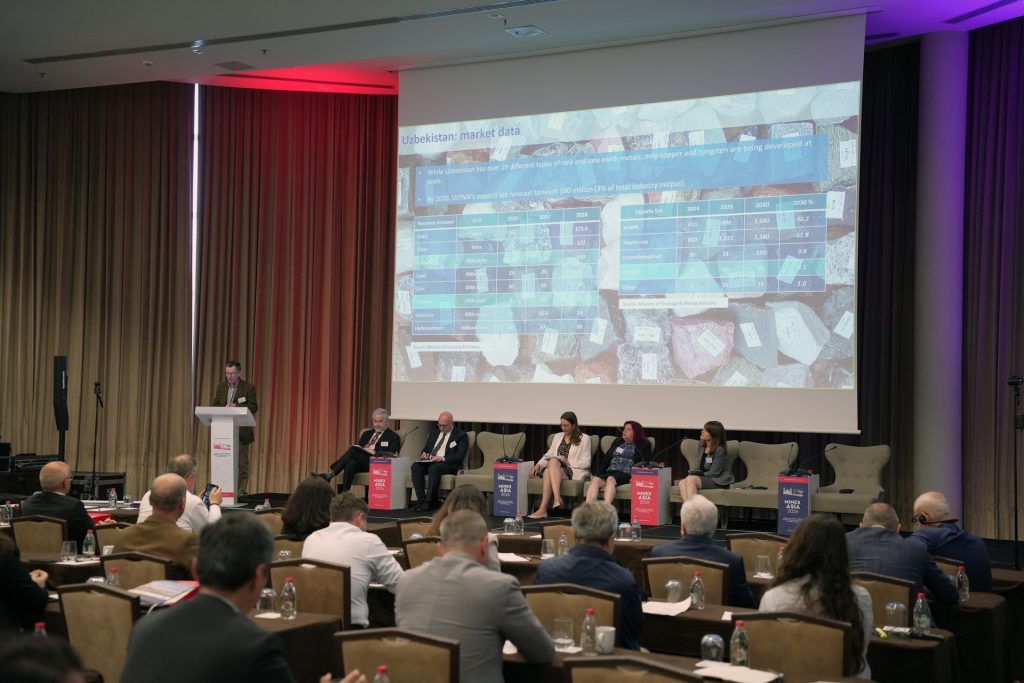
He presents Uzbekistan as the most transparent data source: state copper concern AGMK is forecast to hit $1 billion in exports by 2030 (40% of Uzbekistan’s metal exports), while tungsten exports are forecast around $80 million. Deal activity is concentrated almost entirely in Kazakhstan and Uzbekistan, dominated by sovereign rather than private financing — he highlights the $1.4 billion Cove Capital/Kazakhstan/Sinohydro tungsten deal, backed by $1.1 billion in US state financing, as an outlier with no regional comparison. Citing BCG’s Andrea Nawrocki, he flags recurring execution problems: unrealistic timelines, overly complex decision-making, and weak feasibility-study preparation that discourages investors.
He proposes regional hub clustering — Kazakhstan and Uzbekistan as processing hubs, with Kyrgyzstan, Tajikistan, and Turkmenistan supplying semi-processed inputs in the near term (2026–2030) and hosting satellite processing by 2030–2040. He closes by outlining four opportunity areas for Turkish involvement: mining investment/project-readiness expertise, integrated industrial solutions (technology transfer, logistics, recycling, renewable energy), building a regional knowledge/R&D economy, and helping architect a regional CRM ecosystem.