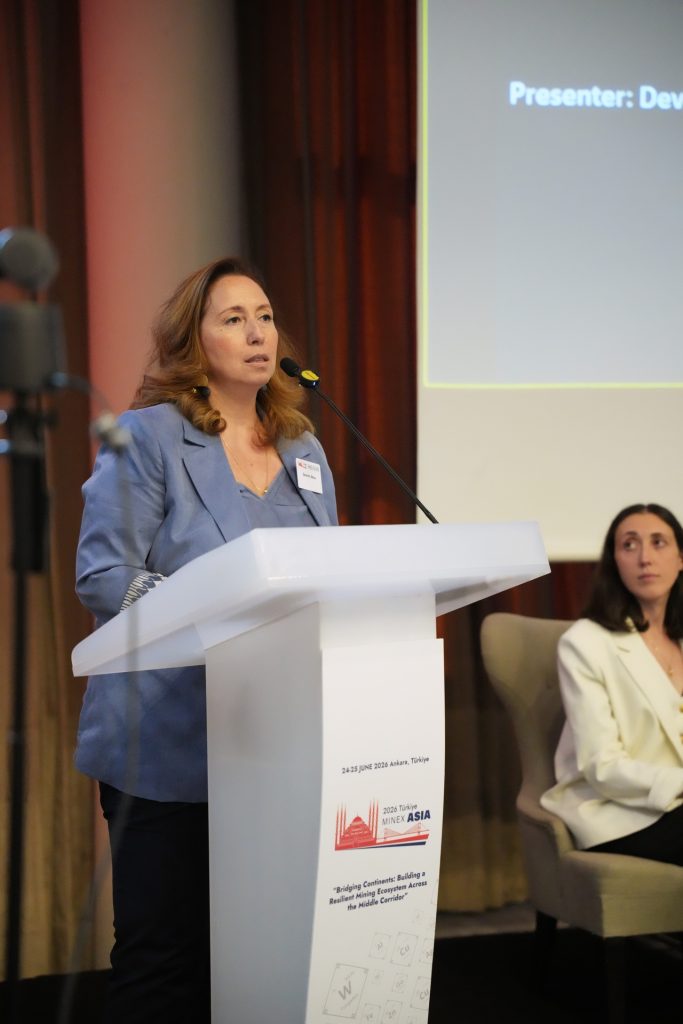
Devrim Aksu — Strategic HR & Organizational Transformation Advisor
Aksu opens by noting the irony that a two-day conference dominated by discussions of capital, reserves, investment structures, and supply chains has allocated only about fifteen minutes to talent — even though people are who actually execute all of it. She cites a World Economic Forum uncertainty index showing current global uncertainty levels running well above the 18-year average (rivaling COVID-era peaks), arguing this volatility disproportionately affects the people expected to deliver on capital-intensive strategies, and that no amount of capital or technology investment succeeds without the right people behind it.
She outlines a shrinking, aging talent pool: experienced geologists are retiring, and while university interest and program capacity for mining-related degrees have both risen encouragingly, graduates increasingly decline to enter the profession after finishing their degrees. She attributes this to working conditions — remote locations, prolonged separation from family, inconsistent compensation practices, serious health-and-safety risks, and rising accountability expectations at every level. She references a recent hotel fire tragedy with major loss of life as a case study in how visible incidents affect morale and retention industry-wide, alongside her own experience conducting exit interviews after a fatal mining incident that claimed nine colleagues’ lives — both cited as evidence that new engineers are being actively discouraged from staying in the field. Compounding this, the profession increasingly requires digital fluency (IoT, digital twins, simulation, drone operation and data handling), which further narrows an already shrinking pool — a challenge intensified by chronic underrepresentation of women and, she argues candidly, a poor sector image overall.
She proposes five practical strategies. First, expand the talent pool deliberately — she cites her own team’s shift from roughly 10% to 25% female representation as a concrete, replicable result. Second, deepen university partnerships beyond career-fair sponsorship into co-developing curricula, research centers, and early-career pipelines — noting successful early hires brought in from third-year university, developed through blended work-study arrangements. Third, stop outsourcing all training to external providers and instead build a properly resourced, independently structured internal learning function (not buried under HR or admin), including investment in digital learning platforms. Fourth, give people a genuine sense of purpose and visible career pathways — she argues employees should be able to articulate why they’re going to work each morning, and that companies must be able to answer basic career-progression questions credibly. She adds a related point about local talent in regions like Central Asia: the real gap isn’t hiring locally, but ensuring meaningful knowledge transfer from expatriate staff is written into contracts and incentive structures, not left implicit. Fifth, track critical roles and succession planning rigorously — she warns that failing to plan clear succession timelines for critical positions is a direct risk to organizational sustainability, alongside rethinking retention tools beyond compensation (family relocation options, a credible answer to “what do I gain from five hard years here”) and running structured attrition-risk assessments across the workforce, blue-collar included.
She closes with a direct challenge to the room: investment due diligence should assess a founding team’s ability to build a team, not just their technical plan — because capital is an advantage, but the right people are a strategic one.