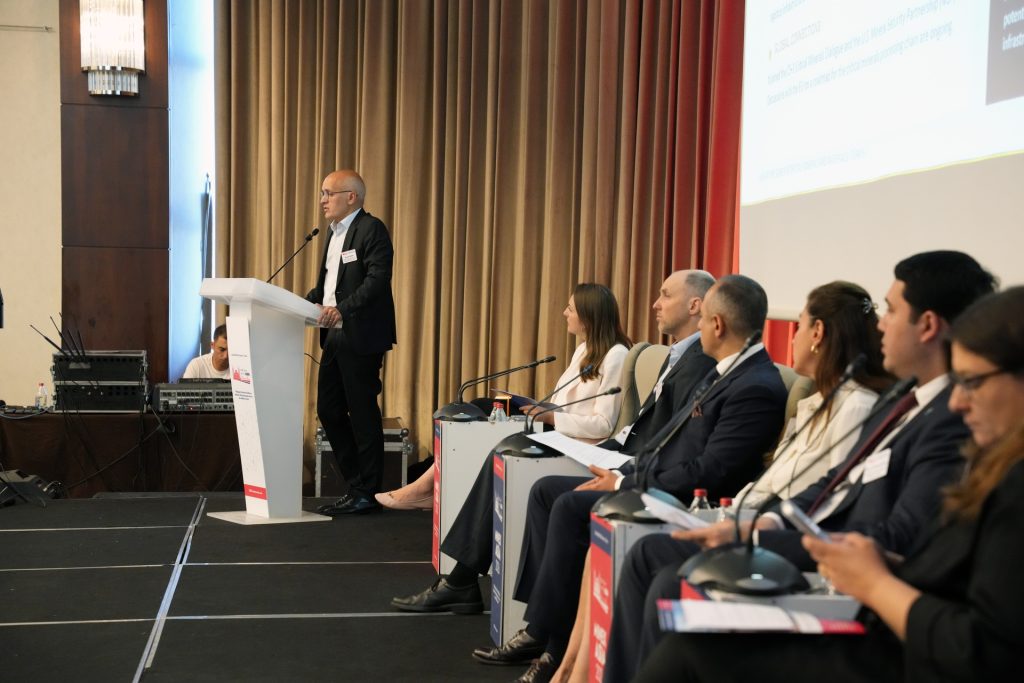
Başlar opened his presentation by framing the scale of the challenge facing Western supply chains: China’s overwhelming dominance in critical minerals processing, which he placed somewhere in the range of 60–90% of the global market depending on the mineral in question. Rather than treating this as an abstract policy problem, he positioned Turkey as the country with the most realistic pathway to erode that dominance within a meaningful timeframe, provided the right strategic and institutional steps are taken.
His central argument rested on Turkey’s geographic and cultural position as a bridge between Europe and Asia. He pointed to Turkey’s demonstrated agility and track record of success in small- and medium-scale mining operations, arguing that this operational experience is directly transferable to mining projects in Kazakhstan, given the two countries’ shared “Turkic world” identity and long-standing cultural affinity. He referenced a shared long-term vision between Turkic states as a foundation for deeper cooperation in critical minerals specifically.
Başlar then broadened the geopolitical frame by invoking Turkey’s historical relationships with South Korea and Japan. He cited a 75-year relationship of trust between Turkey and South Korea dating to the Korean War, and a 135-year relationship of friendship with Japan tracing back to the Ertuğrul frigate disaster of 1890. He proposed that these historic bonds of loyalty could be reactivated commercially, forming the basis for a technology and processing partnership among Turkey, South Korea, and Japan in critical minerals.
He then addressed the definitional question of what makes a mineral “critical,” identifying three overlapping criteria: strategic importance to the economy or national security, difficulty finding substitutes, and supply concentrated among a limited number of countries such that disruption would cause serious economic damage. He described critical minerals as sitting at the intersection of mining, geopolitics, and national security — three domains that, in his view, are increasingly inseparable.
Much of his presentation was structured as a set of institutional recommendations for the Turkish state. His central proposal was the creation of a dedicated Mining Industry Presidency, modeled explicitly on Turkey’s Defense Industry Presidency (SSB). He argued that although the sectors differ, the defense presidency’s accumulated experience in policy design, technical management, and commercial strategy is directly transferable to mining. Establishing such a body, he argued, would transform Turkey’s currently fragmented mining sector into a coordinated public-private ecosystem. Alongside this, he proposed appointing ambassadors specifically tasked with mining diplomacy, whose role would be to monitor strategic mining developments abroad and foster international cooperation from a position of expertise rather than generalist diplomacy.
On the question of capital, Başlar argued that establishing mining and processing capacity is an inherently capital-intensive undertaking, and proposed the creation of a dedicated mining finance fund under the new Mining Industry Presidency, complemented by a separate mining finance vehicle based at the Istanbul Financial Center. These funds, he said, should be capable of providing rapid-response financing at both the exploration and operational stages of mining projects.
He devoted a significant portion of his talk to labor and education, describing a paradox in which the mining sector currently suffers from a severe shortage of skilled labor even as interest in mining education programs has declined sharply. He called for an investigation into the root causes of this decline, identifying the sector’s negative public image — driven by high-profile workplace fatalities — as one of the primary obstacles. He argued that university curricula for mining-related degrees need to be modernized to reflect the sector’s future needs rather than its historical ones.
On exploration specifically, he invoked a Turkish proverb — that even a mountain cannot withstand something that is fully prepared — to emphasize the value of readiness and groundwork. He noted a clear shortage of both exploration companies and exploration projects in Turkey, attributing this partly to insufficient investment in exploration over the past decade and partly to mining companies’ preference for lower-risk, shorter-term ventures over the higher-risk, longer-horizon work that exploration requires. He called for public-sector incentives specifically targeted at exploration companies to correct this imbalance.
Başlar also surveyed the broader regional and international landscape relevant to Turkey’s ambitions. He discussed South Korea’s position as a global leader in processing and refining technology, driven by the fact that its roughly $1.8 trillion economy is directly dependent on uninterrupted flows of critical materials for semiconductor production, electric vehicle manufacturing, and advanced metallurgical processes — a vulnerability that has pushed South Korea to invest heavily in downstream processing capability. He made a similar point about Japan, noting that despite lacking rich domestic mineral reserves, Japan has built a position as a key player in advanced processing and circular-economy metal recycling, producing high-quality metals and chemicals that feed sectors from electronics to defense.
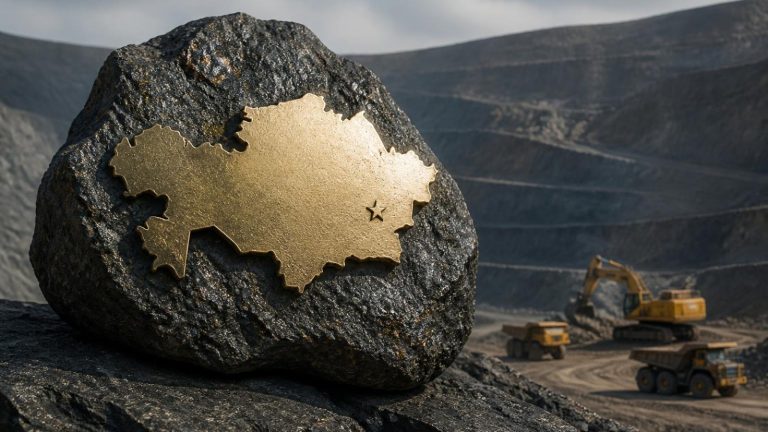
Turning to Kazakhstan, Başlar argued that assessing its position in the critical minerals sector requires looking beyond the raw size of its reserves to factors including geology, mineability, technological capability, regulatory environment, logistics, and geopolitical context. He highlighted Kazakhstan’s Soviet-era mining legacy — an established ecosystem including mining engineering traditions in cities historically built around the sector, along with existing rail and energy infrastructure. However, he noted that this Soviet-era infrastructure creates friction with Western logistics: because Soviet rail systems differ structurally from Western ones, cargo transshipment requires additional coordination, and this is part of the rationale behind ongoing efforts to improve the Middle Corridor’s logistics infrastructure to mitigate geopolitical risk. He noted Kazakhstan’s participation in the C5+1 critical minerals dialogue with the US and in discussions with Europe, while flagging regulatory and investment climate stability, cost, technology, and standards gaps as unresolved issues limiting Kazakhstan’s ability to fully capture the value of its mineral wealth.
He raised similar dynamics for Uzbekistan, noting large gold, copper, and iron reserves alongside legacy infrastructure and an experienced workforce, but also citing inefficiencies in energy infrastructure and ongoing logistics bottlenecks. He pointed out a technical compliance issue shared across many post-Soviet states: their continued reliance on the Soviet-era ABC1/C2 reserve classification system, which does not map directly onto internationally recognized reporting standards such as JORC or NI 43-101. This mismatch, he explained, requires additional verification steps before international investors can rely on local reserve estimates, although he noted that some governments have begun preparing reserve estimates for specific minerals like lithium, copper, graphite, and tantalum in accordance with international standards.
Başlar then pivoted to describing the competitive posture of Europe and the United States. He described the EU’s Critical Raw Materials Act as a comprehensive strategy aimed at ensuring no single country accounts for more than 65% of the EU’s annual consumption of any strategic material. On the US side, he referenced the 2025 critical minerals list published in November 2025 (updated on a two-year cycle), and noted that under the 2025 national security strategy, the Pentagon has allocated significant funding — he cited a figure of $7.5 billion — toward critical minerals initiatives, alongside a broader supply-chain security initiative launched in December 2025.
He argued that these developments open specific avenues of cooperation for Turkey across finance and investment, strategic and cooperative collaboration, technology and expertise transfer, and trade facilitation. He situated the current moment historically, noting that China’s restriction of rare earth exports to Japan during the 2010 diplomatic crisis could be considered the true beginning of the “critical minerals era.” He offered a memorable framing: that the supply and processing of critical minerals are as inseparable as hydrogen and oxygen in water, and that a country’s ability to achieve economic sustainability is directly proportional to its capacity to both supply and process the minerals it produces.
He closed with a call to action, arguing that after 15 years of global discussion about the importance of critical minerals, what matters now is not the volume of ideas but the speed of implementation — a speed he compared to the urgency required to repair a collapsed bridge on a busy highway. His concluding recommendations synthesized the presentation: establish a Turkish Mining Industry Presidency; appoint mining diplomacy ambassadors; create a mining capital market; address mining education and labor shortages; encourage government-supported mineral exploration; extend Turkey’s small- and medium-scale mining expertise into Kazakhstan and Uzbekistan via Turkish contracting companies already active in Central Asia; ensure governments provide the transportation and energy infrastructure that mining depends on (which he described as one of three “inseparable siblings” alongside minerals and mining itself); ensure technology transfer is a sustained process rather than a one-time event; establish a standing, government-independent technical mechanism linking Turkey, Korea, and Japan; and create both a critical minerals materials center and a mineral processing technology zone within Turkey.