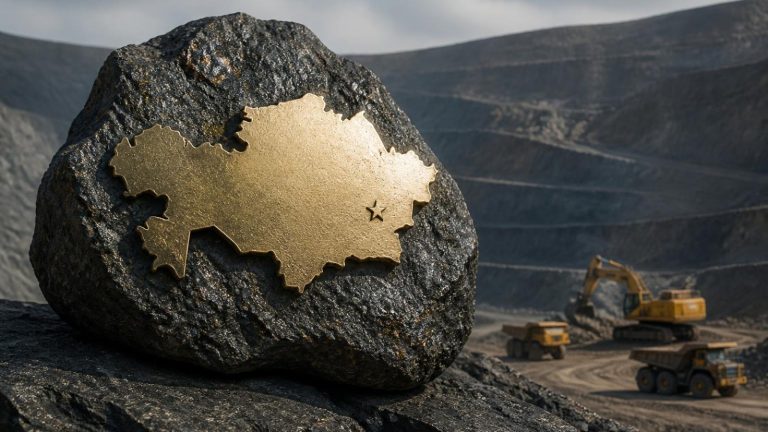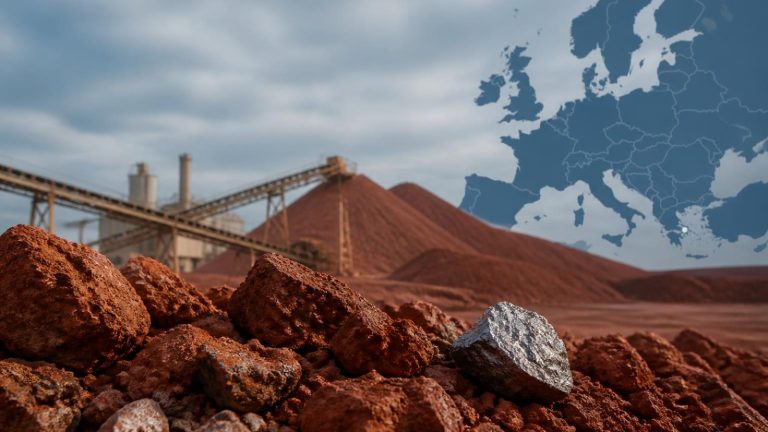
Kazakhstan’s Minister of Science and Higher Education Sayasat Nurbek has issued a pointed challenge to the European Union, arguing that Brussels’ €12 billion Global Gateway package for Central Asia contains a fundamental strategic blind spot: every euro is directed at what can be extracted from or moved across the region, with nothing allocated to what can be created with it.
Writing in an opinion piece, Nurbek welcomed the EU’s most ambitious opening to Central Asia in a generation — the Samarkand summit, the critical raw materials declaration, the Middle Corridor investment — but argued that treating Kazakhstan purely as a deposit and transit route risks replicating in the research domain exactly the dependency trap the EU says it wants to escape in critical minerals. “A partnership that imports Kazakh lithium while ignoring Kazakh laboratories repeats, in the research domain, exactly the dependency trap the EU says it wants to escape,” he writes.
The minister argues Kazakhstan brings more to the table than Brussels currently assumes. The country has overhauled its research infrastructure over three years with a new Law on Science and Technological Policy, digitalised competitive research funding, expanded open science, and a legally binding commitment to raise R&D spending to 1% of GDP by 2029. Nearly half of Kazakhstan’s researchers are under 40 — a demographic profile most EU research systems cannot match. Approximately 40 foreign university partnerships now operate on Kazakhstani soil, including Cardiff University, Heriot-Watt, and European institutions from France, Italy and Germany.
On artificial intelligence, Nurbek says the gap between perception and reality is widest. Kazakhstan’s national supercomputer Alem.cloud runs on NVIDIA H200 GPUs and is the largest computing cluster in Central Asia, supporting a nationally trained large language model and one of the world’s largest sovereign ChatGPT Edu agreements. “This is sovereign compute of a kind most EU member states do not possess,” he writes.
The minister frames Kazakhstan’s active research priorities — green transition, critical raw materials, water security, climate adaptation, AI and life sciences — as directly aligned with the EU’s own agenda, pursued from a geography offering field conditions and data Europe cannot reproduce: the Caspian, the steppe and the glaciers of the Tien Shan. He also points to Kazakhstan’s track record operating the International Science and Technology Centre in Astana under governance standards comparable to Horizon Europe requirements.
The specific ask is concrete: association to Horizon Europe and its successor framework — the same structured route already available to the UK, Canada and New Zealand — alongside two-way researcher mobility, shared research infrastructure access, functioning technology transfer mechanisms and a seat in joint agenda-setting.
“Research association is not a soft add-on to the Global Gateway,” Nurbek concludes. “It is what turns a supply deal into a development partnership.”