Website: Europe.com

  • Portuguese prosecutors seek to annul environment permit for Savannah lithium mine

    Portuguese prosecutors seek to annul environment permit for Savannah lithium mine

    Portuguese prosecutors have asked a judge to annul an environment permit for a lithium mining project being developed by London-based Savannah Resources, alleging various legal infringements, a court document seen by Reuters showed.

    The document, filed by the Prosecutor’s Office in December and seen by Reuters on Thursday, upheld a lawsuit filed by a municipality in northern Portugal that sought to block Savannah from developing what could become western Europe’s largest lithium mine.

    Last year Portugal’s environmental agency APA gave environmental approval, conditional on some remedies, for Savannah Resources to develop a mine in Boticas, in the Barroso region of northern Portugal, a world heritage site for agriculture since 2018.

    The Prosecutor’s Office requested that the Administrative Court of Mirandela in northern Portugal annul the environmental approval of the Boticas mine as it “suffers from the defect of violating the law”, citing risks “known” to APA that the mine could endanger the heritage site and Portugal’s international commitments.

    It also said that APA had failed to correctly assess mining waste management needs or water contamination risks, and did not consider the real joint impact from the Savannah mine and another mine being developed by Portuguese mining company Lusorecursos to extract battery-grade lithium in Montalegre, northern Portugal, despite their proximity and large scale.

    APA did not reply to a Reuters request for comment.

    Savannah said it was “ready to address the concerns” of the prosecutors and cited advice from its lawyers “that the lawsuit is without foundation” and does not impact the project’s activities.

    The Savannah mine was part of a wider probe last year by Portuguese prosecutors into alleged illegalities in lithium and “green” hydrogen deals.

    The probe led to the resignation in November of then Prime Minister Antonio Costa after prosecutors detained his chief of staff and named APA head Nuno Lacasta as a formal suspect in alleged illegalities. Costa and Lacasta have denied any wrongdoing.

    Savannah said in January that after a full legal assessment which included due diligence by independent experts of relevant accounts, facts and documents, “Savannah can confidently reaffirm its solid legal standing.”

    With more than 60,000 tonnes of known lithium reserves, Portugal has been seen as central to Europe’s efforts to secure more of the battery value chain and cut reliance on imports.

    Catarina Alves Scarrott, a campaigner against mining in Barroso, viewed the prosecutors’ move as a victory, but said there was no timing yet for a court decision.
  • EU Green Ambitions Under Siege Amid Red Sea Crisis, Russian Aluminium Ban Fears

    EU Green Ambitions Under Siege Amid Red Sea Crisis, Russian Aluminium Ban Fears

    The European Union has long positioned itself as a global champion of green energy and the world’s battle against climate change. No other region in the world has stricter environmental legislation or has done as much to promote renewable energy sources. Now, the EU’s commitment to the Green Deal is being rigorously tested in the wake of the Ukraine conflict and the anti-Russian sanctions it triggered, as well as the recent escalation in Israel and the Red Sea region.

    These developments are already reshaping the continent’s approach to climate change, particularly in the context of its traditional reliance on Russian aluminium, widely considered one of the most environmentally friendly options in the European market, especially compared to its less green alternatives from Asian markets.

    Despite geopolitical upheavals, most EU countries have actually intensified their renewable plans since 2020. The energy and COVID-19 crises, along with the war in Ukraine, have spurred the green transition in Europe rather than derailing it. EU countries’ climate policies demonstrate a significant shift towards renewable energy: it is now expected that 63% of EU electricity will be produced from renewables by 2030, up from 55% originally envisaged under the previous plan in 2019. This shift would mark a substantial decrease in EU fossil fuel-based power generation, projected to drop to 595 terawatt hours in 2030 from 1,069 TWh in 2021.

    The ambitious green transition is not a one-way street for Europe, however, as the movement is facing a pan-European challenge. Countries like Italy, the United Kingdom and the Netherlands have shown signs of pushback against various EU initiatives aimed at greening the economy. This resistance, termed “greenlash,” is driven by factors ranging from economic pressures to political dynamics. Italy, for example, has sought to water down certain EU directives. In the Netherlands, the rise of the BBB party, opposing the government’s environmental policies, signifies growing discontent with the green agenda. At the same time, Britain’s recent fossil fuel projects have also raised questions about its commitment to climate goals.

    With Europe on the brink of recession, it is increasingly hard to “sell” costly green initiatives to the dissatisfied voters who are already dealing with the daily pressures of inflation and rising geopolitical risks. The sanctions already imposed on Russia, historically one of Europe’s key trade partners, for its role in the Ukraine crisis have severely diminished bilateral commerce and to a large degree backfired against European producers and consumers.

    While the Ukraine crisis is quickly approaching its 2-year mark, the new geopolitical hotspot in the Red Sea is adding additional pressure on the strained European economy. The halt of navigation in what is one of the world’s most important transportation routes, representing roughly 12 percent of global container traffic, means increased time (by adding about 10 days to trip duration if an alternate route around Africa is taken) and costs for consumers. For Europe this translates into higher import costs for such key industrial materials as aluminium, as well as for energy.  Longer travel times also mean more environmental impact for EU-made products, undermining the continent’s green economy goals.

    Russian aluminium, considered a greener option due to its lower carbon footprint, still plays a significant role in Europe’s industrial and environmental strategies. The potential sanctioning of Russian primary aluminium – long favored by some EU politicians and pundits despite strong economic risks – poses a significant dilemma amidst these crises. Due to high energy and labour costs, the EU’s own aluminium production is in steady decline and now accounts for only about 11 percent of its total demand.

    Multiple sanctions introduced against the Russian economy have done nothing to force Russia to change its course on Ukraine. When considering whether to expand them to also include a ban on aluminium EU policymakers must be fully aware of the environmental impact of losing a key source of green aluminium that cannot be easily replaced.

    This underscores the importance of strategic foresight in policymaking to ensure that Europe’s green ambitions remain robust and responsive to an ever-changing global landscape. As Europe navigates through these turbulent times, the balancing act between maintaining its green agenda and responding to geopolitical developments becomes more challenging. The decisions made in the coming months will not only shape Europe’s environmental policies but also reflect its resilience and adaptability in the face of global challenges.

  • Serbia signs €2bn renewable energy deal with Chinese companies

    Serbia signs €2bn renewable energy deal with Chinese companies

    By bne IntelliNews January 27, 2024

    Serbian Minister of Mining and Energy Dubravka Djedovic Handanovic signed a memorandum of understanding (MoU) with two Chinese companies regarding investments in renewable energy sources on January 26. The investment amounts to approximately €2bn, with Shanghai Fengling Renewables being the principal investor.

    The agreement signed with Shanghai Fengling Renewables and Serbia Zijin Copper, in which Serbia holds a co-ownership stake, is the start of Serbia’s largest-ever project in the realm of renewable energy.

    The ambitious project envisions the establishment of a plant near Bor, with total capacity of 2GW.

    It includes the construction of a wind power plant generating 1,500 MW, a solar power plant with a capacity of 500 MW and the creation of a factory for green hydrogen production capable of producing around 30,000 tonnes annually.

    Djedovic Handanovic highlighted that the generated energy will primarily cater to the production needs of Zijin, a major Serbian exporter that has significantly expanded its operations, particularly following the completion of the Bor smelter reconstruction.

    Djedovic Handanovic announced that the construction of the plant is scheduled to start in the first quarter of next year, with the first phase targeting 700 MW set to be completed by mid-2026.

    The goal is to finalise the entire project, achieving the full 2,000 MW and the green hydrogen production capacity of 30,000 tonnes per year, by the end of 2028.

    This initiative is poised to generate between 300 to 500 new jobs, predominantly in the renewable energy sector.

    With this strategic partnership, Serbia is set to emerge as a major hub for the production and equipment of renewable energy projects, including green hydrogen. The project is also expected to play a crucial role in advancing Serbia’s energy security and independence goals, aligning with the country’s ambition to achieve carbon neutrality by 2050.

  • Romanian government fears losing at least $2bn in Rosia Montana gold project litigation

    Romanian government fears losing at least $2bn in Rosia Montana gold project litigation

    The Romanian government is understood to be taking seriously the possibility of losing litigation with Canada’s Gabriel Resources on the Rosia Montana gold mining project, which was blocked by the Romanian authorities, and having to pay at least $2bn — and possibly up to $6.5bn — in compensation.

    The possibility was discussed at the government meeting on January 31 ahead of a final ruling expected from the World Bank’s International Center for the Settlement of Investment Disputes (ICSID) on February 10.

    Since 1997, Gabriel Resources’s main focus has been the exploration and development of the Rosia Montana gold and silver project in Romania to operational status.

    However, the project has faced strong opposition from environmentalists within Romania, where it sparked mass protests.

    Gabriel Resources announced in June 2017 that it would file a CAD5.7bn (€3.8bn) claim against Romania, accusing the country of violating investment treaties regarding its Rosia Montana project.

    Despite opposition from Gabriel Resources, Romania’s government of technocrats headed by Dacian Ciolos asked later in 2017 to place the historic site under UNESCO protection. In June 2021, the site was included on UNESCO’s World Heritage list – which put an end to the gold mining project.

    UNESCO said at the time that the site had been placed on the list “due to threats posed by plans to resume mining which would damage a major part of the inscribed mining landscape”. Mining in the area dates back to the period of the Roman Empire.

    While the Romanian authorities unanimously cheered the UNESCO decision at the time, Gabriel Resources said the decision went against its rights.

    The company said that “UNESCO Application and Inscription are fundamentally at odds with Romania’s obligations under its investment treaties in relation to Gabriel’s investments and these acts, together with other measures taken.”

  • French government flags fresh funds for nickel rescue

    French government flags fresh funds for nickel rescue

    The French government plans to offer fresh subsidies and loans for a New Caledonia nickel plant co-owned by commodities group Glencore but won’t go any further than that, Finance Minister Bruno Le Maire said on Tuesday.

    The French-controlled Pacific territory has some of the world’s largest nickel reserves, but high costs have left its three processing plants on the verge of collapse.

    Le Maire has previously estimated the short-term financing needs of the three nickel processing groups – SLN, KNS and Prony Resources – at 1.5 billion euros ($1.61 billion).

    Commodities group Glencore, which co-owns KNS, has said it will provide funding only until the end of February. French miner Eramet has repeatedly said it will not provide more funding for SLN, in which it holds a majority stake.

    Le Maire on Tuesday said that the government would provide 60 million euros ($64 million) through subsidised energy prices, 45 million euros in additional resources and a 100 million euro loan.

    “Now it’s up to the shareholders to take their responsibilities. We will not go any further and we will not subsidise losses,” Le Maire told lawmakers in the lower house of parliament.

    The French state, which has complicated relations with New Caledonia authorities over some parties’ pro-independence stance, also wants the territory’s northern province to participate in the rescue, Le Maire said.

    His ministry on Monday said that the France would continue talks until the end of February to save New Caledonia’s nickel industry after last month’s failure reach a deal to meet its funding shortfall.

  • Gravitricity to demonstrate energy storage tech in deep mine

    Gravitricity to demonstrate energy storage tech in deep mine

    A Scottish company aims to demonstrate its gravity energy storage technology at full scale in one of Europe’s deepest mines, near a small town in central Finland.

    Gravitricity said the plan to transform a disused mine shaft into an underground energy store – using its technology – could “offer new opportunities” for the remote community of Pyhäjärvi.

    The Edinburgh company has developed an energy storage system, known as GraviStore, which raises and lowers heavy weights in underground shafts, which it says offers “some of the best characteristics of lithium-ion batteries and pumped hydro storage”.

    Gravitricity said: “The community of Pyhäjärvi, with just 5000 inhabitants, lies 450 kilometres north of Finland’s capital, Helsinki. Nearby lies Pyhäsalmi Mine – Europe’s deepest zinc and copper mine – owned by First Quantum Minerals, a Canadian mining corporation, and descending 1,444 metres into the earth.

    “Many of the mine’s operations have now ended.”

    Gravitricity noted its technology uses heavy weights suspended in a deep shaft by cables attached to winches. When there is excess electricity, for example on a windy day, the weight is winched to the top of the shaft ready to generate power. This weight can then be released when required – in less than a second – and the winches become generators, producing either a large burst of electricity quickly, or releasing it more slowly depending on what is needed.

    The local community has set up a special development company, called Callio Pyhäjärvi, to promote regeneration projects at the historic mine, of which the GraviStore scheme will be part, Gravitricity noted.

    The Edinburgh company said: “The two organisations have now signed an agreement to transform a 530-metre-deep auxiliary shaft into a full-scale prototype of Gravitricity’s technology – and anticipate this could become Europe’s first GraviStore deployment.”

    It added that the scheme being developed would deliver up to two megawatts of storage capacity, declaring: “This would tie straight into the local electricity grid and provide balancing services to the Finnish network.”

    Gravitricity noted it had last year signed an agreement with Swedish-Swiss energy multinational ABB to use ABB’s mine-hoist expertise to help accelerate the adoption of underground energy storage.

    It added that it anticipated ABB would lend its expertise to the project, alongside Gravitricity’s other strategic partner, Dutch winch specialist Huisman.

    Gravitricity executive chairman Martin Wright said: “This project will demonstrate at full scale how our technology can offer reliable long-life energy storage that can capture and store energy during periods of low demand and release it rapidly when required.

    “This full-scale project will provide a pathway to other commercial projects and allow our solution to be embedded into mine decommissioning activities, offering a potential future for mines approaching the end of their original service life.”

    He added: “It will also provide vital new low-carbon jobs in an area which has suffered significantly from the end of traditional mining operations.”

  • Cornish Metals shares rise on new drill results from tin project in Cornwall

    Cornish Metals shares rise on new drill results from tin project in Cornwall

    Cornish Metals (LON, TSXV: CUSN) shares rose on Monday on new drill results from its flagship South Crofty tin project in southwest England.

    Earlier, the company reported results from the first six drill holes of the ongoing 9,000-metre Carn Brea drill program.

    All six drill holes intersected the Wide Formation lode structure, which is characterized by strong tourmaline alteration and variable tin mineralization, similar to all historically mined tin-bearing structures in the South Crofty area.

    This structure has been confirmed over a strike length of at least 1.6 kilometres, a downdip extent of at least 525 metres, with thicknesses ranging from 1.8 to 4.8 metres, and remains open.

    Highlighted Wide Formation drill intercepts include 1.21 metres grading 0.87% tin and 1.90 metres grading 0.83% tin. Drilling at the newly identified Great Flat lode splay also returned 3.38 metres grading 1.01% tin and 1.00 metre grading 1.56% tin.

    Additional notable intercepts include 0.30 metre grading 7.48% tin and 3.09 metres grading 1.21% tin between the two structures.

    There is currently no primary mine production of tin in Europe or North America, and the US has included the metal in a list of minerals considered critical to the country’s economic and national security.

    South Crofty could generate up to 5,000 tonnes of tin a year, with first production expected in 2026. The company said the mine will create up to 270 direct jobs and support a further 750 in the region, one of the UK’s most underprivileged.

    Shares of Cornish Metals rose 9.3% by 2:10 p.m. EDT. The company has a market capitalization of C$91 million ($67 million).

  • Germany invests $1.1bn to counter China on raw materials

    Germany invests $1.1bn to counter China on raw materials

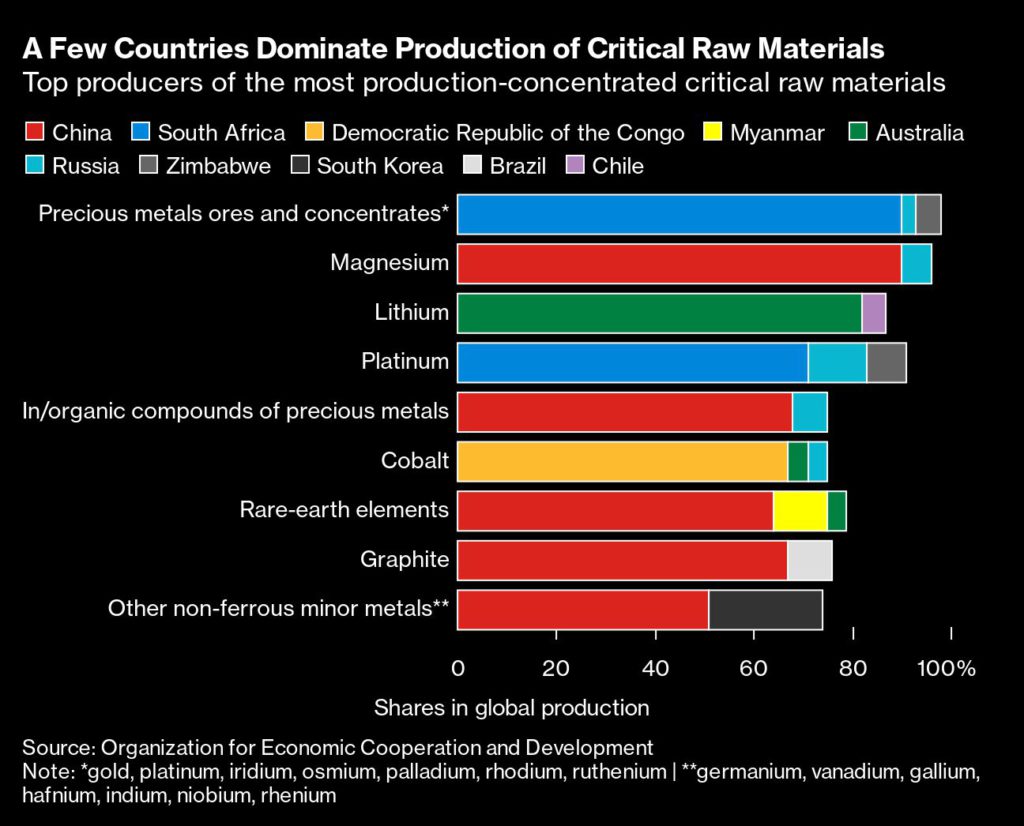
    The German government earmarked about €1 billion ($1.1 billion) for raw materials investments as it seeks to reduce dependency on producers such as China for critical minerals, according to people familiar with the plan.

    A selection process will be established to determine which projects — including in extraction, processing and recycling materials — are eligible, the people said, speaking on condition of anonymity. Financing, via Germany’s state-owned KfW development bank, will consist of equity capital to make acquisitions of minority stakes.

    Projects in Germany and abroad will “contribute to the security of supply of critical raw materials,” an Economy Ministry spokeswoman said. The ministry didn’t give details on how the state fund would be structured.

    Pandemic-triggered supply-chain disruptions across the globe and Russia’s invasion of Ukraine exposed the vulnerability of Europe’s reliance on energy and raw materials for high-tech and green projects. Chancellor Olaf Scholz’s government pledged to ratchet up efforts to access to critical materials over the longer term.

    Raw materials including cobalt, copper, lithium, silicon and rare earth metals are needed to make microchips, wind turbines and batteries for electric vehicles.

    As Germany’s parliament approves Scholz’s 2024 budget on Friday, the billion-euro fund is to be set up for four years. Investments will be coordinated with Italian and French initiatives in the raw materials sector, the people said. Policymakers will focus on mineral projects defined as critical in the European Union’s Critical Raw Materials Act.

    Veronika Grimm, a member of Scholz’s panel of independent economic advisers, said the aim of diversifying raw-material supplies must be a “top priority” for the EU as a whole.

    “The raw-material fund can be an element, but it won’t be a enough,” Grimm told Bloomberg.

    KfW declined to comment on the plans. The lender is expected to make a statement about its role managing the project at its annual news conference next week on Feb 7. The EU agreed on measures in November under the Critical Raw Materials Act to boost domestic mining and reduce dependency on any one country.

    While Germany still has to set up a structure to organize its investments into raw materials, Japan could provide a model. Since 2004, the state-owned Japan Organization for Metals and Energy Security has invested in the storage of raw materials, explored reserves, provided loans or guarantees for commodity companies and bought their shares directly.

  • Serbia wants talks with Rio Tinto over Jadar lithium project

    Serbia wants talks with Rio Tinto over Jadar lithium project

    Serbia wants to hold further talks with Anglo-Australian miner Rio Tinto about its lithium project in the country, President Aleksandar Vucic said on Wednesday, adding that there should also be more public discussion over whether it should go ahead.

    Belgrade revoked licences for Rio’s $2.4 billion Jadar lithium project in Western Serbia in January 2022 after massive environmental protests. If completed, the project could supply 90% of Europe’s current lithium needs and help to make the company a leading lithium producer.

    Regarded as a critical material by the European Union and the United States, lithium is largely used in batteries for electric vehicles (EV) and mobile devices.

    Speaking on the sidelines of the World Economic Forum in Davos, Vucic said he had “a difficult conversation” with representatives of Rio Tinto earlier on Wednesday.

    “We are facing the question of whether the company will file a lawsuit against us or not,” Vucic told Serbian reporters. “I asked them not to take measures to protect their interests.”

    In 2021 and 2022 Serbian environmentalists collected 30,000 signatures in a petition demanding that parliament enact legislation to halt lithium exploration in the country.

    Green activists have repeatedly warned that the mining projects will cause more pollution in Serbia, already one of Europe’s most polluted countries.

    Vucic said he had sought Rio’s assurances about environmental standards and said that the next government – expected to be formed by May following December elections – should address the issue.

    “(Rio) must offer the cleanest solutions, which could be satisfactory to our people, the highest standards in the world for the nature and the people who will work there,” he said.

    In an emailed response, a Rio Tinto spokesman said: “We continue to believe the Jadar project … could act as a catalyst for the development of other industries and tens of thousands of jobs for current and future generations in Serbia.”

    The company is focused on consultation with all stakeholders to explore options related to the project’s future, the email added.

    To bolster economic growth and revenue, the Serbian government has offered mineral resources to foreign investors including China’s Zijin copper miner and Rio Tinto.

  • ArcelorMittal and French Government Invest €1.8 Billion to Decarbonize Dunkirk Steel Plant

    ArcelorMittal and French Government Invest €1.8 Billion to Decarbonize Dunkirk Steel Plant

    ArcelorMittal SA, the world’s leading steel and mining company, in partnership with the French government, has announced an ambitious €1.8 billion investment to decarbonize its steel plant in Dunkirk, France. The move is a significant stride in the global fight against climate change, poised to reduce France’s industrial carbon emissions by a substantial 6%.

    Investment Details

    The colossal investment will fund the construction of two electric furnaces and a direct reduction plant at the Dunkirk facility. The furnaces will replace existing blast furnaces, drastically reducing the carbon generated by the company’s steel production. The French state’s contribution to this transformative project could amount to as much as €850 million.

    A Strategic Win

    The project is not only a win for the environment but also a strategic triumph for France. The country has successfully secured this major investment in decarbonization from ArcelorMittal, outmaneuvering competing nations such as Belgium, Germany, and Spain. Bruno Le Maire, France’s Finance Minister, emphasized the economic and ecological significance of this investment for France.

    Long-term Nuclear Power Supply Contract

    As part of the initiative, ArcelorMittal also plans to sign a letter of intent with Electricite de France SA (EDF) for a long-term supply contract of nuclear power. This contract will further promote decarbonization efforts, underlining the commitment of both ArcelorMittal and France to create a sustainable future. Le Maire, recently reappointed to his ministerial role with an expanded portfolio that includes energy, is set to visit EDF’s nuclear plant in Gravelines and the Dunkirk steel factory to further champion this investment.

    EDF, a key player in the nuclear energy sector, also has plans for expansion. The company intends to construct two additional reactors at the Gravelines nuclear site, signifying a growing trend towards cleaner, nuclear-powered industrial operations.

    In summary, the substantial investment by ArcelorMittal and the French government in decarbonizing the Dunkirk steel plant is a significant step towards reducing France’s industrial carbon footprint. It reflects the broader efforts by both parties to curb CO2 emissions, demonstrating their commitment to a greener, more sustainable future.